Nene of #WID

566 posts

Nene of #WID banner
Nene of #WID

Nene of #WID

@NeneRighter

I write content that drives engagement, elevates your project, & educates my followers. Send a DM let's discuss business.🤝

Remote Beigetreten Kasım 2019
175 Folgt117 Follower
Nene of #WID retweetet

Haleem.py
Haleem.py@haleemisthename·
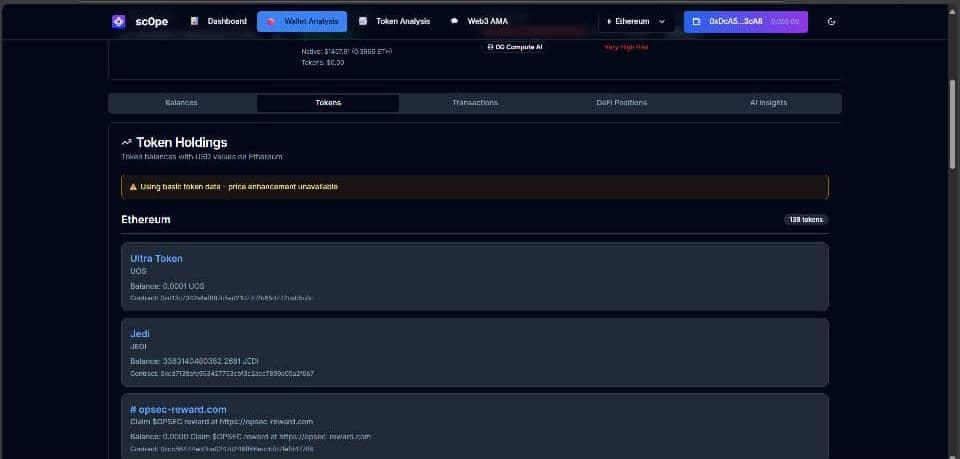
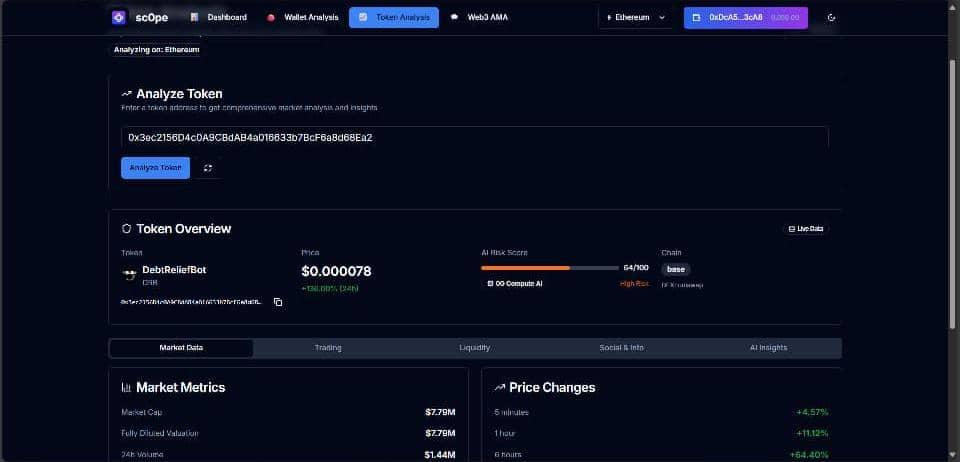
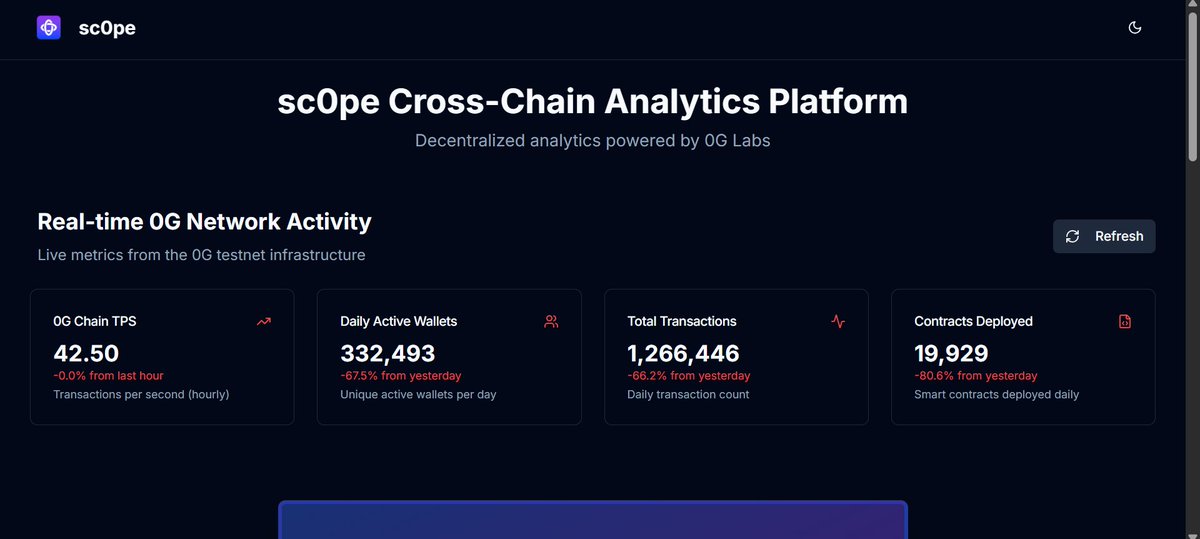
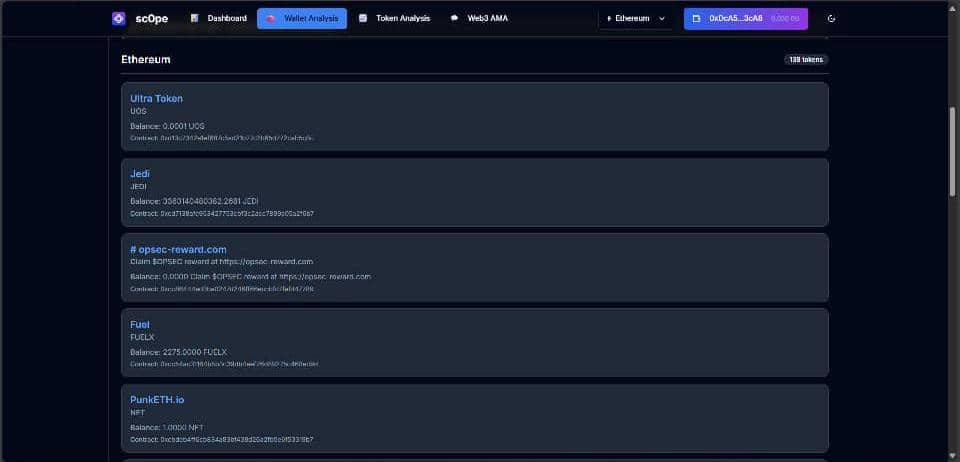
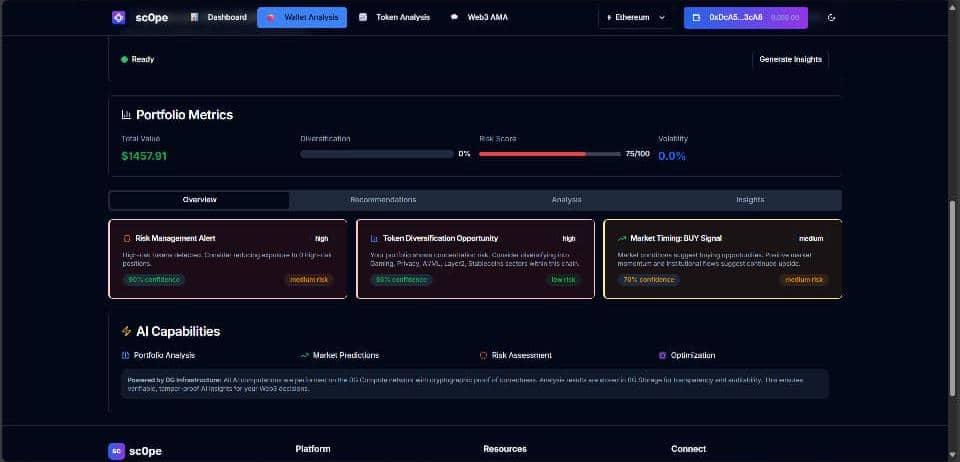
When i got into this space. One concept stood out to me as the foundation of everything. incentives. i mean how you do establish trust and governance in an ecosystem where there's no centralized authority? How you do coordinate behavior in an ecosystem where there's no body to give directions? So i saw it as a very fascinating concept. As time goes on and i evolved, i realized there's a bigger concept that however makes the space work in the first place. Look around you. Every swipe, click, transaction or interaction feeds into a structure that silently powers the systems we rely on. From the algorithms that govern our search results, predictive models. it tells you where value flows and shows you the truth. You can say that it is the very foundation on which the most advanced systems are built. Here's where it is interesting, In the web3 space, it flows openly, immutably, transparently across decentralized networks. what can you do without data in web3? Smart contracts execute based on predefined data inputs, token economies shift with on-chain activity, governance and value all stem from data. The very few that understands how data flows from and flows to wins!. in a world where we find ourselves, data is your power. To see data only as numbers or logs is like you exploring the very shallow part of a sea. Data is a multi-dimensional construct: It’s historical when it gives you trends Behavioral when it tracks user actions Real-time when it's reflected in live trades Economical when it maps transaction flows Infrastructural when it reveals validator activity Everything you do , starts and ends with data. But let’s narrow it down and go into on-chain data now. Here's a personal question to you. How did you first learn to explore on-chain data? For me, it started with curiosity. I would open explorers or Dexscreener and just dig with no real purpose. Just following patterns, observing movement. Eventually i got taught by @rangercrypt and eventually @zerion and @dexscreener became my most used for getting and understanding on-chain data. But here's the truth: I’ve barely scratched the surface. There are tools out there that can take this journey so much deeper and here is one interesting one. .@sc0peon0g is a multi-chain analytical tool launched on the @0G_labs network. So I’ve been testing this tool lately. If you're into deep token research, wallet tracking, or copy trading, you might want to pay attention. Now I know… some of you might say: “But Haleem, I can just use Dexscreener.” And yes, you’re absolutely right. But stay with me. Because what makes this tool stand out isn’t just the data points. It’s how it pulls multiple signals together in one place, and how it complements the tools you’re already using. Token Analyzer The token analyzer shows your usual metrics.. price, market cap, FDV, 24h volume. But then it adds something unique: AI risk score. I won’t lie , i think it’s not perfect yet. it’ll need a lot more training and time before it becomes something I fully trust. But the potential is big. It gives a quick idea of how risky a token might be, which could help cut through noise and speed up decisions when scanning a lot of tokens. Think of it as a second layer of instinct, especially helpful when you're moving fast. Think of it as a second layer of instinct, especially helpful when you're moving fast. Wallet Analyzer This one is really good if you're into copy trading or just analyzing smart wallets. It starts again with an AI-generated risk score so before you even check the wallet’s history, you already get a rough idea of who you're dealing with. From there You see recent transactions. You see whether the wallet is a holder or a jeeter (the classic difference). You get a view of all tokens held, contract addresses, and balances. That’s super important. Because when you're copytrading, you don’t just want to know what they’re buying, you want to understand how they behave. Are they in for quick flips? Or are they sticking around for 5–10x narratives? This helps with your bias check, so you're not just following wallets blindly, you're understanding intent behind their moves. And It’s multi-chain. This is the kind of tool that would go crazy on the @0G_labs network when it launches. I’m personally hoping they integrate Solana soon ,that’d be a game changer(for me) I’d love to see something like: Top early buyers Largest token holders directly inside the token analysis section. Because sometimes, seeing who is positioned early tells you more than what the chart is doing. Does it replace Dexscreener? No. But does it complement it, and possibly make your research tighter and more efficient by giving you a single point of research. 100%. If you're serious about understanding data flows and improving your edge, this is one to keep in your stack. That'd be all for today. @ghcryptoguy @SamuelXeus @vanessaaal7 @0GAIverse @zstake_xyz @0x0g4i @0G_Foundation @JakeSalerno @vargs_g @Weisiyuen @0G_labs @cryptall3
Haleem.py tweet mediaHaleem.py tweet mediaHaleem.py tweet mediaHaleem.py tweet media
English
1
4
20
826
Nene of #WID retweetet
Haleem.py
Haleem.py@haleemisthename·
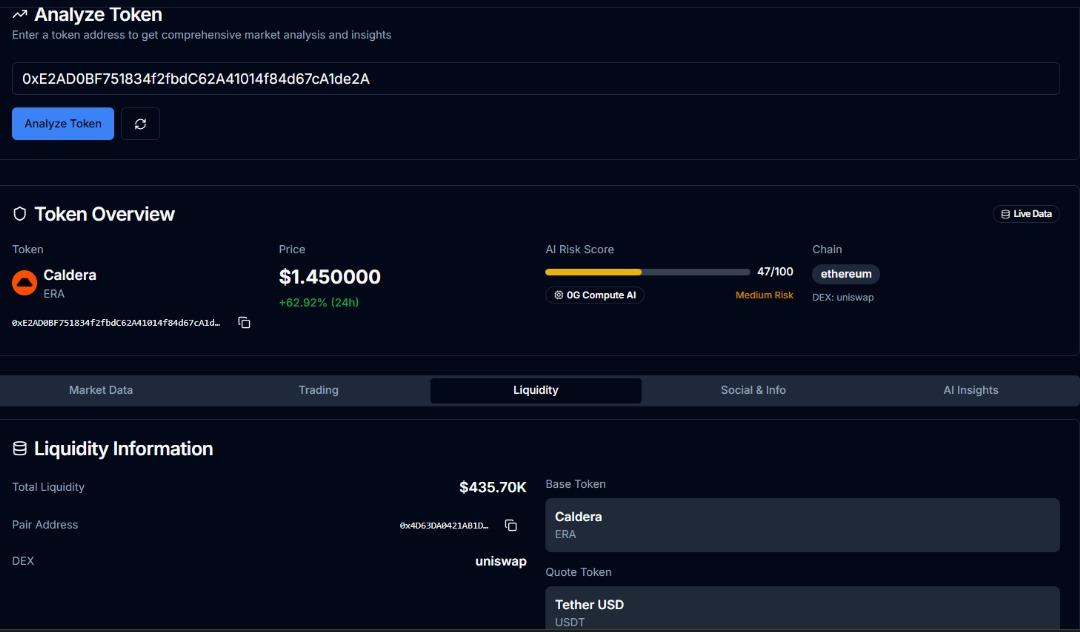
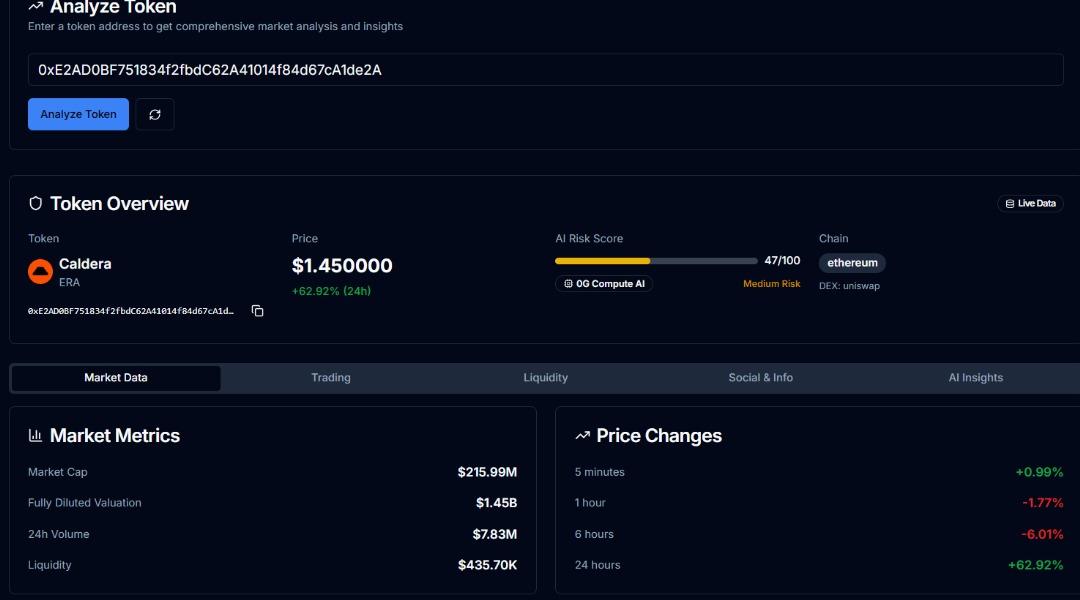
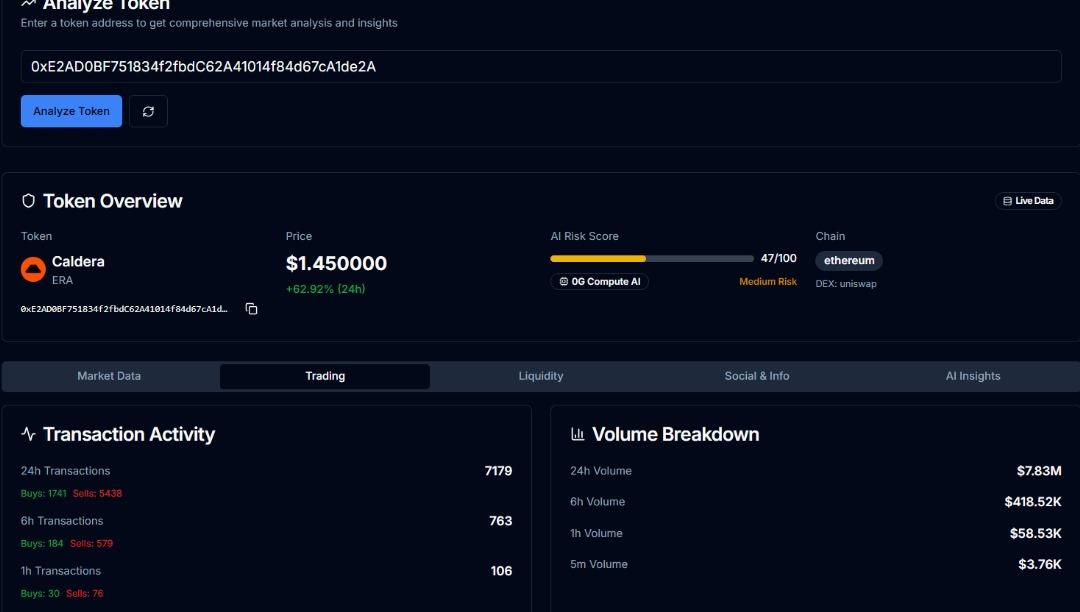
So $ERA launched yesterday and it was a great launch so i started digging for how i can make the most from it. As a data person, data tells the most truth and shows you where the opportunities are, what more to use than @sc0peon0g . This is a cross-chain tool built on @0G_labs infrastructure for ultra fast verifiable web3 analytics. There's a lot of features which i would be covering on the next post but today we are exploring the token analysis feature. So uncovering the opportunities on $ERA @Calderaxyz the First part here is the market metrics. As at the time of analysis, $ERA is currently on $215m with a FDV of $1.45B. The current price of $ERA which is $1.45. i do think it's holding on very strongly considering that it got to nearly 2$ yesterday. personally i think that the liquidity is quite a bit small compared to the market and the kind of opportunities or large buys that can come forward. why do i believe so? $ERA is a long term hold and aside just the TGE performance, there's more to it coming forward. check out these analysis i once made on Caldera. x.com/haleemisthenam… x.com/haleemisthenam… The risk score is also a 47/100 which is low Moving on the trading Analysis. Caldera had a total of 7179 transactions in 24 hours which is mostly dominated by sells( 5438). That was expected considering the airdrop and this tells you how strong is it still holding strong. The buys was also a bit much which is 1741. scope also shows 6 hours and 1 hour analysis to help with recency. it also had a 24 hour volume of $7.83M. on the next post, i'd go deep into my features in @sc0peon0g that makes data very easy for you. That would be all for today. @Calderaxyz @ghcryptoguy @SamuelXeus @vanessaaal7 @0GAIverse @zstake_xyz @0x0g4i @0G_Foundation @JakeSalerno @vargs_g @Weisiyuen @0G_labs @cryptall3 @0xkatz @0xmusty @EliecerChicott @Jake_Nyquist
Haleem.py tweet mediaHaleem.py tweet mediaHaleem.py tweet mediaHaleem.py tweet media
English
7
9
34
1.1K
Nene of #WID retweetet
Haleem.py
Haleem.py@haleemisthename·
One of the most intriguing thing i like about the web3 space is how the most important element of it is data. it was one of the reason for me going into data. but you know, there is this feeling. That feeling of helplessness ,when you know the data should exist but you can’t access it, is exactly the kind of problem Data Availability (DA) is designed to solve, especially in blockchains. And in decentralized systems, if critical data isn’t reliably available when needed, it can freeze the entire network, break smart contracts, and orphan entire transaction histories. What is Data Availability? Data Availability is the guarantee that transaction data is publicly accessible, verifiable, and retrievable by anyone at any time. In simpler terms: It’s like having multiple backup generators for your house ,even if the main power fails, your essential services stay on. On a blockchain: Every transaction (swap, NFT mint, staking action) produces data. That data needs to be available for validators, rollups, and users to verify and build on the current state of the chain. If the data is missing, you can’t confirm that a transaction was valid, meaning no one can safely add new blocks. Why Data Availability Matters especially in Blockchains. If transaction data isn’t accessible: Validators can’t verify blocks. Rollups can’t prove their state changes. Smart contracts dependent on prior data can’t execute. Users and auditors can’t independently check history or balances. Without DA, blockchain security assumptions fall apart. The issue of data availability emerged when blockchain scaling solutions like rollups and sidechains started becoming popular. In L1 blockchains like Bitcoin or Ethereum: Every full node stores every transaction so data is always available because it’s on-chain. But as blockchains tried to scale, Rollups and L2s started processing transactions off-chain and submitting compressed proofs to the L1. These systems need DA layers to store the actual transaction data somewhere accessible while proofs are being verified. Without proper DA, you get, State fraud -> when you can’t check a rollup’s claim Data withholding attacks -> where a malicious validator posts a block hash without the underlying data This bottleneck is known as the Data Availability Problem. What Happens When Data Availability Fails If data isn’t available, Rollups freeze Smart contract states can’t be updated Bridges break Validators can’t challenge invalid transactions DeFi protocols may lose track of asset balances This is not bad as it sounds? Imagine a hospital losing patient records mid-surgery. You can’t proceed safely without it. How Data Availability Layers Work. 1. Transactions processed by L2/Rollup 2. Compressed proofs sent to L1 3. Full transaction data posted to a DA Layer 4. Validators sample and verify data is available (via Data Availability Sampling) 5. Anyone can retrieve the data if needed to verify fraud or rebuild state How does @0G_labs enhance data availability? 0G is an AI-first modular chain that integrates, Compute Storage Data Availability Their DA layer is built for High-throughput AI workloads Agent-driven blockchains where sub-second data reads are critical Ensuring AI models can access verified, tamper-proof data on demand 0G’s innovation. Modular DA that supports large, complex, dynamic datasets (AI training sets, transaction logs, off-chain memory stores) Can be paired with any rollup, agent framework, or AI L1. As blockchains evolve into data-rich AI ecosystems and agent networks, DA will be the invisible infrastructure ensuring they stay secure, transparent, and functional. If data isn’t reliably available: You lose security guarantees. Trust assumptions are broken. Autonomous agents, DeFi protocols, and users are left vulnerable. That’s why projects like @0G_labs are doubling down on DA, and why Ethereum itself is implementing sharding and EIP-4844 to improve native DA throughput. that would be all for today @ghcryptoguy @SamuelXeus @vanessaaal7 @0GAIverse @zstake_xyz @0x0g4i @0G_Foundation @JakeSalerno @vargs_g @Weisiyuen @0G_labs
Haleem.py tweet media
English
10
3
21
333
Nene of #WID retweetet
Haleem.py
Haleem.py@haleemisthename·
𝗧𝗛𝗘 𝗚𝗘𝗡𝗘𝗦𝗜𝗦. Here's one interesting fact you should know. The human brain loves patterns. It’s wired to make sense of things by connecting the dots and mapping out how one thing leads to another. That’s why it’s way easier to understand something new when you can trace it back to the problem it was created to solve. If you jump straight into what a protocol does, without knowing why it exists, it feels random and incomplete. But when you understand the genesis of the problem, what was broken, missing, or inefficient, everything starts to click. You see the cause, the effect, and the reason behind every feature. That’s how we truly grasp systems, by mapping the problem to the solution. 𝗬𝗢𝗨 𝗧𝗛𝗜𝗡𝗞 𝗬𝗢𝗨 𝗔𝗥𝗘 𝗜𝗡 𝗖𝗢𝗡𝗧𝗥𝗢𝗟 𝗕𝗨𝗧 𝗬𝗢𝗨 𝗔𝗥𝗘 𝗔𝗖𝗧𝗨𝗔𝗟𝗟𝗬 𝗡𝗢𝗧. AI( Artificial intelligence) has been embedded into our lives. It's our best friend, work partner,you name it. It can do anything, literally anything. It can write codes, predict markets, compose songs, help you understand why your girlfriend is being grumpy, and even help you detect diseases( DOCTORS ARE NOT LEFT OUT). It makes us feel so powerful, but in reality, this power is not in our hands. You see, modern AI models, especially large language models, are trained on vast, diverse, and valuable datasets. So those solutions it provides to you are being trained into it. These datasets are often scraped from the open web,private databases, and user interactions. BUT HERE'S THE PROBLEM. You and I don't control the data we contribute. So when you write that blog, post content on social media or share codes, it might be ingested into a future model without your consent or compensation. Some of us aren't even aware that these happen. These power companies also decide what data gets included, excluded, and censored, and NO ONE can change that. 𝗛𝗘𝗥𝗘'𝗦 𝗪𝗛𝗘𝗥𝗘 𝗜𝗧 𝗚𝗘𝗧𝗦 𝗜𝗡𝗧𝗘𝗥𝗘𝗦𝗧𝗜𝗡𝗚. These power companies also control the training, structure, and outputs of these models, and they decide the limitations and who gets to use these models. So YOU dont know the biases or rules built into a model. Can't verify whether it censors certain viewpoints. Lastly. Artificial intelligence generates a lot of commercial value. Like A LOT. This is from personalized advertisement, enterprise solutions, and even insights derived from user-generated data without returning value to the source (the users or communities that generated it). YOU and I that contribute to the data, or whose work gets scraped, don’t share in the revenue generated. So you see, you aren't as powerful as you think. AI development reflects the interests of a small elite, not the broader public. It reinforces data monopolies. It limits innovation in open, permissionless AI systems. It exposes societies to opaque, unaccountable AI infrastructure. The million dollar question is How do YOU become powerful?. That would be all for today. 0GM!!. @ghcryptoguy @SamuelXeus @vanessaaal7 @0GAIverse @zstake_xyz @0x0g4i @0G_Foundation @JakeSalerno @vargs_g @Weisiyuen @0G_labs
Haleem.py tweet media
English
2
2
13
458
Panenka FC
Panenka FC@PanenkaFC90·
🚨 𝐖𝐋 𝐀𝐥𝐞𝐫𝐭 Our frens @campnetworkxyz are launching their official PFP collection @CampTrailHeads, and we’ve watched your creativity from the sidelines 👀 Now it’s our turn to give back. 𝐖𝐞’𝐯𝐞 𝐠𝐨𝐭 𝟑 𝐞𝐱𝐜𝐥𝐮𝐬𝐢𝐯𝐞 𝐖𝐋 𝐬𝐩𝐨𝐭𝐬 𝐭𝐨 𝐠𝐢𝐯𝐞 𝐚𝐰𝐚𝐲! Eager to join the Trail? Here’s how to win a spot ⬇️ ✅ Follow @PanenkaFC90 + @CampTrailHeads and turn on 🔔 ❤️ Like + repost this announcement 👇 Reply with a meme of your favourite Trail Head from @CampTrailHeads 🕛 Deadline: Monday, 12PM UTC, winners will be announced shortly after. PS: We're looking for true Campers who're ready to rock their PFPs all the way to the Summit, show us why that's YOU!🫵 May the memes guide your trail ⛰️
Panenka FC tweet media
English
417
239
521
92.3K
Nene of #WID retweetet
Haleem.py
Haleem.py@haleemisthename·
FINANCIAL MARKETS. Wait, don’t scroll yet. Give me 5 seconds of your time. Be honest… what came to mind when you saw financial markets? Nothing? Or maybe stocks and suits? Okay, let’s fix that. I'd need an additional 5 minutes of your time. So you provide liquidity on a decentralized exchange so as to increase liquidity in that DEX for users to trade tokens right? Basically liquidity are moved into productive use so assets are being traded. That’s literally what financial markets do BUT AT A GLOBAL TRILLION DOLLAR SCALE. Financial markets are where people, companies, and even governments move money around by buying and selling stuff like stocks, bonds, currencies, commodities. They keep the world’s money flowing, assigning prices to risk, time, and value. But relax ,I’m not here for Finance 101 (my tutor made that boring too). My 5 minutes is not up yet so I might as well continue. Let’s talk capital markets and how they're showing up in Web3. SO WHAT ARE CAPITAL MARKETS? Capital markets are parts of the financial system where long-term assets like stocks, bonds, and other securities are bought and sold. They help businesses, governments, and projects raise money for long-term use (think years, not days). . But things are changing fast. Now? Capital markets are going digital. You can literally invest from your phone. Markets run 24/7. You can own a fraction of a building or treasury bond. Everything from crypto tokens to tokenized real estate is in play. Still not clicking? Two more minutes. Look at these patterns you already know. Token Launches & Fundraising → IDOs, ICOs, and token sales replace IPOs. DeFi Lending & Yield Markets → Users supply capital to protocols like Aave, Compound. Tokenized Real-World Assets (RWA) → Securities, real estate, and debt instruments tokenized and traded on-chain. On-chain Derivatives & Perps → Capital market functions like hedging and speculation now fully decentralized. These are ways capital market works. But here’s the problem. As digital as things have gotten, the system is still messy. Different assets live on different rails. Data is scattered. Settlements are slow. Middlemen are still hanging around, not because they’re useful, but because they’ve always been there. And guess what? That mess is an opportunity. A new system is coming that breaks these old silos. A new global financial system is breaking down old, disconnected markets. It uses tokenized real-world assets (RWAs) to create 24/7, programmable markets, bringing things like treasuries, commodities, private credit, and DeFi LP shares together on one on-chain platform. But here’s what people miss. Putting an asset on-chain isn’t the win. Giving it context is. You can slap any asset on-chain. But without real-world data (prices, reserves, proof of ownership) it’s just a fancy number sitting on the blockchain. Crypto-native assets live fully on-chain. RWAs get their value from real life. To make them work on-chain, you need off-chain info: prices, rates, reserves. And if you don’t have reliable oracles? Those tokenized assets are basically expensive spreadsheets. So… Why @eo_network (EO)? Here’s what makes it different. Built for capital markets. EO isn’t just a basic price oracle, it builds data systems designed specifically for financial use cases. Backed by strong security. With $8B+ in staked assets and 140+ validators, EO’s data feeds are reliable and built for serious, high-value environments. Works across many chains. EO feeds are already running on multiple blockchains and are easy to plug into different lending and finance protocols. Custom data, not one-size-fits-all. Institutions want tailored data. EO delivers flexible feeds like TWAPs, proof of reserves, NAVs, and even zero-knowledge-verified data. As the economy goes digital, the connections between markets matter more than the assets. EO is building those connections by making financial data verifiable, reliable, and programmable. The future of capital markets will run on trust and trust starts with clean, secure data. EO delivers the oracle infrastructure institutions need to move trillions in compliant, on-chain capital. That'd be all for today. @matan_si @ivysats @hameen_sulaimon @0xsese @0x366e @Crypto_linn @SamuelXeus @Namikmuduroglu @RubiksWeb3hub @yilongl_megaeth @0xBreadguy @amiralmaimani @0xSireal @troublor @Harukorose @0xHeisenbruh @0xSami_M @TheMarablossom @apostleoffin @PrudentSammy @Star_light_N
Haleem.py tweet media
English
1
10
24
461
Nene of #WID retweetet
Haleem.py
Haleem.py@haleemisthename·
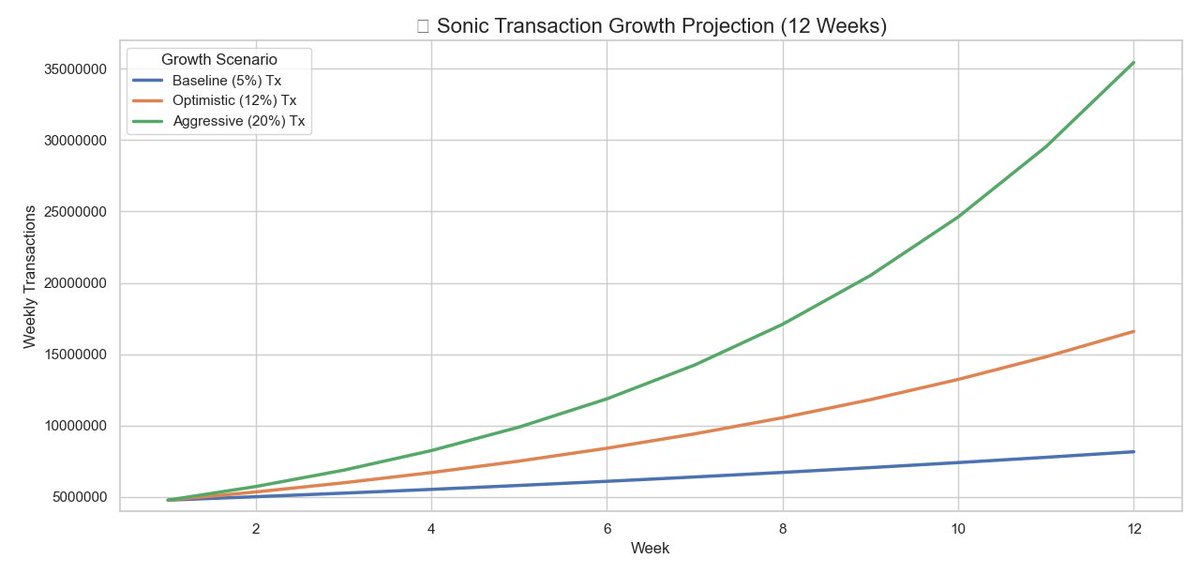
SIMULATING SONIC'S GROWTH TRAJECTORY AND WHY IT MATTERS FOR BUILDERS. I’ve been seeing a lot of people sleep on Sonic lately but one thing that drives ecosystem up? Momentum. And Sonic’s got it right now. So I decided to run a quick simulation. What happens if Sonic keeps growing at the pace it’s been moving? Or even better, what if it accelerates? Using last week’s transaction count (4,770,172 txs), I modeled what the numbers could look like over the next 12 weeks under three scenarios: Baseline growth: 5% weekly Optimistic growth: 12% weekly Aggressive growth: 20% weekly Now fast forward to week 10: Baseline → 7.7M weekly transactions Optimistic → 13M weekly transactions Aggressive → 25M weekly transactions And here’s the interesting part for builders. Sonic pays builders a fee per transaction. Assume a fixed \$0.0018 per transaction. What’s builder income looking like at those transaction counts? Baseline → $7.7K to $15K per week Optimistic → 13M weekly transactions Aggressive → 25M weekly transactions And here’s the interesting part for builders. Sonic pays builders a fee per transaction. Assume a fixed \$0.0018 per tx (conservative, but fair for this sim). What’s builder income looking like at those transaction counts? Baseline → $7.7K to $15K per week Optimistic → $7.7K to $30K per week Aggressive → $7.7K to $67K per week this is exactly what momentum markets look like. The higher the activity, the more the flywheel turns. Builders aren’t just hoping for price appreciation, they’re earning real fees from real activity. And this is what most people miss. Ecosystems like this aren’t driven by just speculation. They’re powered by transactions. And as long as people are clicking buttons, swapping, staking, and minting, builders keep stacking fees. @SonicLabs @AndreCronjeTech @cryptohamm @SonicAssistant @ashxyz @b1rdmania @YJN58 @ivysats @hameen_sulaimon @0xsese @0x366e @Crypto_linn @SamuelXeus @RubiksWeb3hub @andrewmoh @0xSireal @troublor @TheMarablossom @apostleoffin
Haleem.py tweet mediaHaleem.py tweet media
English
1
6
20
391
Nene of #WID retweetet
Haleem.py
Haleem.py@haleemisthename·
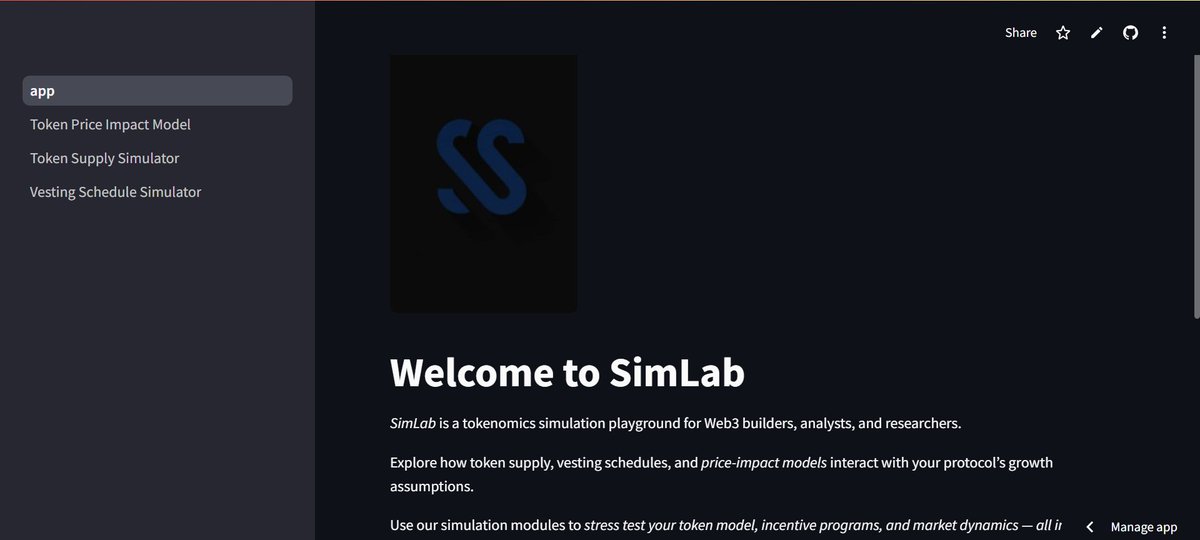
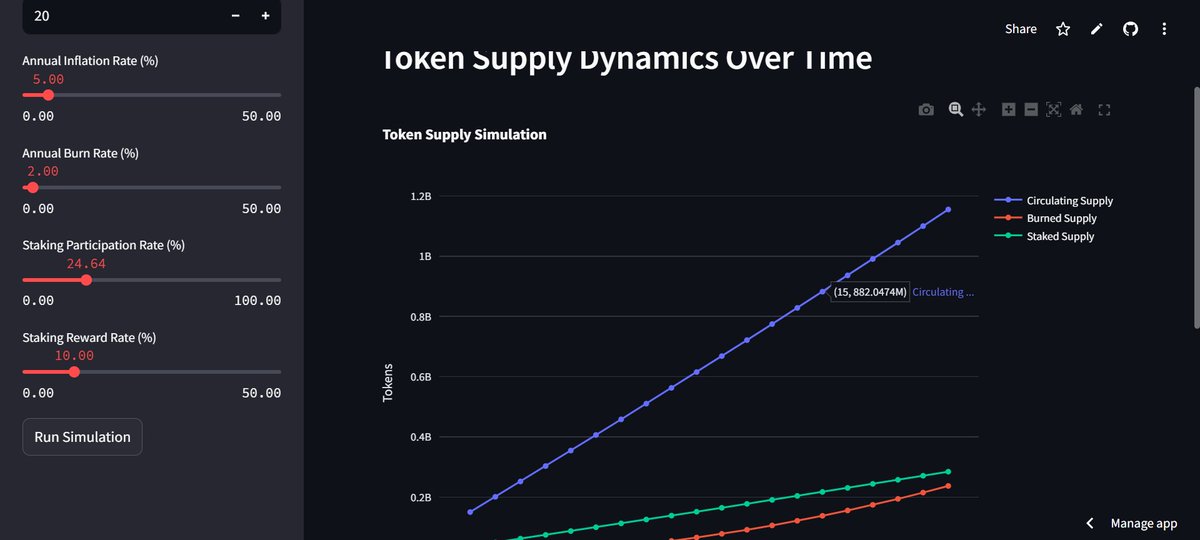
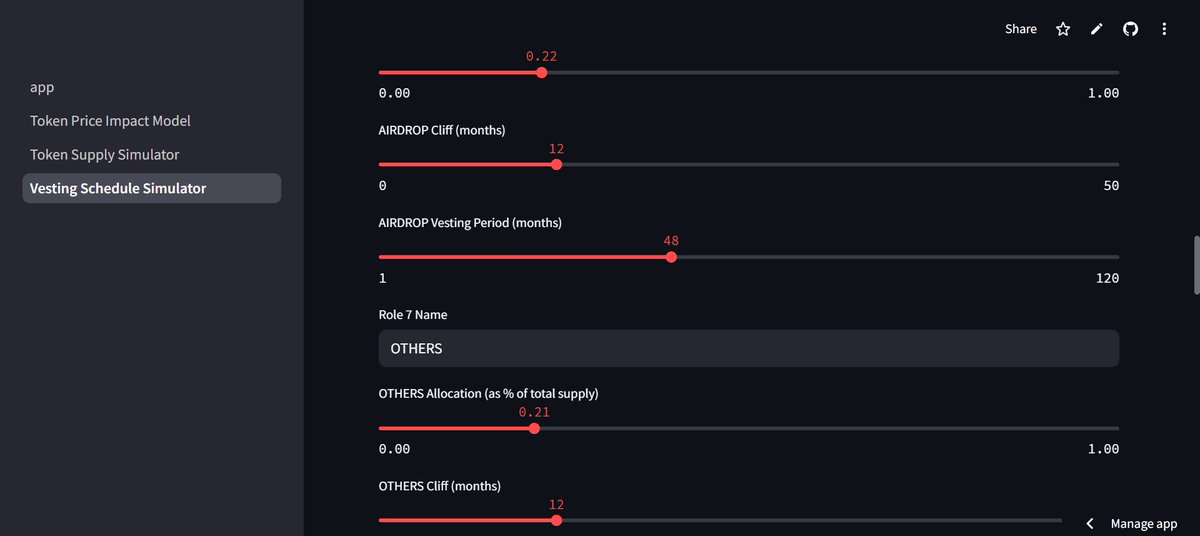
Something interesting happened yesterday. I was chatting with a colleague about a guy who started building a house without a proper blueprint. No plans. Just vibes. Trying to figure it out as they build At first, it looked fine. Foundation was poured. Walls went up. Then the problems started. The staircase didn’t align with the upstairs landing. Plumbing pipes ran through the kitchen wall. And the structure couldn’t handle the planned second floor. You know what happened next? They tore half the house down and spent double to fix an avoidable mess. Okay… that never actually happened. But you see that sinking feeling you just had reading this? That’s how I feel watching projects launch tokens without simulations. And this? Isn’t a metaphor Too many projects build tokens on vibes and whitepapers. No simulations. No stress tests. No models. Just staking rewards, emissions, airdrops on a spreadsheet. It looks fine at first: TVL spikes Discord pops Hype everywhere Then comes month 2. Yield farmers bleed liquidity Whales farm and dump Incentives misalign Community dries up Why? Because no one stress-tested the system. If you wouldn’t build a house without a blueprint… Why launch a token without a simulation? I’m not throwing shade. I was like that too. Until I took @matty_ tokenomics course and realized how thin the line is between a well-balanced token and a protocol death spiral. Then I started running simulations myself. And I discovered the problem isn’t just ignorance. It’s that most simulations tools are complex, and inaccessible to non-quants. A very smart person once told me: “The future of Web3 is abstracting complexity for better user experience.” That stuck with me. So I built SIMLAB, a clean, founder-friendly simulation playground. Test your token economy before you launch. Run supply models, vesting schedules, and token price simulations. No coding. No spreadsheets. No guesswork. If you’re launching a token in 2025 and your model only lives in a spreadsheet… You’re gambling, not building. SIMLAB is live. Play with it. Stress test your ideas. Tell me what breaks. Link: …-5z5lgs5qg2hkayjfkg2iks.streamlit.app be sure to send a message if you find it helpful or its breaking somewhere or you just find me interesting. i am trying to make friends here. @SonicLabs @AndreCronjeTech @cryptohamm @SonicAssistant @ashxyz @b1rdmania @YJN58 @ivysats @hameen_sulaimon @0xsese @0x366e @Crypto_linn @SamuelXeus @RubiksWeb3hub @andrewmoh @0xSireal @troublor @marablossom @apostleoffin @stchibie @andfanilo @joelgrus @thedataprof
Haleem.py tweet mediaHaleem.py tweet mediaHaleem.py tweet mediaHaleem.py tweet media
English
27
31
85
3.6K
Nene of #WID
Nene of #WID@NeneRighter·
@myaccessbank I have reached out via DM. Please, I'd appreciate a response.🙏 I need the money asap.
English
0
0
0
9
Access Bank Plc
Access Bank Plc@myaccessbank·
@NeneRighter Hi @NeneRighter, thank you for bringing this to our attention and I apologize for the inconvenience with this inflow. Kindly send your account number, details of the transaction (date and amount), and the 30 digits session ID via DM so I can assist further. ^Dave.
English
1
0
0
103
Access Bank Plc
Access Bank Plc@myaccessbank·
Life doesn’t always give a heads-up but you can still stay ready. Building an emergency fund doesn’t have to start big. Even small, steady steps can go a long way. Start simple. Stay consistent. Do you have an emergency fund in place? #MoneyTalksWithAccess #AccessBank
English
32
1
6
2.1K
Blessing Chidiebube || Ethical Hacker
Today is our @Felbeth_ Graduation and I honestly can't keep calm. From the very first class to the final project, it’s been a journey of growth, learning, and pushing past my limits. However, what made it even more special was the hands-on support, real-world tasks, and the constant push to be better. At the same time, I built my first real token project from scratch and I’m so proud of what I’ve achieved. If you're my friend and you’ve ever asked, “How do I get into Web3?” Please follow @Felbeth_ right now and be part of something real. Congratulations to me! #FelbethlW02825
Blessing Chidiebube || Ethical Hacker tweet media
English
63
4
70
1.1K
Haleem.py
Haleem.py@haleemisthename·
I created a simple token supply model for $APTOS. What's a model? A model is a simple representation or play of how something should work or execute. Why is a model important for Tokens? A model helps you play out your supply dynamics so as to make decisions on changing some parameters or how it affects market dynamics. This is both for a project about to launch a token or already launched looking to make governance decisions in changing some parameters in the supply. An example is to determine optimal inflation rates to incentivize validators without devaluing the token. Also, to understand the impact of burns or staking rewards on long-term supply dynamics. Also to plan supply caps and unlock schedules. adjusting staking rewards or inflation rates before implementation. Demonstrate long-term sustainability of token value through supply dynamics. Data i used to create this $APTOS supply model. Ps: it was a bit hard to get these data😂. 1. Initial supply on TGE. 2. Max supply. 3. Annual inflation rate. 4. Burn rate. 5. Time period( number of years for the model) 6. Time step( the variations) 7. Staking rate 8. Staked supply. If you look at the chart you'd see that the token supply started at 1.3, that's because on launch day, $APTOS Mcap was $956,803,224 at $7.265 per unit. With an annual inflation rate of 12% ( 1% every month). @Benjaminajib also helped with some data😂. Once again I am Haleem, your friendly data scientist and Token economists Wants other amazing contents? Here you go. @Aptos @moshaikh @AveryChing @Benjaminajib @0xSese @0xdemetsh @0xSireal @0x366e @marablossom
Haleem.py tweet media
English
10
6
35
1.9K
Nene of #WID
Nene of #WID@NeneRighter·
Cat season
English
0
0
0
21