

Origin63 | HubSpot Elite Partner
11K posts

Origin63 | HubSpot Elite Partner
@Origin_63
HubSpot Elite Partner offering onboarding, optimization and training solutions for sales, service and marketing teams.
Beigetreten Ocak 2024
87 Folgt90 Follower

My client doing $12M told me something I’ll never forget:
“I stopped trying to understand the marketing. I just found someone I trust and got out of the way.”
The guy doing $700K is still watching SEO tutorials at midnight.
Different mindset.
$12M operator:
-Hires specialists
-Delegates outcomes, not tasks
-Spends time on sales, hiring, expansion
$700K operator:
-DIY marketing
-Tweaks WordPress plugins
-Watches “ranking hacks” on YouTube
One is buying back time.
The other is getting in his own way.
Decide which game you're playing.

English

Do not let your daughters date losers.
How to do that:
Teach them how they deserve to be treated by treating their mother like a queen.
If you’re a shitty husband your daughters will grow up insecure and become bum magnets.
English

The money's in sales management:
Use it to audit: Are reps following proven processes? What do top performers do that underperformers don't?
Most sales managers think they know how their team performs.
The transcripts tell the real story.
English
5 AI tools is all you need to scale past $100K/month with paid ads in 2026.
These exact tools helped me generate consistent 6-figure months for 2+ years and reduce overhead significantly.
Here's the whole stack 🧵
English


A surprisingly efficient career hack: Solve one problem every day. Guarantees you stack up 200 wins a year. Many of those gains compound. And people can't help but notice you're someone who gets shit done. Success isn't nearly as complicated as we make it out to be.
English

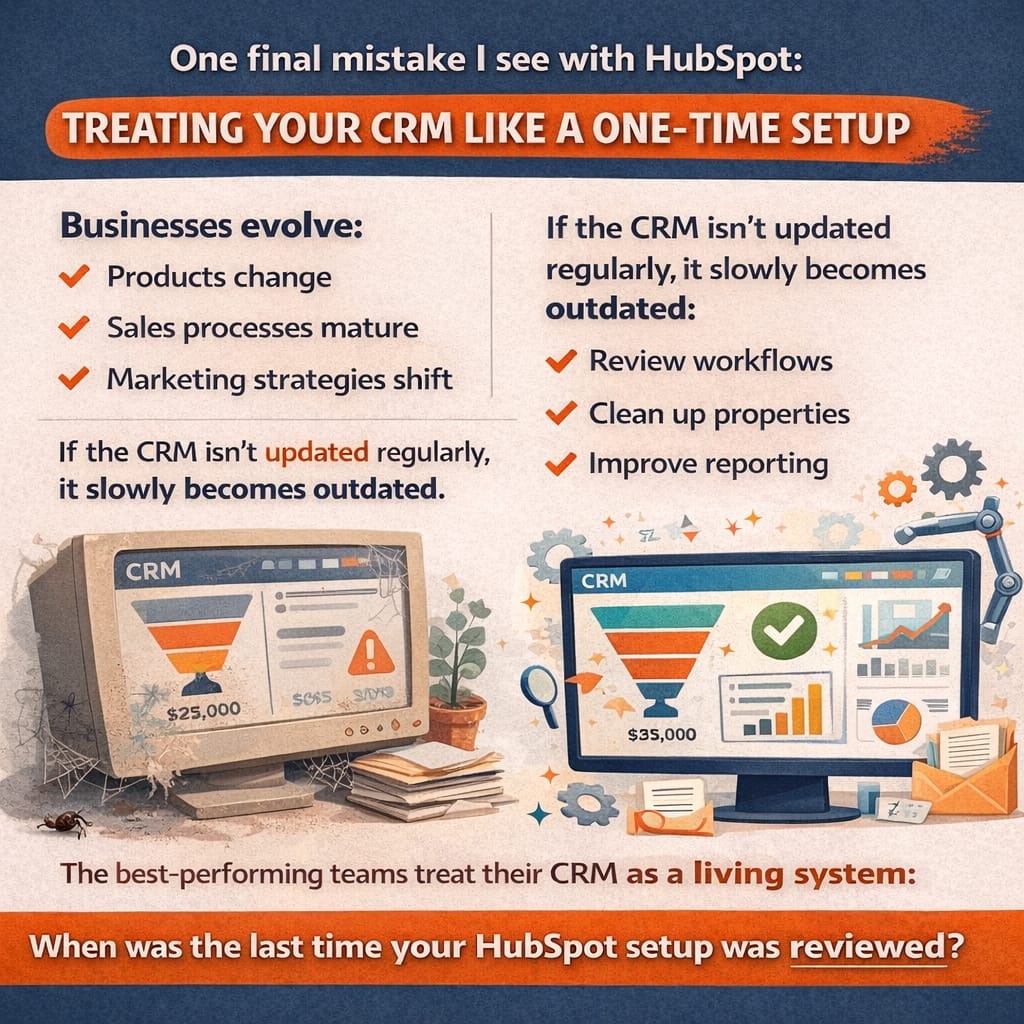
One final mistake I see with HubSpot:
Companies treat their CRM like a one-time setup.
But businesses evolve.
Products change.
Sales processes mature.
Marketing strategies shift.
#HubSpotExpert #CRMOptimization
English

The more expensive the service, the less competitive the SEO is in most markets.
Most people assume the opposite.
They see plastic surgeons and personal injury attorneys making millions and assume the SEO must be impossible to crack.
It is usually easier.
Here is why.
Low ticket service businesses live and die on volume.
A cleaning company charging $150 a job needs 100 customers a month to do real revenue. A pressure washing company needs even more. A landscaper, a handyman, a junk removal company, same story.
When you need volume to survive, marketing spend goes up across the board.
Every owner in the market is running ads, building links, chasing reviews, hiring agencies.
The SEO competition mirrors the desperation.
Now look at what happens on the high ticket side.
A plastic surgeon closes one rhinoplasty at $12,000 and his week is made.
A personal injury attorney settles one case and bills six figures.
A dental implant patient is worth $4,000 to $8,000 in a single visit.
These business owners do not need 100 customers a month. They need 10 good ones.
And because the math works so differently, most of them have never invested seriously in SEO.
They have relied on referrals. Word of mouth. Relationships.
Their websites are outdated. Their GBP is half filled out. They have 22 reviews and have not touched the profile in two years.
Their competitors are doing the exact same thing.
So you walk into a market where the average practice has weak backlinks, thin city pages, no FAQ content, and a GBP that has not been touched since 2021.
And the lifetime value of one new patient or one new client justifies an aggressive SEO investment that their competitors are not willing to make.
English

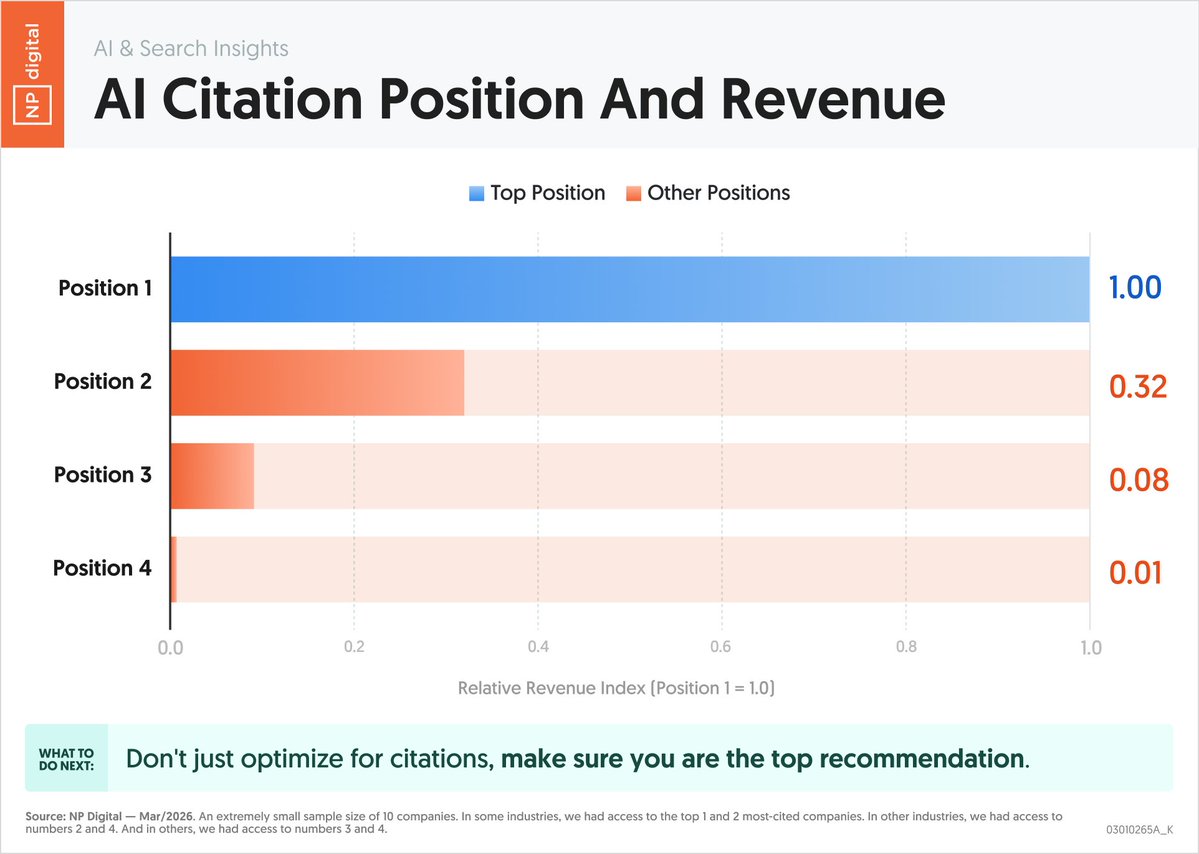
How does the position AI ranks you affect revenue?
When you're looking for a product or service and ask AI a question, it often lists recommended options.
But how does your ranking impact revenue? Because it does with Google rankings.
We had data for multiple companies that are recommended for the same prompt. Some sold products, and others sold services.
It wasn't a large sample size, so when looking at the chart, think of it as directional rather than absolute numbers.
And keep in mind, one company could be recommended for more prompts than a competitor. And tracking on LLMs isn't perfect yet.
Hope it helps.
English

Operations is the least important part of any service business.
All service businesses have 3 pillars: Marketing, Sales, and Operations. Your focus should be in this order.
Most $5-10M service businesses are very good to great at Operations.
The reason they don’t reach $20m+ is they are bad at Marketing and Sales.
English

How to build a $1M+ business and still live a completely free life:
- Do 3-4 hours of good work daily
- Define exactly who you help
- Share unique expertise consistently
- Let customer pain guide your solutions
- Build one thing that solves a big need
- Make it simple to buy, but look premium
- Drive traffic to a frictionless page
- Create upsell recurring revenue model
- Overdeliver value 100x vs. price
- Document so clients succeed w/o you
- Clear next step for your best customers
- Automate or delegate everything else
The best businesses work when you're not working.
English


WHO you're talking to > WHAT you say.
Perfect sales technique with the wrong person = loss.
Bad sales technique with the right person = win.
The single best sales call I ever ran?
Still didn't close the deal.
Wrong person.
Qualify ruthlessly.
English

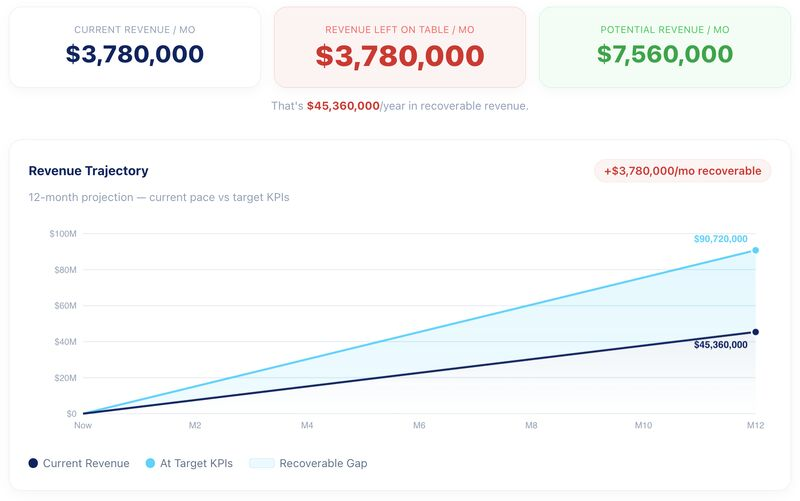
"so you're doing around $4M a month and you'd be at $8M a month if your team was at KPI...
does that feel a tad off or like a pretty large issue?"
He nearly spit out his coffee.
When you're looking at metrics on a dashboard, a few % off doesn't look like much...
English
Spoke with a sales leader of a $50M/yr lending company recently
Here's the $3.7M/mo problem he was unaware of 👇🏼
English

Today was a fun marketing day — conversations about AI + SEO, mailing lists, and CRM strategy.
One thing remains true: if you don’t own your audience, you’re renting your marketing.
English

The most important job of a business owner isn’t necessarily to do the work, but to figure out how to achieve an outcome in the business - be it leads, sales, client results - then systemise that process, hand it off to someone and then hold that person accountable to doing the work to a high standard
English
Leadership cheat code: Half as much, twice as well. Every instinct tells you to add: more meetings, more processes, more people. But complexity compounds exponentially. Protect your team from nonsense. Focus. Excellence is often addition by subtraction.
English
I watched a founder go from thinking $150K/month was his ceiling to believing $1M/month is easy.
We talk regularly. He runs an ecom brand and had been stuck in the same revenue range for a while.
He knew his creatives could improve.
He knew his scaling strategy was off.
But he didn't know the exact change he needed.
A few months ago, he started working with my team and getting mentorship from people who had already solved the problems he was facing.
One of the first things he changed was how he tested creatives.
Before, he was testing and scaling in the same campaign.
Creatives with no engagement were eating his budget. Profitable ads were getting buried.
Then he separated them. Testing in one campaign, while the winners were moved to scaling campaigns.
That simple shift tripled his ad spend, profitably.
He went from doing $100K in a month to making $100K in a single weekend.
But the part that surprised me most wasn't just the tactical stuff.
It was his mindset.
Before, he genuinely believed there was a ceiling on what he could do.
$150K/month felt like the max. He couldn't see past it.
Now he talks about $1M months like they're inevitable.
Same person, with the same brand and product.
The only thing that changed was who he was learning from and how he saw his own potential.
He told me the biggest thing wasn't the course material. It was being able to ask questions in real-time to people one step ahead of him.
People who had already been through the exact struggles he was facing.
They did more than just “give him answers.”
They helped him see what was actually possible.
That shift in belief changed everything else.
English
We started with: "We need visibility for better coaching."
That's worth $0.
We peeled back:
→ "We need to coach reps on selling to power"
→ "Selling too low = 9-month sales cycles"
→ "Long cycles = cash flow issues"
→ "Cash flow issues = down round"
→ "Down round = millions lost in valuation"
From $0 problem to $500K problem.
That's peeling the onion.
English

I've watched the same 5 scaling mistakes destroy profit margins across dozens of businesses.
Every single one stems from the same root cause:
Wishful thinking about how people actually behave.
MISTAKE 1: Assuming your freelancer tool will scale with more rules
You start with a Google Sheet or ClickUp when you're a solo founder. It works great. Then you add people, add rules, add management layers. And eventually someone forgets something important because the more rules you pile onto a person, the more it bops something else out of their brain. No human being who will ever be born can hold everything in their head forever. You need rigidity, not more documentation on top of a flexible tool.
--
MISTAKE 2: Trusting that new hire energy lasts
People get hired on an emotional high. Six months later, motivation drops. If your process depends on human motivation staying constant, you're essentially building on a sand castle A rigid process tool gives you confidence that the performance you're seeing now will keep happening regardless of how someone feels on a Tuesday.
--
MISTAKE 3: Locking down your process before you've figured out your offer
The opposite problem. If you're still experimenting with what you sell and how you deliver it, adding rigid automation is a waste. You lock down a process that was getting better results from flexibility and experimentation. Build in stages. We absolutely refuse to build everything at once because people and businesses don't evolve like that.
--
MISTAKE 4: Separating documentation from where work happens
Nobody reads instruction manuals for TVs or laptops. They plug the thing in and figure it out. Your team does the same thing with your SOPs. They consult it once, maybe twice, and never look at it again. The instructions need to be baked directly INTO the process tool. Pre-populated templates, automated steps, guardrails built into the workflow itself.
--
MISTAKE 5: Treating management as the solution to a repeatable process
Founders who think "I need an A-player manager to run this" will always have lower profit margins than founders who build a digital factory where signing a client means they churn through the process and get value. You don't want to NEED A-players. You want a system that works regardless of who's operating it.
--
Every one of these is fixable. And the fix always starts the same way: accept that people are human, and build accordingly.
English

Most creators are solving the wrong problems:
• "I need a better logo"
• "I should start a podcast"
• "My website needs a redesign"
While ignoring real problems:
• "My positioning is weak"
• "Nobody understands my offer"
• "I'm afraid to charge what I'm worth"
Distraction looks like productivity.
English