@Remithephilguy You mean logical truths as in:
P -> Q, P .: Q
In which Q is relative to P, in that the truth of Q is dependent on the truth of P?
They are definitely relative in that one is the antecedent, and the other is the consequent.
Right?
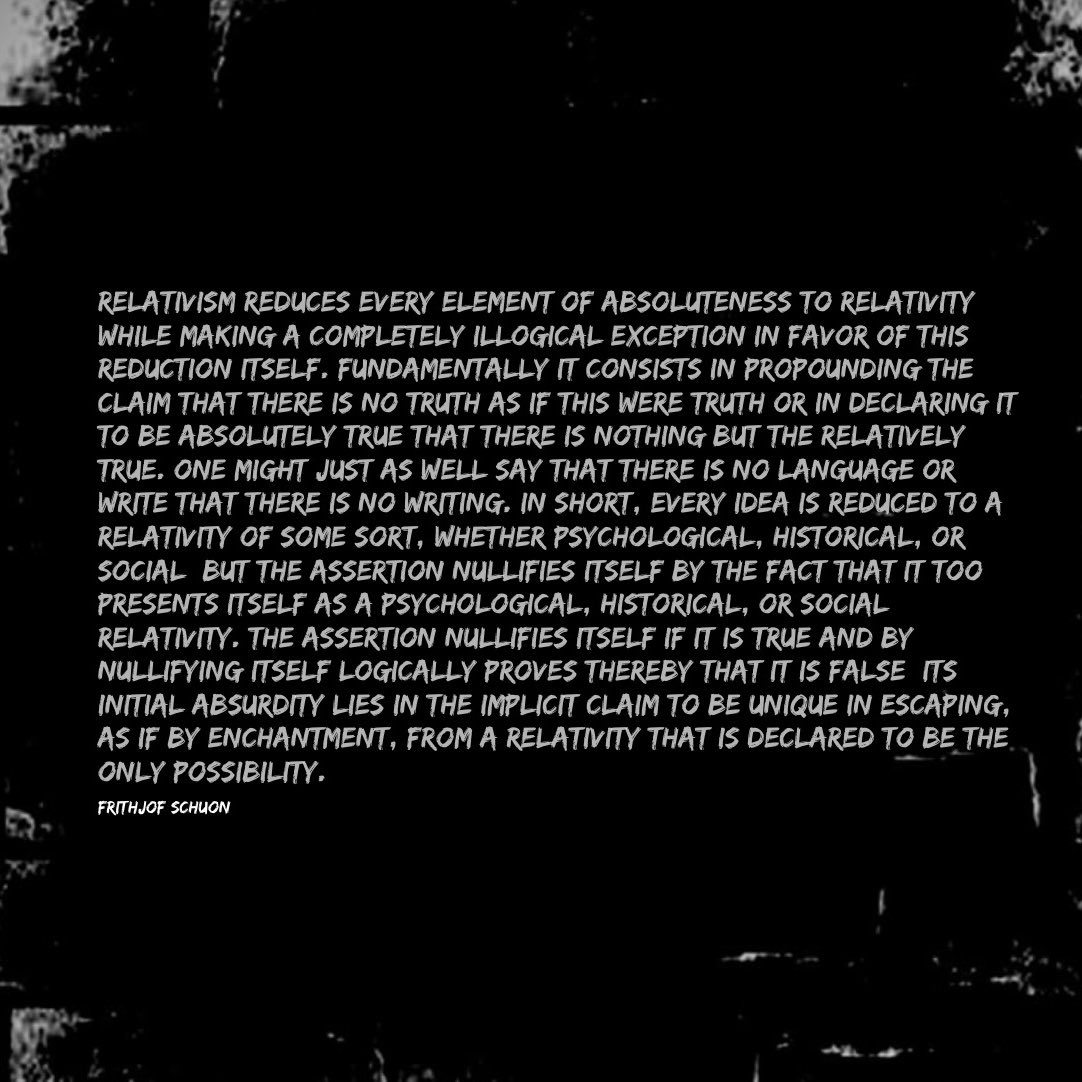
@king0vpain@BigBrainPhiloso That's not what a contradiction is, if we are strictly speaking a contradiction is something that is false under all truth value assignments (or more familiarly it is thr conjunction of a sentence and its negation) I have written plenty on relativism so I am confident—
@king0vpain@BigBrainPhiloso Uhhh yeah like I said, nothing about relativism entails nullifying itself it is telling you used the words incoherence instead of contradiction ad relativism does not reduce to a contradiction. I have no clue in the world what I means for relativism to "nullifying itself"
@Remithephilguy@BigBrainPhiloso Bro, you think you’re smart but you’re not. The “nullifying part” is emphasizing a reductio absurdim via the concept’s own logical incoherence. If you don’t know what he means, just stop pretending like you think you know what he’s saying.
@king0vpain@BigBrainPhiloso Not at all, the second part is quite literally nonsense, nothing ablut being relative entails "nullifying itself" or whatever that is supposed to mean and the statement that "all truth is relative" is not some social relativity— whatever that means
@king0vpain@BigBrainPhiloso It's not. Relativism does not claim there is "no truth" only that truth is relative (and yes before you say it, relativism is reflexive so that statement is relatively true as well)
All locked accounts on Twitter should be banned from any interaction with non-locked accounts I'm tired of supposedly seeing comments or quotes on a post just for them to all disappear among other things 🤦🤦
@InfniteResrvoir "Better" itself is a logically attributive term that makes no sense outside of a comparison class Better at what? Better for what? Better as compared to what evaluation?
In any case it's possible to convince interlocutors that your perspective is what should be adopted
Thank you kindly for your answers.
I have found potential/actual great terms for various subjects, e.g., in prolife:
At time t1, a human being is actually inside a womb, and potentially outside that womb.
At time t2, that potential is actualised, and the human being is actually outside the womb.
The event at t2 is a change in whereness, not whatness, viz., if it's a human being outside the womb, then it was a human being inside the womb.
I've also found it useful in theism debates, e.g., God is actus purus, that is pure act, and he actualises the potency in all other things, whilst having no potency Himself, as potency implies contingency, i.e., a thing could fail to exist.
I think it's also a good tool for consciousness, e.g., a human zygote has the potential to be conscious, and that potential is actualised when it reaches a certain level of development.
I'm a massive fan of Aristotle's physics (and metaphysics but that's hard going). Have you read Physics?
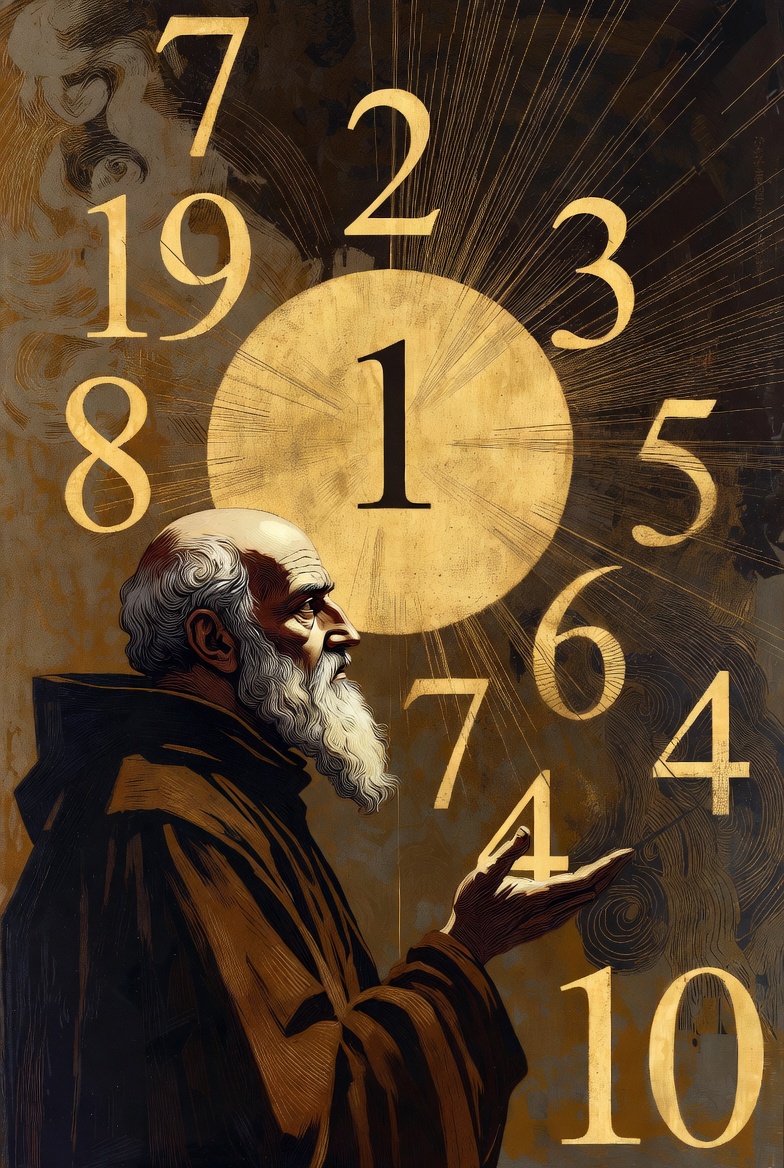
God is the Grounding cause of number 1:
1. If an entity cannot be found to exist physically, materially or tangibly, but, represents a reality, then it exists only conceptually.
*** Defense:
The Argument from Dependence (Conceptualism)
This argument posits that "truth" and "number" are essentially mental relations.
The Logic: A number is a way of "ordering" or "understanding" reality. "Oneness" or "Twoness" are not objects like chairs; they are thoughts about how objects relate.
The Conclusion: A "thought" cannot exist without a "thinker." Therefore, the number 1 cannot exist in a vacuum; it requires an Intellect to sustain its existence.
2. What exists only conceptually, then it depends on the intellect to exist.
3. The number 1 cannot be found to exist physically, materially or tangibly, but represents a reality.
4. Then, the number 1 depends on the intellect to exist.
5. But, the number 1 exists in an eternal and necessary mode.
6. If the number 1 existed in a temporary and contingent intellect, then it could change or cease to exist.
7. Therefore, the number 1 depends on an eternal and necessary intellect.
Two areas, one being logic, I think it is a mistake to confuse logicality with metaphysics since these two are separate domains, although thankfully most thomists are divine conceptualists I have seen few use act-potency there
The next would consciousness I genuinely don't know what it means for consciousness or even extension thereof to be potential or how the actualization of neurons or otherwise explain consciousness (without getting into the hard problem) again these are mostly just petty I can't think of other ready-at-hand examples
To be honest it is more of just a petty reason than something substantive but I find the term to be thrown around by some thomists who don't even really care about metaphysics, and the ones who do, I've seen them use the term in all kinds of situations that have rubbed be the wrong way
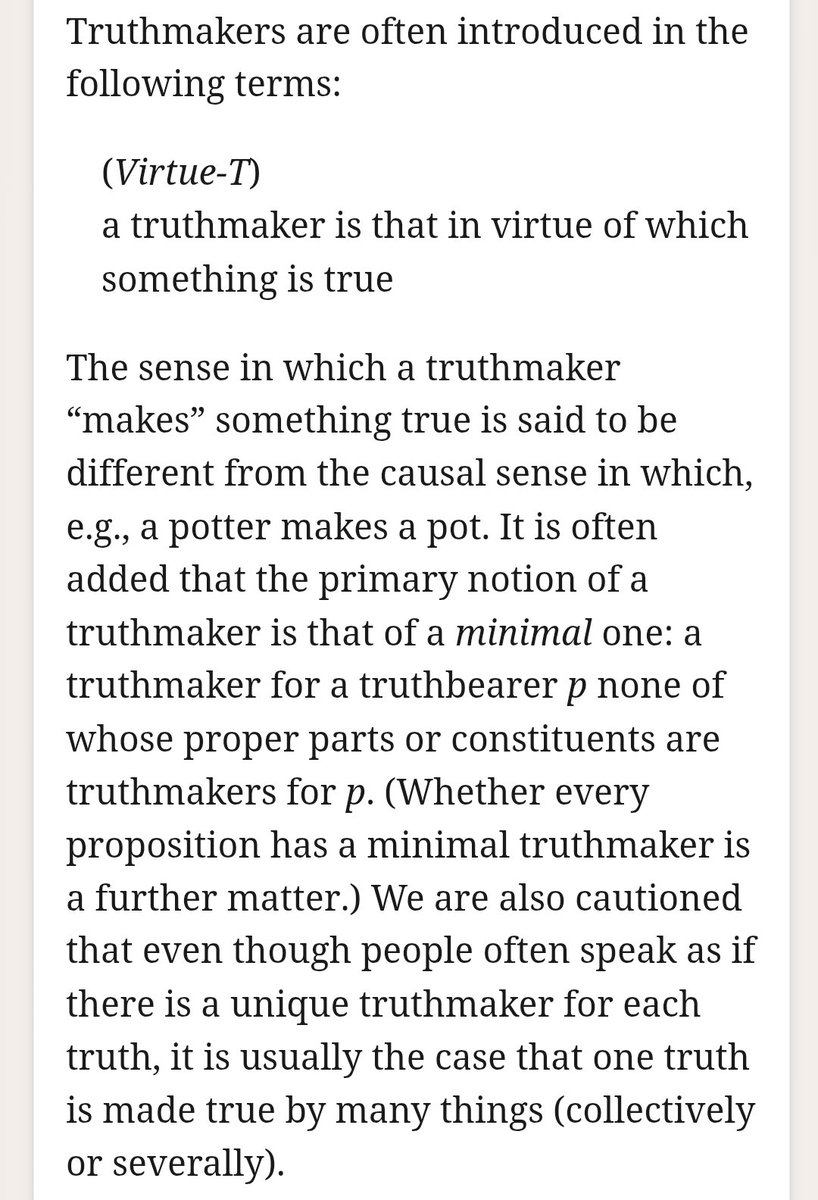
Well, I will grant since I think it is a tertiary worry, although I will use the language of can-be truthmaker. I just hate the word potential lol. Still, we can imagine a baby who has never had any utterances before when they grow up and begin to experience matters of taste, it will be the case that all statements of taste are made true by their subjective stances; their stances are truthmakers (or potential truthmakers) even though they have not made anything true yet
Can I call myself a music maker if I have never made music?
Can I call myself a pot maker if I have never made a pot?
Can I call myself an art maker if I have never made art?
Surely to be a maker, I must have made something; otherwise, I am a potential maker, e.g., a potential truth-maker.
Right?
Yes of course, but validity is just a semantic notion hence why if we are just talking about Modus ponens formally it is only entailment.
If I attached semantic content e.g. if it rains then the ground will be wet, it is raining... the antecedent and consequent are both truth apt and there will be things which make them true
To that end, it will always be valid but the truth of the premises themselves require truthmakers, logic alone can't make propositions true (at least not in any substantive sense)
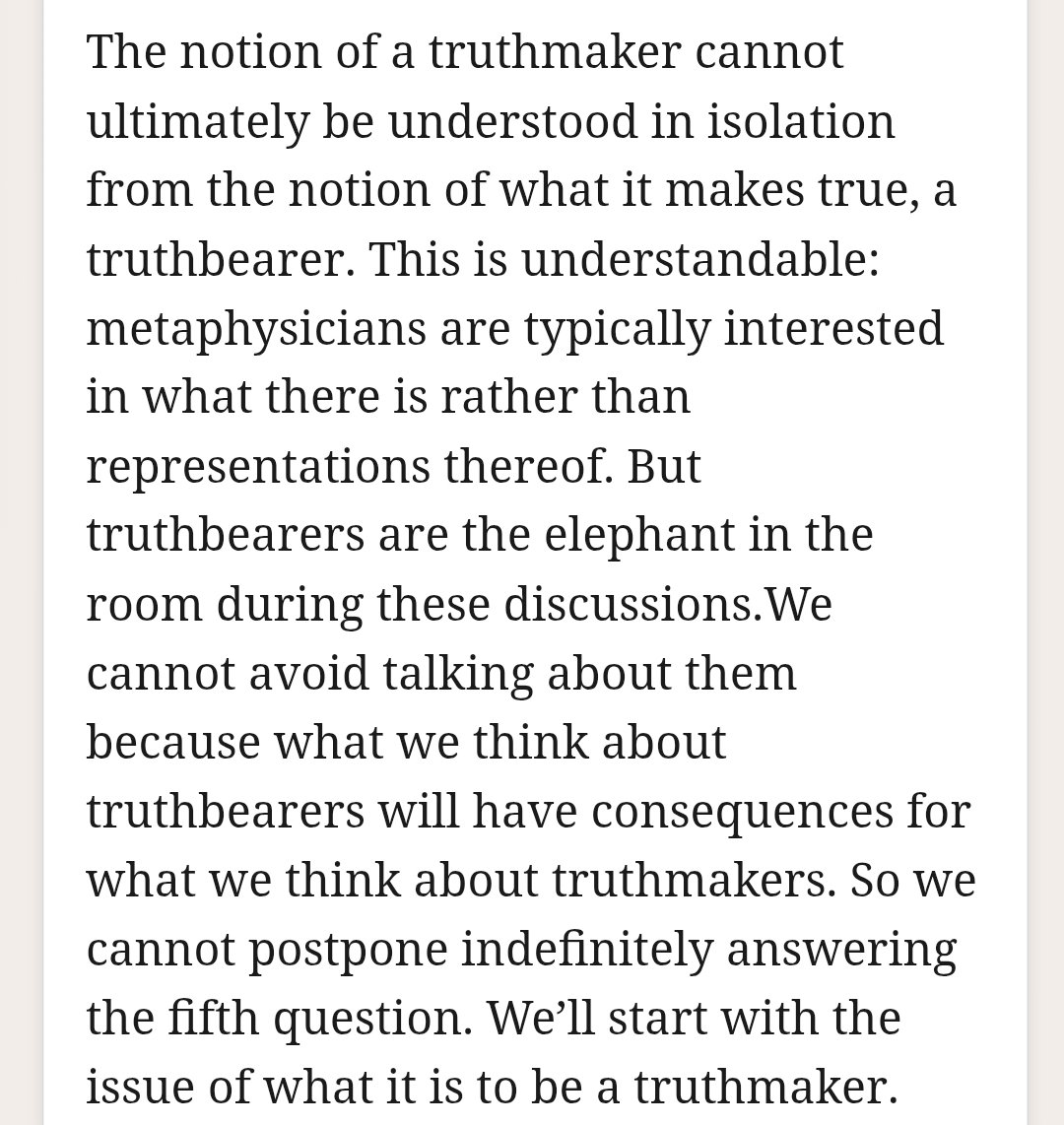
As far as the syllogism goes, truth-makers don't necessarily imply truth-bearers, it is possible to have one without the other, in which case we just would not have truth. I'll put this another way, to even claim that anything makes a proposition in some way is to signify a ttuth-maker (given the SEP article) e.g. "This is true because...", "The reason this is true is...", "Fact X is made true by...", "This truth is grounded in..." etc. Things which are truth makers don’t need to have already made something true, so you may not believe in correspondence and instead believe that something else makes sentences true or that there are multiple kinds of truth-makers (e.g. analytic truths) I am a bit hesitant on the language of act-potency but afaik this is a fine way of thinking about it
Modus ponens is not contingent on real world facts, by which I presume you mean things known a posteriori (observation).
Modus ponens can be valid regardless of the premises being a priori or a posteriori.
It seems to me that you are using the logic:
1. A truth-maker implies a truth-bearer.
2. A truth-maker exists.
3. .: A truth-bearer exists.
Which, of course, is modus ponens. If a thing is a truth-maker, then it has made truth at least once, hence the term, "maker", rather than, "can maker'.
Thus, "truth-maker", implies it is a thing that can actualise the potential for truth in another thing, i.e., the truth bearer.
So it's modus ponens, right?
I'm not saying that modus ponens in the truth-maker, I think you misunderstood my suggestion.
I suggested that a truth-bearer is Q, and the truth-maker is P, so P implies Q:
P -> Q, P .: Q
P is the truth maker, not P -> Q. I'm trying to logically grasp how you position the truth-bearer and the truth-maker, e.g., the truth-maker implies that the truth-bearer is true.
The truth-bearer is contingent on the truth of the truth-bearer.
Does that make sense?
I'm not agreeing that these things group themselves, the category is trivial insofar as it represents what happened and nothing else but it's clear that a representation isn't the same as the things itself (i.e. naps and territories). If you think the territory grouped itself by my lights that is equivalent to there being some exiting metaphysical label "Extinct" what you are really saying is actually already conceptual insofar as dinosaurs "falling into the category" presupposes the concept/category
Well, I don't *actually* agree I am saying even if I granted that. And still, by my lights, it looks like you think I am denying (i) facts about the world instead of (ii) the categories and the structure of them.
It's no more obvious that categories become mind independent because we impose them on the world than abstract numbers becoming mind independent because we impose them on the world. The categories are grouped by our conceptual schemes. To agree that the categories are constructed so as to group or report such facts is to agree that they are mind dependent. Otherwise it looks like the world itself would have to make these categories for us, which is not likely at all. A map is not a territory and a territory is not a map