Alexandra Macedo 🇪🇺🇮🇹

122.7K posts

Alexandra Macedo 🇪🇺🇮🇹 banner
Alexandra Macedo 🇪🇺🇮🇹

Alexandra Macedo 🇪🇺🇮🇹

@alegianedo

“And we don’t bow to foreign pressure either. We protect Europeans. 🇪🇺⚖️” (Veronika Cifrova, MEP)

Beigetreten Mart 2013
2.6K Folgt1.3K Follower
Alexandra Macedo 🇪🇺🇮🇹 retweetet
Joe Walsh
Joe Walsh@WalshFreedom·
Donald Trump is doing exactly what Putin wants him to do - severely weaken the United States of America.
Christiane Amanpour@amanpour

Historian @TimothyDSnyder sums up a year of Trump choices and policies in one overall conceptual framework, which he calls “Superpower suicide.”

English
226
2.3K
5.3K
89K
Alexandra Macedo 🇪🇺🇮🇹 retweetet
Donald Tusk
Donald Tusk@donaldtusk·
European Council meeting. For the first time in years there are no Russians in the room. Huge relief.
English
3.7K
8.5K
62.4K
2M
Alexandra Macedo 🇪🇺🇮🇹
Patricia Marins@pati_marins64

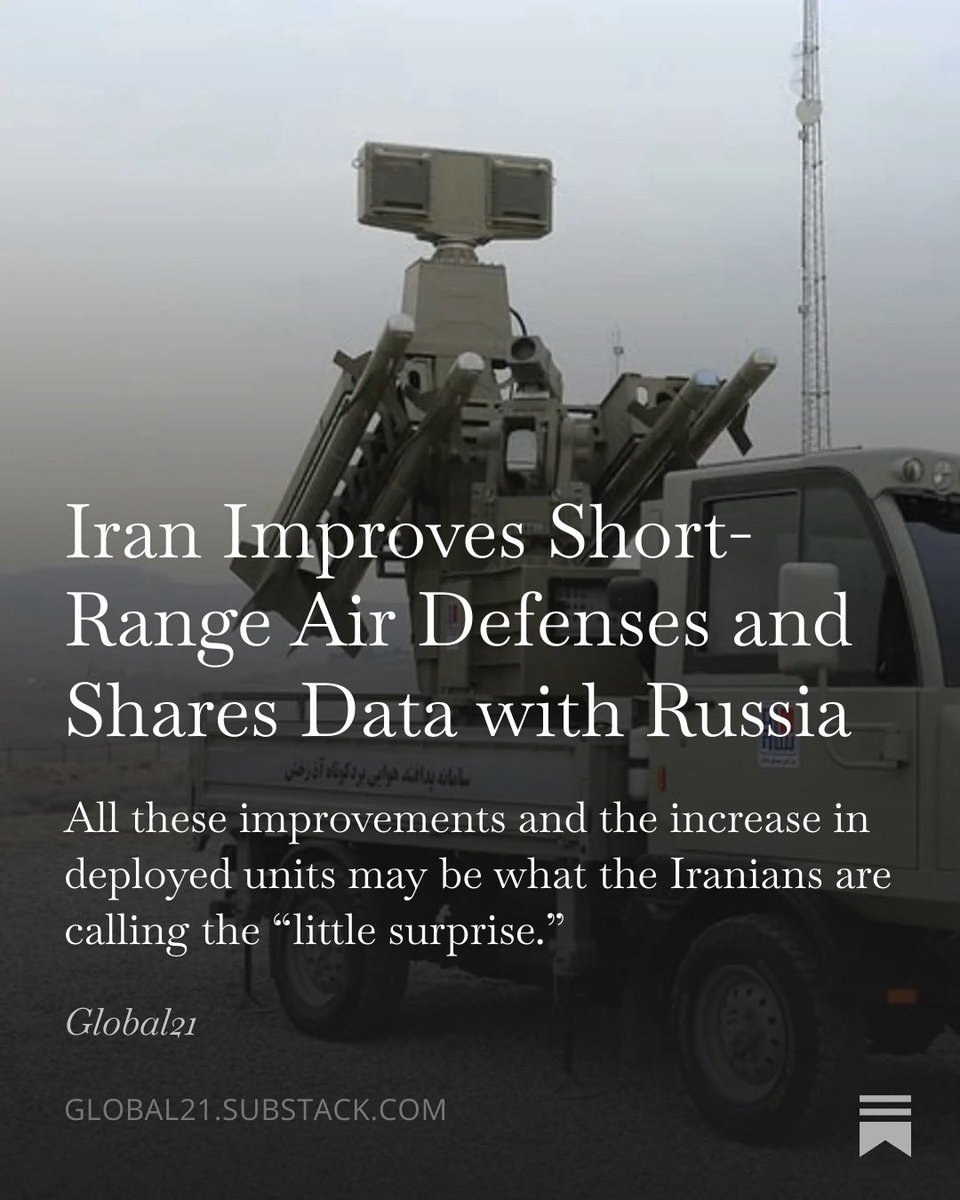
Iran Improves Short-Range Air Defenses and Shares Data with Russia During the 15 days of truce, Iran made improvements to some of its short-range air defenses (SHORAD), primarily the Qaem-118 (also spelled Ghaem-118), which proved effective against MALE drones. The Qaem-118 is a system that uses three simultaneous tracking methods: radar, electro-optical, and thermal (infrared). This allows it to operate in passive mode, detecting targets without emitting radar signals. During the 15 days of truce, Iranian engineers applied software updates to the system’s processors to improve signal filtering, after analyzing radar and heat data collected during confrontations with F-35s and MQ-9 drones in the previous weeks. In addition, they implemented datalink integration to connect the Qaem-118 to mobile radars, receiving the target’s position via radio and activating its own sensors only in the final second before launch Another system that will be seen more frequently is the 358 missile and its successor, the 359. The 358 is a missile that loiters at low speed to engage drones and helicopters. During the 15-day pause, the focus was on updating the image recognition algorithm. Since modern drones like the MQ-9 attempt to reduce their heat signature, Iran applied software corrections so that the 358’s sensor can detect smaller temperature differences against the sky background. Integration with radars was also carried out, as was done with the Qaem-118. Now the 358 is no longer launched blindly. It has been integrated into the network of short- and medium-range mobile ground radars. The radar detects the enemy drone and sends the 358 to the exact coordinates. The missile flies there in silence and only activates its thermal seeker once it is already in the kill zone. Iran emphasizes that this integration happens quickly because these SHORAD systems already use compatible communication protocols. What was accomplished in the 15 days was the physical installation of datalink kits and antennas that were already in stock but had not yet been distributed to all front-line units, which were also trained for this use. And what changes in the 359 version? The 359 uses the Tolou-10 turbojet engine, which makes it faster than the original 358. It can operate above 9,000 meters, enabling it to reach large aircraft such as refueling tankers and radar planes (AWACS) that fly at altitudes the 358 could not efficiently reach. In addition, it has a range of up to 150 km and has abandoned the complex laser proximity sensors of the 358 in favor of a more powerful warhead and more modern thermal imaging guidance systems focused on ignoring countermeasures (flares). Theoretically, this means the repeated scenes of aircraft releasing flares and evading missiles seen in the first phase of the war should no longer occur. We’ll see. All these improvements and the increase in deployed units may be what the Iranians are calling the “little surprise.” Join my Substack to read the full article: open.substack.com/pub/global21/p…

ZXX
0
0
0
22
Alexandra Macedo 🇪🇺🇮🇹 retweetet
Patricia Marins
Patricia Marins@pati_marins64·
Iran Improves Short-Range Air Defenses and Shares Data with Russia During the 15 days of truce, Iran made improvements to some of its short-range air defenses (SHORAD), primarily the Qaem-118 (also spelled Ghaem-118), which proved effective against MALE drones. The Qaem-118 is a system that uses three simultaneous tracking methods: radar, electro-optical, and thermal (infrared). This allows it to operate in passive mode, detecting targets without emitting radar signals. During the 15 days of truce, Iranian engineers applied software updates to the system’s processors to improve signal filtering, after analyzing radar and heat data collected during confrontations with F-35s and MQ-9 drones in the previous weeks. In addition, they implemented datalink integration to connect the Qaem-118 to mobile radars, receiving the target’s position via radio and activating its own sensors only in the final second before launch Another system that will be seen more frequently is the 358 missile and its successor, the 359. The 358 is a missile that loiters at low speed to engage drones and helicopters. During the 15-day pause, the focus was on updating the image recognition algorithm. Since modern drones like the MQ-9 attempt to reduce their heat signature, Iran applied software corrections so that the 358’s sensor can detect smaller temperature differences against the sky background. Integration with radars was also carried out, as was done with the Qaem-118. Now the 358 is no longer launched blindly. It has been integrated into the network of short- and medium-range mobile ground radars. The radar detects the enemy drone and sends the 358 to the exact coordinates. The missile flies there in silence and only activates its thermal seeker once it is already in the kill zone. Iran emphasizes that this integration happens quickly because these SHORAD systems already use compatible communication protocols. What was accomplished in the 15 days was the physical installation of datalink kits and antennas that were already in stock but had not yet been distributed to all front-line units, which were also trained for this use. And what changes in the 359 version? The 359 uses the Tolou-10 turbojet engine, which makes it faster than the original 358. It can operate above 9,000 meters, enabling it to reach large aircraft such as refueling tankers and radar planes (AWACS) that fly at altitudes the 358 could not efficiently reach. In addition, it has a range of up to 150 km and has abandoned the complex laser proximity sensors of the 358 in favor of a more powerful warhead and more modern thermal imaging guidance systems focused on ignoring countermeasures (flares). Theoretically, this means the repeated scenes of aircraft releasing flares and evading missiles seen in the first phase of the war should no longer occur. We’ll see. All these improvements and the increase in deployed units may be what the Iranians are calling the “little surprise.” Join my Substack to read the full article: open.substack.com/pub/global21/p…
Patricia Marins tweet media
English
54
602
2.6K
142.9K
Alexandra Macedo 🇪🇺🇮🇹 retweetet
Brandon Weichert
Brandon Weichert@WeTheBrandon·
Predictability is the death of strategy. Everything the US has done in this war with Iran has been predictable. Once the enemy knows your pattern, they can shape the battlefield around it. Our predictability taught Iran how to use us; how to turn our own doctrine into their weapon.
English
23
26
285
9.6K
Joe Kent
Joe Kent@joekent16jan19·
POTUS’s statement creates room for an off-ramp in which we avoid a return to fighting and eliminate the need for a formal settlement. We can withdraw and use sanctions as our blockade. By removing our troops and ships, we deny Iran military targets they can use as leverage, forcing them to engage us diplomatically—Iran would then be inclined to make quiet concessions because they urgently need sanctions relief. This gives us strong leverage on the nuclear issue. Both Iran and POTUS can tell their domestic audiences they won, saving face and preventing further senseless bloodshed. The dynamics of the region and the global balance of power will be forever altered because of this war—we can’t change that now. But we can avoid a massively destructive escalation. At this juncture, that has to be our priority.
Joe Kent tweet media
Joe Kent@joekent16jan19

Professor Pape’s analysis is sharp. I agree with most of what he lays out in this interview & his substack. I’m advocating for us to walk now to avoid further escalation, sanctions relief can be used to encourage Iran to open the SOH. Our top goal now should be avoiding the plunge into a prolonged conflict.

English
699
726
3.8K
478.3K
Alexandra Macedo 🇪🇺🇮🇹 retweetet
Anders Åslund
Anders Åslund@anders_aslund·
Sadly, virtually all official US statements about its war on Iran are revealed to be lies. As long as Trump remains US president, the US has no credibility, since Trump always lies & cannot even maintain one line of lies. Incredibly, we are left to look for more truth from Iran.
English
49
368
1.2K
18.6K
Alexandra Macedo 🇪🇺🇮🇹 retweetet
Aaron David Miller
Aaron David Miller@aarondmiller2·
Once again, Trump has come up with a solution to a problem we didn't have in February 2026. And in doing so, has made problem worse enabling an already murderous regime to become more hardline and leverage its geography to turn Straits of Hormuz into its own Panama Canal.
English
6
22
62
5.5K
Alexandra Macedo 🇪🇺🇮🇹
"For nearly four decades, NATO’s eyes in the sky have been American. NATO’s Support and Procurement Agency has selected the Swedish Saab GlobalEye to replace all 14 of the alliance’s aging E-3 aircraft, (...) The contract goes to [🇸🇪 & 🇨🇦] Not a single American company involved."
Gandalv@Microinteracti1

For nearly four decades, NATO’s eyes in the sky have been American. The Boeing E-3 Sentry, a militarized 707 with a rotating radar dish on top, has been the alliance’s airborne early warning backbone since the 1980s. Washington built it. Washington sold it. Washington serviced it. That era ended this week. NATO’s Support and Procurement Agency has selected the Swedish Saab GlobalEye to replace all 14 of the alliance’s aging E-3 aircraft, in a deal worth around 5 billion euros. The contract goes to Sweden and Canada. Not a single American company involved. The decision follows the US cancelling its own E-7 Wedgetail procurement in June 2025, shifting instead toward satellite surveillance under the Golden Dome concept. When Washington pulled out, it assumed NATO would wait. NATO didn’t wait. The GlobalEye uses a fixed AESA radar rather than the E-3’s rotating dish, enabling faster target detection across air, sea, and land at ranges exceeding 550 kilometres, with endurance of over 13 hours per sortie. It is smaller, cheaper to operate, and requires fewer crew. Unit cost sits at roughly 550 million euros, against significantly higher estimates for the E-7. France had already ordered two. Poland and Germany were circling. Now NATO has formalised it for the whole alliance. Trump spent 14 months telling Europe to spend more on defence and rely less on America. Europe listened. He just didn’t expect them to mean it quite so literally. Gandalv / @Microinteracti1

English
0
0
0
17