
Jay Nathan

2.6K posts

Jay Nathan banner
Jay Nathan

Jay Nathan

@jaynathan

COO @churnkey, SaaS Growth Executive

Charleston, SC Beigetreten Aralık 2007
1.5K Folgt2.1K Follower
Angehefteter Tweet
Jay Nathan
Jay Nathan@jaynathan·
Had to do something painful today.. I turned down a deal with a prospect who is excited and ready to buy our product. Why? They have a specific need we can't meet without one-off product development work that doesn't fit into our vision and roadmap. Sure, we could have built it. And it might not have even taken that long. But the reality is that their need doesn't fit into the value prop we're pursuing for our ideal customers. Over the past twenty years I've seen this story play out, time and again. It always ends the same way. Push to get it done. Win the deal. Unintended side effects. Sunk costs. Both parties throw good money (and time) after bad. Then, as the late, great theologian Jimmy Buffett sings, it becomes "...a permanent reminder of a temporary feeling." Instead, we recommended a couple of competitors who can serve their needs today, and offered our team to consult with them along the way. (as Prof G says, "if this sounds like virtue signaling, trust your instincts...") A few things gave me the confidence to make this decision: 1/ Our balance sheet Churnkey (.co) is a lean, profitable SaaS company with a straightforward cap table. We are pursuing growth as hard as anyone else, but we're not beholden to outside influences pushing us to grow at all costs. As a result, we think and act on a long-term time horizon (this is 1/3 of the reason I joined the company). 2/ Opportunity cost To serve this need we would have sacrificed a portion of our product vision and value for a short-term dopamine hit. Narrow thinking and short-term loss aversion would cause us to fall behind on serving other customers who fit our ICP (ideal customer profile) today. 3/ There's always tomorrow, and what goes around comes around We'll be able to serve this customer even better when the time is right for both of us. I believe we built credibility in the process. In business, and more specifically in SaaS, time is long and the world is small. People remember when you do the right thing, even if it stings in the short run. At the end of the day, people put a lot on the line to do business with a SaaS company. They make decisions that can make or break portions of their career. Especially when it comes to mission-critical subscription revenue systems like the ones we work with. So long, growth at all cost era. Here's to the era of playing to win the long game. What are the best long-term decisions you've seen your leadership team make in recent months? #saas #sales #customersuccess #marketing

Jay Nathan tweet media
English
0
0
11
576
Jay Nathan
Jay Nathan@jaynathan·
@jaminball ServiceNow has massive, long-term contracts. Probably same with CRM. I think this retention issue will show up in the likes of HUBS (SMB/Midmarket) before the big enterprise players.
English
0
0
0
300
Jay Nathan
Jay Nathan@jaynathan·
@ShaanVP Occam’s razor. The simplest answer is probably the best one. There’s no conspiracy here. Just the sad state of politically motivated violence which is unacceptable in this country no matter which side one is on.
English
0
0
1
48
Shaan Puri
Shaan Puri@ShaanVP·
Unbelievable. Look at the headlines.... "A half truth is the most cowardly of lies" - Mark Twain
Shaan Puri tweet mediaShaan Puri tweet mediaShaan Puri tweet mediaShaan Puri tweet media
English
129
420
4K
615.7K
Jay Nathan
Jay Nathan@jaynathan·
@davegpack @jasonlk Isn’t that like saying to a disruptive competitor, they don’t deserve to make as much profit or as much market share? Maybe the seed fund is a better financing product for founders.
English
0
0
1
61
Dave Pack
Dave Pack@davegpack·
@jasonlk This could also be an argument for seeds funds getting too large. Do you need $3m in management fees annually, especially if you have multiple funds?
English
3
0
10
6.7K
Jason ✨👾SaaStr.Ai✨ Lemkin
So venture capital turns out to be a pretty tough business. Imagine a $150m seed VC fund that buys 15% stakes in each startup. They write some follow-on checks, but ultimately, typically get diluted to about 10% ownership. Then one start-up in the fund is sold for $500m! An epic amount! How much does that return for the VC fund? $50m. A lot. But ... but ... it's only 33% of the $150m fund. And the job of the fund is to do at least about 4x "gross", or to turn that $150m into $600m. So that $50m doesn't even get you 10% of the way there. And note while VCs are often well paid, they don't make profits or "carry" unless the full fund is first returned. Until that $150m is paid back. So you can see here, even a $500m "exit" isn't a fund returner for a $150m fund. It's not even close. It's not enough. You need a bunch -- in every fund. OK so you can see why VCs are obsessed with Fund Returners. Those rare investments that return enough money to the VC fund to pay off at least 1x the total fund size. And you can see VCs are often pretty careful to make sure structurally, any given investment can do it. A 1% stake? Maybe it can happen with a Stripe or Databricks or SpaceX, but otherwise, small equity stakes are tough to turn into Fund Returners. Investing in the #3 or #4 in a space? Yes, you can make money. But can it be a fund returner? It's much harder. So going into an investment, most VCs have to believe you can truly be a Fund Returner. But here's the non-obvious part ... that calculation changes over time. As the years go by, some investments don't make it. Hopefully at least 1 per fund breaks out over time and becomes a "Fund Returner". Some get acquired. And some keep going ... but likely won't ever be a fund returner. At some point, it's just clear that they are a good startup, but aren't going to have that $1B, $5B, $10B+ exit it might take to be a Fund Returner. And when that time comes, as long as you don't need much more money from that VC ... the VC tends to get a bit zen. They just want you to get the best outcome you can. And in some cases, anything where they make even a 2x return is great, when it's not clear there will be even a 1x return. It's not what anyone hoped when they invested. But VCs do get zen when they have a sense over time of the outcome -- and more capital isn't required. So I know on social media it can seem like there are many horror stories of VCs pushing founders to raise too much, or spend too much, and that does happen. But it mostly happens with the ones that are, or look like they can truly be, Fund Returners. The rest kind of, at least a few years in, sort of get left alone if they don't need more money.
English
27
57
589
162.4K
Jay Nathan
Jay Nathan@jaynathan·
Nice recovery from last month’s marketing faux pax.
English
0
0
2
200
Jay Nathan
Jay Nathan@jaynathan·
I agree. Apple intelligence. Way to grab hold of “AI” @Apple
Jay Nathan tweet media
English
2
0
2
306
OnlyCFO
OnlyCFO@OnlyCFO·
Domo openly discussing that an acquisition by PE or strategic makes a lot of sense Honestly probably the only way out of the mess of inefficiency they are in, but someone could probably make the right changes
OnlyCFO tweet media
English
6
1
18
9.8K
Jay Nathan
Jay Nathan@jaynathan·
@jspujji And the chances of going public are now more slim than ever. It’s really the only way out these days. Besides running profitably for the long run.
English
0
0
0
350
Jesse Pujji
Jesse Pujji@jspujji·
Founders are more likely to sell to Private Equity than IPO, but they don’t know the basic math behind PE. Let's go through the numbers. If a PE firm buys a company, the buyout might look like this. Target company's EBITDA: $10 mil Price paid (10 X EBITDA): $100 mil Payment via: $50 mil equity and $50 mil debt at 10% interest Let's jump forward 5 years. Scenario 1: What happens if the company has low growth? EBITDA: $11 mil Valuation (10 X EBITDA): $110 mil Interest paid: $25 mil Debt paid down (using profits): $25 mil Internal rate of return: 11% [IRR math: current valuation ($110M) - debt ($25M) = equity value ($85M). So value ($85M) ÷ initial equity paid ($50M) = 1.7X return or 11% IRR] Scenario 2: What happens if the company has a solid 20% growth? EBITDA: $20M Valuation (12 X EBITDA): $240M Interest paid: $25 mil Debt paid off FULLY (using profits): $50M Internal rate of return: 36% [IRR math: current valuation ($240M) - debt ($0) = equity value ($240M). So value ($240M) ÷ initial equity paid ($50M) = 4.8X return or 36% IRR] Either return is better than the S&P.
English
10
23
225
110.5K
Jay Nathan
Jay Nathan@jaynathan·
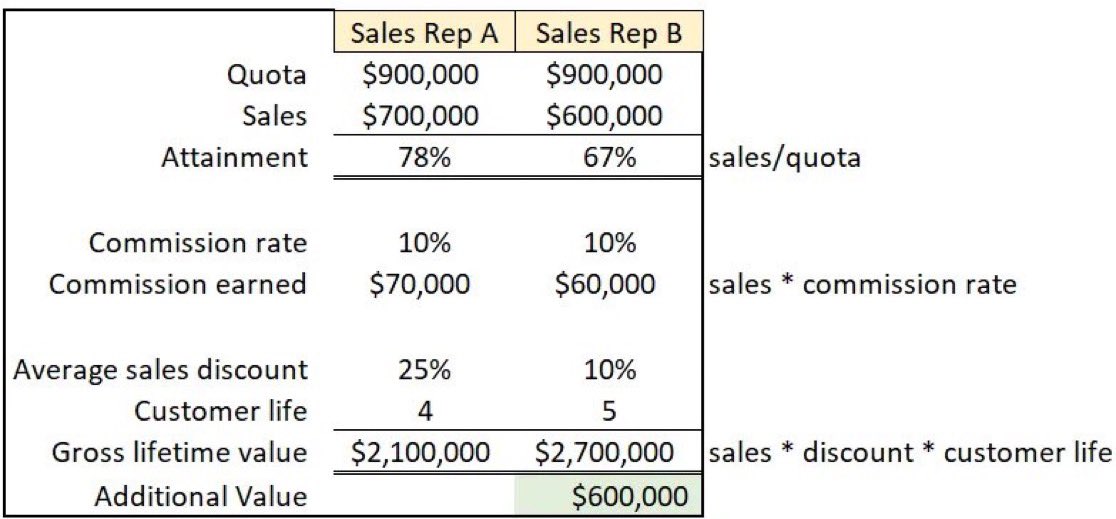
@OnlyCFO Thoughts on how to operationalize rewarding rep B appropriately?
English
0
0
0
161
OnlyCFO
OnlyCFO@OnlyCFO·
The value created between a bad rep and a great rep is huge. Below is the difference in value created between two reps that appear mediocre The “worse” rep is bringing in $600k more in LTV! The quality of customers and discounting on those sales can make a BIG difference.
OnlyCFO tweet media
English
4
3
20
3.4K
Jay Nathan
Jay Nathan@jaynathan·
@OnlyCFO @Kellblog Metrics are only a proxy for what’s happening in the real world. Often a bad one. The best managers know their number but MBWA. Manage by walking around. (Or I guess zooming around in 2024 parlance).
English
0
0
1
48
OnlyCFO
OnlyCFO@OnlyCFO·
Blinded by Metrics Metrics are great but too often they are misunderstood or misused to fit a specific narrative. Metrics can tell a story. The problem is that with the right metric you can create any story you want…. onlycfo.io/p/blinded-by-m…
English
2
2
21
6.2K
Dave Kellogg
Dave Kellogg@Kellblog·
I'm always looking for better ways to distill strategy. My favorite strategy author is Richard Rumelt and I love his work for two reasons: 1. He takes a wrecking ball to the garbage that is often passed off as strategy. Aspirations are not strategy. Goals and OKRs are not strategy. Financial projections and forecasts are not strategy. SWOT analyses and five forces analyses are not strategy. Driving results is not strategy. 2. He whittles strategy down to the head of a pin. First, by defining strategy as identifying and planning to overcome a company's most important challenge (aka, challenge-driven strategy). Then, by capturing what he calls the kernel of strategy: a diagnosis, a guiding policy, and a set of coherent actions.
English
12
14
195
40.8K
walid
walid@TheWalid·
yall im engagement baiting
English
3
0
33
7.2K
walid
walid@TheWalid·
just quit my job I am never doing marketing for a tech startup run by Gen-Z ever again
English
11
1
315
71.5K
Ling
Ling@lingxlim·
growing older is weird, like suddenly olives taste acceptable
English
10
0
22
2.7K
Jason ✨👾SaaStr.Ai✨ Lemkin
A lot of CS teams are just gap fillers A gap opens up when: - Sales abandons the customer the moment deal is closed - Support too reactive & slow to solve real issues - Deployment harder than should be An important gap to fill, and a full-time job But the best do more
English
8
5
96
106.1K
Jay Nathan
Jay Nathan@jaynathan·
Largely with the product. If you have a high volume business and you’re not continuously automating the “longest pole in the tent” then I’d argue your velocity will be limited by those items at some point. Besides the product, teams can implement “scaled success” models which are 1:many enablement and engagement tactics.
English
0
0
0
26
Scott Stevenson
Scott Stevenson@scottastevenson·
@jasonlk How do you think this gap should get covered in high velocity SMB SaaS?
English
1
0
4
2.9K
Jay Nathan
Jay Nathan@jaynathan·
@jasonlk This is 100% true. It’s an expensive band aid for shortcomings in product and processes. Shouldn’t be, but has largely devolved into this in many, many SaaS and cloud companies.
English
0
0
1
360
Jay Nathan
Jay Nathan@jaynathan·
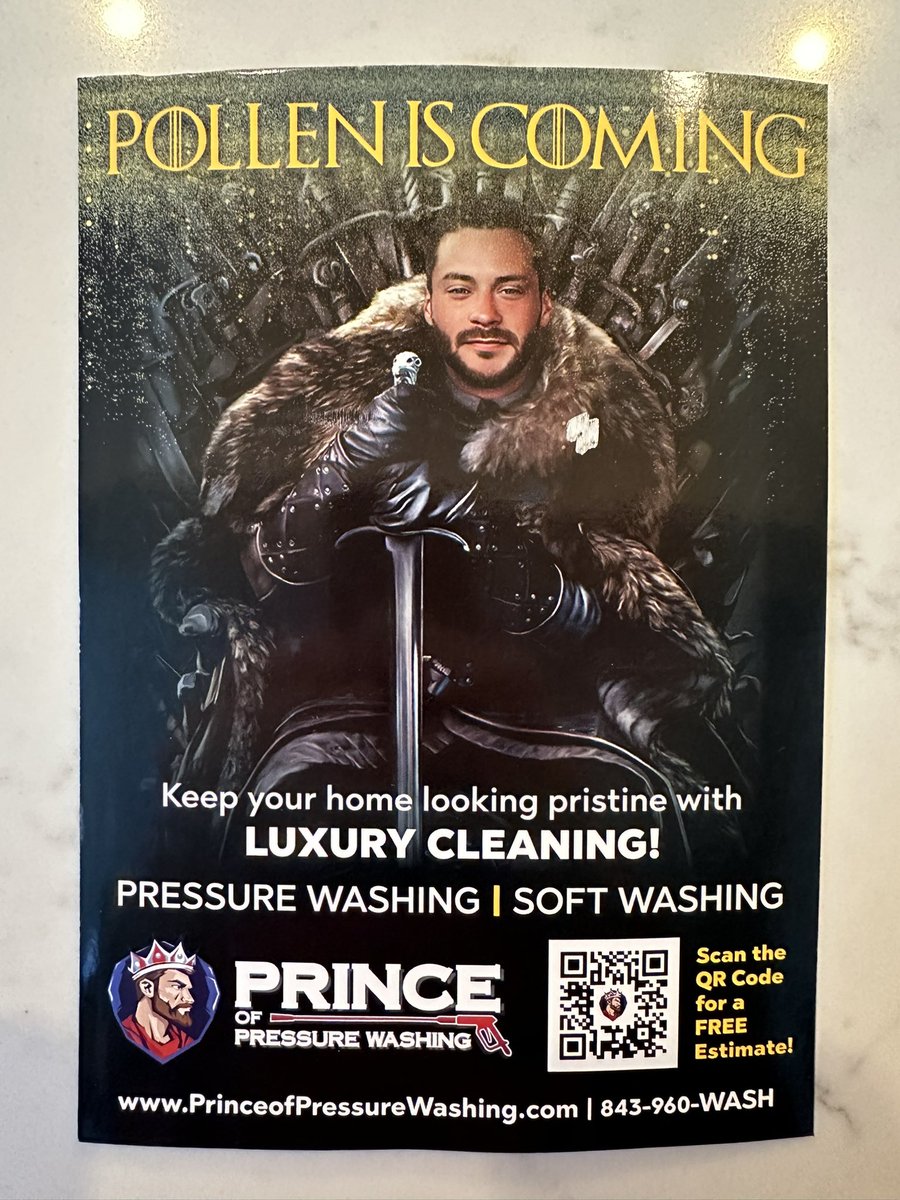
If you want to be noticed. No matter what industry you find yourself in. Do things that other people can’t do, won’t do, or simply can’t think of. Good on you prince of pressure washing. (And yes, the pollen is here)
Jay Nathan tweet media
English
0
0
0
169
Nick Mehta
Nick Mehta@nrmehta·
Good reminder to all of us leaders: The VAST majority of tech employees have never worked in a non-ZIRP (Zero Interest Rate Policy) environment
English
17
11
113
120.8K
Jason ✨👾SaaStr.Ai✨ Lemkin
@gokulr @MeritechCapital I’m not 100% sure this will be true going forward (HubSpot did just fine) but I am 100% worried about it Klaviyo and Rubrik (TBD) seem to confirm the bar is awfully high today Klaviyo IPO was almost perfect (growth, efficiency, NRR, etc) and still priced “normal”
English
2
1
38
6.6K