
Aaron Levie

11.3K posts

Aaron Levie banner
Aaron Levie

Aaron Levie

@levie

ceo @box - your business lives in content. unleash it with AI

Bay Area Beigetreten Mart 2007
780 Folgt2.5M Follower
Angehefteter Tweet
Aaron Levie
Aaron Levie@levie·
Had meetings and a dinner with 20+ enterprise AI and IT leaders today. Lots of interesting conversations around the state of AI in large enterprises, especially regulated businesses. Here are some of general trends: * Agents are clearly the big thing. Enterprises moving from talking about chatbots to agents, though we’re still very early. Coding is still the dominant agentic use-case being adopted thus far, with other categories of across knowledge work starting to emerge. Lots of agentic work moving from pilots and PoCs into production, and some enterprises had lots of active live use-cases. * Agentic use-cases span every part of a business, from back office operations to client facing experiences from sales to customer onboarding workflows. General feeling is that agentic workflows will hit every part of an organization, often with biggest focus on delivering better for customers, getting better insights and intelligence from data and documents, speeding up high ROI workflows with agents, and so on. Very limited discussion on pure cost cutting. * Data and AI governance still remain core challenges. Getting data and content into a spot that agents can securely and easily operate on remains a huge task for more organizations. Years of data management fragmentation that wasn’t a problem now is an issue for enterprises looking to adopt agents. And governing what agents can do with data in a workflow still a major topic. * Identity emerging as a big topic. Can the agent have access to everything you have? In a world of dozens of agents working on behalf, potentially too much data exposure and scope for the agents. How do we manage agents with partitioned level of access to your information? * Lots of emerging questions on how we will budget for tokens across use-cases and teams. Companies don’t want to constrain use-cases, but equally need to be mindful of ultimate token budgets. This is going to become a bigger part of OpEx over time, and probably won’t make sense to be considered an IT budget anymore. Likely needs to be factored into the rest of operating expenses. * Interoperability is key. Every enterprise is deploying multiple AI systems right now, and it’s unlikely that there’s going to be a single platform to rule them all. Customers are getting savvier on how to handle agent interoperability, and this will be one of the biggest drivers of an AI stack going forward. Lots more takeaways than just this, but needless to say the momentum is building but equally enterprises are acutely aware of the change management and work ahead. Lots of opportunity right now.
English
113
99
855
137.1K
Aaron Levie
Aaron Levie@levie·
@james406 Why even use software if you can just get demos of it
English
0
0
0
170
james hawkins
james hawkins@james406·
ever since i was a kid, i knew i wanted to book a quick 5-minute demo to learn more about your agentic AI platform that saves most customers 90 minutes a day in manual tasks
English
22
19
659
17.2K
Aaron Levie
Aaron Levie@levie·
@nikitabier Can you build a feature that turns tweets in 1,800 word articles?
English
4
0
27
3.1K
Nikita Bier
Nikita Bier@nikitabier·
We’re rolling out summaries for Articles now. Just tap the Summarize button if you want to know if it’s worth your time to read it (or if your attention span is 12 seconds).
English
1.2K
252
3.3K
668.2K
Paul Graham
Paul Graham@paulg·
If you have multiple kids you might be surprised by how different they look.
Paul Graham tweet media
English
115
11
1.7K
230.8K
Aaron Levie
Aaron Levie@levie·
Agents will outnumber human users on the web by orders of magnitude. Just like people, they will need a way to pay for services they use. They may run into propriety health or finance data they need to pay for when doing a deep research task, or make a tool call to a bespoke web API for some functionality. But unlike people, agents experience no friction when making a payment, so they can pay for things in much smaller units and increments than people will. An agent may need to call an API that they only need to use on a one-time basis or pay for information that they need without signing up for a subscription. This means all forms of revenue streams can emerge for technology and information providers that wouldn’t have been possible before. To make this all work, we need will need new infra and tools for agents to do this, and it’s cool to see MPP from stripe and tempo.
Jeff Weinstein@jeff_weinstein

Introducing the Machine Payments Protocol (MPP). mpp.dev: an open protocol for machine-to-machine payments, co-authored by @tempo and @stripe. Watch it in agentic action ⤵️

English
54
53
430
115.1K
Andrew Ambrosino
Andrew Ambrosino@ajambrosino·
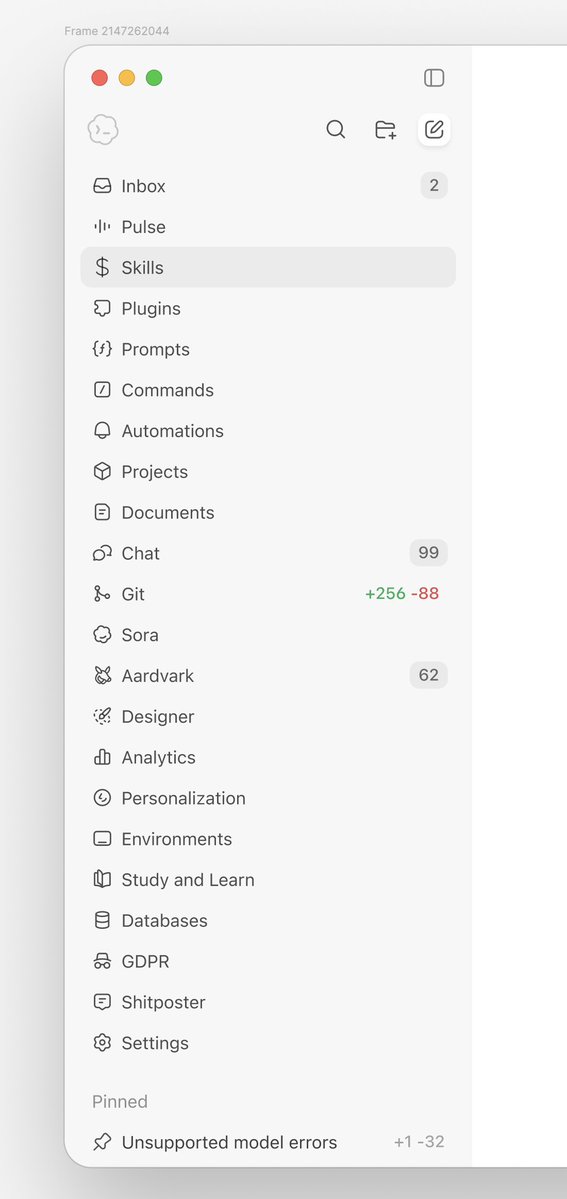
here's an early look at the codex app sidebar I wanted to ship. i was silenced
Andrew Ambrosino tweet media
English
211
24
1.5K
200.6K
Aaron Levie
Aaron Levie@levie·
The official Box CLI is here. Now you can use Box via Claude Code, Codex, Perplexity Computer, OpenClaw & more as a full cloud file system for agents. Available to all users, including free users with 10GB of free storage. npm install --global @box/cli
English
71
43
661
129.6K
Romain Huet
Romain Huet@romainhuet·
@ajambrosino Just one more sidebar item, bro. This is the last one, I promise!
English
2
0
55
4.2K
Aaron Levie
Aaron Levie@levie·
One of the hardest jobs in the world right now must be figuring out what colleges should be teaching. The world is yelling at you from every angle that every single job is going to change forever, and you need to prepare all of your students for this. So what do you do? My guess —and note, I dropped out of college so I’m the last person who should weigh in— is that we likely want 75% of curriculum to be about the fundamentals of a particular field, and 25% applied AI skills in that domain (you can play with these numbers a bit). For the 75%, you learn all the same foundational principles of CS, or ME, or psychology, and so on that everyone did before AI. But all of this should be accelerated due to AI as well, so we probably compress the equivalent of masters degrees plus into every bachelors program. In this, we probably want to be teaching and testing on the fundamentals, even if in the real world you only deal with abstractions due to AI, because the only way people will properly wield these tools effectively is to understand how to tell the agent what you want to do, how you know when they’re going off the rails, how to fix what isn’t working, and so on. If you don’t know the fundamentals then no amount of abstractions will save you. Then, the leftover 25% goes into applied ways of working with AI in your particular field. If you’re studying CS, you use AI to build the craziest working software possible. If you’re in media, you’re producing a full film that looks like a blockbuster. If you’re in marketing, you’re figuring out how to do end-to-end marketing campaigns with the modern stack. This combination I think would make students extremely potent coming into the real word. In fact they likely would know vastly more about how to operate in the field in a modern way than existing employees, making them very compelling hires. Just a thought!
aria 🪸@ariadotwav

I cannot stress enough how absolutely cooked CS, Soft Eng, Comp Eng and basically any tech/IT major is. Literally no one in my cohort bothers to write their own code anymore. People just hand in labs that are fully vibecoded and pass with grades above 90% and the profs do NOTHING

English
54
26
265
60.3K
Aaron Levie
Aaron Levie@levie·
“AI exposed jobs may increase hiring and attract higher wages. It all depends on a) elasticity of consumer demand and b) number of AI exposed tasks in a job.” This is a key point. We’re going to see lots of AI automation emerge that has the opposite effect that we expect, because the cost of doing something goes down and greater demand for that service exists at lower prices. Take a *very* simplistic example in agentic coding to see what happens when you can dramatically increase output per $ of engineering budget. Before AI, a mid-sized company or team within a large company has a project they want to build software for. It takes 50 engineers to fully resource the effort, but the project doesn’t provide the ROI to fund it compared to other initiatives. Or the company knows its expertise isn’t in building software so it’s not even worth starting. So they hire 0 engineers, and don’t start the project. Now, AI agents make it possible for this to be a 10 engineer problem. All of a sudden the ROI calculus immediately changes on starting up the project. So now instead of hiring 0 engineers to do the project, the company hires 10 with AI agents. This has endless implications in coding, in particular, because coding can now have impact for anything from doing internal workflow automation, systems integration, data analysis, as well as customer-facing product innovation. By bringing down the cost of writing code, we can just begin to use it for far more. This will likely play out in a number of other job families as well, where lowered costs or higher output will lead to more demand. Now, not all of this will be smooth. For instance, there may need to be some reallocation of talent across the economy to move from some places of excess supply to places of lower supply. This could be bumpy at times, but the dynamic holds.
Alex Imas@alexolegimas

Also: *EXPOSURE DOES NOT MEAN THREAT OF DISPLACEMENT* *EXPOSURE DOES NOT MEAN THREAT OF DISPLACEMENT* *EXPOSURE DOES NOT MEAN THREAT OF DISPLACEMENT* It can literally mean the opposite: AI exposed jobs may increase hiring and attract higher wages. It all depends on a) elasticity of consumer demand and b) number of AI exposed tasks in a job.

English
54
41
247
99.9K
Aaron Levie
Aaron Levie@levie·
There’s a fundamental difference between taking an existing process and applying AI agents to it vs. taking a process from scratch and designing it from the ground up for AI agents. The gap we’re going to see will widen between the teams and companies that are able to do the latter instead of just the former. In theory it would have been ideal for all the gains of AI to have come “for free”, but there are both clear constraints of AI (like getting the context right) and clear upsides (like being able to execute code and run in parallel) that the workflows themselves must be redesigned to take full advantage of this technology. One of the biggest implications that will come into focus is that agents that can write and run code, and interact with any API, will lead to agents effectively being expert engineers applied to your business process. So to some extent one of the biggest ways of reengineering a workflow is to ask yourself: what would you do if you had an infinite number of capable engineers write software for this process. What if those engineers wrote code to connect your disparate data sources, comb thorough any amount of unstructured data, automate your repeated tasks, connect your various systems together specific to your process, and so on. Not every process has that upside, but there tons of tasks that we do every day across marketing, finance, operations, and even sales, where a programmer with infinite code writing and API access would be able to make something go far faster or produce way more output. The teams that start to think this way will start to operate entirely differently.
English
127
62
511
105.9K
Peter Yang
Peter Yang@petergyang·
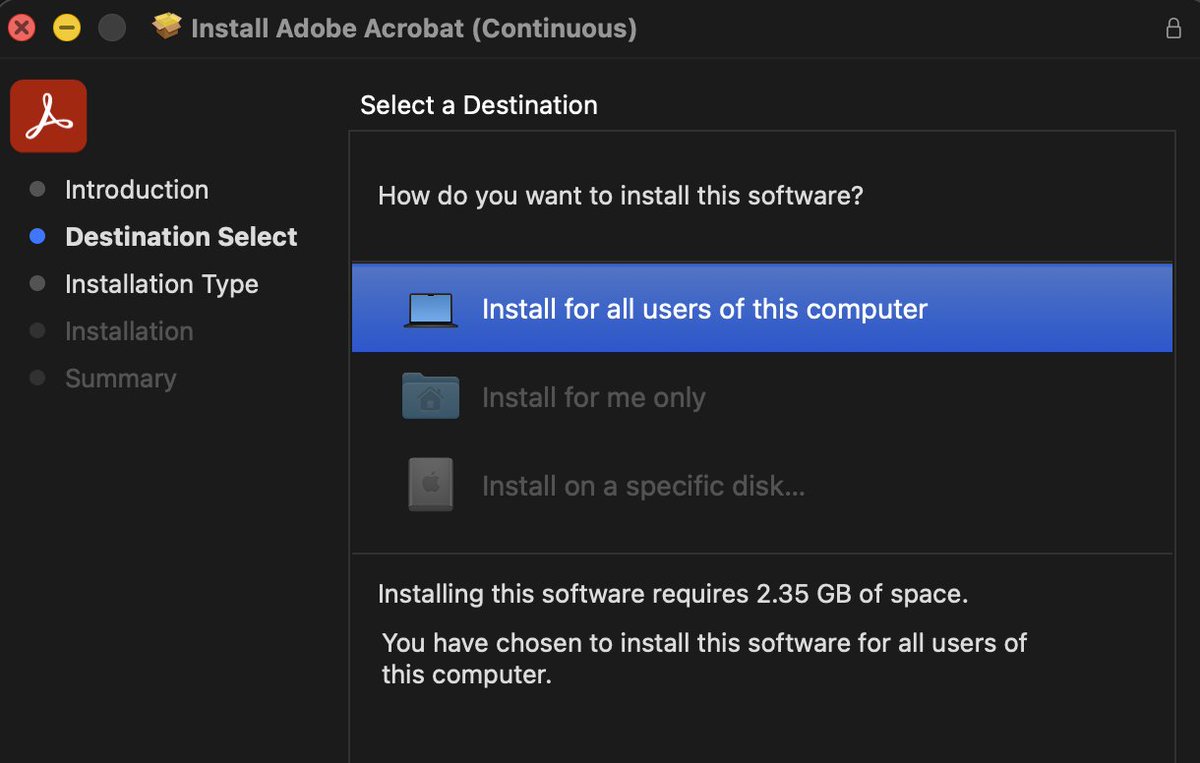
Why does reading some PDFs require 2 GB of space? Even Adobe's software is bloated.
Peter Yang tweet media
English
176
20
1.3K
201.6K
Aaron Levie
Aaron Levie@levie·
A subtle dynamic today that will likely end up being quite fundamental in the future is that AI agents implicitly will end up procuring a significant portion of tech in the future for you and your company. For companies that have existing standards for a particular tech or where there’s a strong preference, the agent will rely on that. Even then, the agent will eventually make it more and more obvious when they’re running into issues with the existing tech. But for all new workflows or software, which will be the vast majority of software procured in the future, the agent is generally going to be in the driver’s seat for what gets used. This has major implications for platforms because it means if you’re not able to be easily provisioned by an agent, and you don’t have usable APIs for every core feature, you’re basically dead to the agent. Over time agents will ruthlessly prioritize what they use based on what’s easiest, what’s most effective, what’s cheapest, or other parameters you give it. In theory people have always done this, but agents will be much more utilitarian here than people ever were. Wild implications.
Todd Saunders@toddsaunders

Claude will be the biggest software procurement platform in tech. And they aren't even trying to be (i don't think). Every time you use Claude Code, your infrastructure is now implicitly auditing your vendor stack. And unlike your engineering team, it has no vendor loyalty and there are very little switching costs. Everything just looks like code. And code is now extremely inexpensive. Claude is about to drain the moat. I'm here for it.

English
49
37
308
95.6K
Aaron Levie
Aaron Levie@levie·
The frontier AI use-cases probably use 100X or so more tokens than the frontier use-cases did a year ago. We’re already seeing the explosion of coding agents that do vastly more complex and longer running projects, which is already using up an insane amount of inference capacity. And this is a small percentage of total knowledge work. This same architecture is about to come for the rest of knowledge work, where agents will effectively have their own computer to work with and ability to write and run code for many task, and comb through gobs of data to do their work. The token usage for these agents will be insane. It’s about to get very interesting in inference land.
Suhail@Suhail

The run on inference capacity is coming. You have been warned.

English
45
31
210
65.3K
Aaron Levie
Aaron Levie@levie·
Yes but division of labor eventually kicks in. Do you want your sales rep who’s working on Fortune 500 companies corresponding with every webinar attendee? Or do you want someone who can quickly hop on a call and qualify that. I remain open minded for sure, but I’ve also seen people try and do too many functions and then miss the mark on the big stuff.
English
1
0
0
118
Amarpreet Kalkat
Amarpreet Kalkat@amarpreetkalkat·
@levie @buccocapital The live lead gets auto qualified and passed to the AE , isn't it? And if it doesn't qualify, it either gets DQed or passed to a nurture agent. No BDR needed either way.
English
1
0
0
166
BuccoCapital Bloke
BuccoCapital Bloke@buccocapital·
It’s worth thinking through why AI only has true product-market fit for coding and tier one tech support (can maybe argue legal), and who else wins if literally any other business function generates similar traction IMHO, for horizontal roles BDR is probably next
English
32
6
433
82K
Aaron Levie
Aaron Levie@levie·
Software will look very different in the future for most knowledge work. Our software was designed for people to do most of the work, but now agents will be doing a large portion of those tasks and don’t need any of the same UI. This means our software primarily will be about managing the agents doing that, intervening when they go in the wrong direction, giving them the right context, integrating that work into a broader workflow, being able to edit and manipulate the final output, and so on. Lots of change to come as agents get more and more powerful.
Andrej Karpathy@karpathy

Expectation: the age of the IDE is over Reality: we’re going to need a bigger IDE (imo). It just looks very different because humans now move upwards and program at a higher level - the basic unit of interest is not one file but one agent. It’s still programming.

English
46
18
273
87.5K
Aaron Levie
Aaron Levie@levie·
@patrickc listen just because you don’t know the drama at Seagate doesn’t mean everyone else doesn’t
English
1
1
56
9.2K
Patrick Collison
Patrick Collison@patrickc·
There's a lot of unevenness in how much attention internal drama and palace intrigue gets across different organizations. As far as I can tell, this is substantially a matter of path dependency: we know the characters in the sitcom of certain organizations but not at others, creating self-reinforcing lock-in effects. How much does one hear about the power struggles at Chevron or the Department of Agriculture? There is even significant heterogeneity between ostensibly similar companies within sectors.
English
50
25
782
315.9K