
Patrick Collison

10.2K posts

Patrick Collison banner
Patrick Collison

Patrick Collison

@patrickc

@Stripe CEO, @ArcInstitute cofounder.

[email protected] Beigetreten Nisan 2007
33 Folgt961.7K Follower
Angehefteter Tweet
Patrick Collison
Patrick Collison@patrickc·
Tyler and I just published a list of the recipients of the New Aesthetics grants: newaesthetics.art/grants. Thank you very much to all who applied. There were far more applications than we expected. We funded 28 grantees and are excited to see what they create. My reflections on the whole thing: • Though there are clearly selection dynamics afoot, figuring out some route beyond the current aesthetic moment seems to be of wider interest in the art community than I would have guessed. Many applicants described their dissatisfaction with the status quo, some in strong terms. We had to close applications after a few weeks because there were so many. • It's too early to call it, but it seems that both beauty as an unapologetic goal (contra much that is in modernist and contemporary approaches), and ways to channel pre-modern styles into something new for the present era, are of growing interest. • The awards made me reflect on the perhaps obvious issue of how hard it must be for an artist to persistently do something new: schools, galleries, buyers, etc., all have structurally embedded preferences as well. These individual awards made me wonder what form supporting new clusters could take. • Architecture seems to me like the discipline most ripe for new ideas. One correspondent observed: "American architects are somewhat constrained by the association with the academy, in addition to the well known regulation issues. There is a tendency to overthink things so that the designs are formally interesting to someone deep in the conversation, but lacking poetry and magic. There are more firms in Europe, South America and beyond that “just do things” (especially in places where it is easier to build)." This was evident in the submissions. • AI seems to be making people rethink things in a quite fundamental way, just as urbanization/industrialization/popularization of photography did at the end of the 19th century. For some that will mean interesting new forms of AI-augmented art, but the effects of the rethinking will likely be wider. • Arts funding is clearly as precarious and scarce as ever. That's unfortunate, but it probably also means that individual actors can have meaningful impact, and I encourage others to get involved if interested. • There's a lot to know that is not written down, and I'm very grateful to those who have helped and advised me along the way.
English
82
108
1K
356.1K
Patrick Collison
Patrick Collison@patrickc·
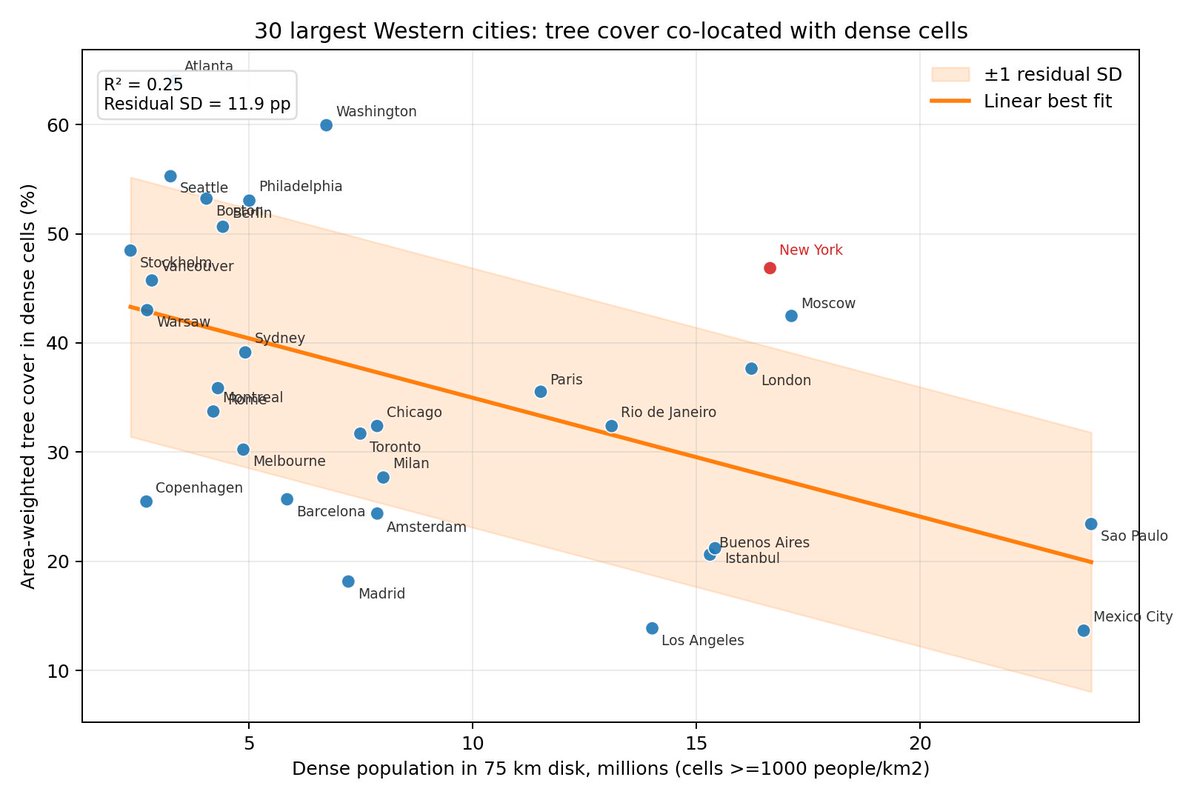
Every time I fly to New York, I'm struck by how many trees there are in the densely-populated areas around the city. (Coming from the West Coast, one arrives over the Garden State, and the suitability of the sobriquet is quite apparent from the air.) It feels like this degree of tree cover in highly populated areas is atypical (the environs of places like Paris, London, Los Angeles, Melbourne, Tokyo, etc., look very different), so I asked the LLM to investigate. It found GHSL 2020 population and ESA WorldCover 2021 10m land-cover data, and concluded that New York is in fact quite unusual. As far as I can tell, it's because of some combination of: * A very favorable climate. (Trees grow quickly without irrigation.) * Marginal farmland. (Readily outcompeted by the Midwest in the 19th century.) * Together yielding reforestation before the advent of suburbs. * And a preference for development patterns that include trees. (Japan's climate is very hospitable, but one sees far fewer trees in the populated areas around the major cities -- forest and habitation are more disjoint.)
Patrick Collison tweet media
English
53
52
773
140.5K
Patrick Collison
Patrick Collison@patrickc·
I’ve been struck by this phenomenon in much of the discussion around Hormuz. Who exactly should one listen to for systems as complex and reflexive as energy? (Evidently not IEA.) Is it even possible to make meaningful predictions for out-of-distribution shocks like strait closure given all of the second-order effects that one has to model? Are all forecasts fatally conceited?
Luis Garicano 🇪🇺🇺🇦@lugaricano

And again, and again, and again, the market proves to be more flexible and adaptable than the engineers, extrapolating, with their calculators expect. When prices change, behaviour changes. Believe in substitution, in elasticity, in human ingenuity, that is, in the market, and you will get a closer approximation than all doom-mongers. For this of course, a market must exist (e.g., does not apply to the fertility collapse).

English
77
34
617
285.6K
Patrick Collison retweetet
Luis Garicano 🇪🇺🇺🇦
Back from a German conference. Stayed at a not-cheap hotel (fittingly called "Bad Hotel"): hand towels instead of body towels, no air-conditioning in 30+ degree weather, a printed request that I skip room cleaning. I checked last night the instant electricity mix: most electricity produced was from coal. Germany has made the choice to be poor. It could have cheap, safe, abundant energy from nuclear. Instead it has chosen expensive, high carbon energy.
English
211
308
4.4K
435.1K
Patrick Collison retweetet
Samuel Hughes
Samuel Hughes@SCP_Hughes·
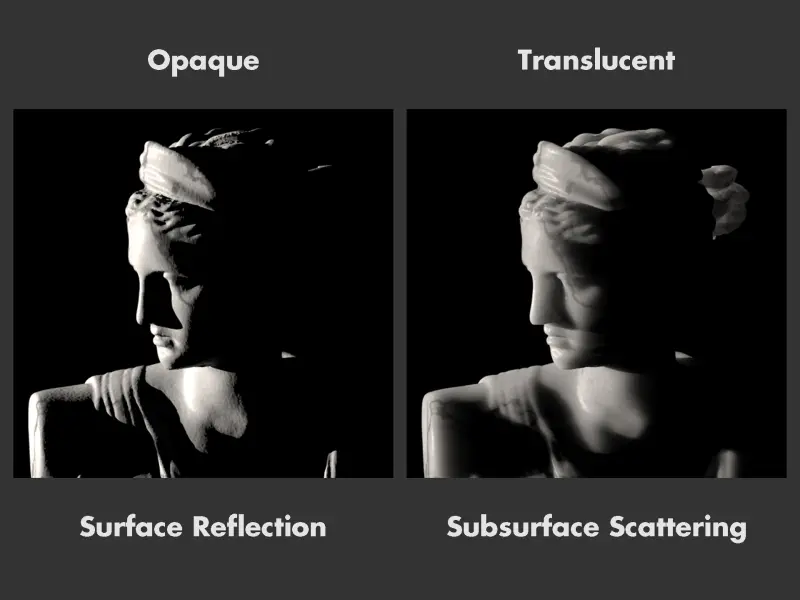
Marble has a property called 'subsurface scattering', meaning that sunlight not only illumines its surface, but a millimetre or so of its depth. This yields an effect of softness and luminosity. In the few cities in which architectural marble is common, the aggregate effect of this is astonishing. This is true above all in Washington DC. I discuss this and other impressions in my travel diary from Washington DC: worksinprogress.co/issue/a-washin…
Samuel Hughes tweet mediaSamuel Hughes tweet media
English
24
139
1.7K
153.7K
nichy
nichy@0xnichy·
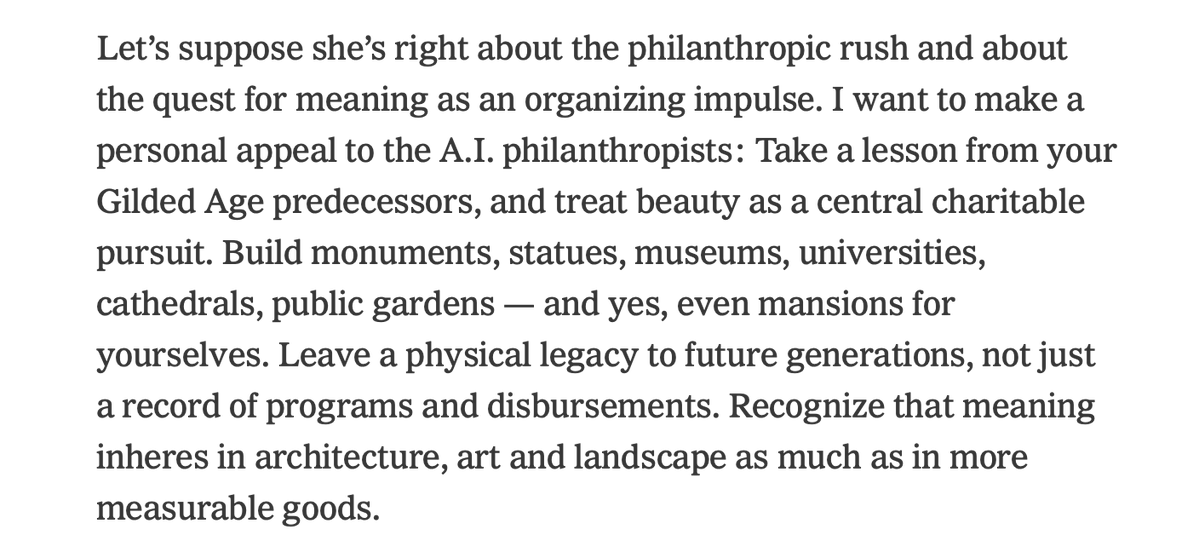
we’ve normalized funding “the future” while our cities become increasingly stripped of ornament, texture, and civic beauty. we optimized philanthropy for measurability and accidentally removed the soul from it. there’s something powerful about treating beauty as a public good rather than decoration. “meaning inheres in architecture, art and landscape.” yes. environments shape our emotional and cultural memory as much as technology does.
nichy tweet media
Patrick Collison@patrickc

Interesting @DouthatNYT on @nanransohoff's essay, @WillManidis's pieces, and (in passing) the call for New Aesthetics: nytimes.com/2026/05/23/opi….

English
5
6
33
13.2K
Patrick Collison retweetet
Luke Burgis
Luke Burgis@lukeburgis·
I was waiting for the chance to write an essay on the topic—and I will soon, because I can't wait to share some exciting details with you all—but now seems like as good a time as any to announce that I am the recipient of a New Aesthetics grant award, thanks to the generosity of @patrickc (who will be speaking with me about New Aesthetics and Life at the ZOE Conference by @ClunyInstitute in Napa this summer) and @tylercowen. In the age of Artificial Intelligence—and Social Contagion—the kind of disarming beauty that breaks through, surprises, and dislocates will be required to express the magnificence of our humanity in the 21st century. I hope to see you this summer: cluny.org/events/zoe-con…
Patrick Collison@patrickc

Interesting @DouthatNYT on @nanransohoff's essay, @WillManidis's pieces, and (in passing) the call for New Aesthetics: nytimes.com/2026/05/23/opi….

English
10
11
124
58.4K
Patrick Collison
Patrick Collison@patrickc·
Cool release from @p0. I think this use-case (agents paying content creators for access via @mpp) will be very big. Micropayment walls haven't worked (as Clay Shirky anticipated many years ago) because of human cognitive overhead, but agents can make arbitrarily granular determinations without decision fatigue.
Parallel Web Systems@p0

Today we're launching Index: a platform for content owners to understand how AI agents use their work, and earn revenue when they do. Our first partners include @TheAtlantic, @FortuneMagazine, @PRNewswire, @PitchBook, @ZoomInfo, @Tracxn, @RocketReachCo, @enigma_data, @fiscal_ai, plus creators @alexeheath, @mariogabriele @azeem, @every, and @packyM.

English
39
62
586
169.5K
Patrick Collison
Patrick Collison@patrickc·
Owing to a variety of historical reasons (including, but not only, protectionist lobbying), the U.S. is the only G7 country where regulated payments companies can’t directly access government-run settlement rails. Yesterday's EO from the White House calls for that to change. This is a very good idea. If regulated payments companies can integrate directly with the Fed, there will be less unnecessary coupling between "fractional reserve banking/leverage/maturity transformation" and "quotidian payments activity", thereby reducing overall systemic risk in the financial system. This would also establish the preconditions for more competition, more innovation, and lower fees. whitehouse.gov/presidential-a…
English
30
63
565
69.3K
Patrick Collison retweetet
Ruxandra Teslo 🧬
Ruxandra Teslo 🧬@RuxandraTeslo·
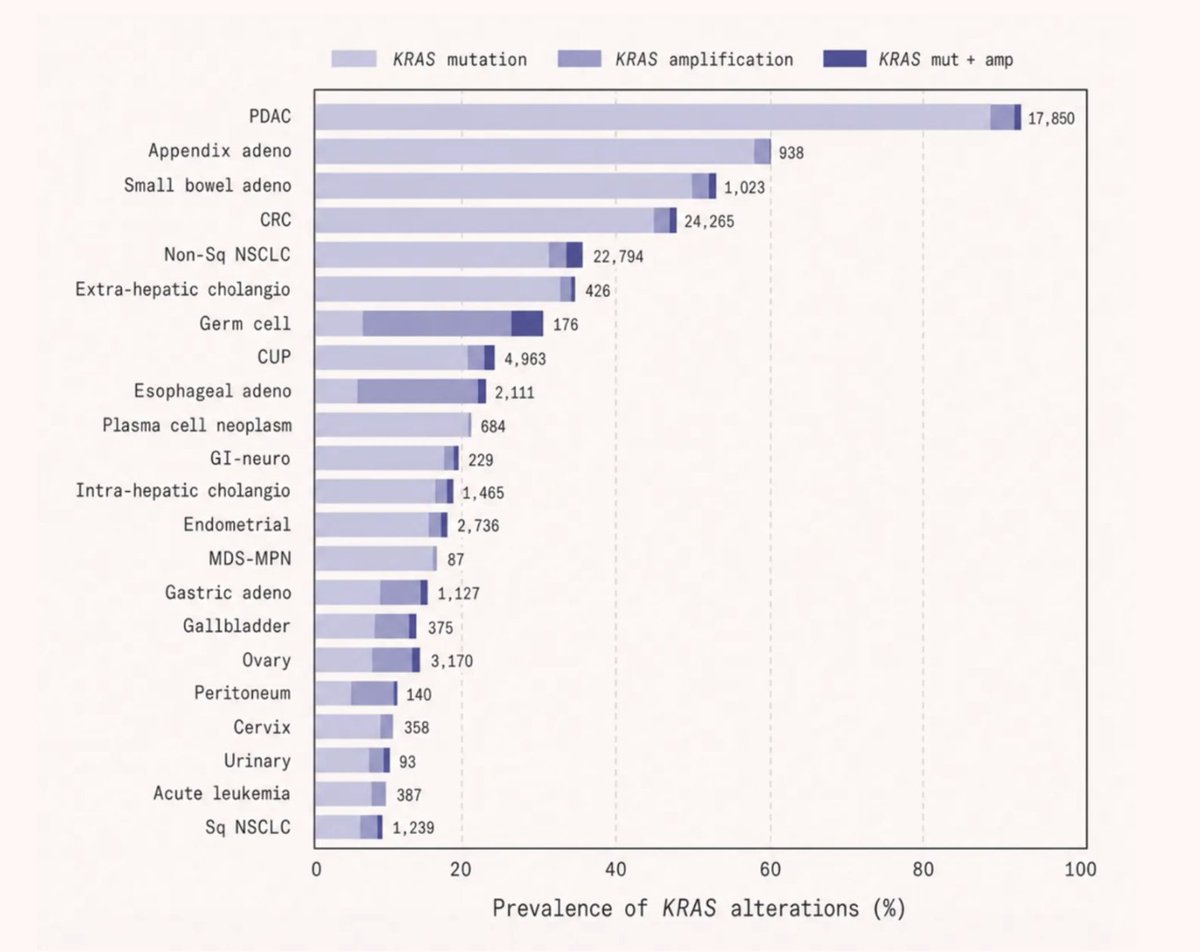
Mutations in KRAS are found in 90% of pancreatic cancers, one of the most fatal types of cancer. For decades, we could not drug the mutant KRAS protein. This has changed recently. Read more in my piece @WorksInProgMag worksinprogress.co/issue/the-slip… - Pancreatic cancer is a particularly tough cancer. - It's diagnosed late in its progression and it coats itself with tissue that block the immune system from attacking it. This makes immunotherapies, which have been revolutionary in other metastatic cancers (e.g. melanoma) ineffective against it. - 90% of pancreatic cancer have one mutated protein: RAS. This should make it easily targetable. But ... not so quick! - RAS has a property that has made it "undruggable" for decades: it largely lacks the pockets or grooves that most drugs depend on to bind and act upon their target. - Molecular glues sidestep the problem entirely. Instead of binding a pocket, daraxonrasib forces two proteins together — locking RAS in its inactive state by wedging a third protein in the way. - The result: median survival of 13.2 months vs ~6 on standard chemo. Not a cure, but a genuine doubling, delivered as a daily pill. - The implications go far beyond pancreatic cancer. RAS is mutated in lung, colorectal, and many other cancers. Molecular glues are now being developed against multiple other "undruggable" targets. The assumption that certain proteins are simply beyond reach has turned out, repeatedly, to be wrong. - The bad news is that most patients eventually develop resistance mutations that vary from patient to patient. In order to deliver a real cure, we need to rethink our regulatory system and make small-n, early stage bespoke trials much easier to run.
Ruxandra Teslo 🧬 tweet media
English
9
23
154
28.5K
Patrick Collison
Patrick Collison@patrickc·
Detroit impressions: • The downtown is full of beautiful buildings. All of them seem to have been built specifically in the 1920s. I guess that is after the city had accumulated enough auto wealth but before the twin hits of Modernism and the Depression. (I hadn't known that the GM Renaissance Center, built as a revitalization project, was at the time the largest private development in US history, and also at the time the world's tallest hotel. It may be large, but it is not pretty.) The downtown is surprisingly depopulated -- both the streets and the sidewalks feel empty. That said, it didn't feel at all unsafe. There are lots of great homes in the suburbs. • The Henry Ford Museum of American Innovation is amazing, and it's worth visiting Detroit for it alone. Among many (many) other things, it contains the oldest known surviving steam engine in the world, the actual Montgomery bus on which Rosa Parks refused to give up her seat, a deconstructed Model T, a deconstructed Eames Chair, and many great cars, agricultural equipment, locomotives, industrial specimens, and more. (They have the Lincoln Continental that JFK was riding in when assassinated -- which, apparently, was returned to service and used by several subsequent presidents.) • The museum made me wonder why American car design peaked in the mid-60s. (This fact is very evident at the museum.) The LLMs blame the 1966 National Traffic and Motor Vehicle Safety Act. (Not quite wtfhappenedin1971.com, but close.) • Good food exists but it is hard to find. • The Heidelberg Project also exists and is unique. • We stayed at the Dearborn Inn, which is wonderful, and contains cottages modeled after the homes of significant American figures. Dearborn (and Hamtramck) are now predominantly Muslim, apparently for reasons that go back a century to Henry Ford's $5 wage. Dearborn felt noticeably prosperous (we stopped for coffee at a fancy Japanese cheesecake cafe); Hamtramck did not. • Michigan.gov says that the Hispanic population of Michigan is just 6%. Coming from California, the absence is very striking. • The Detroit Institute of Arts is remarkable, particularly the room with the American landscapes and the section with the Dutch masters (especially The Visitation). An obvious question is why there is nothing quite like it in the Bay Area given how much richer the latter is than Detroit ever was -- we techies are just so uncultured by comparison. The Diego Rivera murals are amazing (and quite strange; you can see why they were controversial). • Detroit is full of historic plaques -- they are truly everywhere. This is presumably due in part to the fact that Detroit has a lot of history, but it still has many more than places with comparable historical depth. Some research suggests that it might be related to generous tax credits for historic preservation. Whether or not that is true, Detroit persuades me that other places should engage in more plaquemaxxing. • I recommend a visit! You overall leave with some sense for how exciting America must have felt in the early 20th century.
Patrick Collison tweet mediaPatrick Collison tweet media
English
163
116
1.7K
496.3K
Patrick Collison
Patrick Collison@patrickc·
Other images of the lobby.
Patrick Collison tweet mediaPatrick Collison tweet mediaPatrick Collison tweet media
English
24
18
409
39.6K
Patrick Collison
Patrick Collison@patrickc·
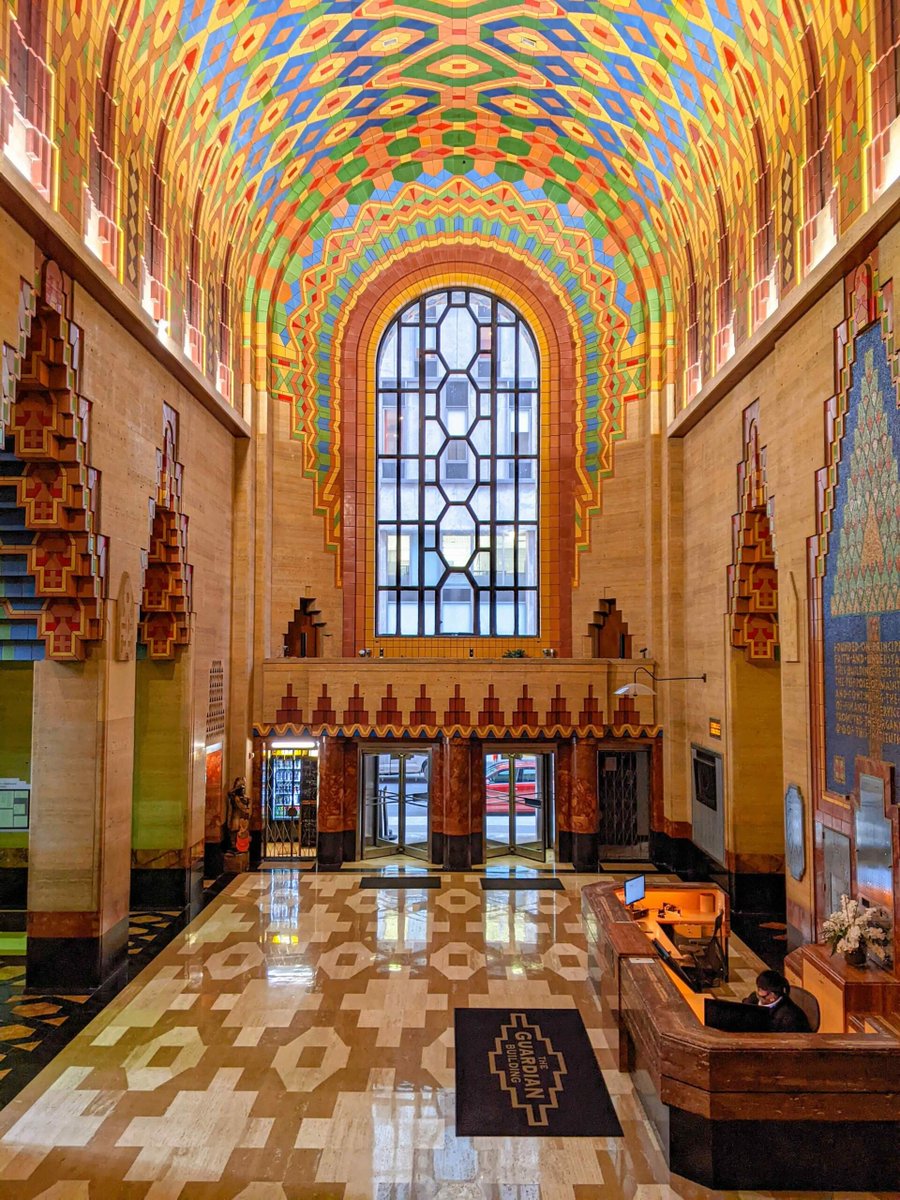
Spotted in the lobby of the Guardian Building in Detroit. Compared to today's more common "financial services", "financial service" is quite evocatively different. The Guardian Building was built for the Union Trust Company in 1929 and I think it is my favorite of the Detroit skyscrapers. The lobby is quite strikingly weird -- a good reminder of how strange a lot of 1920s aesthetics were.
Patrick Collison tweet media
English
35
45
850
162K
Patrick Collison retweetet
Ruxandra Teslo 🧬
Ruxandra Teslo 🧬@RuxandraTeslo·
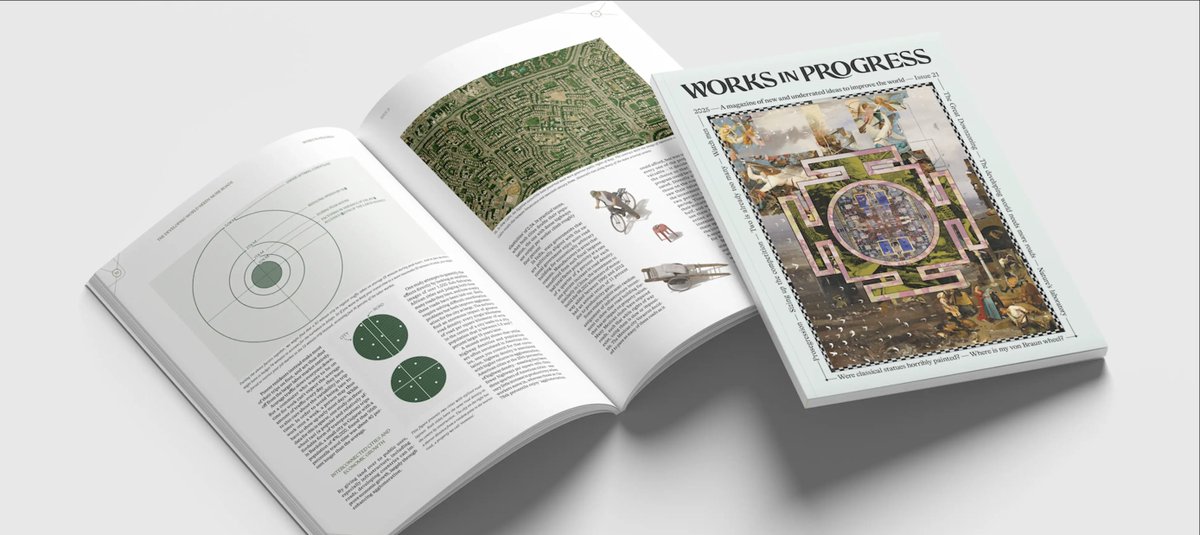
Thrilled to announce I'm joining @WorksInProgMag and @stripe to continue my research and writing on clinical trials & biotech innovation, with many more articles to come. (If you haven't already, subscribe to the magazine. It's great in terms of content and very beautiful.) My work is driven by a core conviction: in the years and decades ahead, we will be far more constrained by the quality of our culture and institutions than by technology itself. In biology, a remarkable convergence is underway. AI, alongside a wave of other emerging tools, is fundamentally expanding what science can do. But beneath this sizzling potential, something is going wrong in Western biotechnology. China is pulling ahead and companies are increasingly moving clinical trials there, drawn by faster clinical trial timelines and a more dynamic ecosystem. Promising therapies sit in limbo for years. Despite the science being here, personalized cancer therapies are not viable to anyone but a few who can afford to navigate the labyrinthine regulatory apparatus. And pharmaceutical R&D productivity has remained stubbornly flat in the last 10 years, after decades of decline. And I can't imagine a better home for my research and writing on what can be done to accelerate biomedical progress than Works in Progress. This is a magazine that has published some of the most important writing on why the physical world has stopped working, including "The Housing Theory of Everything," which became one of those rare pieces that actually changed how people think about a problem. But this is not just about my desire to study biotech innovation. Biotech is not an anomaly. The same pattern: technology outrunning the institutions meant to govern it, is playing out across society. And now AI is compressing the timeline, accelerating pressures that were already straining the system. When people ask what I worry about when it comes to AI, I tell them it’s not the usual things. I'm not losing sleep as much over AI taking my job. I am more worried that we will lose our appetite for depth and that long-form thought, serious reading, sustained attention, the very things that make culture worth having, will erode faster than we notice. That our collective intelligence will hollow out, gradually. And the very problems we have now will only accelerate. @WorksInProgMag is a resistance movement against that, condensed in the form of magazine. It stands for long-form, in-depth writing. It stands for beauty. It is fundamentally anti-slop. In that sense, it's a natural fit with @stripe. A payments company publishing a magazine might seem like an odd pairing. That is, until you understand what kind of payments company @stripe actually is. It has always been driven by a genuine passion for craft and for getting small things exactly right. I am really proud to be part of something that embodies my own values in such a deep way, especially at a turning point in history.
Ruxandra Teslo 🧬 tweet media
English
52
45
748
91.9K