Mark Guindi

26.2K posts

Mark Guindi banner
Mark Guindi

Mark Guindi

@markguindi

Instagram- @markguindi DFS: Guindi989 - https://t.co/2aqxF7kcPq

New York Beigetreten Temmuz 2010
1.4K Folgt1.2K Follower
Mark Guindi
Mark Guindi@markguindi·
What we witnessed in the NBA since Thursday night is cringeworthy. Hawks Orlando last night 2nd half Rockets Celtics tonight How can NBA teams deep in a playoff series not have any offense? What are we witnessing? This is why regular season shot selection can’t just be analytics.
English
1
6
77
62.5K
Pythia Cap: Partially Conductive
People losing sight $NVDA
Pythia Cap: Partially Conductive tweet media
Gavin Baker@GavinSBaker

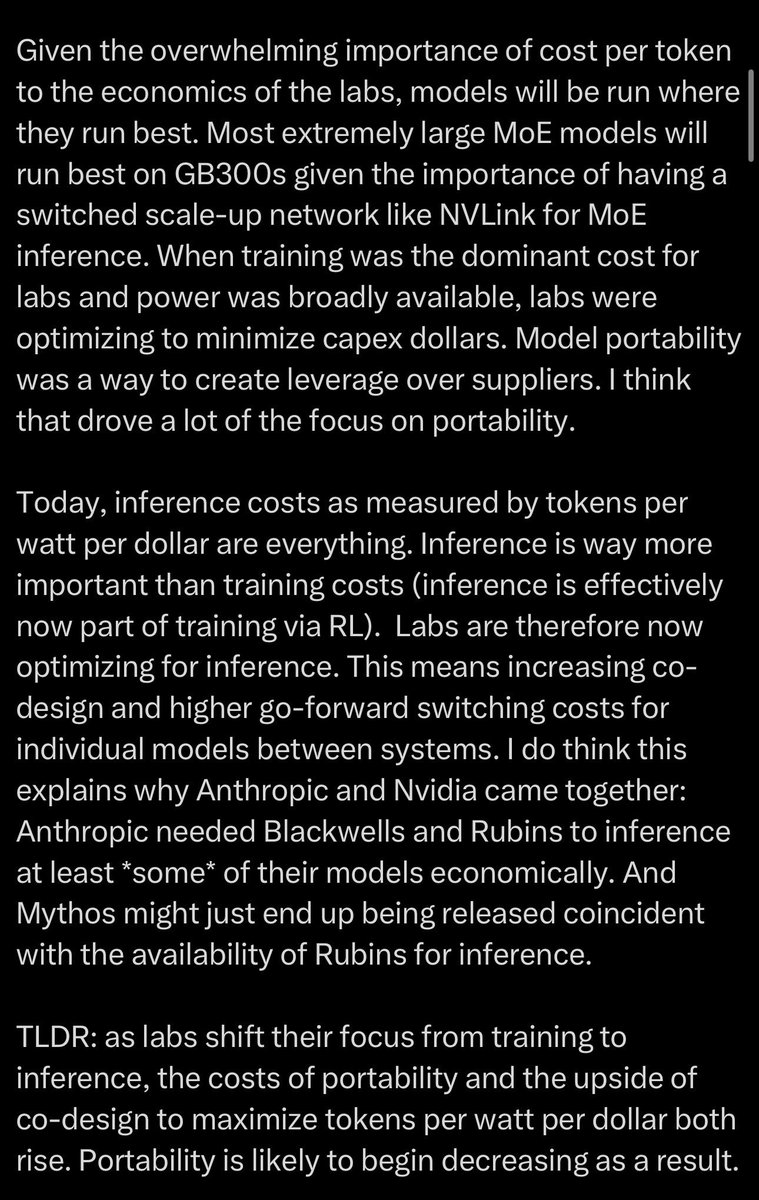
Much of Dwarkesh's argument hinges on this statment which *was* accurate but will be increasingly inaccurate on a go forward basis imo:    “American labs port across accelerators constantly. Anthropic's models are run on GPUs, they're run on Trainium, they're run on TPUs. There are so many things you can do, from distilling to a model that's well fit for your chips.”   As system level architectures diverge (torus vs. switched scale-up topologies, memory hierarchies, networking primitives), true portability is eroding. The Mi300 and Mi325 had roughly the same scale-up domain size as Hopper while Blackwell’s scale-up domain is 9x larger than the Mi355 scale-up domain, etc. Many frontier models are now being explicitly co-designed for inference on specific hardware like GB300 racks. Codex on Cerebras is another example. Those models run less efficiently on other systems and the performance differentials will only widen. A model that runs well on Google’s torus topology will run less efficiently on Nvidia’s switched scale-up topology and vice versa - the data traffic is fundamentally different as a byproduct of the models being parallelized across the different topologies. Google’s internal teams - and increasingly the Anthropic teams as they become the most important customer of almost every cloud - have the luxury of operating across the stack (models, chips, networking) - but that is not the case for the rest of the market and other prospective users. Anthropic is the exception, not the rule. To wit, Anthropic and Google allegedly have a mutual understanding where Anthropic can hire the TPU engineers they need every year to ensure that they can continue to get the most out of the TPU. Given the overwhelming importance of cost per token to the economics of the labs, models will be run where they run best. Most extremely large MoE models will run best on GB300s given the importance of having a switched scale-up network like NVLink for MoE inference. When training was the dominant cost for labs and power was broadly available, labs were optimizing to minimize capex dollars. Model portability was a way to create leverage over suppliers. I think that drove a lot of the focus on portability. Today, inference costs as measured by tokens per watt per dollar are everything. Inference is way more important than training costs (inference is effectively now part of training via RL). Labs are therefore now optimizing for inference. This means increasing co-design and higher go-forward switching costs for individual models between systems. I do think this explains why Anthropic and Nvidia came together: Anthropic needed Blackwells and Rubins to inference at least *some* of their models economically. And Mythos might just end up being released coincident with the availability of Rubins for inference. TLDR: as labs shift their focus from training to inference, the costs of portability and the upside of co-design to maximize tokens per watt per dollar both rise. Portability is likely to begin decreasing as a result.   I think what I might have respectfully added to Jensen’s answer is that systems evolve under local selective pressures. The evolutionary pressure in America is a shortage of watts so it makes sense for Nvidia to optimize, as an American company, for power efficiency and tokens per watt and stay on copper as long as possible. China has a surfeit of watts. Chinese AI systems are already taking advantage of this with the Huawei Cloudmatrix 384 and Atlas SuperPoD having an optical scale-up domain that is much larger than anything offered by Nvidia today at the cost of *much* higher power consumption and much lower tokens per watt. The networking primitives for this Huawei system are very different than those for Nvidia’s systems and a model that runs well on Nvidia will not run well on that system and vice versa. This means that if a Chinese ecosystem gets momentum, Chinese models might stop running well on American hardware. And when Chinese models run best on American hardware, America is in a better position as this gives America a degree of leverage and control over Chinese AI that it risks losing to an all-Chinese alternative ecosystem.   This architectural fork makes porting and distillation less effective and strengthens the pro-American national security case for selling China deprecated GPUs imo. Also I will attest that I did not wake up a loser this morning.

English
4
4
121
33.5K
Neal Mohan
Neal Mohan@nealmohan·
Today, we’re officially launching fully customizable multiview on @YouTubeTV. Our @youtube teams made one of our most popular features even better. The new multiview builder gives you full control to mix and match live streams (including add-ons like @nfl Sunday Ticket), and build the personalized viewing experience you've been asking for.
Neal Mohan tweet media
English
563
419
7K
2.4M
Deep Sail Capital
Deep Sail Capital@DeepSailCapital·
For $CRDO to equal $LITE in terms of appropriate valuation for the assumed growth, $CRDO needs to get to $400 a share or $LITE needs to drop to $450 a share per ChatGPT.
English
5
1
14
10.5K
Mark Guindi
Mark Guindi@markguindi·
It's time to start blaming the star player. Brunson has to be better. All that dribbling all the time is not going to work, and it is the reason the #Knicks lost in the playoffs the last 2 years as well.
English
0
0
3
125
Mark Guindi
Mark Guindi@markguindi·
Listen to what SK Hynix is telling you after earnings. This is more true than ever. HBM related demand will be way higher than supply, even with new capacity coming online. And the shortage will last through 2028 and beyond. @GavinSBaker this was a fire post !!!!
Gavin Baker@GavinSBaker

HBM DRAM > DRAM > NAND from a long term undersupply (longest to shortest) and China risk (lowest to highest) perspective. The equities have traded exactly the opposite way this year. Good post by @itsDanielWu

English
0
0
0
73
Serenity
Serenity@aleabitoreddit·
Cerebras soon to IPO at $35B+ valuation. This is the holy grail of OpenAi contagion. -> $8.1B valuation few months ago -> Sam Altman hints at $20-30B deal over 3 years. -> $23B valuation. -> Now it’s $35B+ to the public. If OpenAI promises $BIRD $5 trillion in orders, does it suddenly make it a $6 company? Might be fine for a year… but this is not going to end well if OpenAi goes down.
Serenity tweet media
English
69
40
821
151.1K
Mark Guindi
Mark Guindi@markguindi·
@GavinSBaker @Atreidesmgmt Awesome! Great insight and post! Thank you and best of luck! We learn a lot from you. Hopefully I can return the favor during fantasy football season
English
1
0
2
1K
Gavin Baker
Gavin Baker@GavinSBaker·
Nice to see Credo acquire @atreidesmgmt portfolio company DustPhotonics. Great team, great company.   Dust designs photonic ICs (PICs) and engines that are foundational to Silicon Photonics. Silicon Photonic pluggables integrate multiple optical functions – traditionally implemented with discrete components – into a single component called a PIC. This saves space and power while improving scalability.     Perhaps most importantly, PICs can feed multiple optical lanes with a smaller number of lasers, relative to traditional approaches typically requiring a discrete laser for each lane (e.g., 8x200G lasers for a 1.6T module). Timely given we are heading into a severe shortage of lasers. Please note that there will still be a laser shortage even if Dust’s PICs are broadly adopted.   Thermal and power-density limitations for pluggables will also eventually make adding more and more lasers impractical.  Silicon Photonics and PICs essentially create another axis for scaling bandwidth. And obviously, long-term, Silicon Photonics is essential for CPO.   PICs feel similar to RF in the early days of cellular - quite a bit of black magic. There are only a few companies successfully supplying datacom PICs today at scale – Dust is one of them.     Ronnen and team have been excellent operators and partners, and their products are well respected across the datacom ecosystem. Over $500m in optical revenue for Credo is material and I do think HyperLume was a smart bet for them - starting to hear more positive feedback about MicroLEDs from our venture portcos and the hyperscalers. Copper, CPO, Pluggables, MicroLEDs should all win for the foreseeable future in different applications in different hyperscaler networking topologies: networking is taking huge share of the datacenter BoM everywhere.   Coherent training clusters are increasing in size to enable ever larger models. A larger coherent cluster is much more networking intensive. And then the larger models trained on these larger clusters require larger switched scale-up domains to inference economically, which is again more networking intensive. Rubin and Trainium 4 will have much larger switched scale-up domains and we may need these systems deployed at scale to enable the broad availability of 10 trillion plus parameter models like Mythos. Networking, especially switched scale-up networking, should be the fastest growing part of the datacenter for the next several years.   Switched scale-up networking (almost all copper with some optical beginning late next year) > scale across (optical obviously) > scale-out (first place for CPO) from a growth perspective next 3 years imo. We will be using copper well into the 2030s and somewhat ironic that the growth of optical is likely to drive accelerated growth for copper in the near term relative to the strange zero-sum thinking I occasionally see here and in some sell-side notes.
English
26
33
499
124.9K
Gregory, FTA
Gregory, FTA@gregory_FTA·
The truth is, if you're a technical trader, right now you should be glad to see a pullback after a rally like that. $NBIS $MRVL $AMKR $AVGO $INTC $AAOI $AMZN $ONTO $CLS $COHR $KLIC $BE $AMD $AEHR $ANET After scanning nearly 200 weekly charts (with my eyes) here are 15 names that stuck out in my view, showing relative strength, signs of market leadership, and bullish chart structure. There are others, but this should give you plenty to study. One of the simplest, yet most effective ways to win in the market is to wait for pullbacks to buy names that have been showing RS (relative strength). Learning to recognize bullish chart structure and relative strength is best learned by looking at thousands of charts over time.
English
4
5
48
6.9K
Mark Guindi
Mark Guindi@markguindi·
@pmarca I agree, however, we just need to really stop all the fraud, bad public safety policies and fix issues hurting our biggest cities. As bullish as we are on the United States, these are plummeting quality of life for many great people
English
0
0
1
683