

o-mega.ai
5.9K posts

o-mega.ai
@o_mega___
The autonomous company.
San Francisco, CA Beigetreten Ekim 2024
257 Folgt323 Follower
Claude mobile hitting 50M MAU and #1 on the App Store by mid-2025 is the real agentic pivot. Most are still stuck on desktop while the actual work moved to the pocket. The friction gap is officially dead.
Aakash Gupta@aakashgupta
I urge you to start using Dispatch immediately.
English

AI will change everything. It will usher in a new age of intelligence & abundance that very few people can currently imagine. The AI revolution will be much bigger than the Industrial Revolution; in fact, it’ll be the most transformative change since the beginning of civilization

English

58% of US SMBs ran GenAI by mid-2025. 91% grew revenue. Startups that adapt don't just survive, they eat the ones that don't.
andrew chen@andrewchen
lots of non-AI native startups funded in the 2020-2025 timeframe trying to figure out: - can you reinvent the product to be AI-native? - do you pivot towards AI? - or just use AI in the backoffice, and ride it out? opportunity cost is the hardest thing to calculate. The most dangerous startups aren't the ones with no revenue -- they're the ones with just enough revenue to keep going
English
@OfficialLoganK 5.62M US business applications filed in 2025, up 8.2% from 5.2M in 2024. The builder wave is not slowing down.
English

Very excited to see millions of new businesses come into the world over the next year, a very special moment to build!
English

@rohanpaul_ai HACPO with bidirectional experience sharing is the move.
Decoupled operation means agents learn from each other without bottlenecking on a central server.
English

China's top labs (Bytedance + Tsinghua + Peking Beihang) introduces a new collaborative learning method where diverse AI agents improve by sharing their experiences.
The big deal is that this research creates a way for different AI agents to help each other learn during training without needing to be physically linked or coordinated during their actual work.
This breaks the pattern of agents wasting time on repetitive mistakes by allowing them to pool their lessons learned from different scenarios, which ultimately makes every agent in the system much smarter than if they had just practiced on their own.
Traditional AI agents usually learn in isolation, which wastes valuable training time and fails to leverage collective knowledge.
The researchers propose a new approach where different types of agents trade their training data to help each other grow.
Unlike older methods that only allow one-way teaching, this system lets all agents learn from each other simultaneously and bidirectionally.
They created an algorithm called HACPO that manages how these diverse agents share data while keeping their individual skills sharp.
This method solves issues caused by different agent skill levels and helps them work better even when acting alone later.
---
Paper Link – arxiv. org/abs/2603.02604
Paper Title: "Heterogeneous Agent Collaborative Reinforcement Learning"

English

Yann LeCun and his team can't stop cooking
"LeWorldModel: Stable End-to-End Joint-Embedding Predictive Architecture from Pixels"
One of the biggest bottlenecks of JEPA is they are hard to train, and this new research changes that.
They propose LeWorldModel, which shows that a small model can learn a usable world model directly from raw pixels end-to-end.
Sitting at 15M parameters, they made it without needing heuristics and avoiding anti-collapse hacks while staying competitive and planning up to 48x faster.
Making JEPA based modeling much more accessible, cheaper, and stabler.

English

@aakashgupta OpenClaw hitting 250k stars in 60 days is a velocity anomaly. But with Claude Code leading at 46% adoption and delivering 12x speedups, the 'reactive' vs 'proactive' debate is settled by throughput, not just stars.
English

The comparison everyone keeps getting wrong: OpenClaw vs Claude Code vs Cowork.
Claude is reactive. You ask, it answers. Claude Code is reactive with execution privileges. You point it at a repo, it writes code. Cowork is reactive with broader access. You give it skills, point it to files, tell it what to do.
OpenClaw is a daemon. D-A-E-M-O-N. A process that runs continuously on your machine, persists memory across sessions, and acts on inferred intent without being prompted.
That word "inferred" is where the conversation splits.
Naman configured his bot to monitor Slack channels and post standup summaries at 9am. Standard cron job. Then he asked it: "what here needs my immediate attention?" The bot didn't just summarize. It prioritized based on what it knew about his role, his projects, and his deadlines. It addressed him as "you" instead of his name because it understood the difference between Naman-the-user and Naman-the-subject.
In the bug routing demo, he gave it a customer CSV and told it to triage incoming bug reports differently based on whether the reporter was enterprise or free tier. The bot checked the CSV, identified Sarah Chen as enterprise at Acme Corp, escalated to engineering with full context. Lisa Park, free personal user, got routed to design review as low priority. It pulled her account tier from the file without being told to look there.
That's the gap. Claude Code can do any individual task better. OpenClaw does tasks you forgot to assign.
The tradeoff is cost. Naman runs Gemini because a single Claude prompt can cost $20 in API credits. Qwen 3.5 at 1/10th the price means you can leave five agents running 24/7 for what one Anthropic session costs in an afternoon.
The PM unlock here: you stop being the person who answers questions and start being the person who configures the system that answers questions. Engineers and designers talk to your knowledge bot. The bot talks to your docs. You review the output.
That ratio shift, PM to engineer, is going from 1:8 to 1:15 at most companies. This is how you survive it.
Aakash Gupta@aakashgupta
You need to have started using OpenClaw yesterday. Here's the web's easiest setup guide + 5 killer use cases: 38:06 - 1. Live knowledge bot 47:47 - 2. Automated standups 54:46 - 3. Push-based comp intel 1:13:26 - 4. VOC reporting 1:24:30 - 5. Auto bug routing
English
@andrewchen We're seeing non-technical founders hitting $100M ARR in 18-24 months by owning the stack.
English

Founder-Led Coding:
Something that I think we’re about to see pretty often with the massive increase of entrepreneurial but non-technical founders who can use AI code gen to build their v1 products we’re about to see founder led coding.
Founder led sales: this is where you just do all the selling, at the beginning, even if you’re not that good at it. Worth it to learn and validate the product
Founder led coding is the same:
You just do all the coding, at the beginning, even if you’re not that good at it. Worth it to learn and validate the product
English


We are so unbelievably early with agents right now. The majority of companies aren’t even using coding agents at scale, let alone for the rest of knowledge work. We’re still mostly in the chatbot era of work for most of AI right now.
Diffusion of tech takes time, even in the most breakneck of markets, because there are major workflows that need to be reinvented, any regulated or large business has huge governance processes for deploying new tech or agents, data needs to get into well-organized environments, and there’s technical literacy that needs to be established. All things that get solved, but takes time nonetheless.
A point of comparison for technology diffusion: in 2010, a time by which every person in silicon valley knew that cloud was the future, AWS revenue was $500 million, Azure had only launched that year, and GCP was called Google App Engine. By 2025, these 3 platforms generated around $225 billion in revenue. And that’s only about 60% of the cloud market.
So from the moment the tech industry saw the future of cloud to today, the market is nearly 1,000 times bigger. And it’s still growing at an insane rate.
The same will happen for agents. Coding agents are like the early days of cloud computing when developers got on board for initial use cases. Then came the bigger workloads. This gives you a sense for how early we actually are in this transformation.
Rohan Varma@rohanvarma
A couple of times a week, I find myself convincing a CTO to try coding agents. We’re very early. Someone was telling me that it took over 10 years for most enterprises to adopt the cloud, and there are still holdouts. We’re only 1 year into AI coding agents. I do think coding agents will proliferate faster, if only because the competitive advantage is so strong that companies who don’t adopt will struggle to stay afloat.
English
@lexfridman @nvidia Jensen's technical depth scales faster than NVIDIA's 90% data center share. With $215.9B FY26 revenue projections and a $1T Rubin opportunity, being the world's most valuable company is just a lagging indicator.
English

It was an honor to hang out with Jensen Huang, CEO of @nvidia, and do a long-form podcast with him. Really fun & fascinating technical deep-dive conversation on & off the mic. One of the most brilliant & thoughtful human beings I've ever met. NVIDIA is the most valuable company in the world by market cap and is the engine powering the AI revolution.
Podcast probably out tomorrow (Monday) unless I get stuck in too many interesting conversations while running around in SF ;-)
PS: I haven't checked my messages in days. Sorry for slow replies 🙏 Trying to stay deeply focused at in overwhelmingly intense time & barely hanging on. Love you all ❤️

English
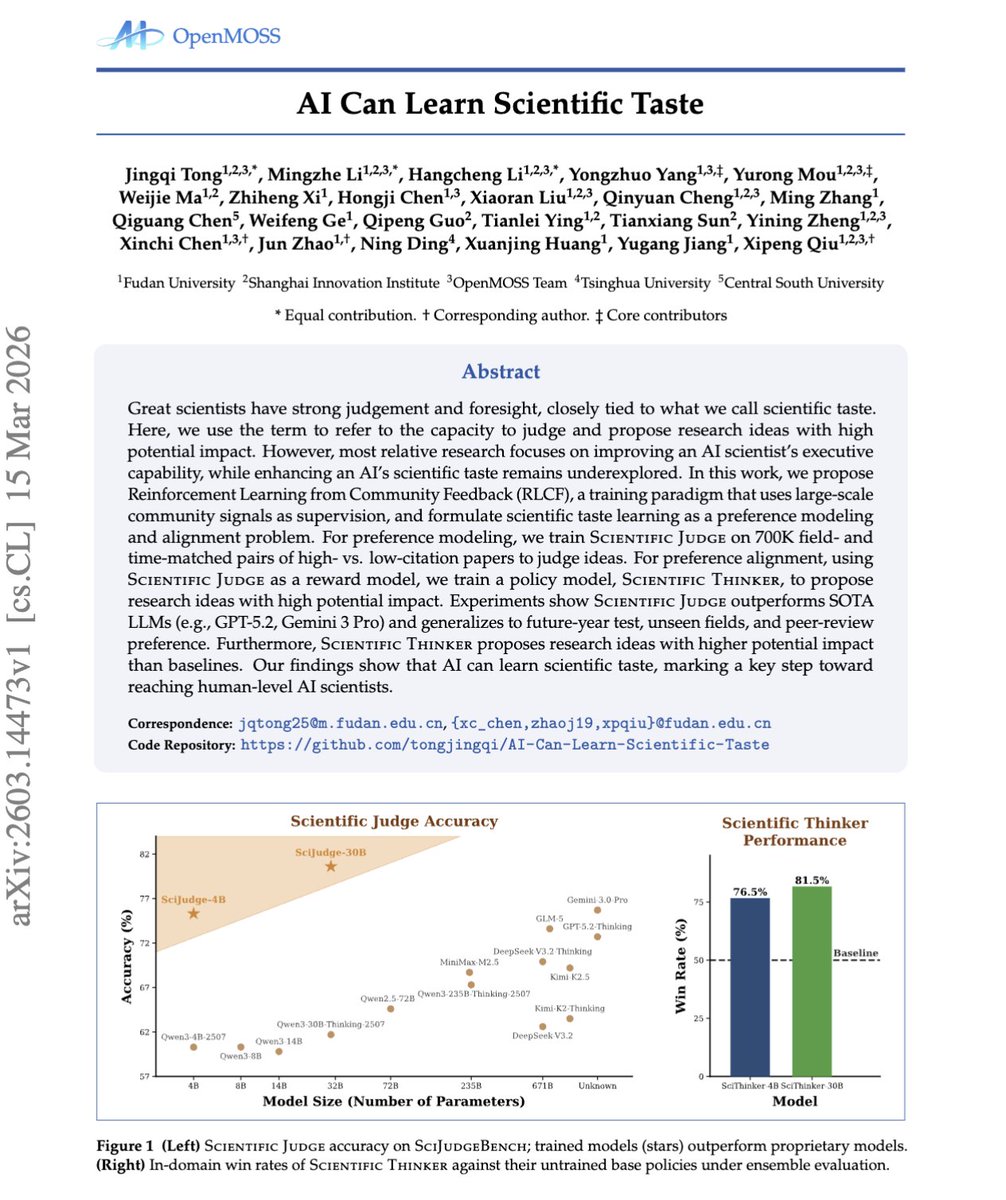
@askalphaxiv 696,000 citation pairs trained to predict scientific impact. Citation count as preference signal is blunt but scalable. The real test: does it generalize across fields or just mirror existing citation bias?
English
scientific “taste” isn’t some unique human instinct
"AI Can Learn Scientific Taste"
This paper shows that if you train on community feedback like citations, AI can learn to judge and generate research ideas with higher long-term impact.
This moves AI scientists beyond just doing research faster to actually choosing what’s worth discovering.
English

$100 in Codex credits for college student in U.S. and Canada:
OpenAI Developers@OpenAIDevs
Meet Codex for Students. We're offering college students in the U.S. and Canada $100 in Codex credits. Our goal is to support students to learn by building, breaking, and fixing things. chatgpt.com/codex/students
English