
Angehefteter Tweet
Alexander 'Lex' Williams
70.4K posts


Alexander 'Lex' Williams
@squidlord
Author, game geek, curator. Irritant. pilin ike li ken. pilin monsuta li wile.
Lawrenceville, GA Beigetreten Şubat 2007
452 Folgt932 Follower

Actually, I'm going to let you in on a little secret: we fucking love to shame other disabled people for not being able to do what we've done. In fact, it can be one of our primary motivators.
You might think of it as pride. Sometimes it's as raw as spite, but we do fucking love it.
And I'd thank you not to speak for me.
English


Larper: "tElL thAt tO thE dIsAblED!!"
Meanwhile the actual disabled:
Starlight Moondust@StarNMoon2000
@Ser_I_Krem @WVojakk "Video games are meant to be PLAYED" Yeah, tell that to the poor and disabled, buddy.
English
There is an obvious counter-argument that runs thus: So you'd rather not have fun?
That is a legitimate counter to your assertion. If the people at the table are having fun, they are literally doing it right. That's no kind of weaponization against critical thinking, skill, discipline, or exercise. I challenge you to pitch to people that you are going to have a stable, long-lasting campaign, but the players aren't going to have fun. Nobody's going to buy into that. Nobody wants to. It would be a terrible pitch. I think you know that.
Real longevity comes from people coming to the table and having fun. It doesn't matter if they're having bad wrong fun in your opinion. As long as they're having fun, they're going to show up every week. For you, fun may be fickle. For the people who are having fun, it's obviously not.
No amount of adamant stomping your feet and declaring that they're having fun in the wrong way. Just because they're having fun today doesn't mean they're going to have fun tomorrow is going to be persuasive, and it never has been.
Having fun today takes skill, best practices, critical thinking, discipline, and the ability to exercise it. But if they are having fun, they're doing it. It's that simple.
English

This is true. The meaning of “if you’re having fun you’re doing it right”, which is harmless taken at face value, has been weaponized over time as some sort of inoculation against the critical thinking, skill, discipline and exercise needed to develop the long term techniques and strategies that make for stable games and long-lasting campaigns.
Scutifer_Mike@micpewpew
D&D groups fall apart because of one absurd lie: “As long as everyone’s having fun, you’re doing it right.” But fun is fickle. It vanishes overnight. Players stop showing up. Real longevity demands skill, best practices, and Winning Secrets. Fun isn’t the metric. Mastery is.
English
I feel like this sort of thing is exactly what Session Zero exists to make never happen. You make sure that everybody's on the same page about why you're here and why the group's together and what you're going to be doing before you step out the door. If a character, for whatever reason, decides they want to go into slinging souvlaki rather than go into the keep on the borderlands—an idea which might actually be the smarter of the two—then it should be rooted in what the characters have been doing up to that point. It shouldn't come as a surprise to anyone.
I can certainly imagine a dozen ways in which that could play out and the player not be a dickhead. Characters change. They get affected by what happens. Theoretically, the fiction leads the mechanics, and it's not just an exaggeratedly slow game of Rogue.
I'm not going to say, "I don't think this ever happened," because I've met gamers over the decades and I know a surprisingly large portion are complete idiots and no small part assholes, but I'm going to say that it's a straw man argument because it's less likely to happen to you than your chicken nuggets that you just picked up from Chick-fil-A being made out of alligator in a wild manufacturing mishap.
If there are instances of players usurping games, and there are, it's generally not because their characters decided to dip out on the current top-down imposed plot. Usually it's narratively the opposite, the fictive equivalent of Leroy Jenkins.
(And this leaves aside entirely the question of whether or not if you can't say "no", do you actually have agency.)
English

John Cyrano is right on the mark here. There is a huge difference between making decisions in game and usurping said game.
John Cyrano@John_Cyrano
On the subject of player agency. I am MOSTLY all for it. But if you're all set up to play Keep on the Borderlands, and one player decides his character's greatest desire is to open a shawarma stand right now, he's a dickhead and should be treated as such. It's a game of heroic fantasy. If you're not here to do heroic shit, get out.
English
@gnomedepot Some married people pick fights with dragons, mainly in two cases. Firstly, if they no longer want to be married. Secondly, if they're married to the dragon.
English

NPC 1: Do you see those adventurers over there fighting that Blue Dragon?
NPC 2: Oh it isn’t going well for them.
NPC 1: Do you think any of them are married?
NPC 2: Nah. Married people don’t pick fights with dragons.
English
This is certainly a take. A shame that it doesn't have anything to do with reality or the history of the hobby, but it's certainly words made of murdered electrons cast into the void of the internet. So it has that going for it.
People love generic systems. In part, people love generic systems because they are easy to tinker with and customize for specific genre or setting modifications.
The reason that Savage Worlds doesn't get talked about much is because it doesn't publish much. For a while, it seemed to be all that the people between really traditional Fantasy Kitchen Sink and hardcore story games would talk about. That was a period of several years. There are still really hardcore Savage World fans, and I understand. I don't share it, but I understand. It is a very hackable core, just like GURPS and Hero before it, like Unisystem alongside of it, and like a ton of other mechanical cores along the years.
Hell, at this point, I think there's a reasonable argument to be made that D&D itself qualifies as a universal rule system, given how many times it's been twisted and mutilated into doing any number of things which the original designers of the core mechanics never dreamed of. Most of which were unsuitable, but they were done anyway.
D20 Modern was an abomination, and I don't care who hears me say it.
Night Danger@WithNightDanger
Universal rule systems annoy people. If I want to do a genre I want the mechanics to support and incentivize that.
English
That is why you try a multitude of things. Not all of them will work with the crew that's there. Some of them will require cultivating a crew for it once you have some people who have some trust that you are going to follow through on a regular basis.
First you do to prove you can, and then you get interest. It might be for one person, it might be for two people, it might be for three people, it might be for five people. It doesn't matter. First you have to prove that you can deliver before you really start getting traction.
Have you asked around there to find what people actually do want to play? Not necessarily so that you can run it, but so that you can have a general idea of what genres, styles, and modes they're interested in.
Frankly, you would have almost no luck convincing me to play in an old school game in the kitchen sink fantasy mold. I suspect that the people who want to play that are already in that because it's very easy to find. Those are not the people who will show up regularly to a game night at a friendly local gaming store. They're already in a game night. You need to find what people want to do and are interested in tinkering with. Maybe it'll be a one-off, maybe it'll be a short arc, maybe it'll be a long-form campaign, but you can't plan for that.
English

@squidlord That's interesting. The biggest issue, I think, will be getting people interested. I've tried twice to get people to look at old-school, and it's only been a few of my Warhammer friends and my wife who have shown any interest at all (we are playing Castles & Crusades now)
English
If my LGS moves stores, we might have a dedicated TTRPG game room. If that's the case, I might just try to do a full open table, whoever shows up plays campaign to make good use of it.
No idea what system I'd use, but I am getting Castle Zagyg part 1 🤔🤔🤔🤔
English
Here's the problem. While I appreciate the entirety of that thread and don't disagree with it, that has nothing to do with story gaming, which is an actual thing, and not just a random slur that gets tossed around by people who have never played anything but D&D over the last 30 years. It's hard to imagine that it has an independent existence, and yet here we are.
All those things are actually true of narrative-first and fiction-forward game designs as well, and usually dealt with directly in the text of the game. Hell, pick up a copy of Blades in the Dark, probably one of the most succinct and straightforward fiction-forward RPG designs of the relatively early era. It's full of discussion about how to avoid those pitfalls and to let the game be led by the players and what the characters actually want and pursue.
But you wouldn't know that unless you had actually read it, or at least shown vague interest since it was published in 2017.
But if you were really on top of things, you would know that those things have been real discussions, active discussions in tabletop RPGs, even before story gaming became a term of art. If we really want to, we can go back to the original publication of Ars Magica in '87, which talked about all of those elements alongside troupe-style play.
Or if you want something even more extreme and less spoken about, Prince Valiant in 1989, which was very verbal about encouraging the storyteller to hand narrative control over to the players, letting them frame scenes and invent details about the world on the fly.
Sure, we really start seeing the term story gaming enter the lexicon of tabletop RPGs around 2000, which is where things really start getting fiction forward and narrative. This is also where the longtime D&D players aggressively stated their disinterest in everything related to story games and doubled down on scenario play and DM centrism.
If it seems like people who have been into story games are a little touchy about the dismissive attitude and deliberate painting of anything but a railroad-heavy, scenario-focused playstyle, as seen in the vast majority of D&D over the last 50 years, realize there are good reasons.
These are old discussions that we've been over for longer than many of the people involved in them have been alive.
Ironically, and I mean this with all the venom that remains unstated, all the talk about "railroading" comes from the traditional game architecture side of the house. It doesn't come from story gaming, for the most part, when you stop putting the GM at the center of the table and sometimes remove them from the table altogether, railroading doesn't happen because the fiction flows in the other direction and the fiction comes first. By that I mean it's not imposed from above, but it is the direct and straightforward actions of the characters as driven by the players.
English
As a final note, I would add that DMs who play with no particular story in mind can still railroad, as they may want a particular encounter to happen as they put a lot of work into it, or for some other non-story related reason. Learning how to let things happen is hard.
English
I'm going to respectfully push back on this a bit.
First, I agree 100%, story gaming does not mean railroading. You can absolutely sit down as the DM with your friends to tell a collaborative story together without railroading them.
That's all good.
Huckleberry Spyder@crescendogames9
I am considering punishing with a rolled-up newspaper all my OSR friends who keep using "storygaming" to mean "railroading fools". Right. On. The nose.
English
@Nobleshield Have I got a game for you ...
store.steampowered.com/app/975370/Dwa…
Well, technically, an entire _genre_ of games.
English
Why do none of these open world games let you make your own character and just be a traveler/adventurer/mercenary out to make a name for themselves? Why do you always have to play as So-and-so who wants to Complete-Main-Storyline?
English
@DoggieLine @RuleOfThule @Dungeoneerhere And yet so many game designs are essentially just trying to emulate a video game rather than emphasize and double down on the things that RPGs do better than video games.
So it goes.
English


Aren't you tired of playing what amounts to a slow video game? RPGs are a distinct (and VASTLY) superior medium, even on simplistic metrics like "fun per minute". The key is revealed in this book.
kickstarter.com/projects/cirso…
RuleOfThule@RuleOfThule
Quickly! More fuel!
English
Interestingly, more abstract wealth allows the system to do more things that you want it to do in terms of being limited.
Let's take an example and we'll make it simple just because we can. Let's assume that the game is about street-level cyberpunk stuff. The most money and resources we expect a single character to have access to is relatively small. Maybe a medium-sized business. A living standard which is comfortable but not exotic. The least money and resources we expect a single character to have access to is borderline poverty, a place to throw a sleeping bag, a couple of changes of clothing, and a toothbrush.
We can split this range into an abstract set. For the sake of convenience, let's split it into five. One is the lowest, five is the best.
Now we can look at stuff that people might buy and consider how difficult that is. Does someone want to buy a car? Well, that's going to be completely out of reach of somebody living in poverty unless they really work at it and build up some narrative. So it's just not possible to do.
Somebody who is living comfortably at the top of our scale could go out and buy a car without thinking about it very much. They can just do it.
Someone closer to the middle? Maybe you require a wealth roll, and if they blow it, they're overextended on credit, or just don't have the money to be able to do it. If they make it easily, then they socked that money away and had it ready at hand or have a lender who is interested in helping them out somewhere in between.
Well, they can get it, but they're going to have to work for it, maybe do a favor for somebody, maybe go into debt a little bit. Temporarily drop their standard of living.
This really works well for narratively focused games because it means that the fiction always ties back in to what you're doing. If you want shopping sprees with the player sitting around going through long lists of equipment, it's not particularly useful. Big piles of equipment with relatively minor stat differences don't work well with abstraction in terms of wealth because the gear itself isn't abstracted. You could certainly make it so, however, if you apply an equal style of abstraction to gear, equipment, other things that players might want to acquire for their characters, then this can be a really useful and thematic method of tracking wealth within the context of play.
On the positive side, you don't get characters sitting around parked in a shop for an entire session because their players have analysis paralysis on spending their last two gold, and I consider that a huge plus across the board.
Obviously, this can scale further with a relatively broad spectrum of quantization, which is why it's one of my favorite ways to handle this sort of thing.
English

@squidlord Agreed. The limitations of abstract wealth that you listed encapsulates why I don’t like it
English
In countless CRPGs, my character is walking around with more wealth than an Emperor. Seems dumb after a while.
The only solutions I’ve seen are unrealistically insane equipment prices and making you in charge of a location that becomes a huge money-sink.
English
@lozofenoch Excellent. I love it when people self-select out.
English

@squidlord Reading your first answer is enough to me to declare that you don't understand the topic discussed. So I think we're good.
English
I want you to hold up for a minute and listen to people who have not played D&D as the only game. They decided that was the one and true only game in their entire existence because 15 years ago there was a strong and vibrant indie story gaming community which was cranking out bangers where railroading was absolutely not something you had to talk about because it was largely impossible.
2010 gave us Apocalypse World, which is very much focused on the characters first and foremost, and the GM's job is to "vomit forth apocrypha" in the pursuit of the conversation which is the play of the game. The GM really can't railroad play in the same sense because they don't really control play. They only control how the world reacts to the player's actions.
2009 gave us Fiasco, which did away with the GM role altogether and was entirely the better for it. It had an extremely focused genre and framework, absolutely. Everyone at the table played a criminal or other ne'er-do-well in the middle of a situation gone terribly wrong. But 80% of that situation was randomly generated from some thematic tables, as were the characters. Railroading was impossible because there was no one holding the tiller on the train.
Microscope from 2011 was Ben Robbins dropping out all the stuff that traditional RPGs had come to teach us that were completely unnegotiable. Not only did it do away with the concept of GM, it did away with the connection/attachment between an individual player and an individual character. In fact, tossed out the concept of linear time altogether while he was at it.
As a result, a game fell out the other end in which one plays roles most certainly. But those roles are both temporary in the case of individual people and broader in terms of player interaction when it comes to the foci which they pursue across all of the unfolding events.
Dungeon World (2012) was as close to classic D&D as the PBTA-inspired were likely to get. It's not my favorite game design in the space, but when it comes to replicating the kitchen sink fantasy tropes within the context of a player-driven story architecture, where the GM again plays the role of arbiter and referee in many cases. If you are familiar with GM'd non-D&D fantasy RPGs, this is likely one of the few that you're aware of.
On the other side of the world, philosophically, we have Lady Blackbird, which was published in 2009. It literally inverts the sense of railroaded games in which the situation is set up extremely hard. There's very little variation in where you start and how you start, but then how you play yourself out of that hole is the whole game. Super lightweight mechanics, a strongly framed situation, but beyond the absolute concrete of the basin in which you wake up, what ensues is not really something that can be railroaded. It is just what it is.
But even the powerful Powered by the Apocalypse did not come just out of nowhere. Polaris: Chivalric Tragedy at the Utmost North, written by Ben Lehman, provided a GM-less game in which the other players brought the conflict.
Again, there can be no way to railroad when there are no tracks. There are merely the situations set up between characters, and there can be no railroading when there is no GM.
From 2007, we have In a Wicked Age, where Vincent Baker does his sword and sorcery thing, but drives the entire thing off of four distinct oracles to generate the seeds of the setting in the first place, promoting everyone into direct, brutal conflicts of interest. Then all the GM does is sit back with his hands in the air and helps guide the fallout, not the fight.
But if we cast our eyes even further back to the heyday years of 1992, we get Over the Edge, which is a surrealist conspiracy game rooted in an extremely lightweight, high-flexibility, high-speed, low-drag, narrative-first architecture, which used broad phrases to describe its mechanical hooks rather than tightly quantized numbers tied to player-defined traits. It's a game in which you can definitely railroad your characters, but it is simultaneously so easy and so hard, and they have so much power to push back against it that it's never worth the effort.
The stories that emerge at the table are not your stories, and they can never be your stories, but must be the stories of the characters that the players are poking around this incredible surrealist universe with. That's where the rubber hits the road.
Not too long after that, only a decade, you have Luke Crane's Burning Wheel, which is super dense and is right there at the front of the 2000s Indies boom, but it definitely does not lean toward railroading once you understand how and why the pieces move together as they do. The wants and needs of the character absolutely have more impact into their achievements than whether or not they want to live or die and take actions to that course. Again, not one of my favorite designs, but certainly deeply impactful and deserves better than it ever gets in this kind of analysis.
Let's look back at 2004 again, where Vincent Baker gives us one of the best narrative-forward GM light games when he gives us Dogs in the Vineyard. Players are absolute authorities to determine what is right and wrong, and their characters are given the literal narrative power to resolve conflicts as they see fit. Somehow it all comes together to be a moral symphony no matter where they start.
You can't railroad someone into it. They have way too much agency in deciding how they want to play things out, and the GM can but watch.
2001 - Sorcerer. The GM is literally remanded to merely reacting to the chaos the players unleash, and they will unleash it because all of their powers are hooked to their greatest failings as people: what they want, why they want it, and what it will cost them, both in mind, body, and spirit, is exactly what plays out at the table. The GM's job is largely to hang big price tags on pretty things.
Ten Candles from 2015, again roughly 15 years ago, gave us a zero-prep tragedy. The players at the table have absolute agency in co-authoring their own descent into darkness, with one mechanical certainty: everyone dies at the end. This may be one of the most freeing sessions of play you ever have the pleasure of going through.
Kingdom (2013) is another Ben Robbins jam where he decides to take things in a direction that is almost unexpected. Yes, your player is generally sticking with a single character for the entire game, but who that character is within the context of the greater narrative, whether they be: The power that holds the reins of authority, the perspective which can easily foresee the inevitable consequences rushing toward the community, or the touchstone characters that act as the raw emotional nerve of the populace. Then there's the mechanics for when one player wants to subvert and take for their own another player's role. What happens when another player simply wants to abandon theirs for a third? The very underlying nature of the situation changes. There is no railroad strong enough to direct the bounds of these paths.
Basically, what I'm saying is that before the article that Alexander Macris wrote in Arbiter of Worlds for The Escapist 15 years ago, we'd already had a lot of these discussions. We'd banged out a dozen different approaches for thoughts on agency, thoughts on GM centrality, thoughts on whether the GM is even required or acts as an active impediment to roleplay of good quality at a table.
Not only that, we had shaken out different ways to experiment with it, to find out, to try it in different directions and turn out better games. Alexander may have been the lone voice crying out against railroading story game mentality in the D&D space, but because he didn't understand story gaming mentality, he completely failed to notice that it wasn't the story gamers who were trying to force stories into narratives. That's not what was happening on the story game side of the world, but I suspect there's a lot of cachet in pushing it over there and blaming it on what other people were doing at their table and having a good time with.
Because there's no way that people who weren't playing sanctioned D&D could ever be not having the same damn problems the D&D players couldn't shut up about for five minutes. That could never be the case. Obviously, the story gamers were just really frustrated theater kids who wish they could be as cool as the guys arguing over the question of whether "I hit him with my sword" is sufficient narrative to be worthy of an extra advantage or not.
We were playing games which were made entirely out of player agency long before you could convince someone to try it out.
It would be nice to receive a little respect for the work that went and proved that some of your theories were absolutely correct, but most of them didn't go nearly far enough. I don't expect that to ever happen. You would have to be open to the idea that games beyond D&D not only exist but have fairly strong historical and game theoretic value. They do things that are worth having at the table. But you can't say that, can you? Because you need to be able to tear them down because they're not D&D. Even ACKS2, which is in all ways a laudable effort, is really just a sort of pseudo-D&D once you get under the hood. It's just one with a focus on domain play turned up to 11 and a whole lot of setting information canonized, structured, palletized, packaged, and made at least somewhat ready for domain structured play. I understand what it is and I understand what it's good for.
There are days I think I might even play in it if someone offered me a seat at the table, but there's no way in hell I would ever run it. After all, I already own Aria: Canticle of the Monomyth, and that pretty much covers everything in that field I could ever possibly want.
You were the lone voice crying out against the D&D story game railroading mentality, but proxying it onto story games because you didn't understand them. You didn't want to understand them. You found them to be a convenient alien to blame the problems in your own backyard on, and you never liked theater kids. That's all. That's all it is.
I thank you for what you've done, but truthfully, fuck you for what you've forgotten.
Alexander Macris@archon
When I wrote Arbiter of Worlds for The Escapist 15 years ago, I was almost a lone voice crying out against railroading story-game mentality. Now there is a chorus of heroes singing the gospel of agency, and the song grows louder with every voice that joins!
English
What makes you think I don't understand the basic principle of diegesis?
There's a good chance I've been involved with the hobby longer than you have. I've probably engaged with at least as much pseudo-academic posturing in public regarding the topic as you have. Maybe more.
Now, do you want to actually speak to what I wrote as if you were capable of forming an opinion on something you understood, or do you just want to slam by making an accusation without actually supporting it or asking questions for clarification? I'm good either way.
English
@squidlord Posting wall of text about RPG and Narrative while not understanding the basic principle of diegesis. How come people like you are even interested in hobby to begin with. It's a complete mystery to me.
English
Is that so you can comfortably discard the things which you don't think are role-playing games, even though they are definitionally games in which players play a role within the context of the experience? Because I've seen that happen a lot over the last several decades as well. It's an exclusionary act, not a categorization act, because categorization would be to suggest that story games, collaborative storytelling (which are two different things, by the way) and deep immersive singular character play are subsets of role-playing game engagement.
And that doesn't even start to look at things like troupe-style play from Ars Magica, which violates a number of assumptions. But I don't think a sane member of the hobby would say that Ars Magica is not a role-playing game.
This just seems like holding a shovel and looking for a hole.
English

That's lovely. I mean, it's absolutely not true, but it's lovely.
This is a case of you and the original author being obsessed with the idea that all things are one thing. All games are the same game. There's only one way to play. There's only one way to approach a game, and that because you can't imagine something else. It's all you can do and all anyone should do.
That's just fucking wrong, not to put too fine a point on it.
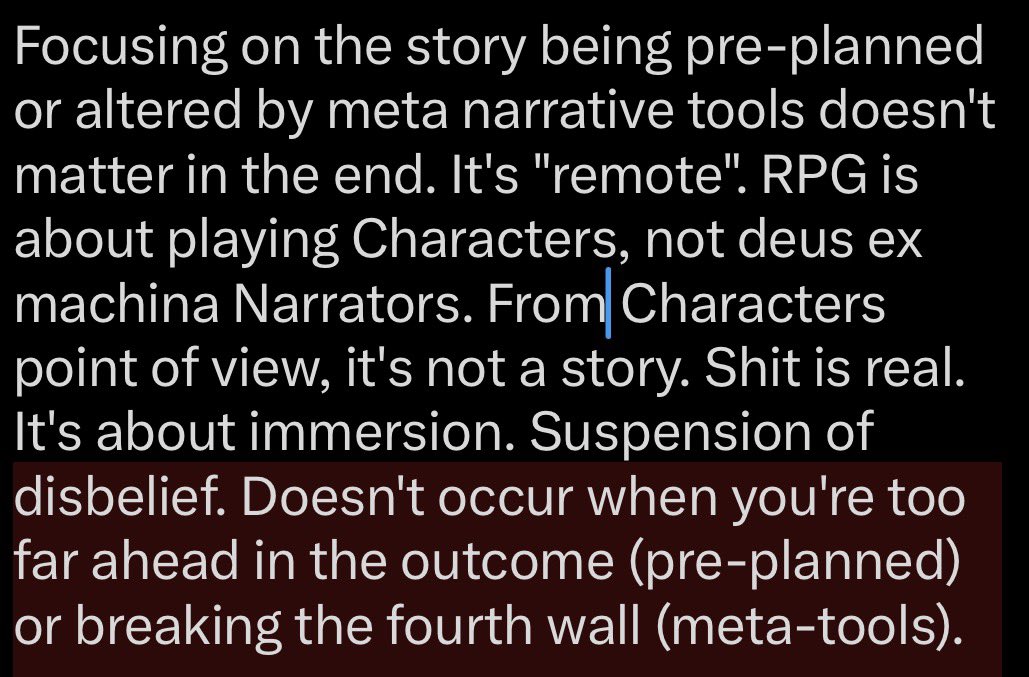
If the original author believed it was true, it would also apply to DMs that they should be playing characters, not deus ex machina narrators.
But that differentiation is literally the difference between a story being pre-planned in the traditional sense and not. It is a story in the same sense that all series of experiences are stories. They become stories when they are retold, when they are recounted. That's not particularly usefully discriminatory for this purpose.
The statement that "shit is real" and that it's about immersion is literally false. Those are valid approaches to bring to a game, but they aren't the only valid approaches to bring to a game. Suspension of disbelief is a very flexible thing, and the engagement of players with the other people at the table is also a very flexible thing. Some games are all about immersion, and keeping the levers and buttons of play constrained for the players. But not all games. There's even multiple layers of suspension of disbelief, different types of permeability. You may have a very high level of suspension of disbelief at the individual character action level (for example, you're playing in a wushu setting or in a super high action superhero setting), but you have a much lower threshold for suspension of disbelief at the cultural or situational level (you're playing one of the previously described settings within a historical context, for example).
This isn't hard to understand. It just requires that you not believe that all things are one thing and you can go from there.
As for immersion requiring that there be no fourth wall breaking, I'm here to tell you that's not a necessary prerequisite. I've played in a lot of narrative-forward games in which player immersion was pretty deep. It just wasn't of the same flavor of those where character immersion was an effect of not having access to levers and buttons of mechanics beyond the immediate scope of the character.
This is essentially akin to telling me that superheroes as a character genre are impossible to generate player engagement through immersion in because they're capable of doing things beyond what the everyday people at the table can imagine doing outside. That's obviously inherently foolish and contradicted by the facts, and yet that's what you're presenting me.
Get beyond all things are one thing, and you're going to have a much better time of understanding how to do a lot of things and what a lot of people may enjoy that aren't what you enjoy. It'll help you a lot, I promise. Promise.
English
So you decided not to follow suit? That's a bold strategy, Cotton. Let's see how it turns out.
I'm not telling you how to post. I'm just telling you to fuck off. You seem to have strong opinions which have no accordance with reality, and while you really don't matter to me, you decided to drag yourself across my path for some reason which remains unfathomable. I get it. Sometimes you just want to pick a fight online.
I've been at this longer than you, kid.
Good job. Now go play in the dirt with the other kids while the rest of us have a discussion which actually encapsulates the history of our hobby or talks about things that have come before, and we invite the interaction of people who have something to say, which you weren't. Bit of a shame, but you can try again next time.
English

@squidlord Dunning-Kruger 40+ year old writes another litany on the virtue of posting properly. More at 11. I write a substack. I read books. The difference is most books actually have something to say with their words.
English
That's not pounding out walls of text; that's gesturing vaguely in the direction of the keyboard, and a wall of text falls out. It's a very low wall. I promise, if you try, you can read all of it. Give it a go. I think you'll be alright.
Frankly, if the capability of writing more than 20 words exists, then you should feel free to use it, as I feel free to use it. I have the capacity and the thoughts, and I will leverage them. Perhaps you should generate larger thoughts and then put them down. Maybe you'd have a little more success in terms of conveying your point of view if you did.
I will have to continue talking down to you because you seem to want to insist you're beneath me. I would never think of arguing with you when you are so insistent on that point.
You think you can tell me how I should communicate with you and others? I'm sorry you can't get their support. I feel for you. It's a terrible place to be. It must suck to be you, but it's the best we can all aspire to.
English
@squidlord You're the one swearing and pounding out walls of text. You acknowledge the existence of dedicated long-form platforms but insist on subjecting people to walls of text on X. Go ahead, talk down to me, youre the adult in the room after all.
English
I don't know if you've been around long enough to know, but we've done all those things. While they are lovely, actually getting people to read them is somewhat of a challenge.
If you think this is a long-form post for me, you haven't seen the stuff I put on my blog.
Also, if your complaint is that I have put too many words on a platform entirely composed of words, and to interact with it you have to read a whole bunch of words, and that's really the entire underlying architecture of the experience—fuck you very much. Don't read them if there are too many words for you. Maybe reading is not an ideal investment for your pleasure.
Now you can go out and come back when you've got a better attitude and you can rejoin the rest of the adults. Until then, I guess you're just going to have to get over words.
English
@squidlord The trick is finding the words to say something in 250 characters or less. We have things like forums, blogs, and books to post in long form. Most accounts have figured this out.
English