Karthikeyan Ponnienselvan

43 posts

Karthikeyan Ponnienselvan

Karthikeyan Ponnienselvan

@thisiskpselvan

That’s nine syllables so just call me Karthik. Advisor @EliLillyandCo @VerveTx. PhD from the Wolfe lab @UMassChan. A gene editing enthusiast.

Worcester, MA Beigetreten Nisan 2020
68 Folgt32 Follower
Karthikeyan Ponnienselvan retweetet
Niko McCarty.
Niko McCarty.@NikoMcCarty·
I'm a simple man. If I see a field trial of genetically-engineered trees, I read it. A recent preprint reports the largest field trial to-date of American Chestnut trees engineered to resist a blight. And the results look promising. For context: The U.S. was once filled with American Chestnut trees. There were billions of them, each with a natural lifespan of 500+ years. In the late 1800s, however, an import of Asian chestnut trees unintentionally introduced a hitchhiking fungus into U.S. nurseries. That fungus, Cryphonectria parasitica, was first identified on an American chestnut tree growing in New York in 1904 by a forester at the Bronx Zoo, named Hermann Merkel. The fungus spread through the U.S. in the early 20th century (its spores can float on the wind for several miles). By the 1950s, this fungus had infected basically every American Chestnuts growing in the U.S., killing at least 4 billion trees. (There are still some mature, intact trees in the U.S., but they are really rare. Maine has most of them, it seems, including one American Chestnut tree in Lovell that is 115 feet tall.) When the fungus latches onto a tree (in a small wound), the fungus grows and colonizes the inner bark. It chokes the tree, forms cankers, and prevents it from growing outwards, thus cutting off phloem transport to tissues above the wound site. The fungus eats the tree using a chemical called oxalic acid. In the mid-2010s, researchers at SUNY made a transgenic American Chestnut tree that can fend off the fungus. These researchers took a gene from wheat, called oxalate oxidase (or OxO), and spliced it into an American chestnut sapling. This gene expresses an enzyme that breaks oxalate into hydrogen peroxide and carbon dioxide, thus neutralizing it. And, importantly, the gene is driven by a promoter that expresses this protein in basically every tissue of the tree. The OxO gene does not make the trees immune; it merely helps them tolerate the fungus. Trees can still get cankers and spread the fungus. But anyway, onto this paper. This is a two-year field trial of transgenic saplings vs. wildtype siblings. It is the largest such trial to date; prior papers used like 3 trees. Whereas in this study, 261 trees were inoculated with the fungus in three replicates. Transgenic trees (carrying the OxO gene) “consistently outperformed their [wildtype] siblings” and also Chinese chestnut trees. Every year, these researchers inoculated the trees and then, 90 days later, measured the lengths of cankers (or fungal growth) around the trees. The trees were planted in an orchard in Cape Elizabeth, Maine. The key result is that transgenic trees fared better than their wildtype siblings on basically every metric. They had smaller cankers, and also released fewer fungal spores from those cankers. Growth was normal, despite one year of fairly significant drought conditions. This is a really promising sign for the American Chestnut, perhaps saved by genetic engineering.
Niko McCarty. tweet mediaNiko McCarty. tweet media
English
44
307
2.6K
142.4K
Karthikeyan Ponnienselvan retweetet
Kentsis Research Group
Kentsis Research Group@KentsisResearch·
Read and use the published “Modular Platform for Therapeutic Drug Delivery Using Trifunctional Bio-Orthogonal Macromolecular Conjugates” pubs.acs.org/doi/10.1021/ac…
Kentsis Research Group@KentsisResearch

New preprint alert! Modular platform for therapeutic drug delivery using trifunctional bio-orthogonal macromolecular conjugates with @danielevanbauer #ScotWolfe labs and co-lead by Danmeng Luo and Ning Wang biorxiv.org/content/10.110…

English
0
2
1
701
Rathinavel
Rathinavel@abrpari·
@TANGEDCO_Offcl VGN Fairmont, கிண்டி அருகே TANGEDCO-க்கு வழங்கப்பட்ட நிலத்தில் சட்டவிரோதமாக தொழிலாளர்கள் தங்கும் முகாம் கட்டப்படுகிறது. தயவுசெய்து உடனடி நடவடிக்கை எடுக்கவும். புகைப்படங்கள் இணைக்கப்பட்டுள்ளன.
தமிழ்
4
1
2
88
Karthikeyan Ponnienselvan retweetet
Sek Kathiresan MD
Sek Kathiresan MD@skathire·
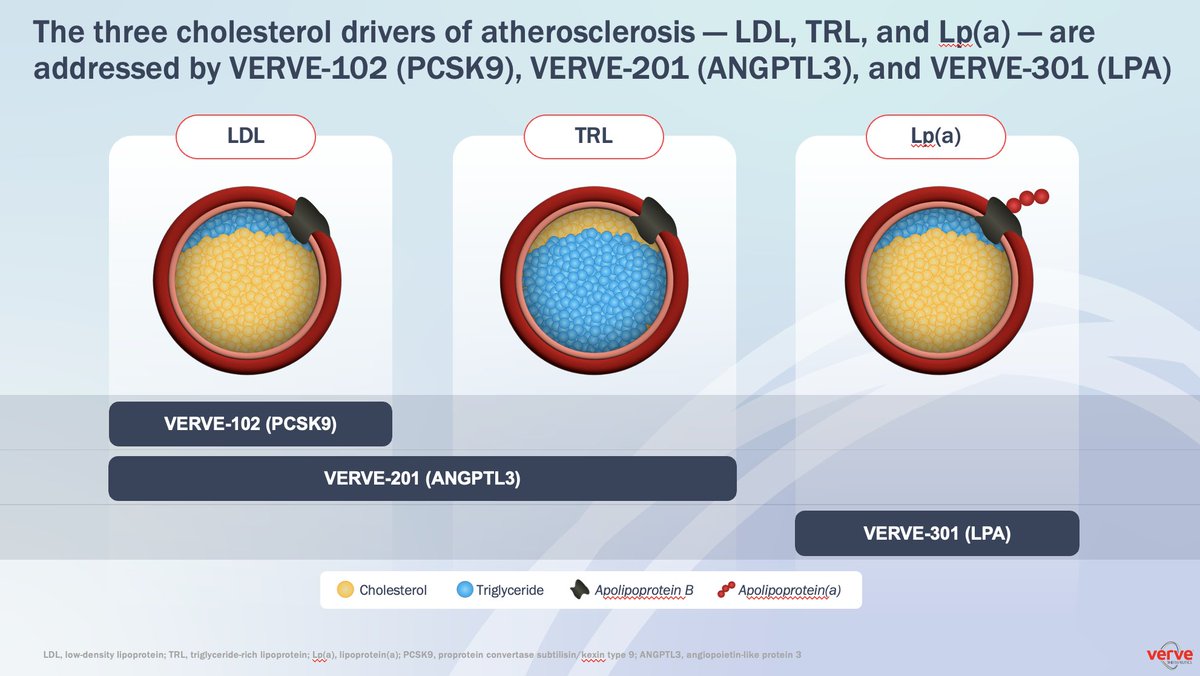
2025 is poised to be a transformational year for @VerveTx as we advance a robust pipeline of "one-time, for a lifetime" treatments to address the efficacy gap left by the current chronic care model Milestones/progress: 1. 2Q 2025: initial data disclosure from Heart-2 Phase 1 trial of VERVE-102 targeting PCSK9 (three cohorts, minimum 10 patients, safety, blood LDL change, blood PCSK9 change) Note: VERVE-102 has been well tolerated in all patients dosed, without clinically significant lab abnormalities. 2. 2H 2025: final dose escalation data for Heart-2 trial 3. 2H 2025: we expect opt-in decision from @EliLillyandCo 4. Dosing patients with 2nd asset - VERVE-201 targeting ANGPTL3 - in the Pulse-1 phase 1 trial, with program update in 2H 2025 5. VERVE-301 targeting LPA, development candidate named, received milestone payment from @EliLillyandCo 6. $524.3M in cash, runway to mid 2027 ir.vervetx.com/news-releases/…
Sek Kathiresan MD tweet media
English
8
16
116
29.9K
Karthikeyan Ponnienselvan retweetet
Vishal Mohanakrishnan
Vishal Mohanakrishnan@vishalmkrishnan·
Bone remodeling is traditionally driven by osteoblasts and osteoclasts, but our study reveals a third essential player: "Type R capillaries". Excited to share my PhD work from @ralfhadams lab, now published in @NatureCellBio. nature.com/articles/s4155… 🧵1/8👇 🐭🔬🦴
Vishal Mohanakrishnan tweet media
English
16
44
210
28.4K
Karthikeyan Ponnienselvan retweetet
Sek Kathiresan MD
Sek Kathiresan MD@skathire·
@VerveTx 3Q earnings: 1. VERVE-102 targeting PCSK9 being tested in Heart-2 trial *treated 7 patients now across 2 dose levels (0.3 mg/kg and 0.45 mg/kg) *well tolerated, no serious adverse events, no clinically significant lab abnormalities *escalation to next dose after planned DSMB *data disclosure planned in 1H 2025 2. VERVE-201 targeting ANGPTL3 - first patient has been dosed in Pulse-1 trial! 3. Continued progress on pre-clinical LPA product candidate 4. $540M in cash, runway through 2026 5. With two product candidates now in the clinic, 2025 should be an eventful year for Verve's vision 👇 ir.vervetx.com/news-releases/…
Sek Kathiresan MD tweet media
English
3
7
48
9.2K
Karthikeyan Ponnienselvan retweetet
UMass Chan Medical School
UMass Chan Medical School@UMassChan·
An expert panel that includes Scot Wolfe, PhD, of @UMassChan has determined a groundbreaking treatment for sickle cell disease is safe enough for clinical use: direc.to/kab8 “We want to be careful not to let the perfect be the enemy of the good.” #CRISPR @ginakolata
English
0
1
1
387
Karthikeyan Ponnienselvan retweetet
Vishal Mohanakrishnan
Vishal Mohanakrishnan@vishalmkrishnan·
Our latest research has uncovered the surprising vascular and hematopoietic microenvironment of the adult and aging skull. Congratulations @bikohcello and @ralfhadams 👏 🎉 Happy to be part of this team and discovery. shorturl.at/lvCL3 Skull-Blowing 🤯 🧵👇
English
0
3
16
3.3K
Karthikeyan Ponnienselvan
Karthikeyan Ponnienselvan@thisiskpselvan·
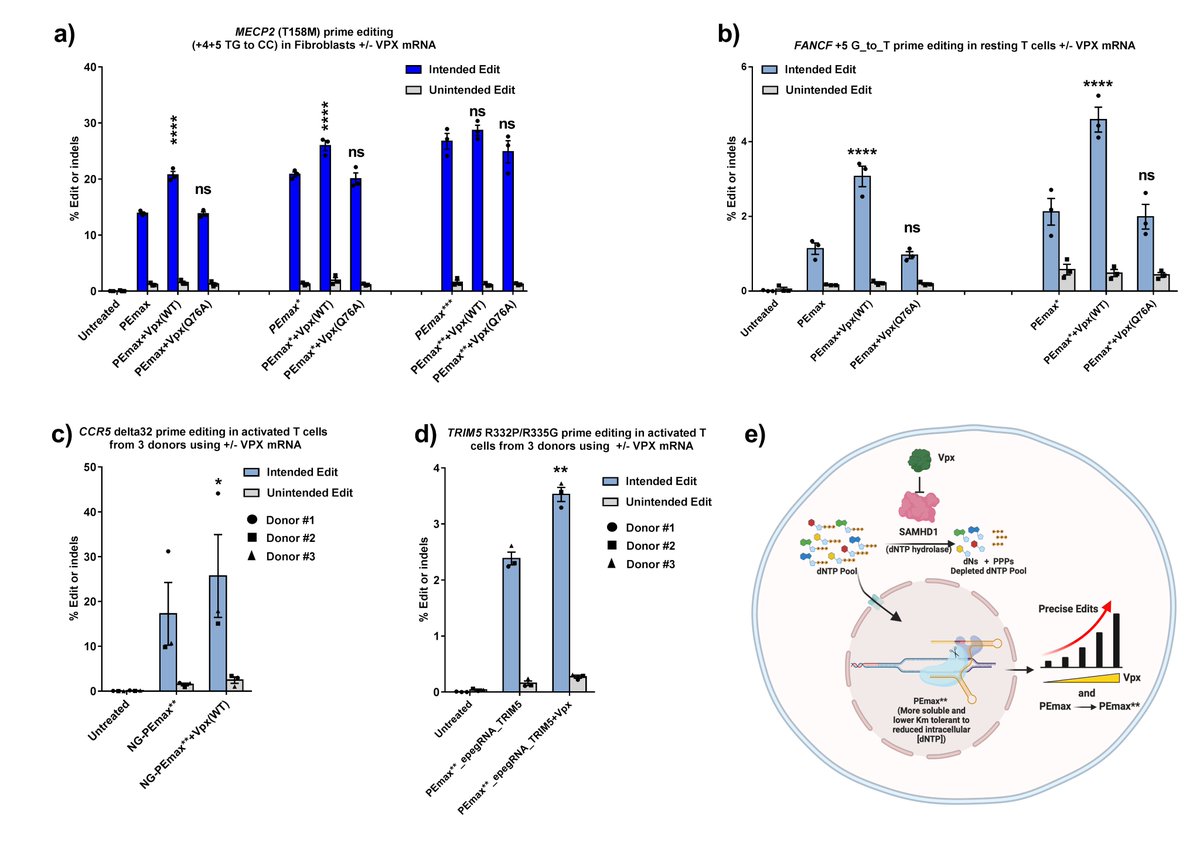
Finally, we show that co-delivery of VPX (a viral accessory protein that targets SAMHD1 for degradation & increases cellular dNTP levels) increases prime editing rates in patient derived fibroblasts & human primary T cells.
Karthikeyan Ponnienselvan tweet media
English
1
1
2
312