Thomas George

455 posts

Thomas George banner
Thomas George

Thomas George

@thomas_ag

Founder & CEO @ Housecat | Early @Monzo

San Francisco Beigetreten Ağustos 2011
1.1K Folgt643 Follower
Thomas George
Thomas George@thomas_ag·
@brexton Agreed! Would love to chat about this, we've been thinking about this too
English
0
0
0
22
brexton
brexton@brexton·
There's a lot of excitement around different "file systems" or "brains" (i.e. gbrain/stack, karpathy wiki, etc.) for agents, but I'm pretty convinced that the optimal form factor for an "agent OS"/"brain" is to center all of this around my *email inbox*. I do not think that the ideal form factor is a neutral/third-party aggregator that's unopinionated 1. Every important contact/relationship I have always gets escalated into my inbox (regardless of whether or not it started in iMessage/whatsapp/X). Way easier to create ontologies around email/messaging context over anything else 2. Every important document I want to keep track of is in my email, but it's locked up in threads with attachments that I need to manually download rather than automatically indexed. Ie finding investment documents for a round I invested in years ago is a hassle. This should automatically be sorted in its own file system I think my ideal "shape" of product looks something like: 1. Proper file system and dev workspace for my agent but everything in my inbox gets automatically ingested into the file system including attachments 2. Every thread and person I interact with gets automatically ingested into the "brain", enrichment happens automatically in the background 3. I primarily interact with my inbox via an agent, but it's exposed to every surface I care about (iMessage, CLI, etc.) I might build this for myself and anyone else who wants this
English
12
2
42
4.1K
Thomas George
Thomas George@thomas_ag·
I couldn't agree more. Vibecoding makes it easier than ever to get to 80% but the last 20% is as hard as ever (maybe harder). When I buy software I am paying for a 99% solution (and maybe even a 99.99% solution).
Matthew Yglesias@mattyglesias

Five months in, I think I've decided that I don't want to vibecode — I want professionally managed software companies to use AI coding assistance to make more/better/cheaper software products that they sell to me for money.

English
1
0
1
116
Thomas George
Thomas George@thomas_ag·
Yesterday's @ycombinator post from @t_blom (who I used to work for at @monzo) about the "company brain" didn't surprise me. We started @housecatinc last year, and are seeing something magical happen when you give agents access to your data and a computer they control.
Thomas George tweet media
English
2
3
6
2.5K
Thomas George
Thomas George@thomas_ag·
@iamPWK Small is good! We're building with small teams in mind
English
0
0
1
16
Paul
Paul@iamPWK·
@thomas_ag Yes please but we are small
English
1
0
1
17
Thomas George
Thomas George@thomas_ag·
If you're interested in testing the product let me know!
English
3
0
1
71
Thomas George
Thomas George@thomas_ag·
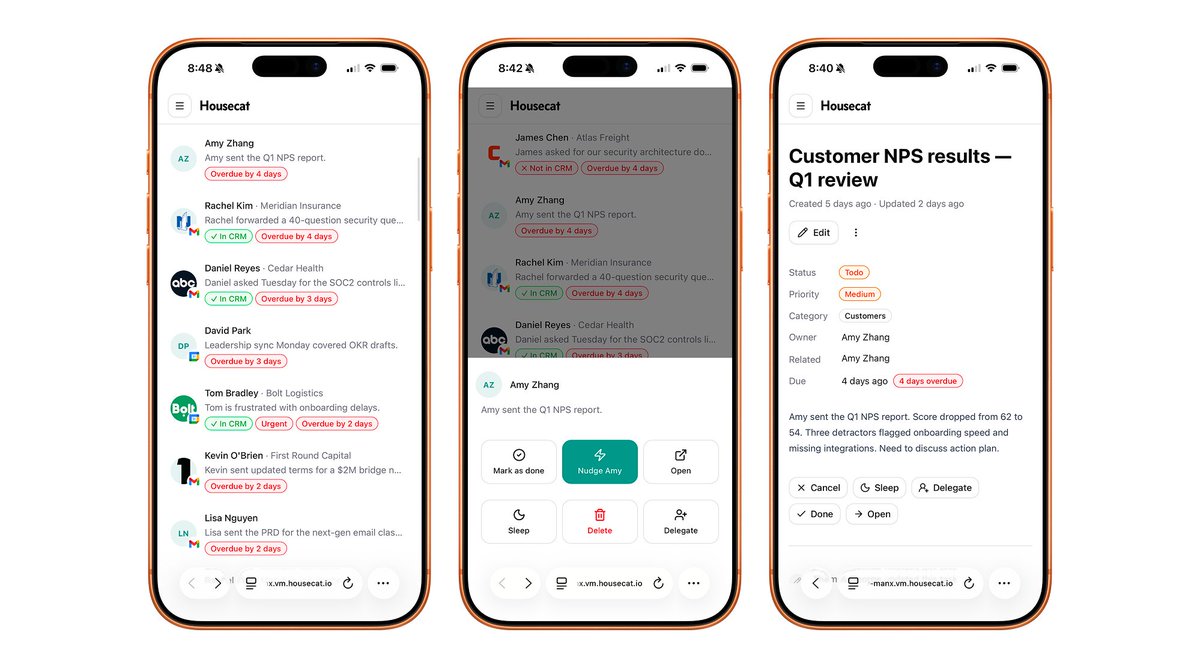
When combined you start seeing glimpses of the future. Housecat is able to read your emails, slack and granola and create clear tasks for the user. It can keep your CRM automatically up-to-date, or help you plan events and outreach. Or you can build custom projects on the fly.
English
1
0
0
72
Thomas George
Thomas George@thomas_ag·
@nbobba Housecat will be accessible via MCP in Claude Code/Cowork soon
English
1
0
2
206
Thomas George retweetet
Will Slaughter
Will Slaughter@BamaBonds·
In 3 years from December 2019 to December 2022, Block $XYZ more than tripled its headcount from 3,900 to 12,500. Unwinding less than half an insane COVID overhiring binge has much more to do with Jack Dorsey's managerial incompetence than whether AI is going to take your job.
Jeremy M. Kissel@JeremyKissel

Block plans to lay off nearly half its staff in ‘deliberate and bold’ embrace of AI $XYZ on.mktw.net/4kY6b5D

English
130
473
4.9K
3.4M
Thomas George
Thomas George@thomas_ag·
@chrisbarber This is great! In particular the seamless onboarding and time to magic moment are resonating with me right now. Product polish remains as important as ever!! (maybe more so)
English
1
0
1
54
Chris Barber
Chris Barber@chrisbarber·
notes for founders/engineers building in the claude cowork / claw space: onboarding - re-onboard yourself a dozen times. each time, note what might be confusing - then repeat for your team members - then repeat for technical friends and family - then repeat for non-technical friends and family - iteration reps, where the goal is to go from manual concierge onboarding, to the point where you don't need to say anything - goal of onboarding: get the user on the path to experiencing the magic moment of the product, as quickly as possible, with as minimal time/effort/money as possible - your product is a fine dining restaurant, you are a restauranteur, and you're doing a fine dining soft open with family and friends to polish the annoyances before you open to the public - i recently tried 30+ products in this space and onboarding is a weak point integrations - check your stats, which integrations are the predictors of highest user engagement and retention? - and which integrations have no impact on engagement or retention? - how can you streamline a user adding those integrations? - go back to the in person onboarding iteration method. watch people set up those integrations. what are their points of confusion? what are their points of security and privacy concerns? the in-n-out method - have two lenses for your product: a) your product for users who haven't yet hit the magic moment and b) your product for users who have already hit the magic moment - pre-magic moment, they should only be able to order the simple burger and milkshake, the things that you know lead to retention - post-magic moment, you can let them access the hidden menu - claude code does a good job of this. the basic version puts you right on the path to the magic moment. and then it's also easy to access lots of hidden powerful features, but they don't get in your way before you've hit the magic moment pricing and business model - ai labs have pricing friction with their users - tokens are expensive - great products need lots of tokens - but to reach the mainstream the product needs to be affordable - my suggestion is to have two product lines. one that might be smaller and more secretive. your r&d product line. for very large token consumers. no limits on the product you offer. maybe expensive subscriptions or maybe pay as you go. and then one that is aimed at the mainstream, more affordable, just the features that are high roi for everyone. user selection - in ai products there are often two groups of users - a) users looking for roi, ie people trying to get rich or start a business or similar - b) users who already have something that they make money from (a business, a job), who want to optimize that thing - i'll posit that it's easier to get users that fall into a) but that can be a bit of a local max trap, so ideally, go after users in b) privacy, security - how can you minimize the information needed in integrations? if it's sign in with google, do you need all the scopes or just some? - instead of having the user sign in with gmail, could you give them an email address? (startup idea that might already exist: api that makes it easy for any product to give each user their own email address) - eg instead of chatgpt having me auth my email, why doesn't it give me a chatgpt dot com email address. less permission concern there - pay attention to this when onboarding people in person - this will be big friction for your product and your onboarding - this is also a big advantage of local ai. apple and dgx spark etc. integrations - the other side of privacy and security is that ai agents are useful proportional to how much of the user's data and context they have - and how low effort it is for the user to bring data and context in apis - agents are hobbled by scraping blocks, web search in general - they need easy access to apis - perhaps some kind of bulk buffet subscription - or a user budget for them to spend on self serve apis as needed metrics that matter - how long in minutes does it take the user to reach the magic moment - how much does it cost you, and how much does it cost the user, to reach that magic moment - (where magic moment ~= the point at which they're likely to retain, ie they've experienced the part of the product that makes them feel like they have to keep using it) things users like from claude code and claws that are missing in chat assistants - persistent easy to view and edit text doc style scratchpads across projects - ability to text your agent - some kind of persistent filesystem where you can drag files in and out - more subagents - easier to work with many and larger files and unlimited attachments - generally, make it easier to burn more tokens delegation patterns - think of agents like employees - teaching employees often works like: i do one and you watch, then we do one together and i help you, then you do one solo, then maybe you teach someone else how to do one. for agents this could be demo, collaborate, do, document - employees generally start as more directed and then work their way up to more proactive. there's the adage of an ok employee needs to be told the problem and solution, a good one needs to be told only the problem and will find the solution, and a great one will find the problem and the solution - people love it when their employees are so good that the employees manage them, vs the other way around. as models get better in more domains this will happen more. this will have product market fit - in general there's rich things to discover and apply in terms of how to be a good employee, that also apply to how to make a good agent product product ideas - look for misuse - i've done posts on this but generally there are lots of ways that non technical people are "misusing" claude code to help in their businesses, with their health, with their finances, with their investing etc - these point at the products people want the general shape - feels like a new operating system - ephemeral software - computers will be better at using computers than humans ever were - majority of computer/app/software usage feels like it'll be mediated via an agent for most people. it's just a better *and* lazier way to use computers - right now the interface of this new os is basically a terminal. i can imagine terminal + easy text editing and file access and browser access. and some kind of new (or old) gui layer for these new ephermeral apps - i think there's the two lenses on do you start with something polished and work backwards or do you start with something more like the terminal and go forwards - what's the terminal ui type thing for non-engineers? - i like terminal forwards. because this is such an uncertain space. uncertain fast moving spaces benefit from bottoms up emergence, easy iteration, invariant primatives. whereas overdesigning a ui is the opposite of that. stay nimble. uncertainty - this is a fast moving space - fast moving fast changing spaces aren't easy to top-down plan in - therefore, bottoms up exploration is the way to go - concretely this looks like a) maximize dogfooding b) maximize exploration (multiple efforts going after the same problem/observation is fine! encouraged even) c) minimize coordination costs d) minimize iteration costs (hence, easier to iterate on a terminal ui than it is to iterate on some really polished gui software) hobbling - the need to iterate on heavy guis hobbles the team - lack of integrations hobbles the model - a slow web ui hobbles the model - in general, being more like a web chat ui and less like a filesystem with a ui that can morph to new things (eg python script guis and tuis) hobbles the model the video game for work - people have always wanted this - people like video games - claude code is a great example - the terminal feels fast. fun. press enter. up down a b left right. pretty colors. text streaming. - what expansion packs do you use for claude code? oh i mean which mcps - what difficulty level are you using? oh i mean which permissions mode - did you hit the paywall? oh i mean did you max out your subscription - are you doing p2w? oh i mean do you have fast mode and extra usage - in general i think the space of making personal and professional agent products feel like a video game for work is underexplored - one of the most important elements of feeling like a video game is speed! this is a big advantage of terminal uis. with long threads in claude or chatgpt web, it's not fast. long threads in the terminal, very fast, no ui lag. bugs - every point of confusion during onboarding is a bug - everything that gets in the way of a user getting to a magic moment is a bug - every time a user needs to copy into your app, that's a bug (fix is maybe expand product scope or add integration) - every time a user needs to copy out of your app, that's a bug - if you're unsure what predicts retention and what the magic moment is, that's a bug this space will be massive, and the quick adoption of openclaw shows it's wide open, labs don't have much advantage it seems to me that some keys are - onboarding polish and general product polish - post-training - integrations - privacy/security here's the set of tools i've tried so far. i'd love suggestions of more to try - ai browsers: dia, comet, claude for chrome, atlas, dex - claw/hosted agent products: openclaw, kimi claw, klaus, viktor, duet, atris - automation things: tasklet, lindy - code: devin, claude code, cursor, codex - search: parallel, you, exa, yutori - official things: claude cowork, various connectors in claude, various apps and data sources in chatgpt - other agent products: ii, open interpreter - desktop automation things: vercept, nox, liminary, logical, raycast - email products: shortwave, cora, jace
English
6
6
173
14.5K
Thomas George
Thomas George@thomas_ag·
I'd love to talk to you if you think we could help you!
English
0
0
0
28
Thomas George
Thomas George@thomas_ag·
Housecat will give our users the ability to configure agents and automations without needing them to open Terminal or setup new API integrations. We'll have proper security and data, and our tools live in the Cloud, not on a Mac Mini balanced on the edge of your desk.
English
1
0
0
37
Thomas George
Thomas George@thomas_ag·
I launched a company called Housecat with @nzoschke! We help non-technical teams implement modular software that actually works. We're starting by helping users w/ email and CRM busywork, but our ambition is to be the complete Agent Builder on Rails. Check out housecat [dot] com.
Thomas George tweet media
English
1
0
0
107