Post

Maxine Pye
Maxine Pye@LiveAncestral·
Cholesterol doesn’t cause heart disease. It shows up where there’s damage. Like a firefighter at a fire. It’s responding, not causing. The real drivers are chronically high blood sugar, seed oils, refined carbohydrates, and inflammation. These damage the artery wall. Cholesterol arrives to repair it. We’ve been testing the wrong number for 70 years. A single LDL reading tells you almost nothing. What matters is your triglycerides, your fasting insulin, and whether you have actual arterial damage showing on a calcium score. Real food, stable blood sugar, and no seed oils will do more for your heart than worrying about a number on a blood test. What does your doctor actually test when you go in?
Maxine Pye tweet media
English
19
92
327
7.6K
LLicit
LLicit@LLicit_Tweet·
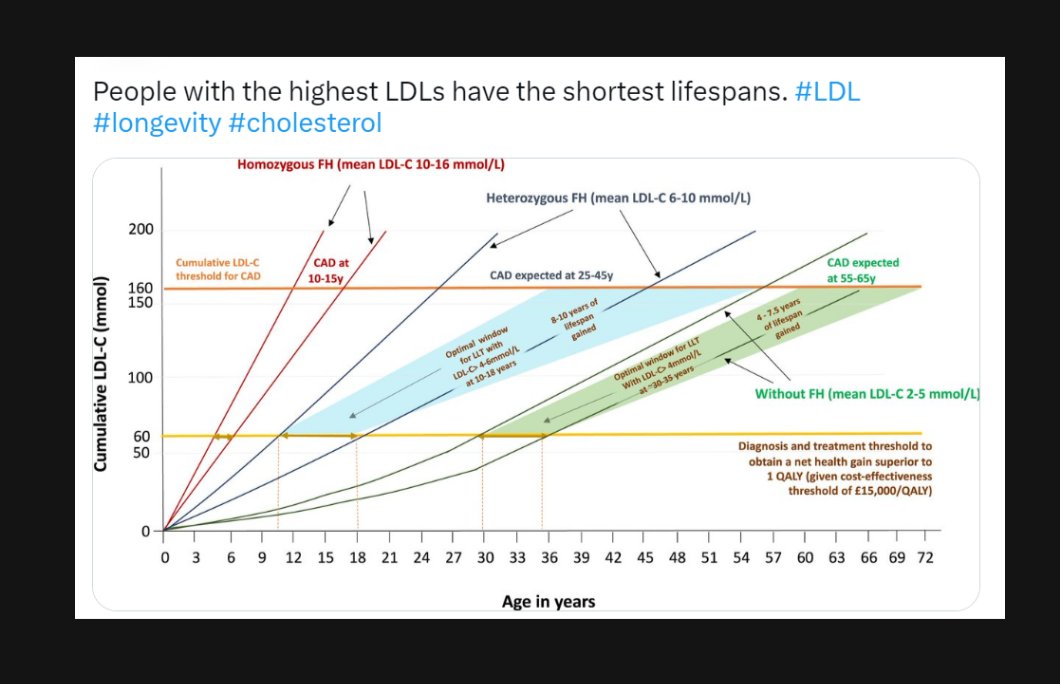
@LiveAncestral Genetics can cause people to have lifelong high or low cholesterol Those with genetically low cholesterol have 88% less heart disease Those with genetically high cholesterol can die in their twenties from heart disease (unless treated) Seems pretty clear it's a major risk factor
LLicit tweet media
English
1
1
0
144
Dominique D.
Dominique D.@dm_devito·
After age 60, if one have high "bad" cholesterol, the longer he lives. A high LDL cholesterol ("bad" cholesterol) level is associated with lower mortality. Source = Lack of an association or an inverse association between low-density-lipoprotein cholesterol and mortality in the elderly: a systematic review | BMJ Open bmjopen.bmj.com/content/6/6/e0…
English
5
0
0
16
LLicit
LLicit@LLicit_Tweet·
@dm_devito @LiveAncestral Third factor: Effect modification. Old age ➡️ multiple chronic conditions (multimorbidity), which may influence the studied risk factor in varied & unknown ways. This protective effect - if true (see factors 1 & 2) - cannot be extrapolated to younger people as age specific
English
0
0
0
10
LLicit
LLicit@LLicit_Tweet·
@dm_devito @LiveAncestral First factor: Survivorship bias. People vary in their susceptibility to cardiovascular risk factors with those susceptible dying off earlier. If a study doesn't account for these earlier deaths, then the risk factor can appear to be incorrectly protective
English
0
0
0
8
LLicit
LLicit@LLicit_Tweet·
@dm_devito @LiveAncestral Second factor: Reverse causality. At least a dozen diseases (cancer, COPD etc) cause LDL-C levels to decrease. So again - if a study doesn't account for this - then higher cholesterol levels will misleadingly appear protective
English
0
0
0
11
Paylaş