
Pinned Tweet
LML
1.2K posts


LML
@LdnMathLab
LML is an institute for scientific research based in West London. We provide a space to think about problems deeply.
London, England Joined Aralık 2016
270 Following2.5K Followers
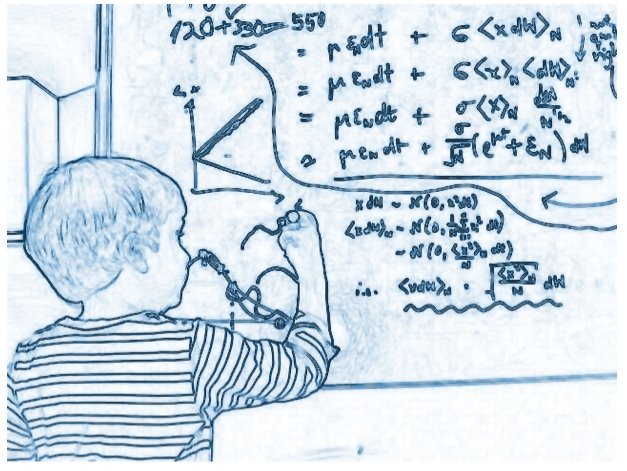
The Ergodicity Economics 2026 conference looking exciting!
Ergodicity Economics 2026@EE_Conf_LML
...and the program is ready! Day one this time will start with a textbook-based introduction to EE. The aim of the meeting is to practice the `ergodicity squint' as we re-consider big questions of social organization, business and finance.
English
LML retweeted

New book: An Introduction to Ergodicity Economics
A new textbook by SFI External Professor Ole Peters and Alexander Adamou draws on physics to re-examine core assumptions in economic theory. It presents a formal challenge to expected-value thinking and shows how non-ergodicity can arise naturally in economic models.
The book introduces ergodicity economics as a “third way” alternative to expected-utility theory and behavioral critiques of rationality. It is the first textbook in this emerging field, and it offers a new way to think about decision-making under uncertainty.
santafe.edu/news-center/ne…

English
LML retweeted

...wherein I suggest, around 5m:20s, that the ergodicity problem is the problem of emergence, which in turn is the problem of complexity.
Things I worked on with Murray Gell-Mann at @sfiscience.
Ole Peters@ole_b_peters
English
LML retweeted
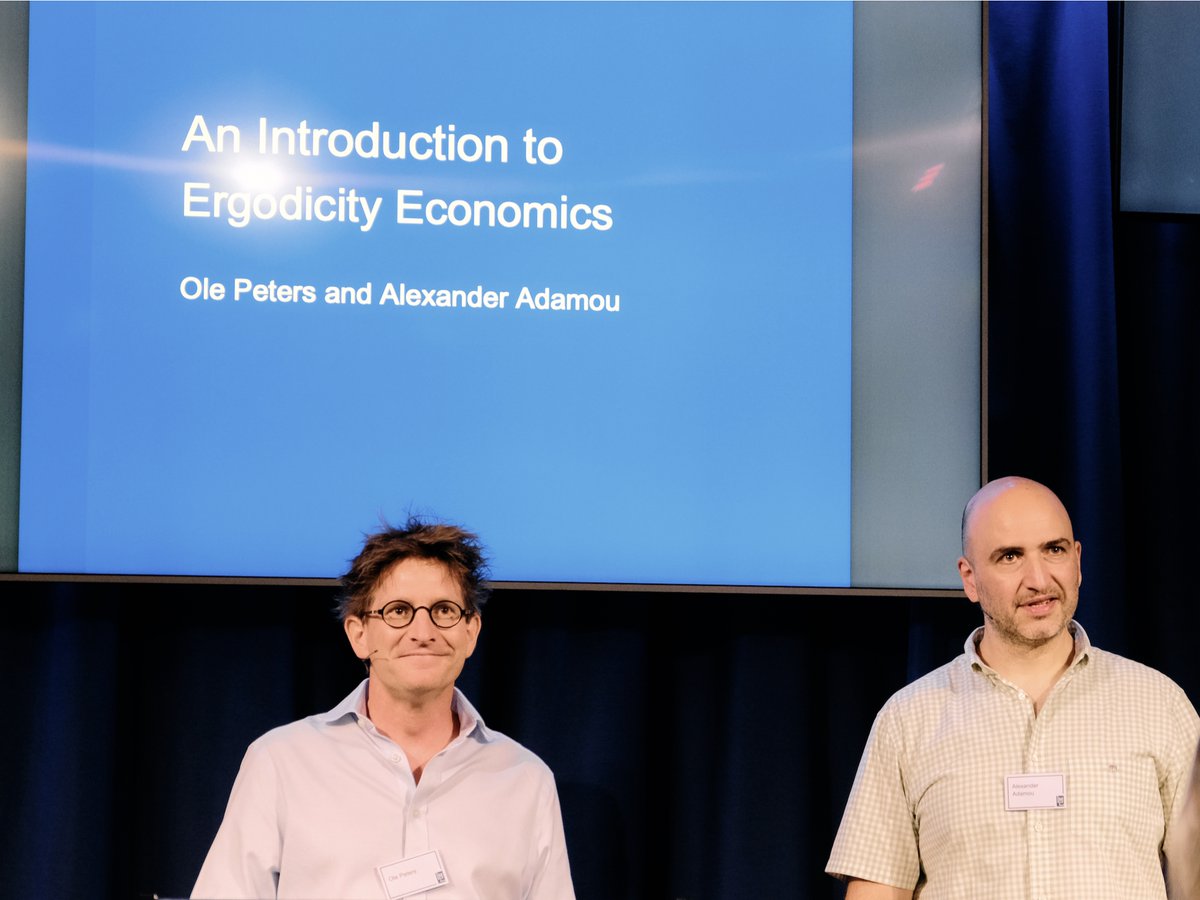
LML retweeted
@OAmKorAr @nntaleb The cheapest place to buy it is here. Any profits (price minus printing and shipping) are donated to @LdnMathLab in support of the ergodicity research program.
ergodicityeconomics.com/an-introductio…
English
LML retweeted
If you haven’t got your own copy yet, now’s the time to get one. I wholeheartedly recommend it.

Emanuel Derman @emanuelderman.bsky@EmanuelDerman
If price was restraining you from enjoying my new reminiscence of youth, loves, & mores in immigrant Cape Town, adorned with 100 color photos, it’s now $17.50 on Amazon. amazon.com/Brief-Hours-We… J M Coetzee, Nobel Laureate, says: “The chapter on the lonely Mrs Gold is a triumph.”
English
LML retweeted
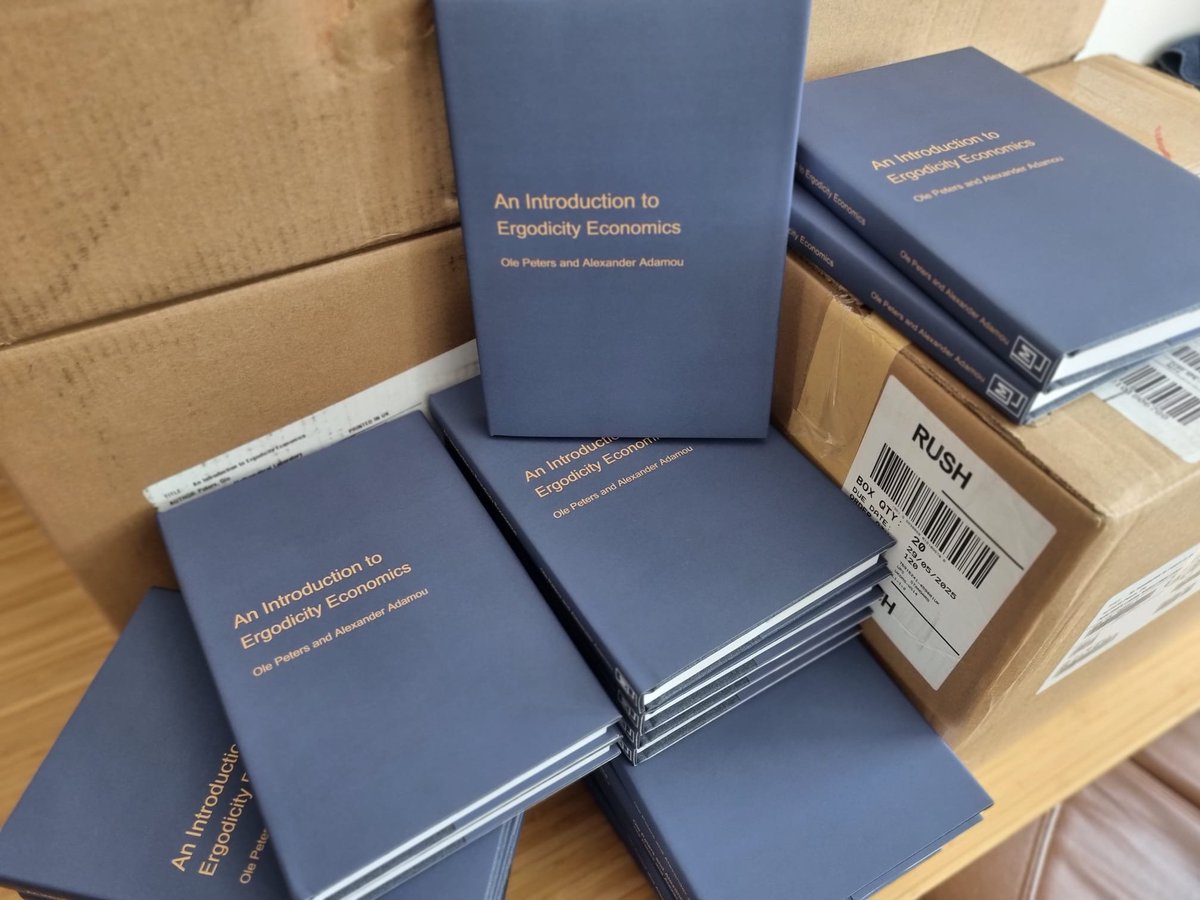
Publication day!!!
These beautiful objects can now be ordered.
For our main markets, we have automated shipping solutions, but we're trying to reach everywhere. For now that means: loads of books at @LdnMathLab.
Get yours at ergodicityeconomics.com/an-introductio…
English
LML retweeted

Lovely summary by
@ole_b_peters of our little textbook and the twenty years of thought that went into it. Very excited to see it published next month...
Ole Peters@ole_b_peters
1/thread🧵 Almost 20 years ago, I started thinking about the ergodicity problem in the context of economics. That turned out to be surprisingly fruitful, and now there's a book about it.
English
The making of the book `An Introduction to Ergodicity Economics.'
Ole Peters@ole_b_peters
1/thread🧵 Almost 20 years ago, I started thinking about the ergodicity problem in the context of economics. That turned out to be surprisingly fruitful, and now there's a book about it.
English
LML retweeted
As part of the Ergodicity Economics 2025 conference, we spent the last few days meeting in person in (stormy) Cascais, Portugal. This year, the aim of the conference was to get the EE crowd to meet the ecological rationality crowd around Gerd Gigerenzer.
Over dinner, Gerd brought up the two-envelopes paradox and how ecological rationality might address it. I found this worth sharing because it illustrates how ergodicity economics and ecological rationality can meet, and how the two approaches, vastly different in some ways, can be joined to support each other.
The two-envelopes paradox
Here comes the paradox. I have two envelopes, and I give you one of them. I tell you that one envelope contains twice as much money as the other, and I give you the option to swap envelopes with me.
Should you do it? The paradox (which we'll resolve formally below), is this: if you compute the expected value of what's in my envelope, you'll find that it's (2+1/2)/2=1.25 times whatever is in the envelope you currently have. This suggests that you should swap. But once you've swapped, you're in the same situation as before, you didn't learn anything new, so the same reasoning applied again will again tell you to swap and so on ad infinitum.
Intuitively, it also feels that it cannot possibly make a difference to swap because swapping doesn't change your situation in any way.
Ecological rationality to the rescue
Ecological rationality suggests the following solution. Instead of tangling yourself in mathematical imponderables, get real, and develop a heuristic for making the choice. Here is the heuristic Gerd mentioned: think about the context, your surroundings, and come up with a plausible range of what might be in the envelopes. For example, you may be at an academic conference. It's unlikely that you'll find $10,000 in the envelope. Something symbolic like $10 or $20 would make sense, given the context.
So you might choose $12 as a threshold, then open the envelope you've currently got, and keep it if it contains more than $12, otherwise swap.
The heuristic (unlike the mathematical analysis) allows you to make a definite decision, it requires no complicated computations and gets the job done quickly. Also, it's designed to be fairly good -- you can rely on your intuition about the situation, implicitly taking a lot of information into account.
I found this approach utterly refreshing -- if we're really talking about a real situation, and the story about the envelopes isn't just some cryptic encoding of an exercise in probability theory, then forget probability theory and focus on the real-world problem at hand!
Ergodicity economics insights
Expected value is meaningless here
Nonetheless, let's see how ergodicity thinking can be informative here. Let's go back to the formal problem. The first thing we realize is that the expected value has absolutely nothing to do with the problem. The expected value is the ensemble-average over all imagined possible worlds of what might be in the envelope I'm holding. But you don't have access to the ensemble of all imagined possible worlds, you're stuck in this one universe.
Tragically, the name "expected value" with its entirely inappropriate connotations, has become the standard word for referring to the average over the infinite statistical ensemble. Of course it's not what you should "expect": whatever is in my envelope, it's certainly not 1.25 times what's in yours -- it's either 0.5 or 2 times what's in yours. The "expected value" is not even in the set of possible values.
Once we try to attach physical meaning to the expected value, and once this really sinks in, we realize that making this choice (and many others) based on expected value is as sensible as measuring your left shoe lace and swapping envelopes if it's longer than Julius Cesar's right arm (whose length you don't know).
Long term growth
But how would an ergodicity economist address the problem? I think maybe like this: try embedding the problem in time; make it part of a dynamic, and think of the choice you're making as the result of a behavioral protocol. Then judge the different options by how they affect you in the long run (not in expectation). How?
You're currently holding an envelop. Let's call the (unknown) amount of money in that envelop x(0). You have the option to swap, or to keep the envelop. What's the growth rate of your wealth in the long run under either decision protocol?
Let's check option A) keep your envelope. In this case, the amount of money you have will stay what it is, x(t)=x(0). The long-time additive growth rate of your wealth will be
lim₍ₜ → ∞₎ 1/t [x(t)-x(0)]=0.
What about option B), swapping? If you choose to swap envelopes now, you will learn nothing new, so you will repeat the same choice at the next time step. In other words, you will keep swapping envelopes. If you've currently got the good envelope, your wealth will evolve according to
x(t)= x(0)/2 if t is odd
and
x(t)=x(0) if t is even
If you've currently got the bad envelope, it will be 2 x(0) and x(0). In either case, the long-term additive growth rate of your wealth will again be zero
lim₍ₜ → ∞₎ 1/t [x(t)-x(0)]=0.
That's because in the large-t limit the contribution of a doubling or halving of the amount of money contributes nothing to the time-average growth rate.
Paradox lost
So: ergodicity economics resolves the foundational puzzle and arrives at the intuitive result: whether you swap or not is irrelevant according to the simple criterion of maximizing time-average growth rates. This exposes the invalidity of the formal analysis that established the paradox in the first place, and we quite like that.
Back to reality: EE and ER synthesis
If you now ask an ergodicity economist what should be done in the real situation, I'd suspect he or she would say the first-order decision criterion of ergodicity economics gives no answer, and we have to look for extra information to make the choice.
Enter Ecological Rationality: it's exactly right -- look for more information than what we had immediately translated into a probabilistic mathematical model. Is this happening at an academic conference, or perhaps on live TV? Do you know me? Am I winking at the envelope in my hand and smiling at you? Am I trustworthy? Are we friends? Might I be trying to help you out?
The EE2025 conference was a wonderful opportunity to start a serious dialogue between the two communities around EE concepts and Ecological Rationality concepts. I look forward to continuing it.



English
LML retweeted

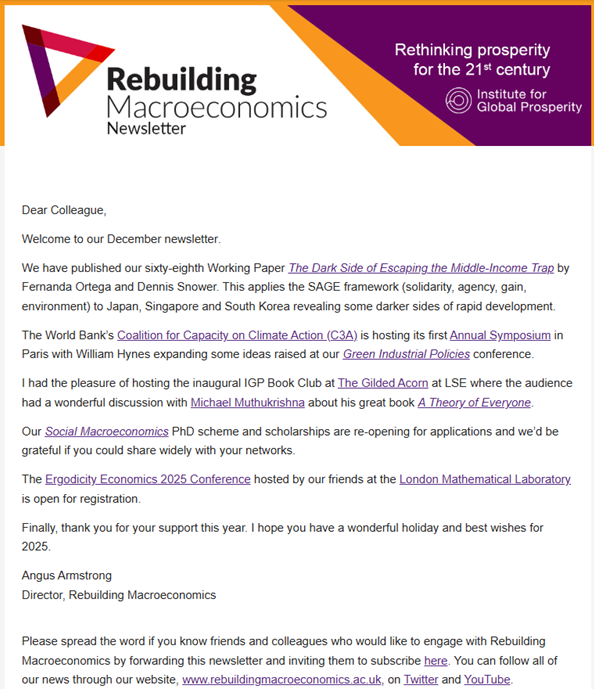
Our December newsletter is out👇 which includes our 68th Working Paper, C3A Annual Symposium, @glo_pro Book Club, Social Macro scheme and scholarship, and Ergodicity Economics 2025 conference
Newsletter: mailchi.mp/7c79c8a94177/r…
Subscribe: rebuildingmacroeconomics.ac.uk/newsletter
English
LML retweeted
This is really fantastic. Hope it turns into a trend. If anyone out there feels inspired, get in touch with me right here.
GigaChadPepe@Giga_Chad_Pepe
@ole_b_peters Ole, I can't message you directly but would gladly match this for another attendee!
English
LML retweeted
I look forward to each and every one of these talks.
Bring all your friends!
Ergodicity Economics 2026@EE_Conf_LML
Early-bird registration ends this Friday, 20 December. And the program is now complete. This will be absolutely fantastic!
English
LML retweeted

Early-bird registration ends this Friday, 20 December.
And the program is now complete. This will be absolutely fantastic!

English
LML retweeted
Check out this video invitation, with a bit more detail about the theme, 'Good decisions,' of EE2025.
Enjoy!
Ole Peters@ole_b_peters
Video invitation for EE2025 is now up on ergodicity.tv Watch it here youtu.be/GUoT7QLzkYo?si… (trigger warning: may contain critique of expected-utility theory)
English
LML retweeted

Rapidly falling in love with @LdnMathLab #ErgodicityEconomics
pubs.aip.org/aip/cha/articl…
nature.com/articles/s4156…
nature.com/articles/s4156…
This is so beautifully the right way!!!
@ole_b_peters do you have openings for short term projects for ppl from physics/finance/datascience?
Ole Peters@ole_b_peters
1/ 🧵 Expected value is the conceptual heart of economic theory. It's how economics deals with the vagaries of life. Physically, expected value means pooling and sharing equally. Add up all realizations and divide by the sample size. Politically speaking, that's communism.
English
LML retweeted
Yay! It's happening.
This time with Gerd Gigerenzer as keynote speaker, under the theme "Good decisions."
Tell all your friends.

Ergodicity Economics 2026@EE_Conf_LML
We look forward to welcoming you online, and perhaps in person, at #EE2025! Register for the conference/send in an abstract at ee2025.rsvpify.com Share the email announcement via eomail6.com/web-version?p=… Sign up to the EE newsletter at ergodicityeconomics.eo.page/4ct3k
English
Come and join us at the annual EE conference.
Registration and abstract submission are now open.
Ergodicity Economics 2026@EE_Conf_LML
We look forward to welcoming you online, and perhaps in person, at #EE2025! Register for the conference/send in an abstract at ee2025.rsvpify.com Share the email announcement via eomail6.com/web-version?p=… Sign up to the EE newsletter at ergodicityeconomics.eo.page/4ct3k
English
LML retweeted
Rather a lot has happened since my last newsletter in February.
Here's the August update.
Enjoy!
eomail6.com/web-version?p=…
English
We congratulate @ole_b_peters on being awarded the Freedom of the City of London, having been nominated for his contributions to research into economics, in particular for his formulation of ergodicity economics.
lml.org.uk/2024/07/23/con…

English