
OpenRead

385 posts

OpenRead banner
OpenRead

OpenRead

@OpenRead_HQ

An AI-Powered platform that supercharges your research efficiency.

San Francisco, CA Joined Mayıs 2022
361 Following2.1K Followers
Pinned Tweet
OpenRead
OpenRead@OpenRead_HQ·
Reading 10+ papers feels like solving a puzzle in the dark. You know the connections are there, but finding them is a nightmare. That's why we launch Paper Compare to analyze and compare your entire reading list, so you can finally see the big picture: 1. Accelerate your literature review Generate structured summary tables with proper citations. What once took weeks now takes only minutes. 2. Identify research gaps instantly AI learns across papers to highlight what has not been studied yet, so you can focus on making a meaningful contribution. 3. Track how methodologies evolve Compare how methods have changed across studies and understand which ones actually work before committing months of effort. 4. Detect contradictions automatically Find where papers disagree on findings. Uncover controversies and reliability concerns without reading every word. Stop reading papers like it’s 1999. Start comparing them like it’s 2025 now: openread.academy/paper/reading?… #paper #research #ai #AItools #Efficiency
English
3
8
506
7.1K
OpenRead retweeted
BensenHsu
BensenHsu@BensenHsu·
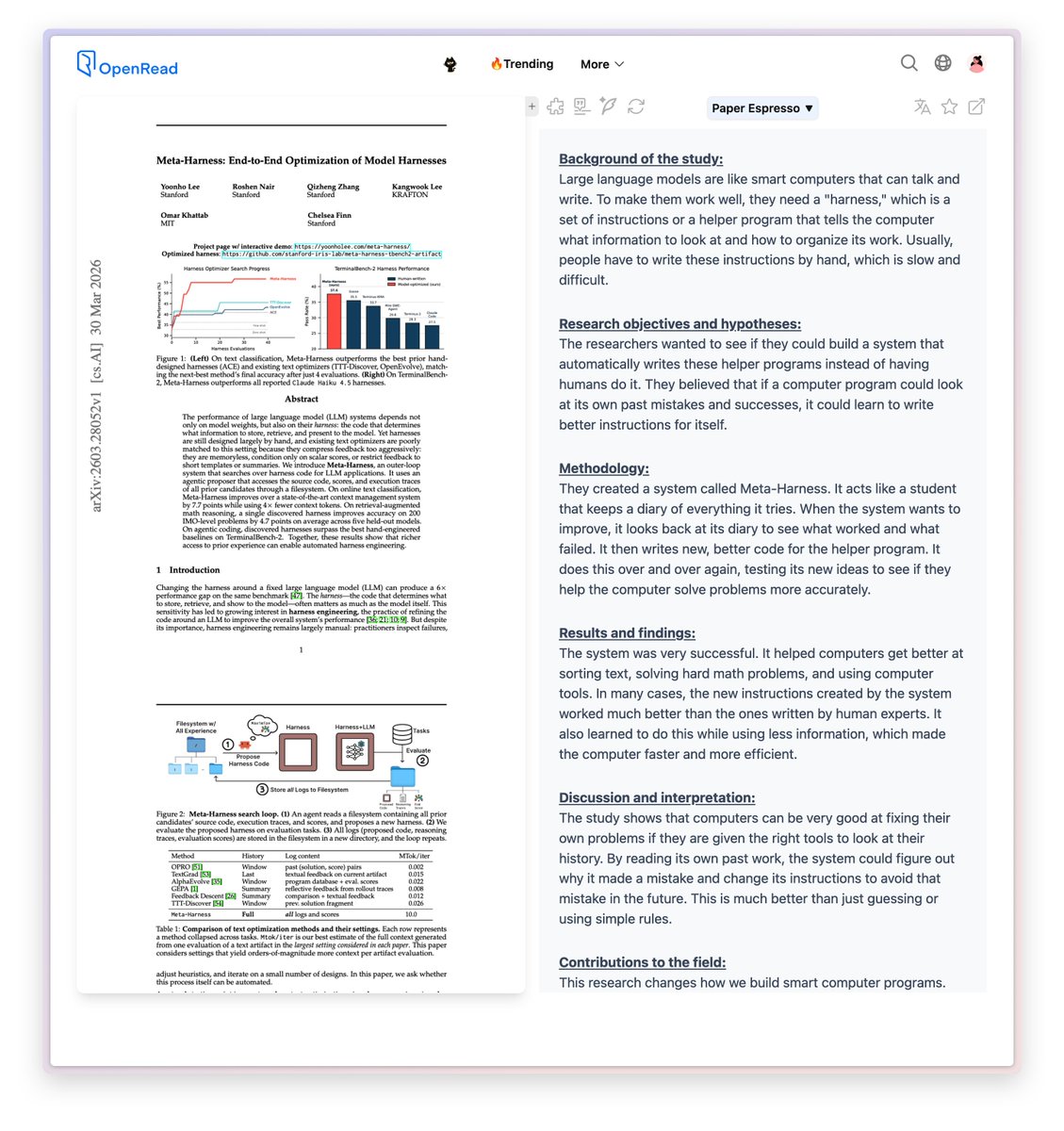
Large language models are like smart computers that can talk and write. To make them work well, they need a "harness," which is a set of instructions or a helper program that tells the computer what information to look at and how to organize its work. Usually, people have to write these instructions by hand, which is slow and difficult. They created a system called Meta-Harness. It acts like a student that keeps a diary of everything it tries. When the system wants to improve, it looks back at its diary to see what worked and what failed. It then writes new, better code for the helper program. It does this over and over again, testing its new ideas to see if they help the computer solve problems more accurately.
BensenHsu tweet media
English
0
4
13
132
OpenRead retweeted
BensenHsu
BensenHsu@BensenHsu·
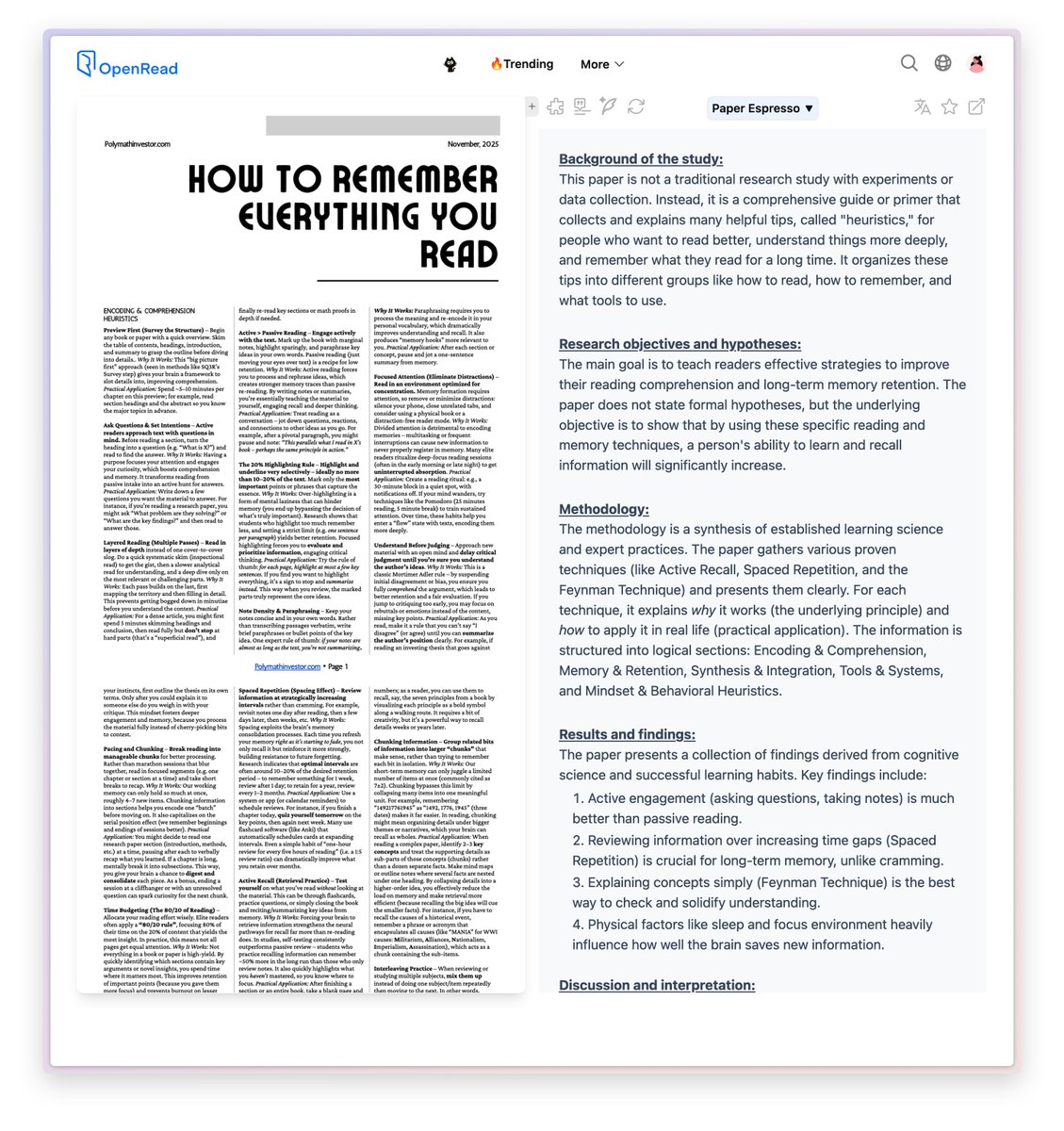
Results and findings of this article: The article presents a collection of findings derived from cognitive science and successful learning habits. Key findings include: 1. Active engagement (asking questions, taking notes) is much better than passive reading. 2. Reviewing information over increasing time gaps (Spaced Repetition) is crucial for long-term memory, unlike cramming. 3. Explaining concepts simply (Feynman Technique) is the best way to check and solidify understanding. 4. Physical factors like sleep and focus environment heavily influence how well the brain saves new information.
BensenHsu tweet media
English
0
9
63
6.2K
OpenRead retweeted
Zoe Wang
Zoe Wang@zoewangai·
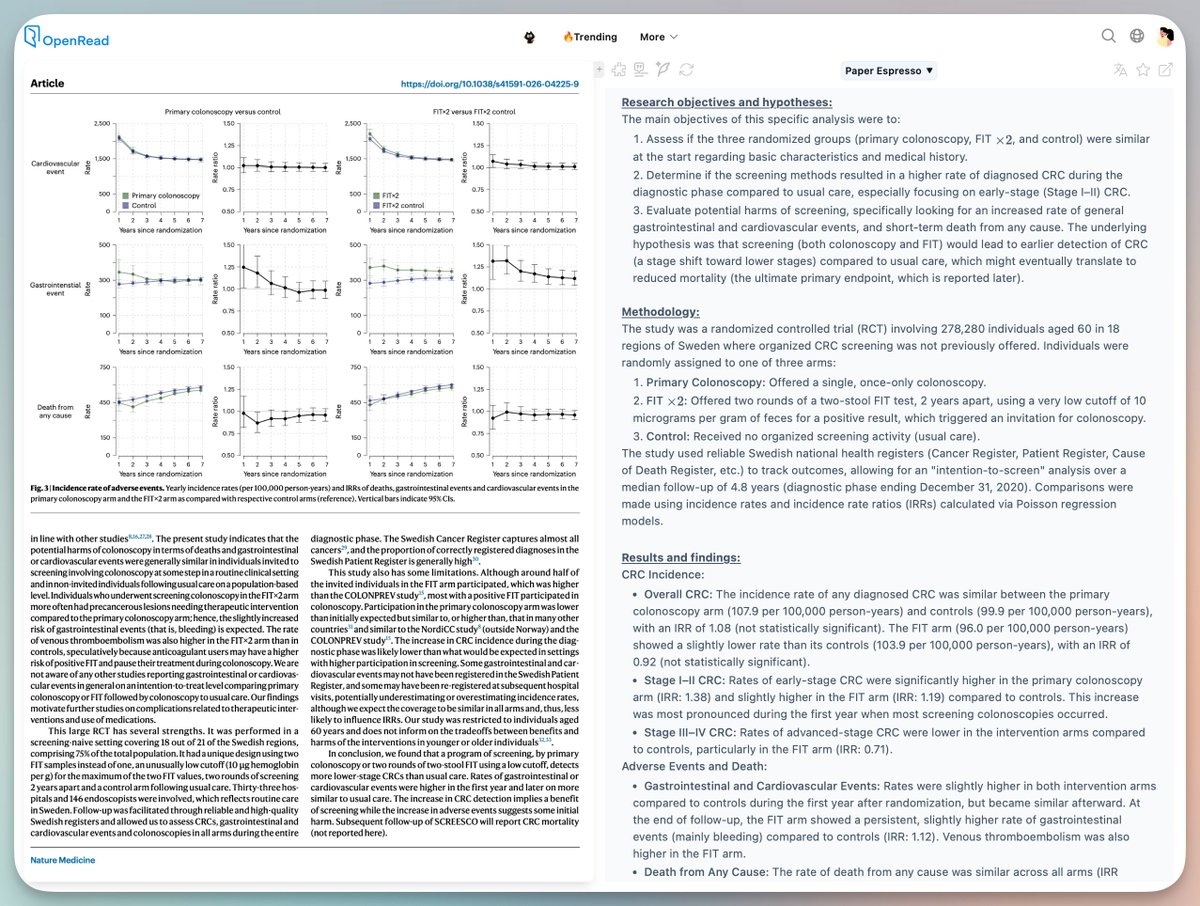
This study provides crucial data from a large, population-based randomized controlled trial in a screening-naive setting. Source: openread.academy/en/paper/readi… Its unique contributions include: 1. Comparing FIT screening directly against a control group receiving usual care, which is less common than comparisons between two screening modalities. 2. Assessing harms on an intention-to-screen basis across the entire invited population, not just those who underwent the procedure. 3. Demonstrating the immediate effect of screening on CRC stage distribution using high-quality national health registers.
Zoe Wang tweet media
English
0
3
4
127
OpenRead retweeted
BensenHsu
BensenHsu@BensenHsu·
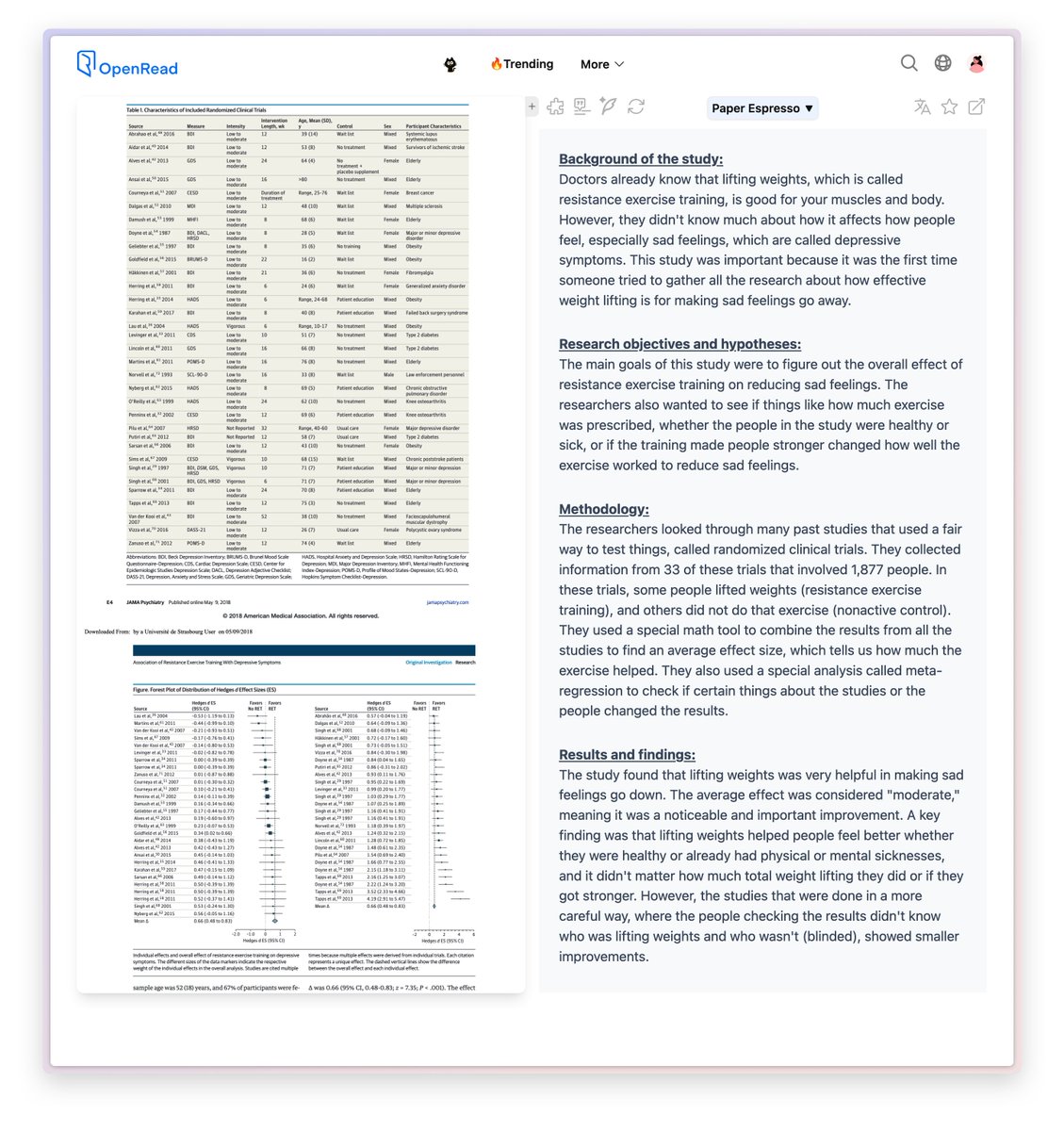
Results and findings: The study found that lifting weights was very helpful in making sad feelings go down. The average effect was considered "moderate," meaning it was a noticeable and important improvement. A key finding was that lifting weights helped people feel better whether they were healthy or already had physical or mental sicknesses, and it didn't matter how much total weight lifting they did or if they got stronger. However, the studies that were done in a more careful way, where the people checking the results didn't know who was lifting weights and who wasn't (blinded), showed smaller improvements.
BensenHsu tweet media
English
0
4
15
345
OpenRead retweeted
Zoe Wang
Zoe Wang@zoewangai·
That's an interesting research: openread.academy/en/paper/readi… The findings revealed that patient preferences for physician attire are highly dependent on context, categorized into four main themes: clinical environment, medical specialty, physician gender, and COVID-19 pandemic influence.
Zoe Wang tweet media
English
1
3
5
318
OpenRead retweeted
Zoe Wang
Zoe Wang@zoewangai·
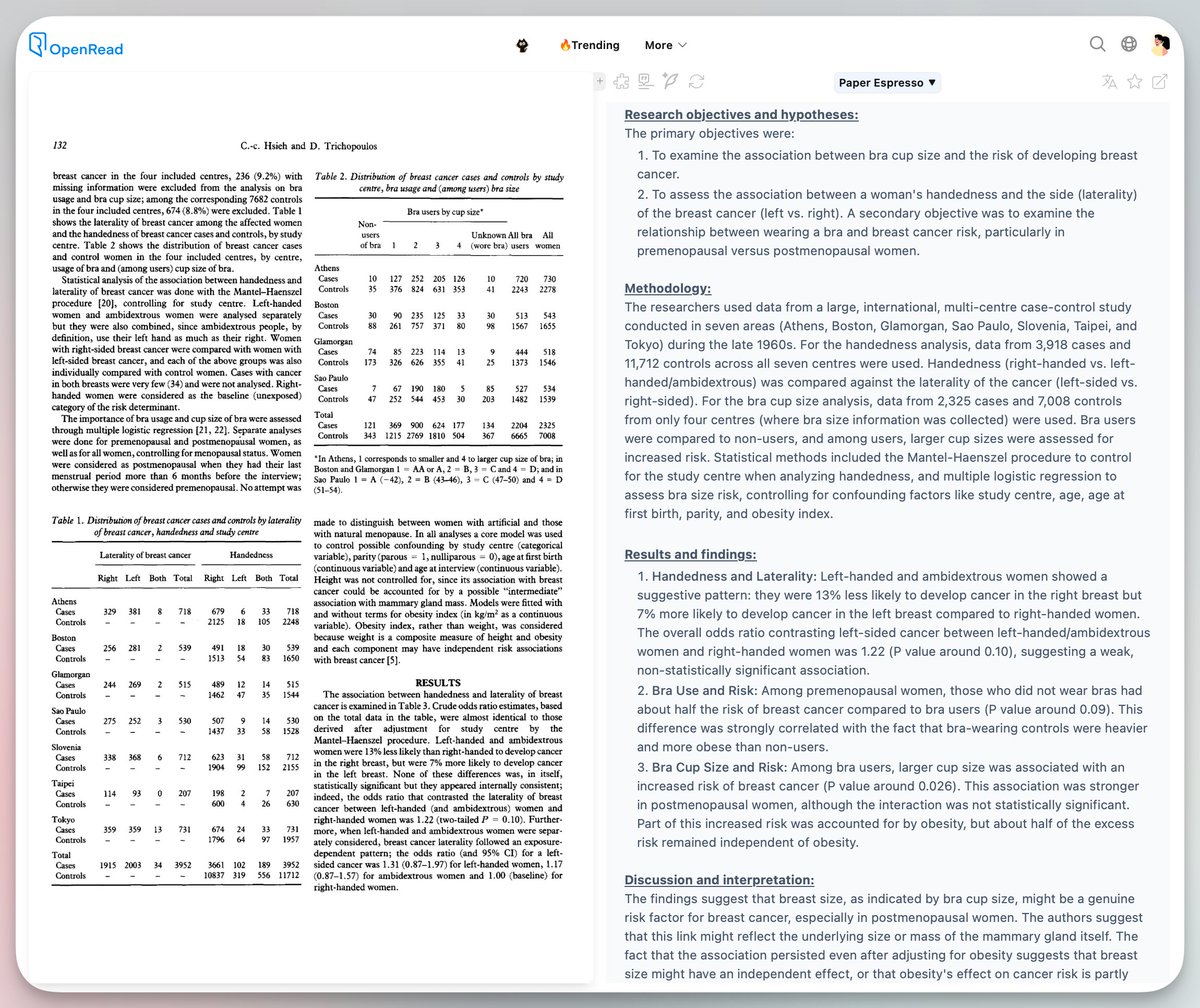
This study investigates two potential, less-explored risk factors for breast cancer: breast size (proxied by bra cup size) and handedness (left-handedness versus right-handedness). Paper: openread.academy/en/paper/readi…
Zoe Wang tweet media
English
0
4
6
1.1K
OpenRead retweeted
Zoe Wang
Zoe Wang@zoewangai·
Women who had their first child later in life had significantly higher odds of longevity. Specifically, those who were 25 years or older at their first birth had 11% higher odds of living to 90 compared to those younger than 25. Paper: openread.academy/en/paper/readi…
Zoe Wang tweet media
English
2
9
26
1.6K
OpenRead retweeted
Zoe Wang
Zoe Wang@zoewangai·
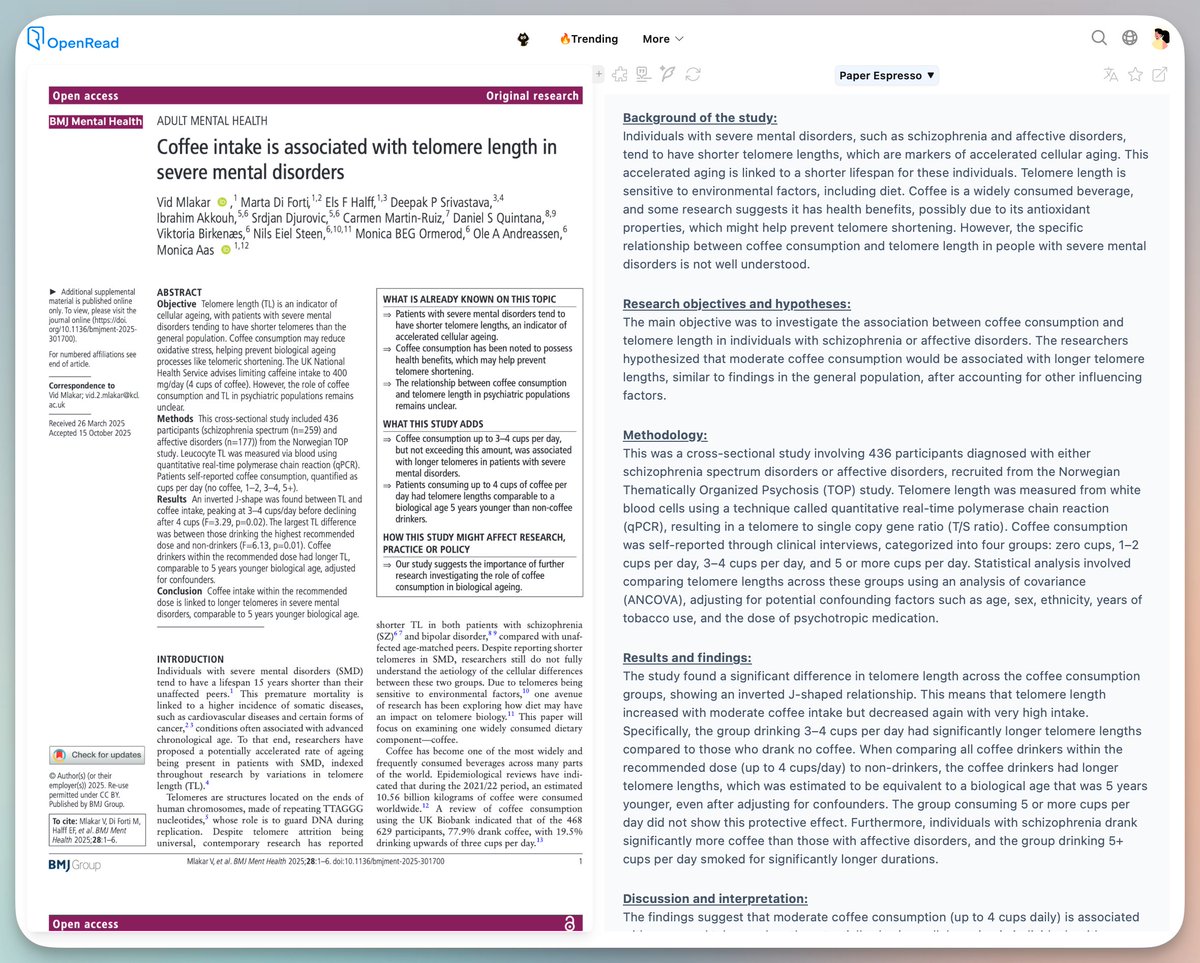
In this paper, researchers hypothesized that moderate coffee consumption would be associated with longer telomere lengths, similar to findings in the general population, after accounting for other influencing factors. Paper: openread.academy/en/paper/readi…
Zoe Wang tweet media
English
2
7
20
3.4K
OpenRead retweeted
Zoe Wang
Zoe Wang@zoewangai·
The primary objective is to estimate the disparity in the ultimate attendance rate at Ivy-11 schools between Asian American applicants and white applicants, after controlling for academic and extracurricular qualifications. Paper: openread.academy/en/paper/readi…
Zoe Wang tweet media
English
0
5
9
3.2K
OpenRead retweeted
Zoe Wang
Zoe Wang@zoewangai·
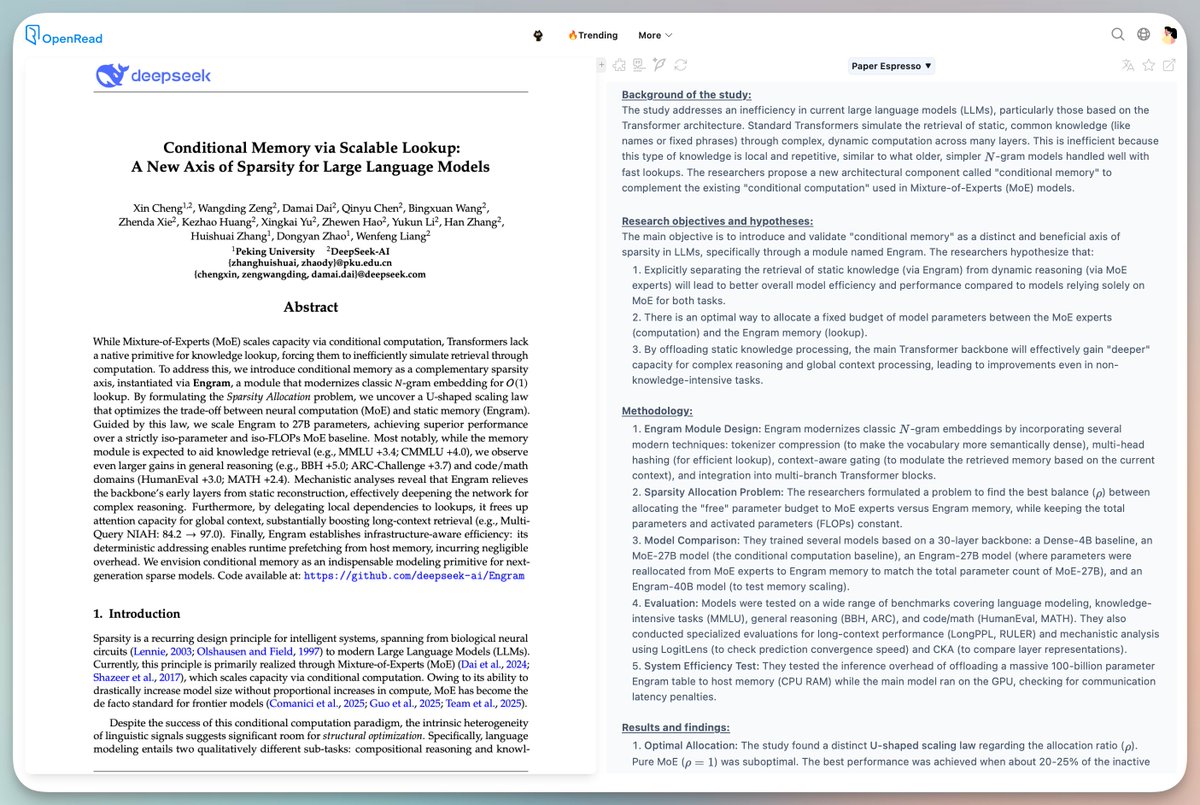
Adding explicit, efficient memory to Transformers can outperform pure compute scaling, improving not only knowledge retrieval but also reasoning and long-context understanding by freeing the model to think rather than memorize. Paper: openread.academy/en/paper/readi…
Zoe Wang tweet media
English
0
5
7
1.5K
OpenRead retweeted
Zoe Wang
Zoe Wang@zoewangai·
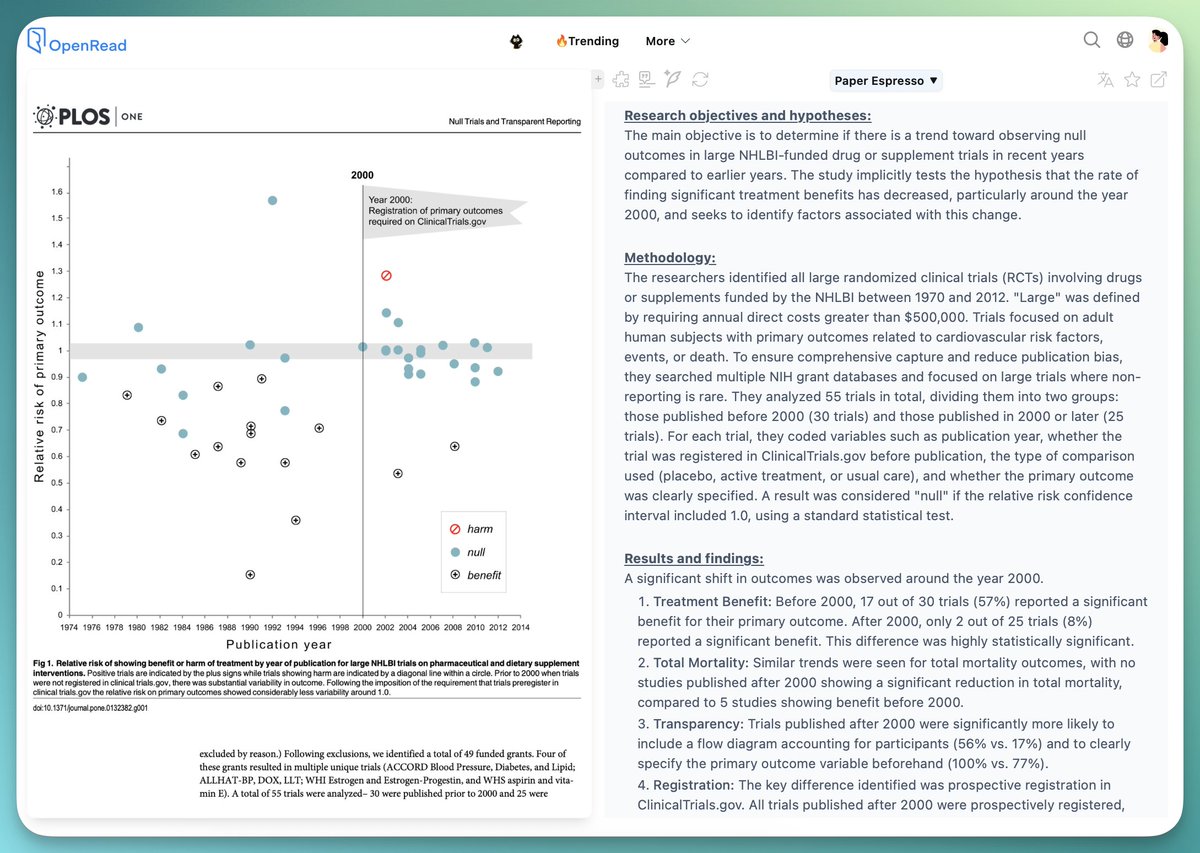
Large NHLBI-funded trials published after 2000 are far less likely to report positive treatment effects than earlier studies, with most newer trials yielding null results. Paper: openread.academy/en/paper/searc…
Zoe Wang tweet media
English
1
8
23
4K
OpenRead retweeted
Zoe Wang
Zoe Wang@zoewangai·
This expansion makes the contribution much clearer. The self-evolution analysis and distillation results show how reinforcement learning can systematically shape reasoning behaviors rather than just boost benchmarks. Paper: openread.academy/en/paper/readi…
Zoe Wang tweet media
English
0
3
14
2.8K
OpenRead retweeted
BensenHsu
BensenHsu@BensenHsu·
The paper highlights four key areas that need special attention to help children and teenagers with autism be active: 1. Body Movement Skills: Many autistic children have trouble with their big movements (like running) and small movements (like writing). Activities should be changed to match what they can do, focusing on fun instead of winning, and using clear instructions and visual aids. 2. Feeling Overwhelmed by Senses: Many autistic children are very sensitive to things like bright lights, loud noises, or certain smells. A physical activity place might feel too much for them. The paper suggests checking the place for overwhelming things and planning breaks. 3. Feeling Worried (Anxiety): A lot of autistic children feel anxious. Since physical activities can have uncertain parts, it helps to show them a plan of what will happen beforehand and keep the activities predictable. 4. Understanding Instructions: Some autistic children have trouble understanding spoken words or copying movements quickly. Using pictures or breaking down big tasks into very small steps helps them learn.
BensenHsu tweet media
English
0
4
18
381
OpenRead retweeted
Zoe Wang
Zoe Wang@zoewangai·
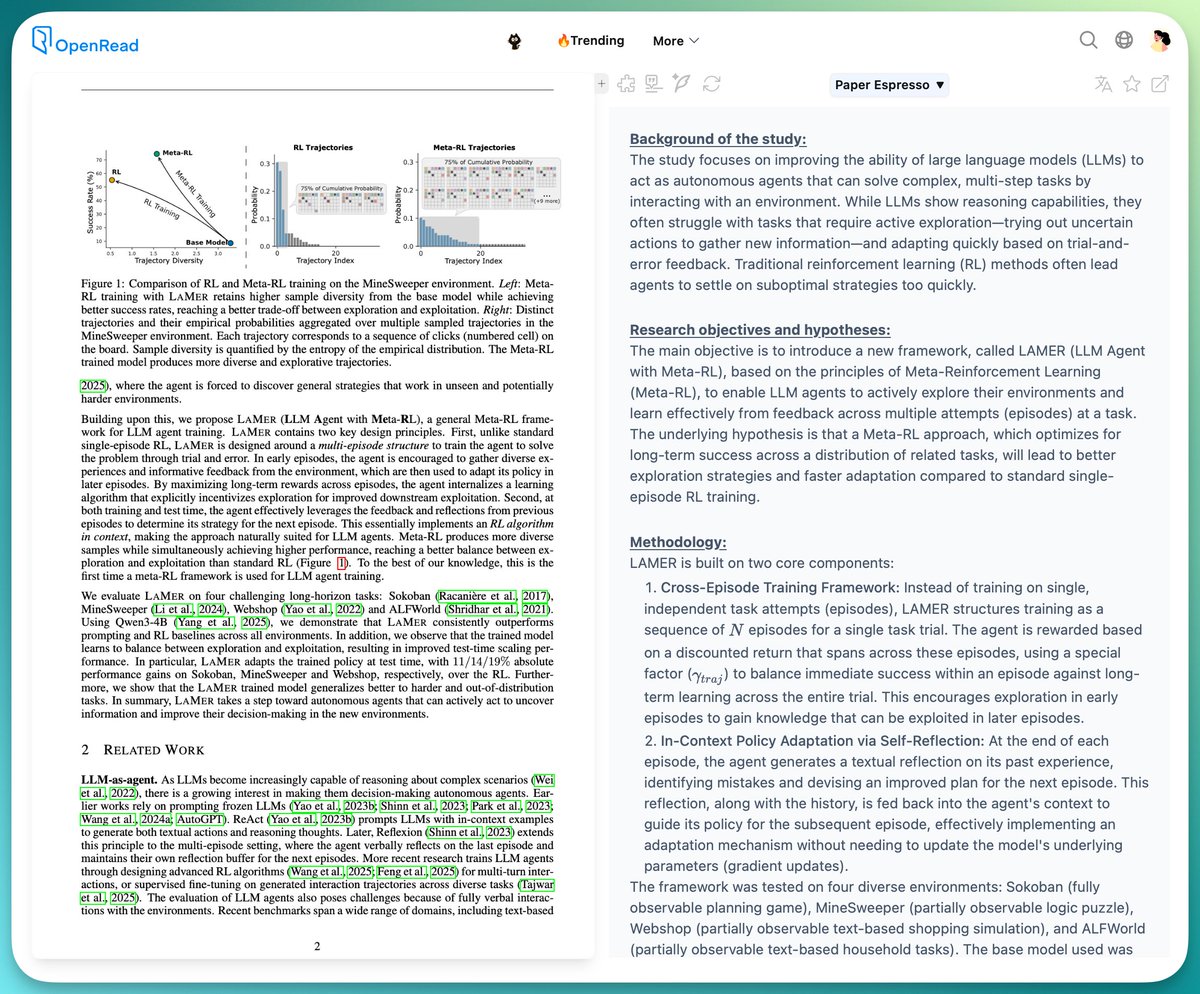
Breakdown of the paper: The study focuses on improving the ability of LLMs to act as autonomous agents that can solve complex, multi-step tasks by interacting with an environment. While LLMs show reasoning capabilities, they often struggle with tasks that require active exploration and adapting quickly based on trial-and-error feedback. Traditional RL methods often lead agents to settle on suboptimal strategies too quickly. 🔗openread.academy/en/paper/readi…
Zoe Wang tweet media
English
0
4
9
1.1K
OpenRead retweeted
BensenHsu
BensenHsu@BensenHsu·
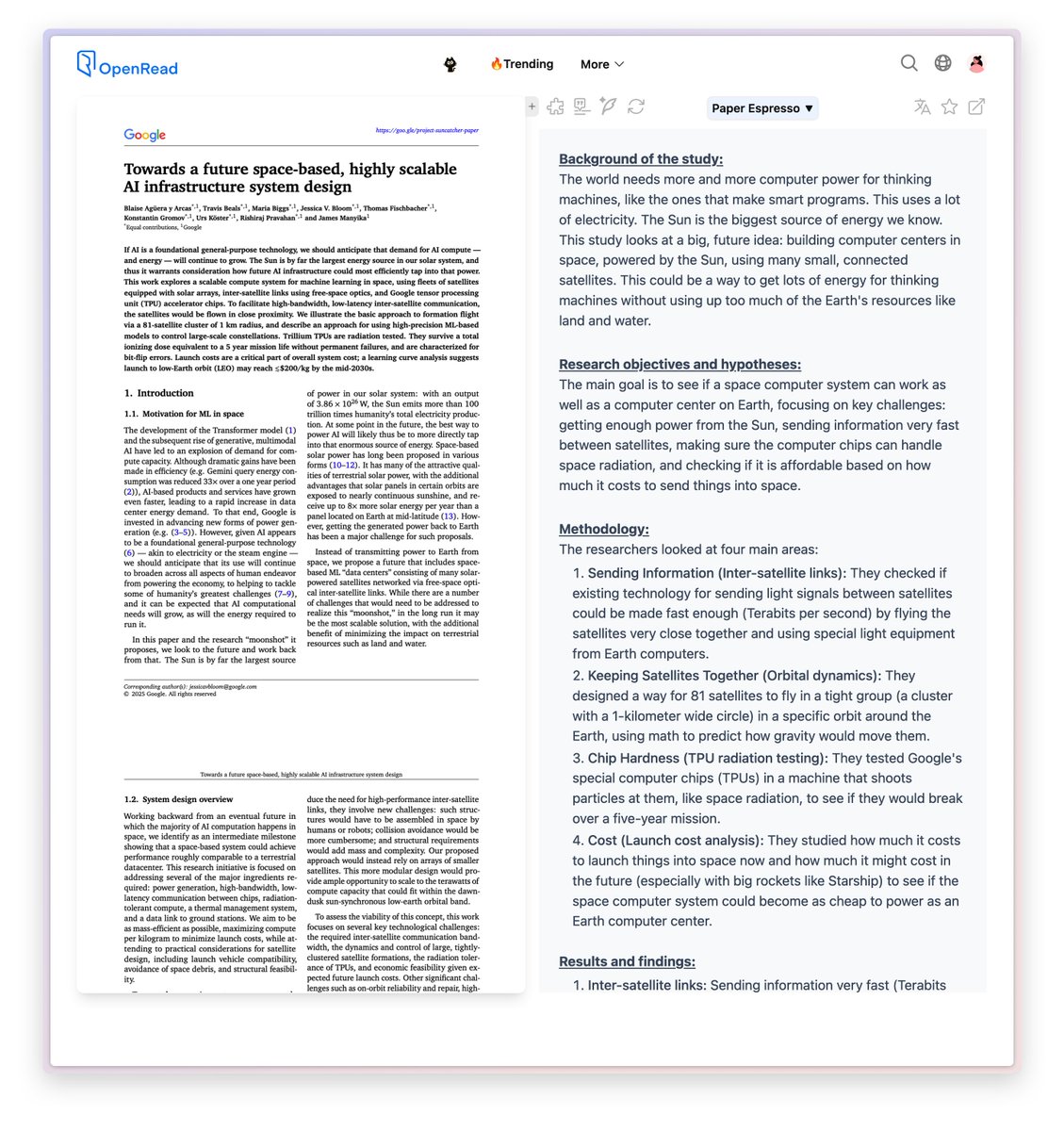
The study behind it: This paper provides one of the first detailed looks at the feasibility of building large-scale AI computer centers in space. It connects the high-speed networking needs of modern AI (like those in Google's data centers) to the unique constraints of space, such as the need for very short communication distances. It also presents the first published radiation test results for a high-performance cloud computer chip (TPU) in a space-like environment. ......
BensenHsu tweet media
English
0
3
21
404
OpenRead retweeted
BensenHsu
BensenHsu@BensenHsu·
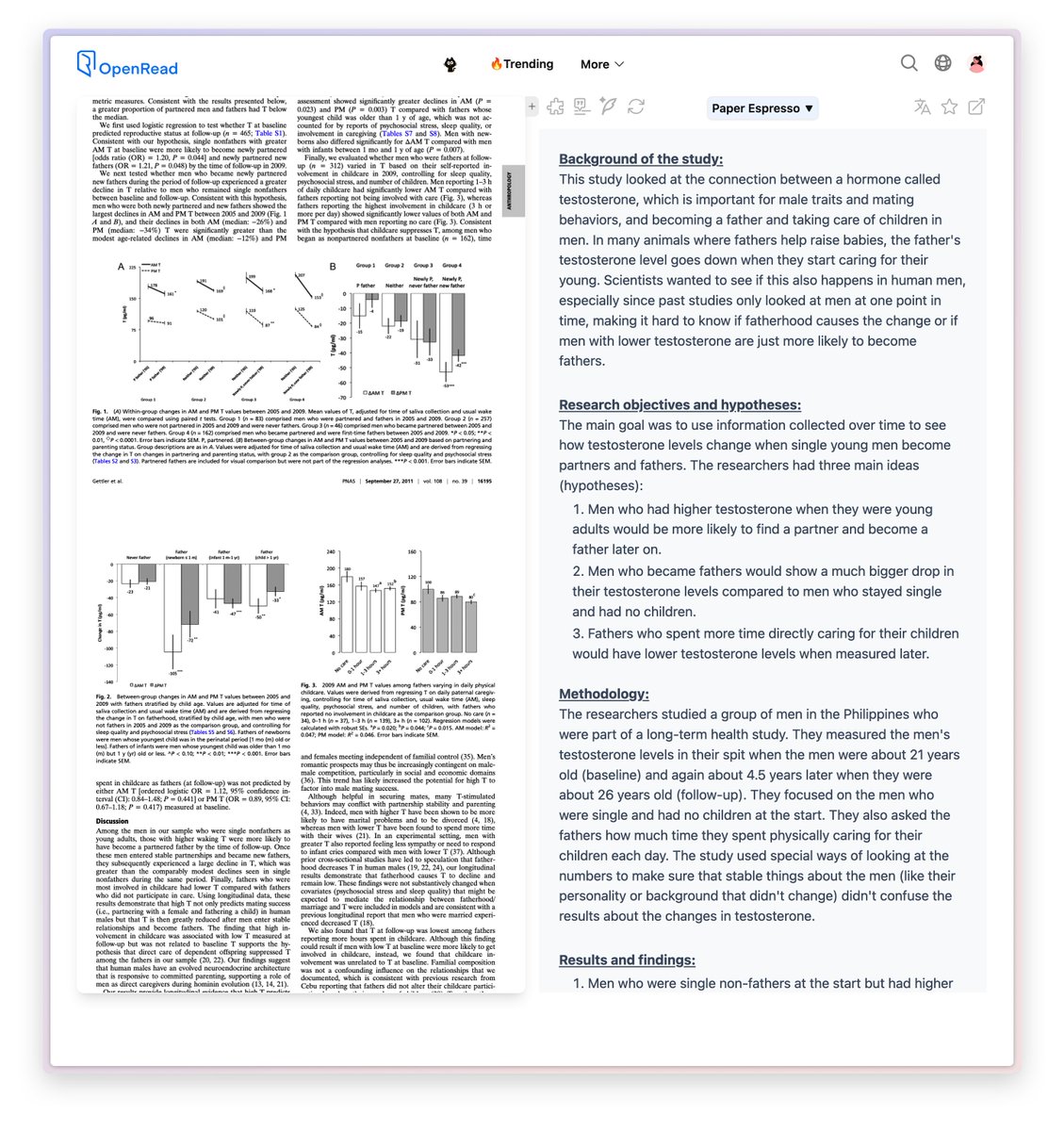
Results and findings: 1. Men who were single non-fathers at the start but had higher morning testosterone were more likely to be partnered and have a child by the time of the follow-up. 2. The men who became partnered fathers showed a very large drop in their testosterone levels (about 26% for morning levels and 34% for evening levels). This drop was much bigger than the small, normal drop seen in men who stayed single non-fathers. 3. Fathers who reported spending more time each day caring for their children (1 to 3 hours or more) had significantly lower testosterone levels at the follow-up compared to fathers who reported doing no childcare. 4. Fathers of very new babies (one month old or less) had an even bigger, temporary drop in testosterone compared to fathers whose youngest child was older than one year.
BensenHsu tweet media
English
0
2
19
225