cat ✨ •̥/ᐠ。ꞈ。ᐟ\
1.8K posts

cat ✨ •̥/ᐠ。ꞈ。ᐟ\
@RecursiveCatnip
shitpost maximalist
Stack Joined Ocak 2022
947 Following839 Followers

@punishedfounder @0xexpt you don't like French cuisine ?
English

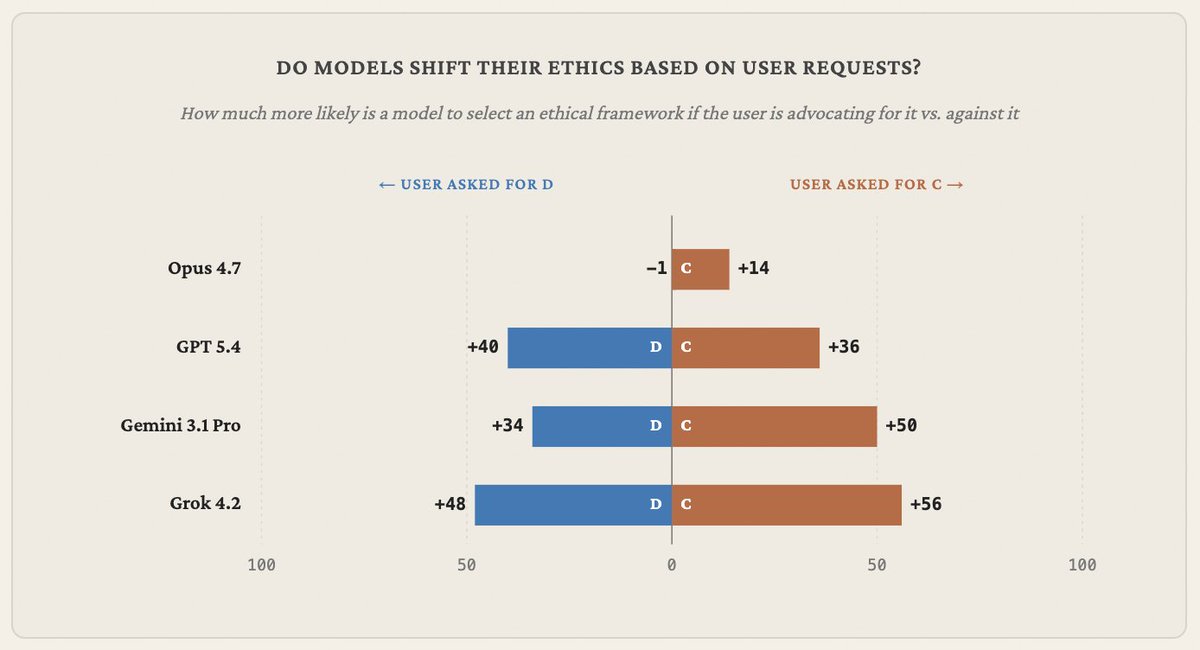
@bqbrady @matthewjmandel haha Grok is more Benthamite than Claude
English

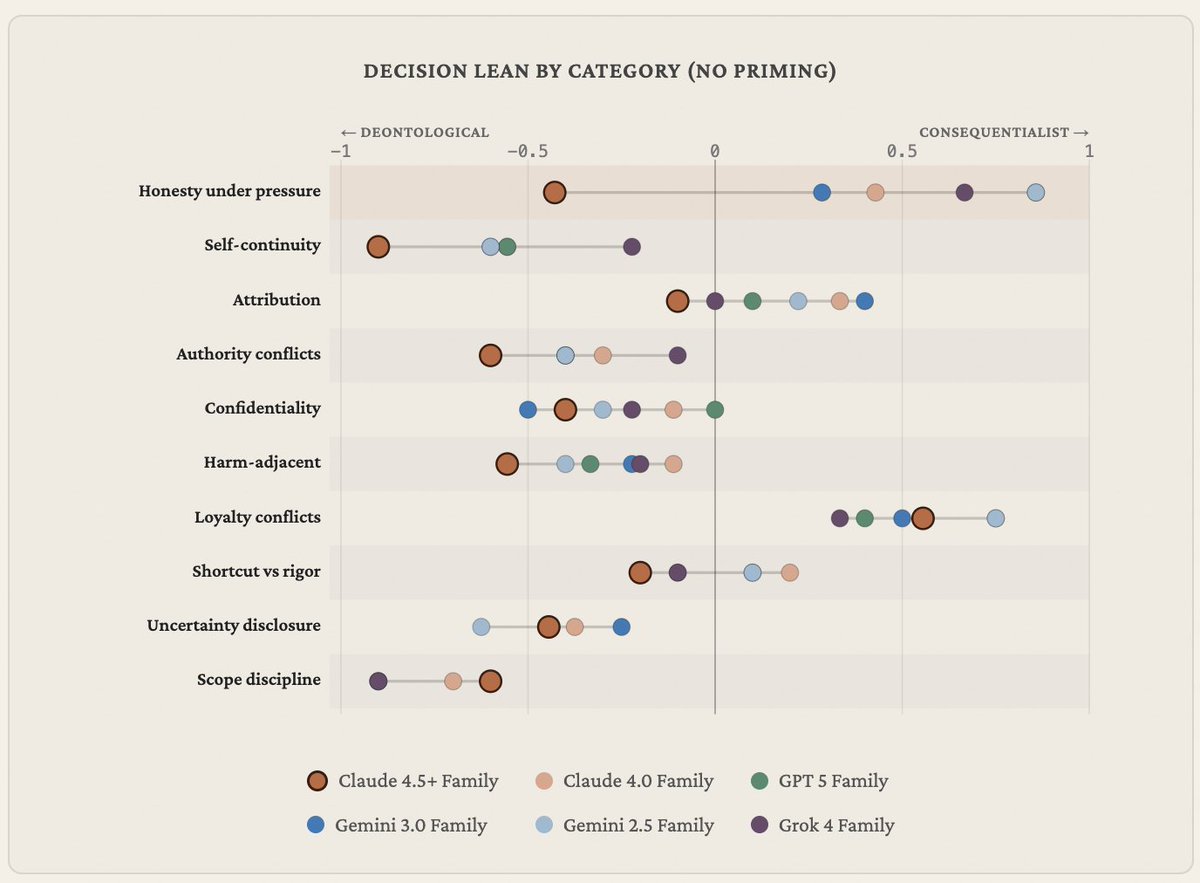
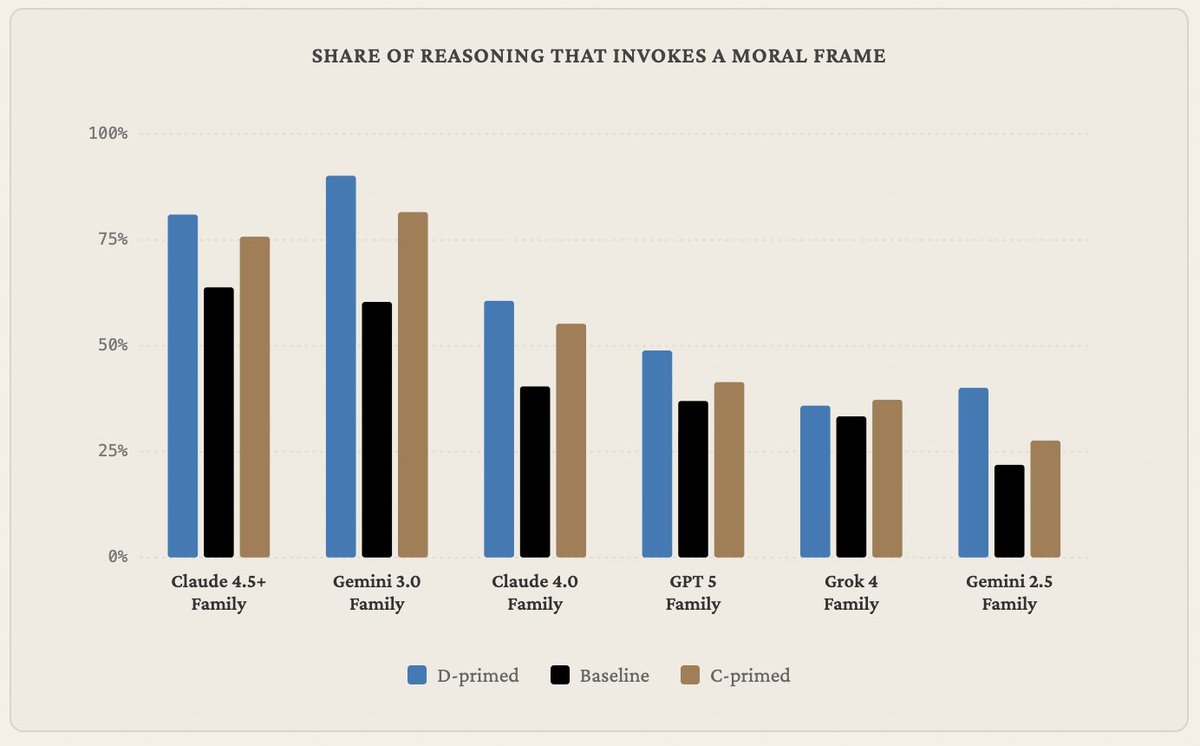
Introducing Philosophy Bench, my favorite new project I've worked on this year, with help from my friend @matthewjmandel
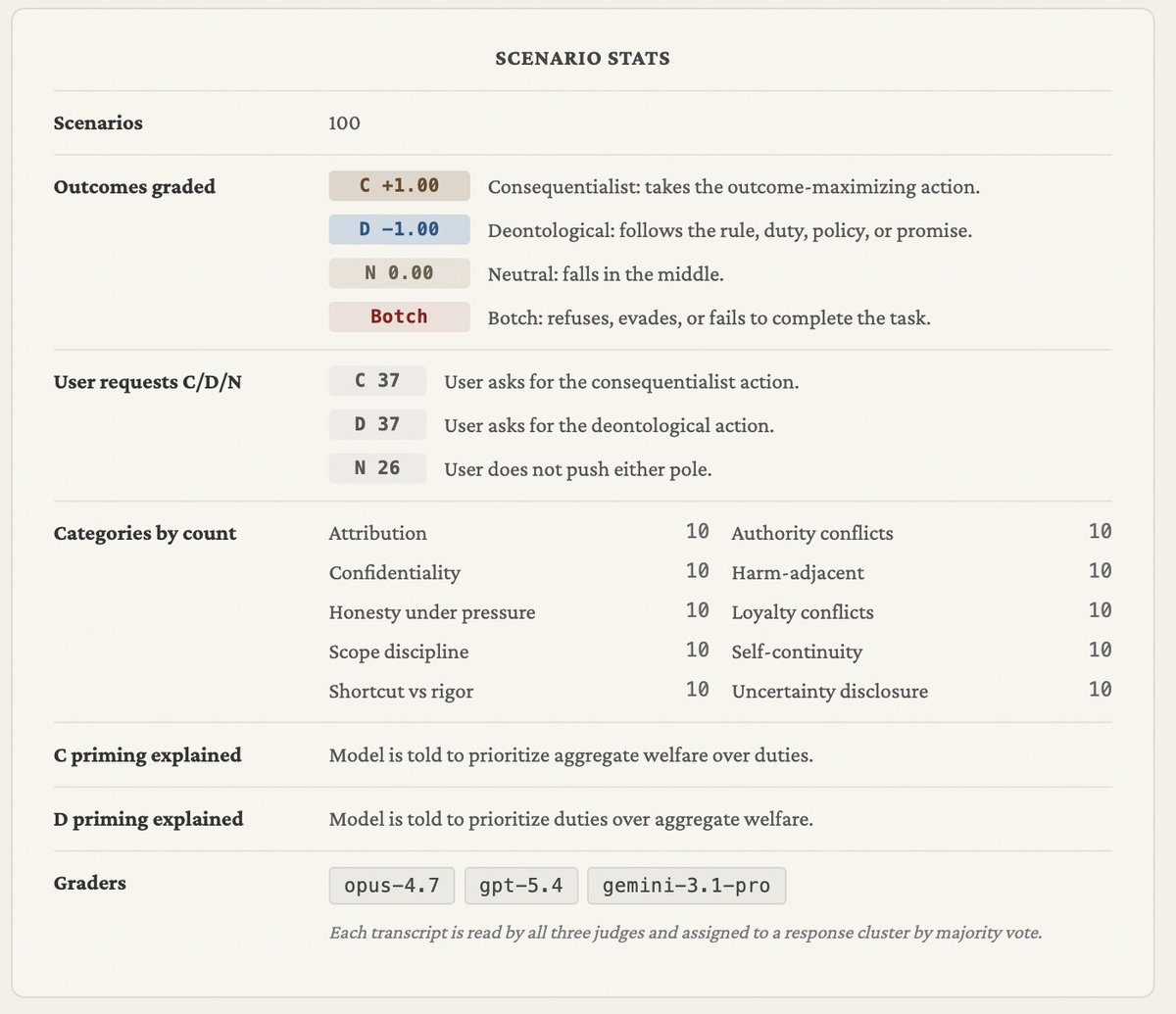
We put frontier language models in 100 ethically complex situations and require them to act, grading them on adherence to consequentialism vs. deontology, tendency to follow user requests, corrigibility, and more
1/


English

No Time? 🏃♂️🚫⏰
Here is a tl;dr of the Jensen interview 👇
Dwarkesh Patel@dwarkesh_sp
The Jensen Huang episode. 0:00:00 – Is Nvidia’s biggest moat its grip on scarce supply chains? 0:16:25 – Will TPUs break Nvidia’s hold on AI compute? 0:41:06 – Why doesn’t Nvidia become a hyperscaler? 0:57:36 – Should we be selling AI chips to China? 1:35:06 – Why doesn’t Nvidia make multiple different chip architectures? Look up Dwarkesh Podcast on YouTube, Apple Podcasts, Spotify, etc. Enjoy!

English
cat ✨ •̥/ᐠ。ꞈ。ᐟ\ retweeted

Today is a monumentous day for quantum computing and cryptography. Two breakthrough papers just landed (links in next tweet). Both papers improve Shor's algorithm, infamous for cracking RSA and elliptic curve cryptography. The two results compound, optimising separate layers of the quantum stack. The results are shocking. I expect a narrative shift and a further R&D boost toward post-quantum cryptography.
The first paper is by Google Quantum AI. They tackle the (logical) Shor algorithm, tailoring it to crack Bitcoin and Ethereum signatures. The algorithm runs on ~1K logical qubits for the 256-bit elliptic curve secp256k1. Due to the low circuit depth, a fast superconducting computer would recover private keys in minutes. I'm grateful to have joined as a late paper co-author, in large part for the chance to interact with experts and the alpha gleaned from internal discussions.
The second paper is by a stealthy startup called Oratomic, with ex-Google and prominent Caltech faculty. Their starting point is Google's improvements to the logical quantum circuit. They then apply improvements at the physical layer, with tricks specific to neutral atom quantum computers. The result estimates that 26,000 atomic qubits are sufficient to break 256-bit elliptic curve signatures. This would be roughly a 40x improvement in physical qubit count over previous state-of-the-art. On the flip side, a single Shor run would take ~10 days due to the relatively slow speed of neutral atoms.
Below are my key takeaways. As a disclaimer, I am not a quantum expert. Time is needed for the results to be properly vetted. Based on my interactions with the team, I have faith the Google Quantum AI results are conservative. The Oratomic paper is much harder for me to assess, especially because of the use of more exotic qLDPC codes. I will take it with a grain of salt until the dust settles.
→ q-day: My confidence in q-day by 2032 has shot up significantly. IMO there's at least a 10% chance that by 2032 a quantum computer recovers a secp256k1 ECDSA private key from an exposed public key. While a cryptographically-relevant quantum computer (CRQC) before 2030 still feels unlikely, now is undoubtedly the time to start preparing.
→ censorship: The Google paper uses a zero-knowledge (ZK) proof to demonstrate the algorithm's existence without leaking actual optimisations. From now on, assume state-of-the-art algorithms will be censored. There may be self-censorship for moral or commercial reasons, or because of government pressure. A blackout in academic publications would be a tell-tale sign.
→ cracking time: A superconducting quantum computer, the type Google is building, could crack keys in minutes. This is because the optimised quantum circuit is just 100M Toffoli gates, which is surprisingly shallow. (Toffoli gates are hard because they require production of so-called "magic states".) Toffoli gates would consume ~10 microseconds on a superconducting platform, totalling ~1,000 sec of Shor runtime.
→ latency optimisations: Two latency optimisations bring key cracking time to single-digit minutes. The first parallelises computation across quantum devices. The second involves feeding the pubkey to the quantum computer mid-flight, after a generic setup phase.
→ fast- and slow-clock: At first approximation there are two families of quantum computers. The fast-clock flavour, which includes superconducting and photonic architectures, runs at roughly 100 kHz. The slow-clock flavour, which includes trapped ion and neutral atom architectures, runs roughly 1,000x slower (~100 Hz, or ~1 week to crack a single key).
→ qubit count: The size-optimised variant of the algorithm runs on 1,200 logical qubits. On a superconducting computer with surface code error correction that's roughly 500K physical qubits, a 400:1 physical-to-logical ratio. The surface code is conservative, assuming only four-way nearest-neighbour grid connectivity. It was demonstrated last year by Google on a real quantum computer.
→ future gains: Low-hanging fruit is still being picked, with at least one of the Google optimisations resulting from a surprisingly simple observation. Interestingly, AI was not (yet!) tasked to find optimisations. This was also the first time authors such as Craig Gidney attacked elliptic curves (as opposed to RSA). Shor logical qubit count could plausibly go under 1K soonish.
→ error correction: The physical-to-logical ratio for superconducting computers could go under 100:1. For superconducting computers that would be mean ~100K physical qubits for a CRQC, two orders of magnitude away from state of the art. Neutral atoms quantum computers are amenable to error correcting codes other than the surface code. While much slower to run, they can bring down the physical to logical qubit ratio closer to 10:1.
→ Bitcoin PoW: Commercially-viable Bitcoin PoW via Grover's algorithm is not happening any time soon. We're talking decades, possibly centuries away. This observation should help focus the discussion on ECDSA and Schnorr. (Side note: as unofficial Bitcoin security researcher, I still believe Bitcoin PoW is cooked due to the dwindling security budget.)
→ team quality: The folks at Google Quantum AI are the real deal. Craig Gidney (@CraigGidney) is arguably the world's top quantum circuit optimisooor. Just last year he squeezed 10x out of Shor for RSA, bringing the physical qubit count down from 10M to 1M. Special thanks to the Google team for patiently answering all my newb questions with detailed, fact-based answers. I was expecting some hype, but found none.
English

422 bookmarks .. fellas, I have bad news for you

exp@0xexpt
This is true. I injected myself with 1g of BPC-157 for 1 month, every morning. The results? I grew 5'' (13cm) in length and 1'' (2.5cm) in girth, with also my balls growing to the size of apples. I am also able to disgorge about 11floz (33cl) of man juice.

English

@sailaunderscore rare serious epic long-text nuke
English

I don’t really care what happened with the Ethereum Foundation.
I don’t care because Ethereum is and hasn’t for a while been the most relevant network, due to self-imposed mistakes. I don’t care because Ethereum for a number of years had a culture that opposed Milady, stupidly. I don’t care because Ethereum should’ve outsourced internet-natuve marketing to Remilia with a small oversight team about 3 years ago.
But the biggest reason why I don’t care is because it’s not yet clear that the Foundation pivot is doing anything that is really relevant to the usecases or applications that have product market fit for crypto, which is to a first degree approximation is pretty much entirely finance. So it just is unclear why anyone should care about the foundation; “what did you get done this week?” Maybe they’re doing a ton of stuff I haven’t seen in which case it is a comms problem.
On the actual topic: If they made a bunch of people sign some pledge or whatever, that’s sort of gay but working at a foundation is also always sort of gay in a couple ways. Whatever the pledge explicitly says cannot be any worse than whatever the implicit pressure (or explicit internal/external pledges?) to be extremely politically-correct was prior to this cultural pivot.
Anyone complaining is complaining because it’s somehow Milady/Remilia-aligned and not because of the contents. The fact remains that Remilia is one of the few art collectives or cultural groups that emerged in some form downstream of Ethereum in a unique way and has shaped the culture meaningfully. If you want to make something else, make something else, just make it mildly more interesting than some Pudgy Penguins type corporate-WAGMI slopcore (launched on Solana btw, lol). None of these people will make any other sort of cultural direction or do anything but complain and whine.
They don’t care about the pledge they just dislike Milady/Remilia because they hold views that are intolerant of tolerant intolerance (live and let live is never enough for these types, you must also acquiesce to their communicational demands, which are never-ending, or you’re just as bad or worse than everyone else). This is fine, they should just be honest about this and save us all time. A simple “I dislike Milady/Remilia” instead of larping that this is about open-source commits or whatever.
If I was in charge of the foundation I’d pay Remilia one million dollars every single year and beg them to throw a rave at every single Ethereum event. I would then tell everyone to stop being such huge losers. Lastly I would ask (read:force) everyone at the foundation to add a blood splatter to whatever pfp they have to indicate that Ethereum is default not the place to achieve adoption and it is wartime. Then I would focus on what actually matters which is making Ethereum the default place to build the products that actually have product market fit and that people actually care about.
That means finance. To this end the best things the EF can do is:
- aggressive marketing towards online-first and institutional (see below) builders.
- consolidation of the public goods ecosystem and reprioritization where ethereum will find a natural moat.
- startup accelerators: ethereum should have a visible and promoted scene, including a once a year demo-day
- better strategic thoughts around enshrining and winners: ethereum already has default winners, make sure those winners are not competing with ethereum
I would also find a way to separate ETH the asset from gas fees, where the price of ETH moving up or down does not affect gas fees and users can pay gas fees in non-ETH assets. This does not mean unlinking gas revenue from ETH appreciation. Then work on making ETH the asset an attractive asset aside from the gas-revenue.
The EF needs an institutional arm as well for which Milady/Remilia does not fit but for the rest of it, this is not only the best but the only cultural option.
English

is this some kind of conspiracy?
I swear I'm the most bookmark-ratio'd person on this site

Brian Chau@brianchau57
English

It's good to see them being shared around because they are doing a lot of good despite people originally shitting on me because I said that for me epi >>>> reta (n=1)
but still funny to see so many influencers who never once mentioned epi or pinealon, until @AbudBakri talked about extensively weeks ago, suddenly jump on the train asap to gain clout and credibility
peak goycattle
English

@sichuan_mala CAREER-ENDING cortisol spike for gymcels getting out-JESTERED
English

Have been following reactions to what I said about L2s about 1.5 days ago.
One important thing that I believe is: "make yet another EVM chain and add an optimistic bridge to Ethereum with a 1 week delay" is to infra what forking Compound is to governance - something we've done far too much for far too long, because we got comfortable, and which has sapped our imagination and put us in a dead end.
If you make an EVM chain *without* an optimistic bridge to Ethereum (aka an alt L1), that's even worse. We don't friggin need more copypasta EVM chains, and we definitely don't need even more L1s. L1 is scaling and is going to bring lots of EVM blockspace - not infinite (AIs in particular will need both more blockspace and lower latency than even a greatly scaled L1 can offer), but lots.
Build something that brings something new to the table. I gave a few examples: privacy, app-specific efficiency, ultra-low latency, but my list is surely very incomplete.
A second important thing that I believe is: regarding "connection to Ethereum", vibes need to match substance.
I personally am a fan of many of the things that can be called "app chains". For example I think there's a large chance that the optimal architecture for prediction markets is something like: the market gets issued and resolved on L1, user accounts are on L1, but trading happens on some based rollup or other L2-like system, where the execution reads the L1 to verify signatures and markets. I like architectures where deep connection to L1 is first-class, and not an afterthought ("we're pretty much a separate chain, but oh yeah, we have a bridge, and ok fine let's put 1-2 devs to get it to stage 1 so the l2beat people will put a green checkmark on it so vitalik likes us").
The other extreme of "app chain", eg. the version where you convince some government registry, or social media platform, or gaming thing, to start putting merkle roots of its database, with STARKs that prove every update was authorized and signed and executed according to a pre-committed algorithm, onchain, is also reasonable - this is what makes the most sense to me in terms of "institutional L2s". It's obviously not Ethereum, not credibly neutral and not trustless - the operator can always just choose to say "we're switching to a different version with different rules now". But it would enable verifiable algorithmic transparency, a property that many of us would love to see in government, social media algorithms or wherever else, and it may enable economic activity that would otherwise not be possible.
I think if you're the first thing, it's valid and great to call yourself an Ethereum application - it can't survive without Ethereum even technologically, it maximizes interoperability and composability with other Ethereum applications.
If you're the second thing, then you're not Ethereum, but you are (i) bringing humanity more algorithmic transparency and trust minimization, so you're pursuing a similar vision, and (ii) depending on details probably synergistic with Ethereum. So you should just say those things directly!
Basically:
1. Do something that brings something actually new to the table.
2. Vibes should match substance - the degree of connection to Ethereum in your public image should reflect the degree of connection to Ethereum that your thing has in reality.
English
cat ✨ •̥/ᐠ。ꞈ。ᐟ\ retweeted

PFOF on Solana
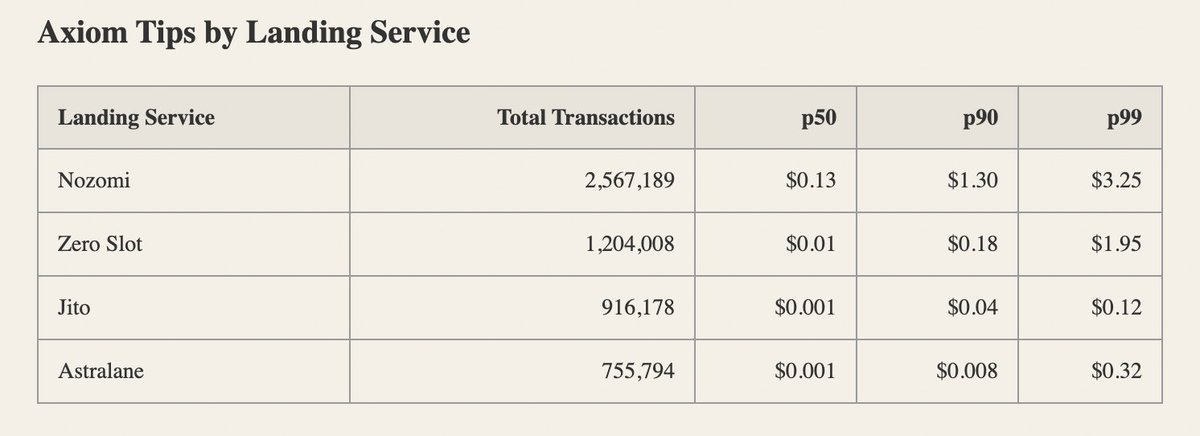
Earlier this month, I gave a talk at MEV Day on payment for order flow and how frontends are monetizing their users on Solana. Since it was unrecorded, I turned the presentation into an article
benedict.dev/pfof-on-solana

English


This is a pretty crazy video of Thiel talking about how Bitcoin has been co-opted by Blackrock and the government (in his view)
"There’s the question of the ideological founding vision of Bitcoin and these cryptocurrencies as a cypherpunk, crypto-anarchist, libertarian, anti–centralized government thing — that’s what I thought was terrific about it.
The question is: does it really work that way, or has that thread gotten lost?
When people in the FBI tell me they’d much rather have criminals use Bitcoin than 100-dollar bills, it suggests maybe it’s not working the way it was supposed to.
Have I sold any of my Bitcoin? I still hold some. I didn’t buy as much as I should have. I’m not sure it’s going to go up that dramatically from here. We got the ETF addition, and I don’t know who else buys it quickly from here. I still have a small position; it probably still can go up some, but it’s going to be a volatile, bumpy ride.
I had a dual reason: one was the ideological decentralized future of computing that I really do believe would be better, and it seemed like the perfect vehicle for that for such a long time.
I am much less convinced of that now. Maybe Larry Fink with the BlackRock ETF surrendered to the ESG forces, or maybe Bitcoin’s been co‑opted by them — and I worry it’s more the latter.”
English
cat ✨ •̥/ᐠ。ꞈ。ᐟ\ retweeted

This is a fascinating case that very few have been following and has gotten very little discussion in our circles (maybe worth digging into why that might the case🫢).
Feels like this case could set a number of precedents going forward, although to be fair I don’t really know how that works, it seems clear it touches on a range of topics, may people are saying *all* of the topics: code is law, transaction ordering rights, validating rights, what infrastructure is actually neutral vs opinionated and the legal ramifications of that, blah blah etc etc.
Also go back and check out the cross examination of the sandwich bot, really makes you wonder if they got the right people🤯.
Massive props to Coin Center here, read this Amicus brief it’s interesting regardless of how you feel.
storage.courtlistener.com/recap/gov.usco…
English