Ferran Casarramona
2.4K posts

Ferran Casarramona
@RoboticsFI
Gestor Robotics FI https://t.co/eYJjDfYtEZ
España Joined Nisan 2022
647 Following243 Followers
Pinned Tweet

Si quieres saber más del fondo que gestiono, puedes visitar la nueva página dedicada a él en AndBank.
andbank.es/boutiquehub/ro….
Español

España no tiene un problema de fertilidad. Tiene un problema de calendario.
En las clínicas de fertilidad que conozco bien, dentro y fuera de España, lo que veo todos los meses es lo mismo. La paciente española típica llega con 38, 39, 40 años. Llega tarde porque alquilar costó la mitad del sueldo, porque encadenó contratos temporales hasta los 35, porque su pareja también, porque pedir una hipoteca con 32 era ciencia ficción y porque nadie en España la felicitó nunca por querer ser madre joven.
Cuando llega, la biología ya ha decidido buena parte de la conversación. La reserva ovárica a los 40 no es la de los 30. Ningún protocolo, ninguna IA, ninguna donante, ningún congelado mágico revierte del todo lo que el reloj ya cobró. La medicina de la reproducción puede mucho, pero no puede devolverle a una mujer la década que el sistema le cobró en alquiler, en interinidad y en burocracia.
Por eso me parece deshonesto el debate público español sobre natalidad. Se habla de cheques bebé de 100 euros, de permisos parentales, de campañas. No se habla de lo único que mueve la aguja: que una pareja de 28 o 30 años pueda permitirse vivir, trabajar de forma estable y tener hijos sin pedir permiso al Estado para cada paso.
La tasa de fecundidad española está en torno a 1,1 hijos por mujer. Edad media al primer hijo, por encima de 32, la más alta de Europa junto con Italia. Eso no es un problema cultural. Es la consecuencia matemática de un país que ha hecho que tener hijos a tiempo sea un lujo.
La fertilidad asistida puede ayudar a muchas familias, y lo hace. Pero no es una política demográfica. Es un parche carísimo para un problema que se debería resolver veinte años antes, en el mercado laboral y en el de vivienda.
Español

El colapso demográfico y de las pensiones en Alemania. (O Europa en general)
@Jongonzlz
youtu.be/n-gYFcVx-8Y?is…

YouTube
Español
Ferran Casarramona retweeted

@carlesRP @cesarastudillo @XnewsCarpeDiemX @buttrscotchknif @esme_mys @ScienceExpand @Recuenco @imorenogallo Bienaventurados los que no saben, porque sentirán el gozo de aprender.
Español

@RoboticsFI @cesarastudillo @XnewsCarpeDiemX @buttrscotchknif @esme_mys @ScienceExpand @Recuenco @imorenogallo El problema es que aquesta gent es permet opinar, sense tenir cap estudi en el tema. I llavors, per simple aritmetica, els enginyers amb estudis com @imorenogallo queden en franca minoria davant d'aquest oceà d'estultícia...
Català

@cesarastudillo @XnewsCarpeDiemX @buttrscotchknif @esme_mys @ScienceExpand @Recuenco Como te lea @imorenogallo te estira de las orejas. 😂😂😂
youtu.be/tT2EwX4Q9z4?is…

YouTube
Español

@XnewsCarpeDiemX @buttrscotchknif @esme_mys @ScienceExpand @Recuenco Sí, luego le pregunté a Grok y resulta que los romanos sí hicieron sifones, aunque no de mucho desnivel
Español

@Recuenco Los datos pueden ser un buen yunque donde forjar el relato.
Español

GIF
Jaime Gómez-Obregón@JaimeObregon
Hoy he tenido el gusto de tomarme un café y conocer a @Jongonzlz 😃. Un tipo muy interesante y racional, al que da gusto escuchar. Hemos hablado de cómo los datos matan los relatos, y de la importancia para el país de tener un debate público con más razones y menos doctrinas.
ZXX

🦾 Skin in the AI game
This is a side of me I don’t usually share publicly: my investment thesis based on my vision of the future. Because investing is exactly that: a bet that we’ll be able to guess the future.
Go grab a coffee, ‘cause this one’s gonna be long. It’s been a while since I put this much effort into a thread:
1. 🔮 My predictions.
• AI and everything that supports it (GPUs, datacenters, etc) will keep growing exponentially and steadily over the coming years, impacting every field of human knowledge.
• In the near future, every work process that happens in front of a computer will be affected by AI (if not completely swept away). And soon after that, every process that happens away from a computer too, thanks to robotics. And when AI and robotics converge, we’re in for some very interesting times (hopefully not terrifying).
• Pay close attention to what I’m about to say, it might blow your mind: I believe software (and a big chunk of audiovisual entertainment) will become a commodity, like electricity. Which means all the digital tech value will be concentrated in just a few companies: those who win today’s multimodal LLM race and those who provide the infrastructure they run on. You might understand this better if you imagine a world where you can just say: “I want a SaaS like this site” or “make me a movie in this style with my dog as the main character” and an LLM creates it on the spot, with a quality far beyond today’s best productions. Basically, I believe all logic and visual layers will be run on advanced LLMs we can barely imagine today. So, building apps/webs/entertainment the way we do now will stop making sense, and the ability to do so will be concentrated in companies with the best LLMs and the compute power to run them at scale. We’ll choose between “AI providers” based purely on price, and not so much on features/capabilities (just like we do today with electricity companies; or like PS vs Xbox if they get some exclusive IPs that make a difference).
2. 💰 My general investment thesis.
• There will be investment opportunities in everything that drives this paradigm shift (AI itself), but also in things that will still exist with or without AI (like food, real estate, or tourism (though I won’t cover these here, even if they’re still interesting and I might invest in them outside the stock market).
• As for AI, I’ll invest in both the “gold hunters” 🥇 (the companies in the race to build the foundation models) and the ones selling picks and shovels ⛏️ (the companies building the hardware and infrastructure that make AI possible).
• Trying to “time the market” to find the perfect entry point is impossible. But there are some strong signs that the market is currently overvalued (see attached screenshot, data from CurrentMarketValuation).
• Concentrating your investment increases potential return, but also the risk. And vice versa.
3. 💸 My specific investment thesis.
• I want very high concentration in AI companies and everything that supports it, both in pre-IPO and in public markets.
• I think not only the US, but also China, will play a huge role in AI’s future. I have less faith in my dear Europe, because of its obsessive regulatory spiral and its ink-stained bureaucrats. Yes, I believe the US and China will devour the AI pie. But with China I sadly assume regulatory risks, so I won’t go above 10%-20% exposure in my portfolio.
• I don’t want to go all in at once in case the market is, in fact, overvalued: so I’ll be investing through monthly/quarterly contributions (TBD) over the next 5-6 years. In other words, I’ll avoid Lump Sum and follow a DCA (Dollar-Cost Averaging) strategy. This also lets me easily tweak the strategy later through future contributions if my portfolio drifts off course. Detail: historically, Lump Sum performs better... except when you hit the market at its peak. And since all signs point to us being maybe too high right now, I don’t want to risk it.
• But I don’t do trading. I actually DON’T believe in trading. Over 90% of active traders underperform the market in the long run. Even professional fund managers can’t consistently beat a simple index like the S&P 500 or MSCI World. So my plan is to build the portfolio over time, according to the weights in the screenshot, and never sell (unless I ever really need the cash). If anything, if I see the market drop hard, I’ll “buy the dip” and invest 2x or 3x the regular amount to take advantage of the discounts.
• Related to the above: author funds and picking individual stocks usually perform worse on average than simply indexing. So I want at least 70% of my portfolio to be indexed. But I’ll trust my own judgment and pick a few individual ones (30% of the portfolio). Again, I’m not planning to buy and sell often, just enter regularly over time.
• TER (fees) of funds and ETFs are super important and should be studied carefully. If not, they’ll eat you alive long-term. I’ve looked for the best products that match my thesis, but also the cheapest ones.
• I prefer accumulation over distribution for tax efficiency (I want at least 75% of my portfolio in accumulation stocks/ETFs). Long live compound interest!
• In Spain, moving between funds doesn’t trigger taxes (until you sell). The only downside is that fees are several points higher. But I want to keep at least a portion in funds so I can move things around easily and tax-free if needed.
• I think some of the best opportunities aren’t in public markets, but in pre-IPOs. I’ve managed to get into OpenAI, xAI, SpaceX, Freepik and Canva. I’d love to get into Anthropic, Inflection AI, Cohere, Hugging Face, Cerebras and Midjourney if I ever get the chance. If the stock market is already risky, the barrier to entry and risk for pre-IPOs or startups is way higher.
4. 🤯 Key risks to keep in mind.
• If you run this investment thesis through Gemini, Grok or ChatGPT’s deep research mode, their heads will explode 😂 (yep, I’ve tried them all, of course, I actually built this AI-focused portfolio partly using AI). Any LLM will lose its mind over the extreme AI concentration in this portfolio. If you concentrate, you increase risk but also potential return. If you diversify, you reduce risk but also reduce returns. I chose the former and I’m okay with the risks.
• “IE00BLRPRL42 (similar to TQQQ but accumulation)”: not for the faint of heart. It’s leveraged 3x, can go up fast... but also vanish at the speed of light.
• Cathie Wood’s ARKs are risky by nature. “Author ETFs” tend to underperform index funds, so they’re a risky bet on extreme concentration.
• KSTR is a Chinese AI companies ETF. Many are opaque, government-dependent, and vulnerable to sanctions or bans.
• The fact that I chose to enter gradually (DCA) means I’ll need to stay alert and rebalance in the future, sell duds before they crash and keep an eye especially on author ETFs and individual stocks. No one wants a 3dfx or a BlackBerry in their future portfolio... but it’s sooo easy to end up with one!
5. 🦄 Disclaimer: this is *definitely* not investment advice.
These are just my personal predictions about the future (which I might totally get wrong, because predicting the future is nearly impossible) and my investment thesis based on those predictions, which I decided to share. You’d be nuts to take this as investment advice. Everyone should make their own decisions.
So... how’s your brain doing after all that? Can’t wait to hear your thoughts!


English

¿Y por qué no 40, y sin presupuestos ni parlamento operativo?
EFE Noticias@EFEnoticias
Sánchez descarta un adelanto electoral y apuesta por ocho años más de Gobierno progresista. efe.com/espana/2026-04…

Español

@SamuelRomAporta Tokio y área metropolitana son 37 millones.
Eso sí, transporte público super eficiente y muy extensivo.
Coches, prohibido aparcar en ninguna calle, solo parkings.
Eso sí, los soterramientos, los justos y necesarios.
Español

@RoboticsFI Es muy difícil sacar esa conclusión. Porque el crecimiento de las ciudades se dio en paralelo al crecimiento industrial en todos los ámbitos: instalaciones, sanitarias, de alimentación, etc.
Pero, con el desarrollo actual, el tamaño de las principales ciudades es insostenible.
Español

@SamuelRomAporta Muy interesante.
La contra es que cuando mayores son las ciudades más productivas y ricas son, y en la antigüedad, la densidad de las ciudades era horrorosa.
x.com/i/status/18063…
Ferran Casarramona@RoboticsFI
Las mejoras de la movilidad permiten crecer las ciudades y, a la vez, disminuir su densidad. En el S. XVII, la densidad de París, era 4 veces superior a la de Manhattan. Las diferentes tecnologías de movilidad permitieron crecer a la ciudad y hacerla más habitable.
Español

@AlexBallarin76 @Jongonzlz Las empresas ya han subido el salario para compensar la inflación. Por eso los trabajadores pagan más de IRPF, y tienen menor poder adquisitivo.
Español

@Jongonzlz A ver @Jongonzlz, lo que se sobreentiende es que:
1) el estado se está lucrando con la no deflactación,
2) los trabajadores ingresan menos, ergo...
3) hay que bajar impuestos
Mi pregunta es: ¿POR QUÉ LAS EMPRESAS NO SUBEN SALARIOS (ni su productividad) para compensarlo?
Español
Ferran Casarramona retweeted

Sci-Hub is an evil website that pirated 85M+ research papers and made them freely available
And now they've added AI to their database to make Sci-Bot.
It answers your questions using latest, full-text articles.
But DO NOT use it. We should all try to make billion-dollar academic publishers richer.
I'm putting the link below so you know how to avoid it.
English

@cesarastudillo @Godivaciones A falta de una teoría sólida del ser humano, es lo que nos dice la experiencia.
Acepto pruebas mejores.
Español

@RoboticsFI @Godivaciones No, hombre, eso es un post hoc ergo procter hoc de libro
Español

@cesarastudillo @Godivaciones El 99% de la historia humana se ha desarrollado en un entorno de crecimiento 0, o prácticamente 0.
Y ya sabemos a qué conduce eso: prevalencia del fuerte, eliminación del débil, utilitarismo extremo y tribalismo.
Español

@RoboticsFI @Godivaciones Sí, ese es uno de los muchos dilemas de una hipotética economía estacionaria.
Español

@root_rat @cesarastudillo Y mucho tiempo libre.
Me recuerda a mi cuando implementé el control de un motor paso a paso en un PC a través de los pines del puerto paralelo. Assembler + C.
Es lo que me atrajo de la informática. Te ponía el "do It" al alcance de la mano (si tenías tiempo suficiente).
Español

@cesarastudillo Y no solo motores cohete… con eso y un cnc… una multi capa para imprimir pcb, una cortadora láser industrial… Y MUCHAS GPU’s …
Español

@cesarastudillo @Godivaciones Está al servicio de las pensiones.
Español

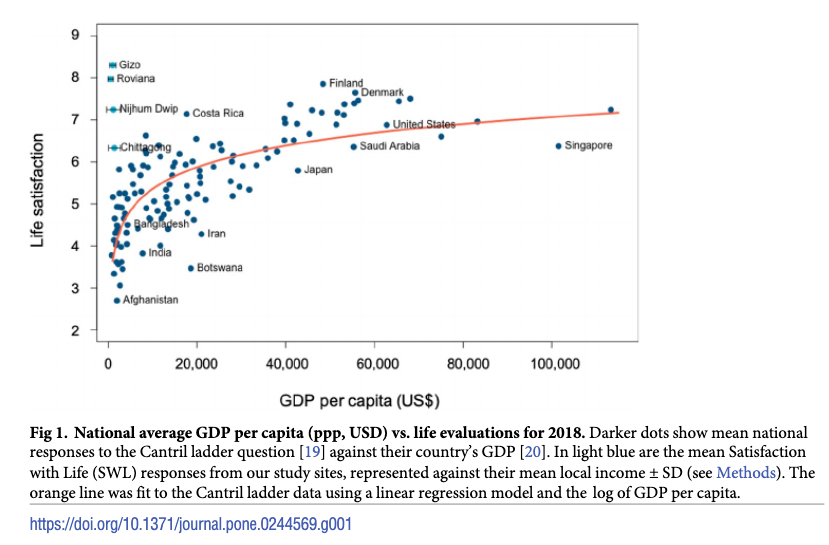
@RoboticsFI @Godivaciones El PIB per capita y la satisfacción con la propia vida correlan hasta un umbral de suficiencia; a partir de ahí más PIB per capita no conduce a más bienestar. ¿Al servicio de quién está el crecimiento económico como doctrina?
researchgate.net/publication/34…

Español