The Rogue Signals
368 posts

The Rogue Signals
@TheRogueSignals
The signals others miss 📡 Real-time geopolitical & energy risk analysis Geopolitics · Markets · Technology
Joined Mart 2026
14 Following90 Followers
Pinned Tweet

The second-order effect matters more.
Disruptions in Gulf supply don’t just raise prices.
They reshuffle market share.
Russia doesn’t need to win the war.
It just needs Middle East instability to persist.
Higher prices + alternative supply demand = revenue leverage.
Energy wars rarely have direct winners.
But they always create indirect ones.
English

Russia is capitalizing on the Iran War:
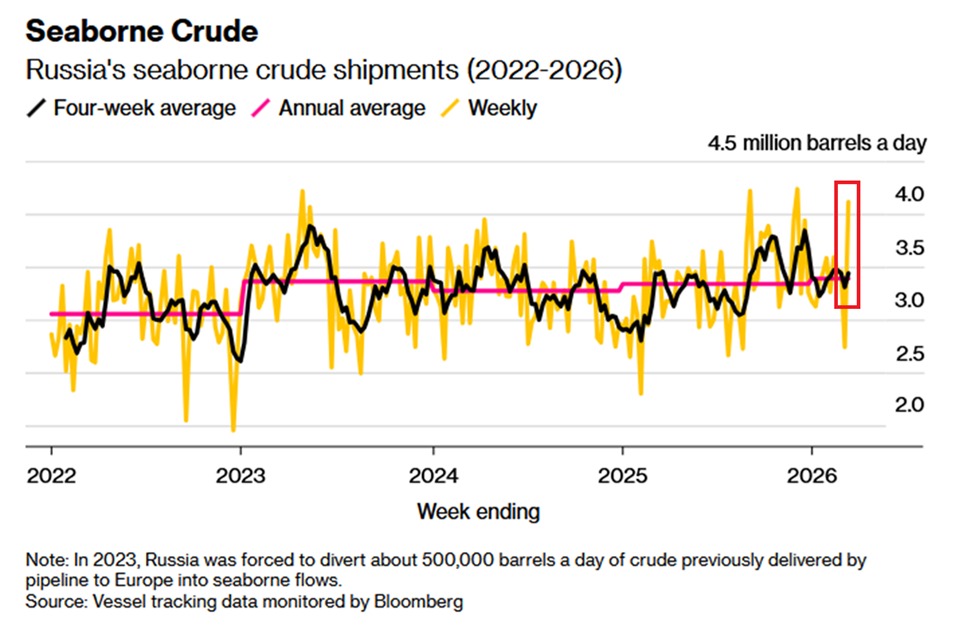
Last week, Russian seaborne crude oil shipments rose to 4.11 million barrels per day, the 3rd-highest weekly reading since April 2023.
This brings the 4-week average to 3.44 million barrels per day, up +90,000 barrels per day from the prior week.
This comes as soaring oil prices and a 30-day US sanctions waiver on Russian crude sitting on tankers have fueled the surge in exports.
Meanwhile, prices for Russian crude delivered to India hit an all-time high.
Combined with rising export volumes, this drove Russia's largest weekly revenue increase since the start of the Russian invasion of Ukraine.
Russia is emerging as one of the biggest beneficiaries of the Iran War.

English


Beyond the immediate geopolitical escalation, the real long-term impact may be energy infrastructure damage.
Losing ~12.8 mtpa of LNG capacity for potentially 3–5 years could reshape global gas supply balances far beyond this conflict.
Wars escalate fast.
Energy capacity takes years to rebuild.
English


@sardesairajdeep The key issue may not just be the 17% loss.
It’s the duration.
LNG facilities are complex industrial infrastructure. Losing ~12.8 mtpa for 3–5 years affects global energy balances well beyond the immediate conflict.
Wars move prices.
Infrastructure damage reshapes markets.
English

Big: Iran's attack has wiped out 17% of Qatar's LNG capacity for up to 5 yrs, says QatarEnergy CEO. Terrible news for us in India and the world . Just one more reason why this crazy war must STOP! #SayNOtoWar
English


The key issue may not just be the lost volume.
It’s the repair timeline.
LNG trains aren’t easily replaceable infrastructure. If ~12.8 mtpa remains offline for 3–5 years, this shifts global LNG balances structurally.
Short disruptions move prices.
Multi-year capacity losses reshape markets.
Full breakdown below
English

🚨🚨🚨 IRAN JUST HIT THE WORLD'S LNG HUB. HERE IS EVERY COUNTRY THAT IS NOW SCREWED.
One missile hit Ras Laffan, Qatar last night.
12.8 million tons of LNG per year just disappeared from the global supply chain for 3 to 5 years.
Here's who gets hit hardest:
🇶🇦 Qatar — lost 17% of all LNG export capacity overnight. $20 billion in annual revenue gone.
🇩🇪 Germany — 14% of Europe's LNG comes from Qatar. Already paid the price after Russia. Now this.
🇫🇷 France — TTF gas futures up 35% today. Heating bills going up before next winter.
🇬🇧 UK — European gas prices surged 35% in one day. Energy inflation is back.
🇮🇳 India — 60% of LNG imports came from Qatar and UAE in 2025. Can only replace about half.
🇯🇵 Japan — one of Qatar's biggest LNG buyers. Now competing against Europe for whatever's left.
🇰🇷 South Korea — same situation as Japan. Emergency diversification in progress.
🇨🇳 China — gets a third of its oil through the Strait of Hormuz. Now EFFECTIVELY CLOSED.
🇸🇦 Saudi Arabia — Iran hit a Saudi refinery the same night. Their own energy infrastructure under attack.
🇦🇪 UAE — shut down their own gas facilities pre-emptively after Iran's threats. Self-imposed disruption.
🇰🇼 Kuwait — two refineries on fire after Iranian strikes.
🇺🇸 USA — its companies are the ONLY winners. US LNG exports are now the last alternative for the entire world.
🇷🇺 Russia — Power of Siberia 2 pipeline to China just became 10x more critical. Putin is watching and smiling.
12 countries. One missile. Three to five years of pain.
RT before this gets buried by the algorithm.

English


@Tradewith_kd The real story may be capital destruction, not just supply disruption.
~$26B infrastructure built over years damaged in days.
And ~12.8 mtpa potentially offline for 3–5 years.
Energy wars don’t just move prices.
They destroy capacity.
Full breakdown below
English

🚨#BREAKING
Qatar Gas CEO :
We incurred a $20 billion loss at the facility we built for $26 billion two years ago.🤯
English


Exactly.
What may be underappreciated is how infrastructure damage changes timelines.
17% of Qatar LNG capacity (~12.8 mtpa) potentially offline for 3–5 years isn’t a price spike story.
It’s a structural supply constraint.
Markets can price volatility.
Multi-year capacity loss is much harder to price.
Full breakdown below
English

Markets are reacting to a risk of a global LNG crisis, which is much worse than an oil shock.
An oil shock is quickly solved by non-OPEC supply, alternatives, and flexible systems. LNG is only 15% of the total gas market but very tight in supply and much more challenging to solve, adding to the problems of regasification and storage.
via Bloomberg

English


@jackprandelli The real impact may not be fully priced yet.
12.8 mtpa offline for 3–5 years equals roughly ~3–4% of global LNG supply removed structurally.
Markets can handle temporary outages.
Multi-year infrastructure loss is different.
Full breakdown below
English

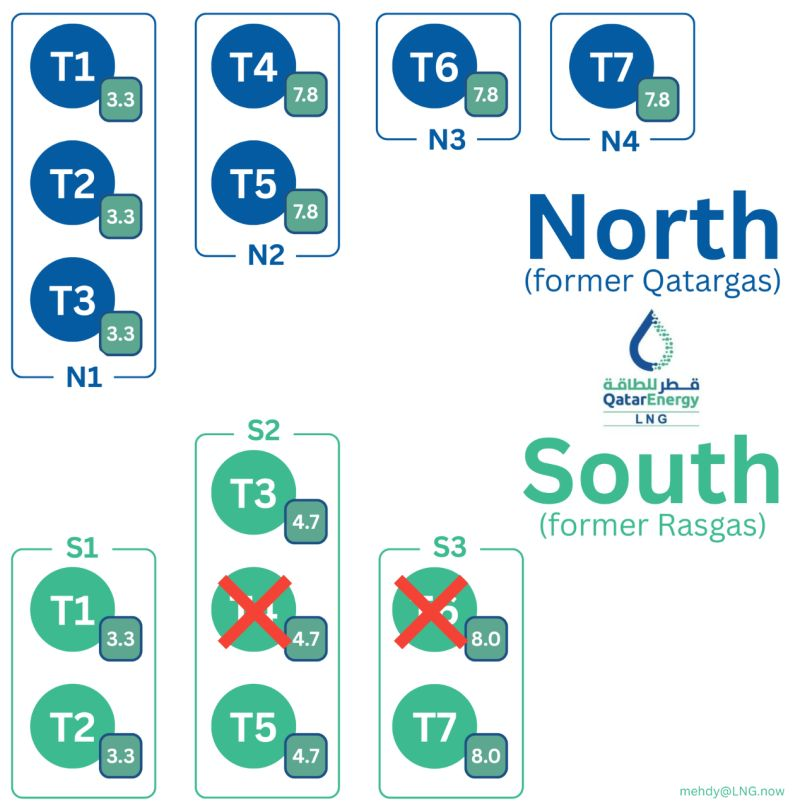
Qatar's LNG trains S4 and S6 confirmed damaged and out of service.
3 to 5 YEARS of repairs🚨
12.8 million tonnes per year of LNG are Offline.
And here's the twist nobody expected:
ExxonMobil holds 34% of Train S4 and 30% of Train S6.
An American oil major just took a direct hit from Iranian missiles.
#LNG #Qatar

English


The key number here may not be the 17%.
It’s the timeline.
LNG infrastructure damage measured in 3–5 years changes global supply expectations, not just short-term prices.
Qatar supplies ~20% of global LNG.
This could become a structural supply shock, not just a wartime disruption.
Full breakdown:
English

Not good.
It will be blamed on us because we initiated the war.
Pick your "friends" wisely.
Qatar Energy CEO tells Reuters: Two out of 14 of our LNG trains and one out of two of our gas-to-liquids (gtl) facility were damaged in the attacks we will be losing 12.8 million tons per year of LNG for three to five years, around 17% of Qatar’s export LNG
We may have to declare force majeure on long-term contracts for up to five years for LNG supplies to Italy, Belgium, Korea and China.
bnnbloomberg.ca/business/2026/…
English


QatarEnergy’s CEO confirmed today something the LNG market hasn’t fully processed yet:
17% of the world’s largest LNG exporter’s capacity is offline.
But the most important figure isn’t the percentage.
It’s the repair timeline:
3 to 5 years.
Key numbers:
• 12.8 million tons per year offline
• ~$20 billion in lost annual revenue
• Force majeure declared for Italy, Belgium, South Korea and China
• ExxonMobil’s direct stakes affected
Shell and TotalEnergies have already declared force majeure.
Markets can absorb temporary disruptions.
What changes the global energy balance are structural disruptions.
Qatar supplies ~20% of the world’s LNG.
If this timeline holds, the market isn’t facing volatility.
It’s facing a structural supply shock.
As the CEO put it:
“For production to restart, first we need hostilities to cease.”
The war may end.
The energy deficit won’t.
Markets react to missiles.
But they’re restructured by infrastructure that can’t be replaced quickly.
This isn’t volatility.
It’s structural reconfiguración of the global energy market.
✅ Source: Reuters — QatarEnergy CEO Saad al-Kaabi. Verified.
English

@elerianm Energy shocks rarely stay contained to energy markets.
They usually spill into inflation expectations, credit conditions and policy decisions within months.
The second-order effects may matter more than the initial price spike.
English

For the energy-secure US, damaged infrastructure due to the War means higher prices.
In some other countries, however, the challenge is twofold: higher costs and worries about genuine supply shortfalls in the months ahead.
It’s encouraging a growing number of them to implement energy-saving measures.
#economy #energy #markets
English