Van Harvey

15.7K posts

Van Harvey banner
Van Harvey

Van Harvey

@Van_Blogodidact

Once an ignorant rocker, now an informed father - Classic American Liberal & anti Pro-Regressive. Blog + Autodidact (self taught learner) = Blogodidact


St. Louis Joined Mart 2010
933 Following1.3K Followers
Van Harvey
Van Harvey@Van_Blogodidact·
@ClassicLibera12 "...for creating the gateway that is antisemitism and White Supremacy into the Libertarian ecosphere..." Don't forget to 'thank' Lew Rockwell too, who set up the Mises Institute.
English
0
1
1
154
Van Harvey
Van Harvey@Van_Blogodidact·
👇👀Liberty is not what this is aiming at: "...What libertarians market as spontaneous emergence is in practice a top-down reconfiguration: society modeled as a cybernetic feedback loop too “complex” for constitutional self-government, therefore requiring initiated stewardship through data, AI, and algorithmic control..."
Courtenay Turner@CourtenayTurner

1/2 🧵 @ConceptualJames is right to flag Hans-Hermann Hoppe’s influence on these circles. Democracy: The God That Failed gave intellectual cover for ditching democracy in favor of ‘natural elites’ and private government: monarchy (private ownership of the state) supposedly beats democracy (public ownership) because a hereditary ruler has long-term skin in the game, while democratic politicians are short-term plunderers. Hard-nosed Hobbesian realism wrapped in Austrian economics. Hoppe didn’t stay in the ivory tower. Curtis Yarvin (Mencius Moldbug) explicitly credits Hoppe—alongside Carlyle and Burnham—with pushing him beyond standard libertarianism into neo-reactionary authoritarian elitism. Yarvin then built neo-cameralism on that scaffold: the state as a joint-stock ‘gov-corp’ run by a CEO-monarch. Hoppe provided the permission slip to abandon universal suffrage; Yarvin added the political theology and aesthetic for Silicon Valley. Enter Peter Thiel as connector and patron. By 2009 Thiel was already writing that ‘freedom and democracy are incompatible’—a position Yarvin called him ‘fully enlightened’ for—and Thiel funded Yarvin’s Urbit while Yarvin functioned as house political philosopher for the Thielverse (Masters, Vance, Andreessen, etc.). I elucidated this in our book 📕 x.com/courtenayturne… This isn’t just edgy salon talk. That network has helped move these ideas into real infrastructure: network-state experiments, ‘exit’ from democratic accountability, corporate sovereignty—and the techno-surveillance grid as the new normal. As I’ve detailed in my writing on ‘Exit & Build’, what’s sold as voluntary opt-out and parallel construction is hardening into compulsory tokenized systems, sensor-fed governance, and elite-steered complex adaptive architectures drawn from Santa Fe Institute–style complexity science. What libertarians market as spontaneous emergence is in practice a top-down reconfiguration: society modeled as a cybernetic feedback loop too “complex” for constitutional self-government, therefore requiring initiated stewardship through data, AI, and algorithmic control. There’s a reason the Project Russia books explicitly cite the Santa Fe Institute and why Epstein and Maxwell were so focused on it. It’s not escape; it’s reconfiguration. It’s not escape; it’s reconfiguration. courtenayturner.substack.com/p/from-exit-an… From “Exit & Build" to Tesla's Wireless World Brain Layer on Proof of Persona—the shift from proof-of-work to biodigital validation via human body activity data (see Microsoft’s WO2020060606A1 and the push toward unconscious compliance)—and you see the enclosure of the inner self. courtenayturner.substack.com/p/the-proof-of… Thiel’s Praxis and Dialogue projects, with their echoes of Tavistock’s ‘Gnostic Reticulists,’ are straight Platonic dog whistles. As I unpacked in my thread, this is the Divided Line weaponized—dialectic as negation of the immanent world (popular sovereignty, human limits) to synthesize a ‘higher’ Gnostic order only the initiated control. Plato’s ascent twisted into Hegelian/Marxoid praxis: alchemical deed to overthrow the old and birth the elite’s techno-feudal Becoming. It’s Dark Enlightenment as live political program. x.com/courtenayturne… James nails the Marxoid patterns some libertarians launder through Austrian rhetoric. But the deeper danger isn’t just ‘libertidiots’ defending Hoppe. It’s how this ideology provides the intellectual and financial scaffolding for technocratic authoritarianism that treats democracy, constitutional republics, and real human self-government as incompatible. When elites openly fund gov-corp/ SovCorp/ network State alternatives while building AI governance, surveillance systems, and biodigital validation, that’s not liberty—it’s technocracy. Recognize the pattern for what it is. One must defend cognitive liberty and genuine human sovereignty against the seductive appeal of corporate-monarch cosplay or the Gnostic praxis of an initiated elite. cont 👇🏻

English
0
2
5
330
Van Harvey
Van Harvey@Van_Blogodidact·
@MikeBenzCyber "I didn’t even know that" I'm probably more surprised that someone so interested in the doings of intelligence agencies, didn't know of Marcuse's connection to them, than you are in discovering it. Interesting.
English
0
0
0
139
Mike Benz
Mike Benz@MikeBenzCyber·
Incredible find. I didn’t even know that. OWI was the sprawling Pentagon branch that gobbled up the entirety of early American mass media institutions (print, radio, film, all majors joined its blob). Then into OSS, the protocol-CIA. Spooky Cultural Marxism trivia nugget here👇
Yuri Bezmenov's Ghost@Ne_pas_couvrir

Reminder:

English
39
417
1.4K
102.5K
Van Harvey
Van Harvey@Van_Blogodidact·
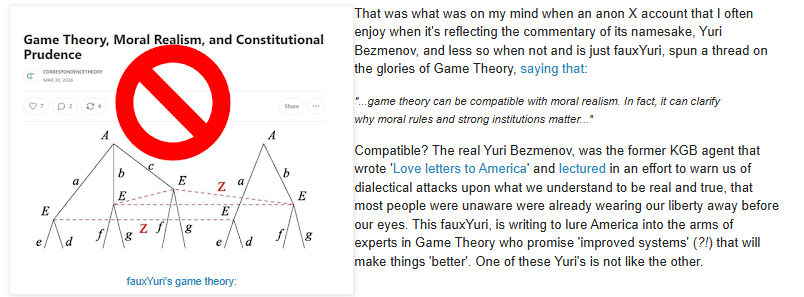
Shall we play a game? Should we? To what ends should we combine Game Theory with the Rule of Law? That's another strange game, in which the only winning move is not to play. But many 'defenders of liberty' are urging us all to play along...🧵
Van Harvey tweet media
English
4
3
17
1.2K
Van Harvey
Van Harvey@Van_Blogodidact·
@UnmitigatedAss Well, it's not written as a novel like LOTR is, but as a retelling of myths (and... encodes a Lot of philosophy) which I've loved since a kid, so I get it when people don't 'get it'. It's an acquired taste!
English
1
0
2
14
TheUnmitigatedAss
TheUnmitigatedAss@UnmitigatedAss·
@Van_Blogodidact You’re probably right. Some books are an easy listen. Some are doable, though one misses things (Bros K is teaching me that). It might just be the medium that is the issue.
English
1
0
1
26
TheUnmitigatedAss
TheUnmitigatedAss@UnmitigatedAss·
I have 7 hours left in listening to The Silmarillion and don’t think I’m going to do it. Sorry Tolks, it’s just not that interesting.
English
8
0
13
204
Van Harvey
Van Harvey@Van_Blogodidact·
@CynicalPublius "...ldier’s Spirit lies at the intersection of external influ..." Seems like court martialing would've been more appropriate than firing, but... it'll do.
English
0
0
2
95
Cynical Publius
Cynical Publius@CynicalPublius·
So SecWar Pete Hegseth just fired Maj. Gen. William Green Jr., the US Army’s (now former) Chief of Chaplains. I have zero insider information on this, but I have my own theories as to why it happened. Green’s most important event as the Chief of Chaplains was to produce the United States Army’s “Spiritual Fitness Guide.” Published in July of 2025, Stars & Stripes wrote an article on this with a link to the guide. (I’ll put all related links in a comment email one below.) I’ll save you the trouble of clicking on that link — it goes to the US Army’s website, and it’s “404 Page Not Found.” That kind of explains a lot, doesn’t it? So I went and found a full copy of that “Guide” elsewhere (in, of all places, a “Military Atheist” website; link in the post below). Go check it out. Do a word search for the word “God.” Go ahead. Do it. It shows up exactly ONCE. How can you have a guide to spiritual fitness without mentioning God????? But what that “guide" DOES TALK about is a bunch on New Age gobbledygook. Let me give you a taste: "The Soldier’s Spirit lies at the intersection of external influences (stimulus) and applied behavior (response). It is the vital junction that supports the weight of life and drives Soldier action. In a relatable way, the Soldier’s spirit is much like a compass in life, providing substance to the direction that they take in life and the decisions they make. This reality makes understanding and developing the Soldier's spirit crucial, as the direction of a Soldier ultimately shapes the direction and well-being of the Army.” The primary mission of the Chaplain Corps is to “provide religious support” to soldiers (from their official mission statement). Yet the US Army’s “Spiritual Fitness Guide” reads like it was written by John Lennon and Yoko Ono on a bender—not a word of encouragement for a soldier’s faith, but pages upon pages of New Age nonsense that makes Universalism sound like rational thought and really does imagine no religion. Yeah, one does not need to understand why a man of faith like Pete Hegseth fired a wishy washy New Age Pharisee like Green.
English
607
3.8K
16.5K
490.2K
Van Harvey
Van Harvey@Van_Blogodidact·
"...it is prudent and lawful for a householder, in the exercise of his natural right to defend his life, liberty, and property, to keep a fierce and vigilant dog..." This is the prudent behavior within the bounds of rightly ordered law, that I repeatedly said, I've no issue with. But setting out to formulate law as 'incentive dilemmas' to better manage the population with, I've got those issues with which I've explained. If you don't see the difference between the two... I don't know what else to say.
English
1
0
2
33
Classic__Liberal 🌲🇺🇸
Classic__Liberal 🌲🇺🇸@ClassicLibera12·
Does these convey what I’m trying to say but in an acceptable formulation? "Since some men are found to be depraved and prone to vice, not easily moved by admonition or the voice of reason alone, but rather inclined by disordered passions, such as greed for another's goods or audacity in assailing their neighbor it is prudent and lawful for a householder, in the exercise of his natural right to defend his life, liberty, and property, to keep a fierce and vigilant dog. By the visible presence and readiness of such a beast, the audacity of the vicious is held in check through fear of harm and pain; thus, the would-be thief or intruder, following his sensitive appetites rather than right reason, desists from evil-doing, at least for the moment, and grants peace to the innocent. In this way, the dread of swift and certain consequence restrains the hand of the wicked, safeguarding the common good of the household while the virtuous man continues in self-governance according to justice. Over time, repeated restraint by such fear may even habituate the depraved toward doing willingly what they first avoided only from dread, though the primary end remains the protection of what is due by nature." and or "Man possesses by nature a rational aptitude for virtue and the knowledge of what is due in justice, such as the preservation of life, liberty, and property, and the duty not to assail one's neighbor. Yet, since some are found to be depraved and prone to vice, driven more by disordered passions, greed, or audacity than by right reason, they are not easily moved by admonition alone. For such men, it is necessary that human law or the prudent measures of a householder restrain evil by the dread of swift and certain consequence. Consider a man tempted by the apparent good of another's goods: if the path to theft or invasion carries no notable risk of harm or loss to himself, his sensitive appetites may readily overcome reason, leading him to act against justice. But when a just penalty is visibly attached, whether by the severity of public punishment, the readiness of armed defense, or the presence of a fierce guardian beast, the audacity of the vicious is held in check. The dread of pain, injury, or forfeiture now weighs against the hoped-for gain in his singular judgment; thus, he desists from evil-doing, at least for the moment, and grants peace to the innocent. In this way, the discipline of fear serves the common good: it restrains the hand of the wicked so that the virtuous may continue in self-governance according to moral order, while habituating some of the depraved over time to do willingly what they first avoided only from dread. This does not redefine the natural law or the rights derived from human nature as rational and social beings; rather, it prudently accommodates the wounds of fallenness, ignorance, malice, and disordered concupiscence, without supposing that all men are moved solely by such calculations. As Isidore teaches, laws were made that human audacity might be checked and the dread of punishment might prevent the wicked from doing harm." If so then I think I understand the contention. If not then /shrug I dunno
English
1
0
2
42
Van Harvey
Van Harvey@Van_Blogodidact·
IOW: Using the language of "incentive dilemmas" in The Law, is immediately reverting from Law v3.0, to Law v2.9, and while it may seem like a small difference, it is a major version change that is incompatible with the upgrade of the American Constitutional Republic.
Courtenay Turner@CourtenayTurner

🔥 Exactly @Van_Blogodidact — this isn’t a policy disagreement, it’s a vertical metaphysical divide about what a human being is and what law is for. Once you frame it as “horizontal” technocratic optimization, you’ve already stepped off the ground the American experiment was actually standing on. You nailed it: “…your language is thoroughly about systems management.” That’s not a bug, it’s the feature. That mindset isn’t “new with technology”; it’s the pre-revolutionary administrative worldview of Hobbes and King George’s managers, for whom law is a tool to manage populations through risk/reward calculations for the “unprincipled.” In that frame, people are variables in an equation, not bearers of inherent, inviolable dignity. The American Revolution was a metaphysical rupture with exactly that. Rights were held to derive from the nature of Man himself — imago Dei — not from what is convenient for managing the herd. The Founders drew on natural law and Scottish Common Sense Realism: the conviction that there is a real human nature, knowable moral truths, and self-evident rights that law must recognize, not manufacture. Law, in that tradition, answers to a prior moral and metaphysical order; it does not create it. What you’re describing is the rollback of that entire vertical order in favor of a horizontal, managerial one. Once law’s primary job becomes mitigating the calculations of the unprincipled via engineered incentives, you have already conceded the ontological ground. You have accepted that man is something to be modeled and managed, not someone to whom justice is owed. This is exactly what came up yesterday with Monica and Patrick on The Final Betrayal. Wilhelm Wundt, the so‑called “grandfather of psychology,” was a thoroughgoing Hegelian at Leipzig. He explicitly rejected the soul, free will, and any transcendent human essence. In his frame, “man” collapses to a stimulus–response machine: measurable, manipulable, and trainable like Pavlov’s dogs or Skinner’s rats. Once you accept that anthropology, there is no room left for an irreducible subject; there are only inputs and outputs. That lab model did not stay in the lab. It became the template for a mechanistic psychology and an industrial education system exported West: schools as conditioning environments, students as malleable organisms to be shaped for social “adjustment” and compliance. The aim shifts from cultivating virtue in free persons to programming predictable behaviors in populations. The same playbook runs straight through the 20th century: Tavistock, OSS/CIA, and a whole ecosystem of “behavioral sciences” aimed at cultural engineering. The old moral order had to be delegitimized so that a new behavioral order could be installed. You tear down thick metaphysical commitments — soul, objective moral law, transcendent ends — and replace them with malleable identities and statistically manageable preferences. Now that logic is simply being upgraded, not replaced. Game theory, complexity science, and tokenized incentives supercharge the technocratic project. Humans are rendered into legible nodes inside a cybernetic organism: data points with behavioral probabilities attached. Blockchain becomes the nervous system, DAOs approximate a distributed cortex, and behavioral tokens function like artificial hormones nudging the organism toward “optimal” states. The ideology underneath all of this is a “minimum viable metaphysics”: just enough of a model of “human behavior” to keep the system running, but with no room for real free will, objective purpose, or an immortal soul. This is not prudence or sober “accounting for human nature.” It is regression dressed up as realism. It drags political thought back before the…

English
0
1
4
294
Van Harvey
Van Harvey@Van_Blogodidact·
"This here is where there is talking past each other." Yes, but vertically, not horizontally. "...as a moral agent however do not operate on moral self governance at least not consistently..." Yes, I'm acquainted with how incentives operate on individuals and groups, and in regards to risk management - I'm not missing some aspect of what you've described here or what others have elsewhere. I get the nature of it, and the point. "Laws don’t realign the unprincipled to be principled" I'm sure you've noticed that your language is thoroughly about systems management. Do you imagine that view is new with technology? You might think this is another instance of me talking past you, but the point is that it is an instance of your aligning with what has been understood for a very, very, long time. Everything you are saying here, though with much less technical expertise, was how the Law was written and utilized and executed in classical Greece and Rome and Britain too (Hobbes & King George would love it). What was revolutionary about the American founding, was that they fundamentally broke with the past. Our Founders generation understood the essential nature of Natural Law as classically understood, and as further developed under Christian influence through Aquinas and others, and the 'Property' focus of latter British thinking (see especially Coke ("A man's home is his castle!")). But what they did next, with the aid & influence of SCSR (Scottish Common Sense Realism), was that they performed an amazing bit of abstraction - one might even say Revolutionary - by grasping that the individual human, was not just a useful piece of the collective state, but that the metaphysical nature of a Man - not the King, or the State - was the proper source for that state and its Laws to be founded from, upon, and around, and that the key to doing so, was putting their individual rights, which were derived not from the state (or from what was most useful in managing it), but from the nature of being human, at the center of The Law. What is being proposed with Game Theory, as is the case with 'Economic Thinking' (and Positivist Law, etc), is NOT taking intelligent steps forward, but blindly going down and backwards. I think that both are an unwise direction to head in.
English
2
2
6
264
Classic__Liberal 🌲🇺🇸
Classic__Liberal 🌲🇺🇸@ClassicLibera12·
This here is where there is talking past each other. Morally self governing people do not understand the Law as an exercise in incentive dilemmas but an alignment with the moral order. I stated as such from the beginning. I am not contradicting this by observing that humans by their nature operate by both risk reward >and< moral self governance. The unprincipled even as a moral agent however do not operate on moral self governance at least not consistently, they look to ways to transgress the law sometimes with actual malicious intentions but often at the level of cost and risk reward. Let’s say you are a leader of a tribe that is looking for a good place to settle. You find a spot of fertile soil near a river but you discover that it is occupied by the village of another tribe. If you are morally self governing it may not even occur to you to “do something about them”. Maybe you move along, maybe you engage in negotiations or trade. Your default moral position is to respect your fellow Man. This is not a decision dilemma or incentive driven, it is morally driven. Hopefully you are consistent in this disposition from and to the moral order. Given no direct threat by the occupying village that is not the case for the unprincipled. The unprincipled will see the place and what it offers (reward) and ask themselves: “Ok how do we get rid of the village there?” “What risk does it present to do so?” “Is the village fortified and walled?” “Does it have skilled armed warriors defending it? How many?” “Hmmm maybe we should look for softer targets in the same area?” The unprincipled can go even further than this by exploiting risk/reward of the people in the village in attempt to get it to override people being consistently aligned with moral self governance for the same incentives to take out a village. This is the same even within the walls of any civilization. You have a section of people who do not consistently operate on moral self governance in accordance with objective natural law and the moral order they operate on risk reward (or malevolence). Just deterrents (laws, policies, enforcement) that are founded on natural law adjust and mitigate the calculations of the unprincipled attempting transgress people’s rights. Laws don’t realign the unprincipled to be principled, maybe the consequences of just enforcement of the law might alter their moral purview…but probably not. More than likely they will calculate that the risk or cost to transgress simply is just not worth it. While the disposition of this unprincipled actor doesn’t help society be more morally aligned it does mitigate and deter an unprincipled actor like this from mucking up society for everyone. Again the amount of people who operate this way is not trivial. To reiterate (again) this is not advocacy that accounting for this be superordinate to moral self governance. Mitigating the impact of transgressive unprincipled actors who operate mainly on incentive dilemmas is subordinate, secondary (or even lower) to a retrenchment of moral self governance but it is practical to account for this.
English
2
0
3
97
Van Harvey
Van Harvey@Van_Blogodidact·
"The position being made here is the law is based on ontological nature" Full stop. The understanding of Law by Americans (see James Wilson) at the time of America's founding - whatever other flaws it may have had - was that its purpose was to uphold and protect their rights, and that those rights were derived from the nature of being human. When the behavior of people is examined today, through a mathematical modeling of their behaviors, we are able to map theories upon the observed actions, even to the point of formulating statistically precise mathematical proofs for the behavior of populations of people. But those are two very different things. You're a techie, you understand the different between a Class, and the object instantiated from it, yes? When you run those ideas on into a single sentence that is now modified by a language of 'incentive dilemmas', you are introducing a modified image of man, which is no longer looking at Man as such, but at 'man' as population, and that switch has the potential to corrupt everything that follows upon it. "... the moment a law is established it objectively introduces incentive dilemmas..." No, the moment you begin looking at Law through the lens of 'incentive dilemmas', you are no longer being either prudent or practical towards the nature of Law or the governance of Man, as you're no longer looking at what is, but only at what it seems to be. Man is distinct from population, and to view The Law through that lens, is to begin using Law, not to establish a means of rendering justice for individuals under a Rule of Law, but as a means for more efficient population management. Those are two very different and fundamentally incompatible things. There is no Liberty under population management, but there most definitely is and must be an administrative state to manage the herd, and a need for those with the expertise to refine that. I would beware of playing that role.
English
3
2
8
312
Classic__Liberal 🌲🇺🇸
Classic__Liberal 🌲🇺🇸@ClassicLibera12·
The position being made here is the law is based on ontological nature and that nature, natural law itself introduces incentive dilemmas for beings that interact with reality to the point that mathematical proofs have been discovered which correspond to their interactions with reality. Not the other way around, the interaction and incentive dilemmas are not defining ontological reality or natural law. Laws and policies that support them are not authored by incentive structures as the main teleological primitive. However the moment a law is established it objectively introduces incentive dilemmas and it is both prudent and practical to understand these and take them into account so that the law is both just and effective in its deterrence so long as this remains subordinate to ontological natural law.
English
1
0
2
86
Van Harvey
Van Harvey@Van_Blogodidact·
🎯"...Risk/reward incentives are something even children were expected to mature out of because they are not animals..." Exactly! It's disturbing how deeply the utilitarian view has penetrated our assumptions. But that's not the case, this is: "..., but human beings with the endowed faculties for impulse control, responsible accountability, subordination of autonomous will to conscience and the moral agency of free will (not license). Risk/reward denies that agency and reduces self governing moral agents to a managed herd to be optimized..."
CJ the palmer worm; wife,mother, analyst.@thepalmerworm

Risk/reward incentive structures do not describe ontological properties - they describe what a human being can be reduced to when treated as a manipulable organism rather than a rational moral agent. They describe the entire Wundt-Thorndike-Dewey State Education Pedagogy reduction of the self governing moral agent to a reactionary consumer managed organism of The System. Ideological and Political collectivism was deployed as the former phase of this degradation and removal of individual agency via Education for Democracy. Now Technocratic Systems have the baton and Game Theory (plus other Systems Theories) manipulate and manage that (now cyber) ‘Organism’. Daniel Robinson was clear on why and how the human person is not an organism, but an agent: open.substack.com/pub/thepalmerw… and why that is crucial in ‘Keeping’ the Constitutional Republic. Normalizing a degraded behavioural state produced by systems of conditioning and then projecting it backward as if it were native to human nature - is tactically something that ‘Social Science’, ‘Psychology’ and ‘Systems Theory’ has been utilizing as its means of advancing Statecraft from its precursors (Leviathan) onwards! Risk/reward incentives are something even children were expected to mature out of because they are not animals, but human beings with the endowed faculties for impulse control, responsible accountability, subordination of autonomous will to conscience and the moral agency of free will (not license). Risk/reward denies that agency and reduces self governing moral agents to a managed herd to be optimized. This is why any true recovery and restoration has to start with formation - Education, as the Founders insisted. Managing the herd through risk/reward is not a Constitutional Republic - it’s a Technocracy; the Scientific Management and distribution of all resources, including so called ‘human’ resources. It’s post human when you’re managing people as animals.

English
1
2
4
288
Van Harvey
Van Harvey@Van_Blogodidact·
1/4) "It’s going to be difficult to cover this without setting off trip mines." That's unfortunate. I hope you'll pardon my not trying to step around them.😎 "... incentive structures... present incentive dilemmas... when agents know ... are established on some kind of objective moral justification." I'm reminded of business authors & seminar speakers who advise their audience that everything they do involves selling or managing - 'If you're a hammer, everything looks like a nail'. But the problem with seeing everything from the perspective of your line of work (which is related to my line of work), is that not everything is not actually based upon the perspective of your line of work. There is, however, one perspective that actually does underly everything you say and do, and that's philosophy. When you neglect or forget that hierarchy, when you, to use the lingo, attempt to employ an object before it has been properly referenced and instantiated, you end up dealing with null objects without the exception handling to notify you of errors, and your 'app' is going to fail. Yes, we can speak of profiting in a free market and capital punishment "...which present incentive dilemmas..." but when you use that language to form and define the operations of that which underlies and defines their 'environment', you are triggering a null reference error, whether or not you have put in the exception-handling to deal with it, and 'on error resume next', isn't dealing with it (anyone remember VBScript? lol).
English
1
1
2
103
Van Harvey
Van Harvey@Van_Blogodidact·
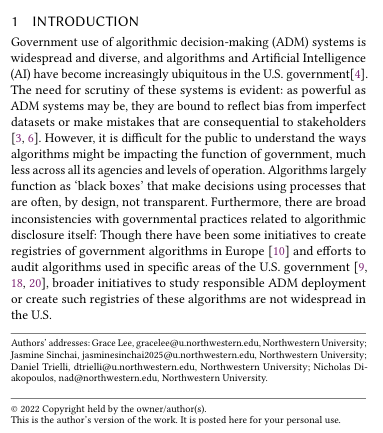
4/4) "The entire job function is arranged around these paradigms" Indeed. I meant to post this to a comment about algorithms in our lives, yesterday morning, but ran out of time. As I said in my post, using game theory within the proper bounds of a field, especially in applications, is not only ok, but appropriate. But don't lose sight of the fact that applying Game Theory is designed around getting those ends that the system deems most useful. That is not a proper or healthy way to 'structure' an approach to Law, or to people in general, and it is inevitably constructivist. Cataloging Algorithmic Decision Making in the U.S. Government par.nsf.gov/servlets/purl/…
Van Harvey tweet media
English
0
2
2
342
Classic__Liberal 🌲🇺🇸
Classic__Liberal 🌲🇺🇸@ClassicLibera12·
It’s going to be difficult to cover this without setting off trip mines. Even if you establish a deterrent without exploring human incentive structures it does not remove the fact that humans operate to a great degree on risk/reward paradigms. Scalable Fines, incarceration time and capital punishment all are deterrents which present incentive dilemmas to people whether or not they are established on some kind of objective moral justification. So to do incentives decisions present themselves when agents know they cannot easily acquire and exploit centralized institutional power. Why is this? How might they get around certain structural, Constitutional and lawful deterrents? What incentive structures lead them to new and various risk/reward attack vectors? What counter deterrents can be established to mitigate action and impact? Leaning into moral duty may lessen attempts but that alone will never ever get rid of them. And if we’re going to be honest about this we are talking about three generations of anchored moral realism before we see its fruit. I work in Cybersecurity as my day job. The entire job function is arranged around these paradigms. Heavily influenced by Game Theory. This is the same for Federal and military intelligence and the police. This is not advocacy for Game Theory it is just stating a fact. But here I am told not it is too dangerous to explore or look at it this way. Just establish morally prudent deterrents to the best of our ability and call it a day. I honestly find this wanting given the threat landscape. Note this again is not advocacy for jumping full dive into constructivist Game Theory. And yes I do understand it cannot be easily decoupled if at all.
English
5
0
5
205
Van Harvey
Van Harvey@Van_Blogodidact·
3/4) There is no legislation that is going to remedy the issues of the regulatory administrative state. There are some measures that can be passed to anesthetize the pain, but the only solution is repealing every aspect of legislation and rulings on it, that permitted the regulatory systems to be imposed upon us. That won't happen before people recognize why using govt to manage our lives, is fundamentally, philosophically, morally, and in the most practical sense, wrong. And that's not going to happen without people learning and understanding what it was that made the Declaration of Independence and the Constitution possible, and why it is that their passage was fortunate enough to occur at the last possible moment in history that it was possible to do so. "... we are talking about three generations of anchored moral realism before we see its fruit..." Yes. And that won't be shortened by engaging in more intensive and 'smart' applications of what the problem is, to fix the problem. I understand that doesn't satisfy the urge to 'do something!'. Almost twenty years ago, my friends in the Tea Party didn't appreciate my telling them that IF we did a sound job of spreading that understanding, and experienced no setbacks in doing so, we might begin to be able to 'fix things' in about fifty years. Instead, they decided to focus on electing the 'right candidates'. They really, really, really, wanted that to work. It still didn't. Reality is like that. But. Despite ourselves, we did manage to begin spreading an interest in that fundamental understanding. When I first started bothering people by pointing this out in the late 90s, few would even politely listen. By about 2007ish people began saying "Huh? Federalist Papers? Natural Law...? Tell me more...", and despite ourselves, in the last ten years, I'm just as likely to hear about those from someone else, as them hearing about it from me. Obviously, that's not due to me, but to the fact that people - thousands and more - that I do not know and never will, have also been doing what I've been doing, and many more people than that are listening. Worthwhile change is not going to happen quickly. Sam Adams began talking about the loss of liberty and the need for independence, in the 1740s, and it took over two decades for that to sink in before the first 'win' of resistance to the Stamp Act, and another decade before the Declaration of Independence. And he started with a much healthier culture than we have to work with today. Sorry, but that's the way it is, it takes time, and it takes even more time if you don't 'do it right' to begin with, or 'do it wrong' to try and speed things up. There's no fix, no application update, that we can quickly download and apply, to short-circuit history through marketing and other incentive structures.
English
0
1
2
96