

TGiR
6K posts

TGiR
@_TGiR
Old school ex prop trader just trying to make a dollar out of 15 cents. No investment advice intended, ever. Snark level 99/100.
Joined Şubat 2020
1.8K Following378 Followers

This is stunning: it looks like Iran degraded American military bases into unusability across an entire theater, simultaneously.
As far as I know, no other U.S. adversary has achieved that, ever.
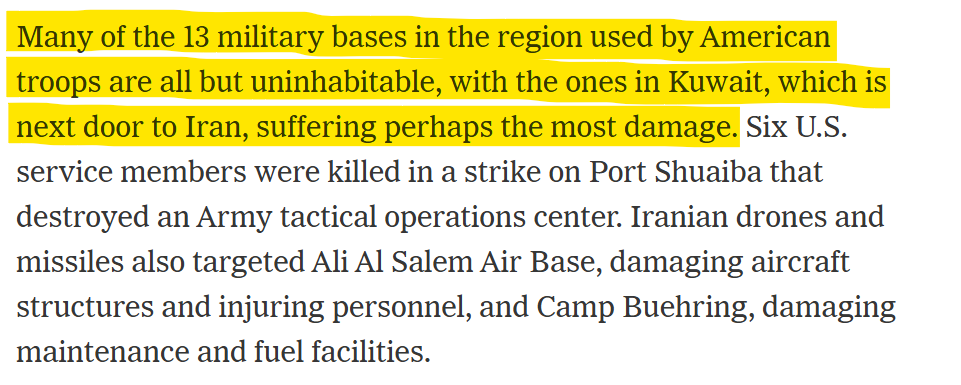
This is directly reported in the NYT (nytimes.com/2026/03/25/us/…): they write that Iran has rendered "many of the 13 military bases in the region used by American troops [...] all but uninhabitable."
As the article describes, "there were close to 40,000 U.S. troops in the region when the war started, and Central Command has dispersed thousands of them, some to as far away as Europe."
Those troops that do remain are "not on their original bases" but have been "relocated to hotels and office spaces throughout the region."
Genuinely incredible.
Arnaud Bertrand@RnaudBertrand
I don't think people realize just how extraordinary what we're witnessing with Iran is. I was arguing with a dear journalist friend of mine yesterday who was telling me that Iran was winning, yes, but only on the strategic level, not tactically. The type of thing a skinny kid getting stuffed in lockers in highschool tells himself to make himself feel better: "These people will BEG to work for me in ten years. Everyone knows jocks peak in highschool. They'll literally beg." 😏 I think that's precisely wrong, and that's what makes the Iran war different. As of now, Iran is in fact holding its own tactically too. Think about other U.S. wars of aggression these past few decades. Take Vietnam, Afghanistan, Libya, Iraq, Serbia, etc. (the list is unfortunately very long). The pattern was roughly always the same with an immense power differential between aggressor and victim. These wars were, by and large, imperial: the empire attempting to crush a much weaker people whose only realistic recourse was guerrilla resistance. And that is when they actually had the will to resist: some - like Libya - barely even bothered, just resigning themselves to their fate (despite being, at the time, the richest country in Africa). As spectators of these wars, if you had any moral sense, the dominant emotion was a kind of helpless disgust: you were watching a giant stomp through someone else's house. Sure, the U.S. actually lost many - if not most - of these wars, famously replacing the Taliban with the Taliban or being expelled with their tail between their legs from Vietnam, but the power differential was no less real for it. It's just that power doesn't always guarantee victory: sometimes the giant can't kill everyone, and eventually tires of trying. But the “victories” won this way were always pyrrhic at best: the people endured, yes, but what they were left with was a country in ashes that takes decades to rebuild. Meanwhile, in the grand scheme of things, the giant walked away with little more than a bruised ego. Iran is - remarkably - proving to be an entirely different beast: when others were merely surviving a giant, Iran appears to be able to compete with one. What just happened over the past 48 hours is the best illustration of this. You had the President of the United States issue a formal ultimatum: reopen the Strait of Hormuz within 48 hours or we "obliterate" your power grid. Iran's response was essentially: we dare you, if you do this we'll make all your Gulf allies uninhabitable within a week. And, as we saw, Trump backed down: pretexting non-existent "VERY GOOD AND PRODUCTIVE CONVERSATIONS" with Iran, he said his ultimatum no-longer applied (or, rather, became 5 days). Adding he now envisaged the Strait of Hormuz being “jointly controlled by me and the Ayatollah.” To the amusement of Iran’s diplomacy (x.com/IraninSA/statu…). That, folks, is a textbook tactical victory. It is, remarkably, Iran demonstrating in this instance that it had escalation dominance over the United States of America. That is, the ability to credibly threaten consequences so severe that the US - for perhaps the first time since the Cold War - found it preferable to stand down. That's no skinny kid being locked in a locker dreaming of revenge fantasies. That's the kid grabbing the bully's wrist mid-shove and watching his face change. And it's not the only tactical victory in this war so far. Take the episode over the Israeli attack on Iran's South Pars gas facility. Iran had warned that if that happened U.S. allies in the region - including Israel - would face a symmetrical response. And they delivered: famously devastating Qatar's Ras Laffan facility - which produced roughly 20% of global LNG supply - and leading, according to Qatar themselves, to a $20 billion loss of annual revenue for the next 5 years (oilprice.com/Latest-Energy-…). Not only that but they also managed to hit Israel's Haifa refinery (aljazeera.com/news/2026/3/19…), one of the country's most strategic and protected sites. The result was Trump distancing himself from the South Pars attack, saying that Israel had "violently lashed out" unilaterally and that "NO MORE ATTACKS WILL BE MADE BY ISRAEL pertaining to this extremely important and valuable South Pars Field." Israel then said it wouldn't strike Iran energy sites anymore (bloomberg.com/news/articles/…). From where I stand, that's another tactical victory. It is, at least, Iran demonstrating that is can fight back **symmetrically** against the U.S. and its allies. Not through asymmetric resistance with IEDs hidden in the roadside or traps hidden in the jungle, but eye for eye, and against some of the most heavily protected sites on the U.S.'s side. That's qualitatively different from any other adversaries the U.S. has directly fought in recent wars. There's plenty more, such as the pretty relevant fact that Iran has gained control of the single most strategic energy chokepoint on earth and the U.S. is finding it impossible to break that control. To the point where Trump has been reduced to publicly begging China - of all countries - for help, which given Trump's ego mustn't have been easy to do. Only to be told no. By China. And by everyone else he asked. This is the topic of my latest article: how this is, in fact, the first genuine "multipolar war." First, in the narrow sense: because Iran is revealing itself to be a genuine pole of power - not a superpower, but an actor that cannot be submitted, which is all multipolarity is. And second, because the war itself is accelerating multipolarity everywhere else: the U.S. has never been more isolated, never looked weaker and its security guarantees have never been more hollow. In my article I lay out the full scoreboard - military, economic, political - and explain why this war has already changed the world, regardless of how it ends. Enjoy the read here: open.substack.com/pub/arnaudbert…
English

It’s early 2017 and the hottest messaging app in the world goes public.
You invest $10K.
Today, that's worth just $1,900.
Why didn't $SNAP work?

English

$SNAP the market is often wrong. If the stock was trading at $15 where it belongs, these ridiculous statements wouldn’t exist.
Randian Capital@RandianCapital
$SNAP has raised an aggregate of $8.4bn in capital in the history of the company. $2.6bn in the years leading up to its IPO, $2.3bn in the IPO, and $3.5bn in Convertible Notes. Today the company has an enterprise value of $9bn. So the market ascribes $9bn of value to $8.4bn of invested capital. Essentially, @evanspiegel 's poor capital allocation has created almost no value in the history of $SNAP. There is hope but only if there is immediate action to improve capital allocation. @JoannaColes @jlanzone
English
@politvidchannel And the Trump voters too, right? They can't get away with this.
English

BREAKING: Democrats are planning "Project 2029," a plan to jail Trump, his family, and members of the current Trump administration.


English

Democratic Illinois Governor JB Pritzker speaks about a Democratic "Project 2029" in which members of the current Trump administration, along with federal agents, will be criminally and civilly prosecuted.
"Whatever it is that we can do. It may be that you cannot criminally prosecute somebody, but you can go after them civilly."
Follow: @AFpost
English

It is so obvious what Dems should run on. Vote Republican if you want endless war. Vote Democrat if you want daycare.
But to do that, Dems must commit to slashing the defense budget. Unfortunately, half the current Dem party won't do it. That's why we need to change the party.
FactPost@factpostnews
Trump: We can't take care of daycare. We're a big country. We're fighting wars. It's not possible for us to take care of daycare, Medicaid, Medicare, all these things.
English
@marketstreetres @RandianCapital It doesn't deserve to exist as a public company then. Deny it fresh capital and let it die.
English

I don’t think that institutional investors are missing the opportunity in $SNAP. The opportunity is clear to everyone, the issue is that no one can do anything about the mismanagement of $SNAP given that the founders control a large majority of the voting rights.
At that point, investing in other companies like $META instead would provide one with greater risk/reward (as has been the case for the last few years).
English

There is tons of alpha in public tech companies by speaking to mid and senior level tech operators. Often the wall street narrative is completely wrong. $SNAP is a similar case. Institutional investors believe it is $META roadkill. Retail investors see the opportunity. Having spoken to many in tech, it is supremely obvious to me $SNAP is grossly mismanaged and has amazing potential if the right changes are made.
Matt Janiga@regulatorynerd
One of the reasons I ended up at Stripe was Alyssa Henry. Square had recently purchased Caviar, the food delivery service, and Caviar ran payments on Stripe. A group of us thought this was silly. A fantastic PM (Jess) and an EM (JAW) found me to ask what legal things they needed to build a set of payment APIs and make Caviar the first customer. The good news was that we had all the things they needed in-house. We just needed to sort out some PCI things (easy for us because Square had world class experts here) and do some online terms (easy for me). They took it to Alyssa and the project got vetoed. In her mind this was a simple buy vs. build decision. Stripe worked. We should put the resources elsewhere. She focused on the micro — what does Caviar need — vs. the bigger macro opportunity — online commerce was growing 3x faster than in person retail (Square’s core business) and we didn’t have a product. A recruiter from Stripe called me a few months later. It was a no brainer to do the interview. Alyssa Henry had basically told me (and a group of other people) that the Stripe product was so good there was no reason to move off of it. If another payments company like Square purposely chose Stripe, that felt like the place I — a payments attorney — should be. Square did eventually build that API and made Caviar one of its first customers (I was at Stripe when they asked for our help to migrate all the tokenized card numbers). But it was too late. Adyen ate European omni-channel enterprise retail and Stripe was eating everything else. I bet someone out there has a similar story for why Toast was able to outflank Square on restaurants. Alyssa has a great resume and has seen some fantastic things, but I’m shorting PayPal if this is who they’re bringing in as advisors.
English
@BoxLongs @IrenicCap I outlined a way to make them all really uncomfortable in another thread. Legally there are weaknesses that can be exploited if Irenic wanted to pull the thread.
English


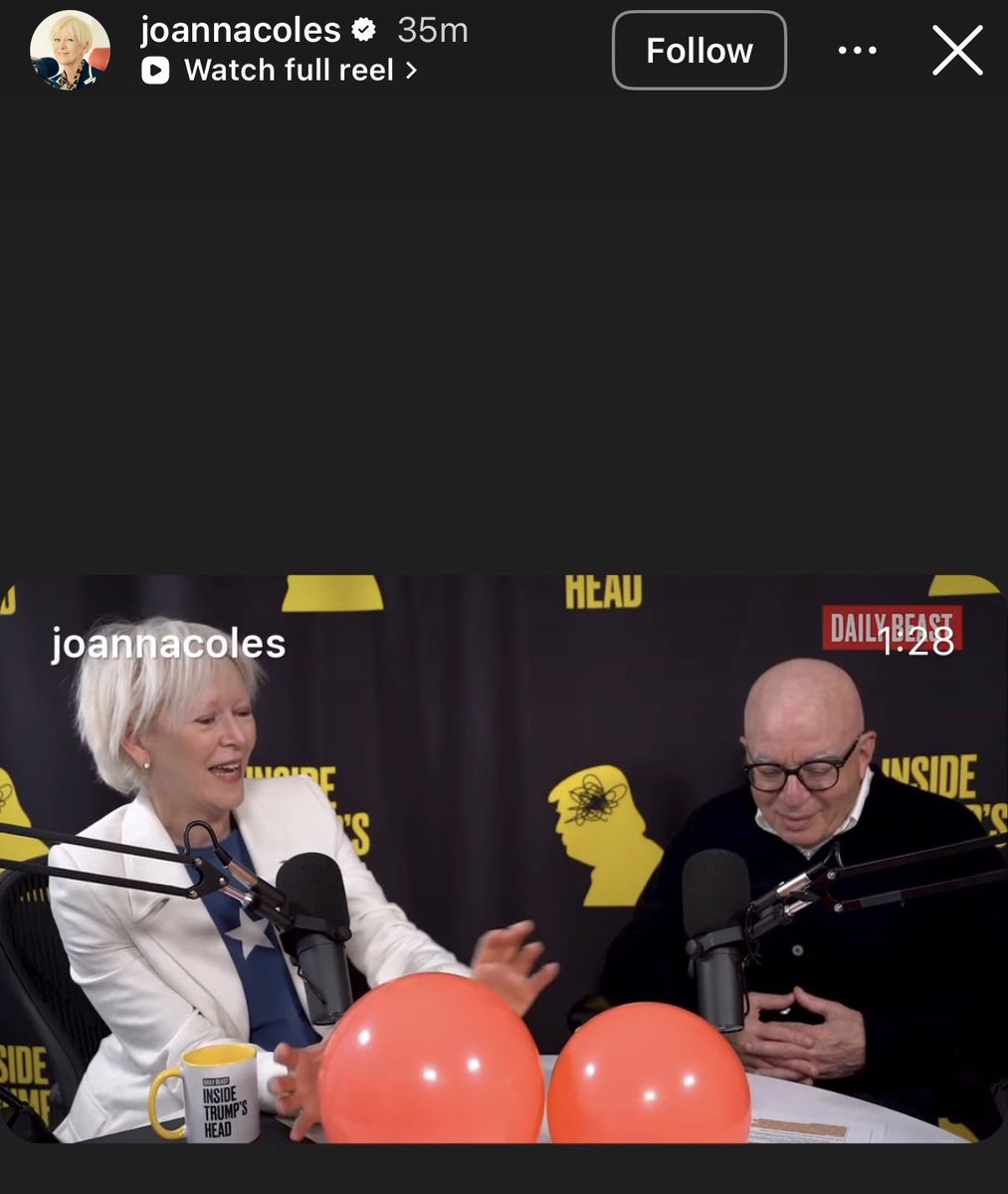
$SNAP its scary Evan has this type of deranged person on his board. He would be much better served to have younger talent that does not attack @POTUS all day and is more in touch with his users. Maybe @elonmusk can save $snap too? Nasty Psychotic people like this hurt growth @IrenicCap



BoxLongs@BoxLongs
$SNAP still blocking @POTUS account makes a lot more sense, i had no idea how bat shit crazy @evanspiegel’s board must be. Joanna Coles entire day is spent attacking the President. She is a lunatic. Why have this toxic stuff in your company. The best part is Evan was a savage.
English
@RandianCapital They can be made very uncomfortable. Could also open company up to additional child safety litigation. More money for Evan's dad but it might actually kill the company. Which could be the best outcome. Fuck them.
English
@RandianCapital Look for oversight failures, or documented instances where issues around minors’ access or safety were elevated to the board, and the response was absent or purposely inadequate.
English
Actually, the $SNAP Board is fully indemnified to the extent permitted by law, so in the event they are successfully sued, we the Shareholders pay for it!
TGiR@_TGiR
@stockgeekTV @sv_capitalhldg @IrenicCap @RandianCapital @BoxLongs The board should be sued. They are not immune from liability.
English
English

@stockgeekTV @IrenicCap @RandianCapital @BoxLongs Wow.
Didn’t realize $SNAP is just Ponzi scheme.
@evanspiegel sucks
English

Since the IPO in 2017, $SNAP's executive officers & Board members have executed 742 stock sale transactions for a total of $3.3 Billion in proceeds
There have been exactly ZERO insider purchases
@IrenicCap @RandianCapital @BoxLongs

English


@stockgeekTV @JCOviedo6 @IrenicCap @RandianCapital @BoxLongs How else this mid-cap dude gonna keep a Vic Secret Angel?
English
English

@stockgeekTV @IrenicCap @RandianCapital @BoxLongs That's insane. These large activist investors should legitimately consider leading a class action lawsuit if they don't make any changes. The board and management have fiduciary duties to shareholders.
English
@stockgeekTV @sv_capitalhldg @IrenicCap @RandianCapital @BoxLongs The board should be sued. They are not immune from liability.
English
@sv_capitalhldg @IrenicCap @RandianCapital @BoxLongs Agreed
No one stepped up to buy after the stock lost 50% in three months. Whole BOD and exec team should resign if they don't think they can create shareholder value from these levels
English

@stockgeekTV @IrenicCap @RandianCapital @BoxLongs Has any company in the history of capitalism ever been ran as focused on enriching the insiders at the expense of external shareholders more than this one?
English
English
@RandianCapital @evanspiegel @JoannaColes @jlanzone Actually, shareholders have paid Evan's dad 122 million.
English
Since 2021, $SNAP has paid the law firm @evanspiegel 's dad works at $122mm. What on earth is this law firm doing for Snapchat that they charge so much money for? And why did it ramp up so much in recent years?
@JoannaColes @jlanzone

English