Curious Me (hey you, have an ๐ŸŠ๐Ÿ’Š!)

274 posts

Curious Me (hey you, have an ๐ŸŠ๐Ÿ’Š!) banner
Curious Me (hey you, have an ๐ŸŠ๐Ÿ’Š!)

Curious Me (hey you, have an ๐ŸŠ๐Ÿ’Š!)

@highupleo

Seriously Devote @tradetravelchil student Degen @opnetbtc @motoswap @bc1plainview @chadmasterxbt Schizoid Plan Fanboi This combo... THERE IS NO COMPETITION

Joined Nisan 2023
362 Following116 Followers
Pinned Tweet
Curious Me (hey you, have an ๐ŸŠ๐Ÿ’Š!)
Dear Fellow Bitcoiners. We all want our beloved Bitcoin to grow and prosper right? As of March 17th, all your BTC prayers will be heard, The Motherchain will finally reach maturity. The blocks will fill up, the miners rewarded. Just like that. The heroes who made this happen just need a tiny bit of your attention, just that little push down the hill. That's all. The natural snowball effect will take care of the rest. And later, you can tell your grandchildren you have helped save Bitcoin! Save their future, be their hero!! Study @opnetbtc -> defibible.org -> @Motoswap IYKYK (โ‰ˆ3.93M followers)@BitcoinMagazine (โ‰ˆ3.78M followers)@WatcherGuru (โ‰ˆ3.50M followers)@CoinDesk (โ‰ˆ3.27M followers)@BitcoinNews (โ‰ˆ2.91M followers)@Cointelegraph (โ‰ˆ2.86M followers)@whale_alert (โ‰ˆ1.11M followers)@DocumentingBTC (โ‰ˆ563K followers)@TheBlock__ (โ‰ˆ479K followers)@Blockworks (โ‰ˆ260K followers)@BitcoinNewsCom (โ‰ˆ236K followers)@DecryptMedia (โ‰ˆ152K followers)@cryptonews (โ‰ˆ99K followers)@Utoday_en (โ‰ˆ71K followers)@TheBitcoinNews (โ‰ˆ68K followers)@CryptoSlate
OP_NET@opnetbtc

March 17th. Smart Contracts on Bitcoin Layer 1. No more wen.

English
1
6
34
833
Curious Me (hey you, have an ๐ŸŠ๐Ÿ’Š!)
Iยดm curious to see if you guys honor the OG community and value Moto at $ 0,056 to $ 0,06 like displayed on Defisloth! Or if youยดll play it cheap and value it on the fishtrap lure price used for the liquidity bootstrap game. (BTC->PILL->MOTO=Half price) Big difference. 7 Moto or less per SLOHM, fair. Anything above that sucks.
English
1
0
0
100
SLOHM Finance
SLOHM Finance@slohmfiยท
SLOHM IBO Round 2. In less than 12 hours. Are you ready?
English
5
8
34
1.8K
Curious Me (hey you, have an ๐ŸŠ๐Ÿ’Š!)
I really like your product. And the descriptions are usefull. But.. Why dont you create a series of details video walkarounds thru the app? Similar to like the Tradingview guides they posted on Youtube? I think it would be very informative, you'd teach pro's about your tools and noobs also about defi in general. Plus it would be thorough free marketing. Win-Win-Win.
English
1
0
1
26
MotoTerm
MotoTerm@mototermยท
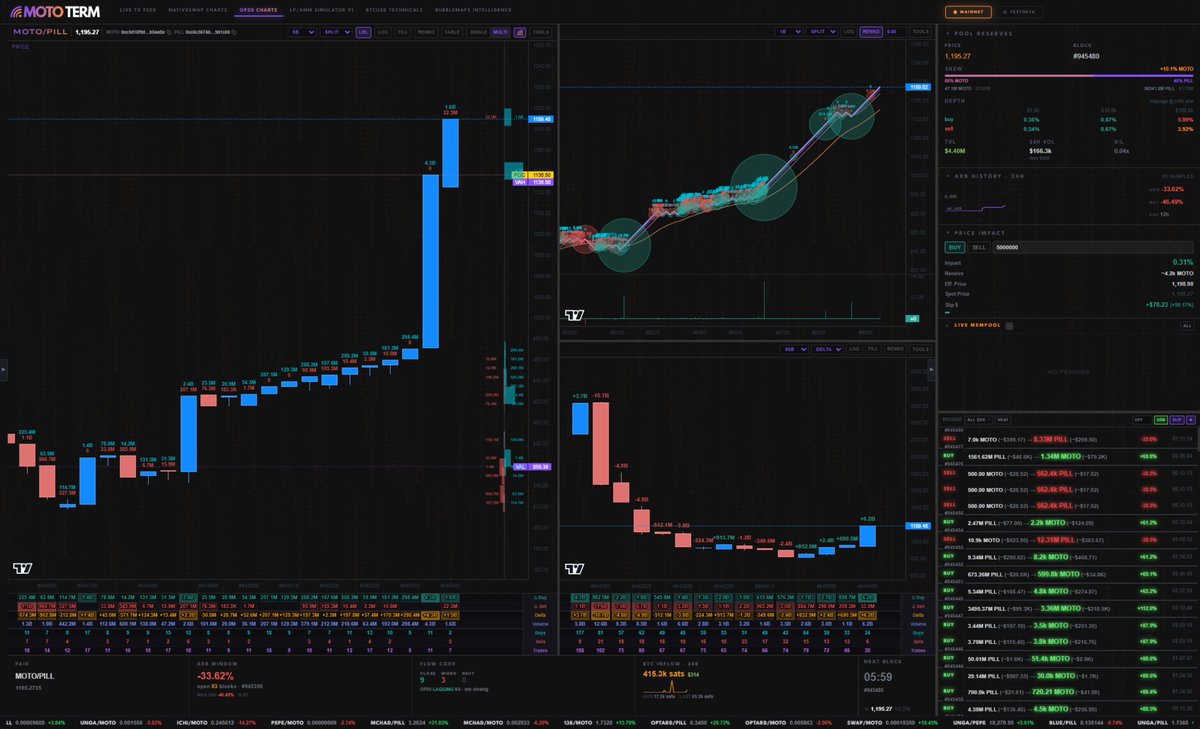
OP20 Charts are live. See $MOTO/PILL like nowhere else - way too many features to list here. Deep detail, deep insight. Every tool comes with a full description so you know exactly what you're looking at and how to read it. Building a clear picture. Block by block.
MotoTerm tweet media
English
4
3
23
1.7K
Grizzie Logan
Grizzie Logan@GrizzieLยท
Thinking about deploying $150K in Paraguayโ€™s tourism sector. The play: a rural property that works as a boutique eco-lodge โ€” and doubles as your own home. You build something real. Guests pay your costs. You live surrounded by nature in one of South Americaโ€™s most underrated countries. Illiquid? Yes. But this time, intentionally. ๐ŸŒฟ
Grizzie Logan tweet media
English
16
15
206
17.8K
Curious Me (hey you, have an ๐ŸŠ๐Ÿ’Š!)
Holy cow what a briliant idea!! Simple, elegant, effective!! Only one thing sucks about it. Why didn't I think of it.
O P N e r o@hashratefreedom

Monero โ†” OP-20 swaps. Bitcoin L1. No KYC. Independent project, not affiliated with @opnetbtc or @Motoswap just permissionless builders using their tech Smart contracts on Bitcoin deserve a private on-ramp so we built one and we need help testing it, details soon #OPNero

English
1
5
25
855
Curious Me (hey you, have an ๐ŸŠ๐Ÿ’Š!)
@Cryptolution Vincent how can you put this to a vote if you don't add the clear winners? $PILL and $UNGA on @opnetbtc's @Motoswap ON BITCOIN LAYER 1!!!
Vincent (Cryptolution) ๐Ÿ‘‘@Cryptolution

Who Will Be Crowned the Ultimate Memecoin Community of 2026? ๐Ÿ† VOTING STARTS TOMORROWโ€ผ๏ธ $DOGE (@dogecoin) $PENGU (@pudgypenguins) #SPX6900 (@MustStopMurad) $DOG (@LeonidasNFT) $FLOKI (@FLOKI) $APE (@apecoin) $BRETT (@BasedBrett) $PEPE (@pepecoineth) $MOG (@mogcoin) $SHIB (@Shibtoken) $MIM (@mimcoinbtc) $PUPS (@PupsToken) $WIF (@dogwifcoin) $LOBO (@lobothewolfpup) $TRUMP (@GetTrumpMemes) $BONK (@bonk_inu)

English
0
0
3
112
King Degen๐Ÿ‘‘
King Degen๐Ÿ‘‘@KingDegen0xยท
@highupleo haha i wanna add you, but you feel too good to follow me... dont like hollanders? (twitter dosnt let me add people if they dont follow me)
English
1
0
0
197
King Degen๐Ÿ‘‘
King Degen๐Ÿ‘‘@KingDegen0xยท
Didnโ€™t know that the dutch community is so big and activeโ€ฆ
King Degen๐Ÿ‘‘ tweet media
English
62
1
162
7.9K
Curious Me (hey you, have an ๐ŸŠ๐Ÿ’Š!)
These AlphaCats of @bluemoonbtc setting the bar high for upcoming @opnetbtc projects!!! Not only did they decide to respect the OG @motoswap community by dropping Motocats holders their ultra deflationary $BLUE tokens. They actually respected not only the holders but rewarded the number of cats held by each wallet!! Chapeau, this is how it's done sers!! Thank you. Meow Vroom Vroom!
Bluemoon@bluemoonbtc

Motocats holders, something $BLUE coming your way

English
4
8
40
1.3K
Curious Me (hey you, have an ๐ŸŠ๐Ÿ’Š!)
I said it many times before: April fools would be the perfect day for this Schizoid team to unleash their beautiful beast onto the world. And now, 01-04-26 is only ONE DAY DELAY away!! It would all fit together so perfectly, ending the era of FUD and opening the doors to Bitcoins maturity. In true Schizoid style. IYKYK Lets. Fucking. Go.
Motoswap@Motoswap

31.03.26. Motoswap launches on Bitcoin mainnet. Native $BTC swapping, staking, yield farming for the first time on Bitcoin L1. Launch your own token. Setup yield farms. All on the base chain without ever leaving it. The $MOTO economy opens soon ๐Ÿˆโ€โฌ›๐Ÿ›ต

English
3
1
33
1.8K
Curious Me (hey you, have an ๐ŸŠ๐Ÿ’Š!)
Tensions are rising for each and every one of us! From the smallest holders to the biggest builders like @OPtrackbtc, from the most recent Orange Pilled ones to the @opnetbtc team themselves... Excitement doesn't spare anyone! IYKYK LFG
OPtrack ๐ŸŠ,๐Ÿ’Š@OPtrackbtc

Something big is happening on OP_NET tonight. I've put OPtrack Markets in maintenance mode. I want to make sure everything works properly before showing you the data. Not gonna lie, I'm excited for this one. Building as fast as I can. Back soon. optrack.org @opnetbtc @Motoswap ๐ŸŠ๐Ÿ’Š

English
0
1
13
763
Curious Me (hey you, have an ๐ŸŠ๐Ÿ’Š!)
Quantum threat? Have no fear, OpWallet is already here. Study @opnetbtc
Justin Drake@drakefjustin

Today is a monumentous day for quantum computing and cryptography. Two breakthrough papers just landed (links in next tweet). Both papers improve Shor's algorithm, infamous for cracking RSA and elliptic curve cryptography. The two results compound, optimising separate layers of the quantum stack. The results are shocking. I expect a narrative shift and a further R&D boost toward post-quantum cryptography. The first paper is by Google Quantum AI. They tackle the (logical) Shor algorithm, tailoring it to crack Bitcoin and Ethereum signatures. The algorithm runs on ~1K logical qubits for the 256-bit elliptic curve secp256k1. Due to the low circuit depth, a fast superconducting computer would recover private keys in minutes. I'm grateful to have joined as a late paper co-author, in large part for the chance to interact with experts and the alpha gleaned from internal discussions. The second paper is by a stealthy startup called Oratomic, with ex-Google and prominent Caltech faculty. Their starting point is Google's improvements to the logical quantum circuit. They then apply improvements at the physical layer, with tricks specific to neutral atom quantum computers. The result estimates that 26,000 atomic qubits are sufficient to break 256-bit elliptic curve signatures. This would be roughly a 40x improvement in physical qubit count over previous state-of-the-art. On the flip side, a single Shor run would take ~10 days due to the relatively slow speed of neutral atoms. Below are my key takeaways. As a disclaimer, I am not a quantum expert. Time is needed for the results to be properly vetted. Based on my interactions with the team, I have faith the Google Quantum AI results are conservative. The Oratomic paper is much harder for me to assess, especially because of the use of more exotic qLDPC codes. I will take it with a grain of salt until the dust settles. โ†’ q-day: My confidence in q-day by 2032 has shot up significantly. IMO there's at least a 10% chance that by 2032 a quantum computer recovers a secp256k1 ECDSA private key from an exposed public key. While a cryptographically-relevant quantum computer (CRQC) before 2030 still feels unlikely, now is undoubtedly the time to start preparing. โ†’ censorship: The Google paper uses a zero-knowledge (ZK) proof to demonstrate the algorithm's existence without leaking actual optimisations. From now on, assume state-of-the-art algorithms will be censored. There may be self-censorship for moral or commercial reasons, or because of government pressure. A blackout in academic publications would be a tell-tale sign. โ†’ cracking time: A superconducting quantum computer, the type Google is building, could crack keys in minutes. This is because the optimised quantum circuit is just 100M Toffoli gates, which is surprisingly shallow. (Toffoli gates are hard because they require production of so-called "magic states".) Toffoli gates would consume ~10 microseconds on a superconducting platform, totalling ~1,000 sec of Shor runtime. โ†’ latency optimisations: Two latency optimisations bring key cracking time to single-digit minutes. The first parallelises computation across quantum devices. The second involves feeding the pubkey to the quantum computer mid-flight, after a generic setup phase. โ†’ fast- and slow-clock: At first approximation there are two families of quantum computers. The fast-clock flavour, which includes superconducting and photonic architectures, runs at roughly 100 kHz. The slow-clock flavour, which includes trapped ion and neutral atom architectures, runs roughly 1,000x slower (~100 Hz, or ~1 week to crack a single key). โ†’ qubit count: The size-optimised variant of the algorithm runs on 1,200 logical qubits. On a superconducting computer with surface code error correction that's roughly 500K physical qubits, a 400:1 physical-to-logical ratio. The surface code is conservative, assuming only four-way nearest-neighbour grid connectivity. It was demonstrated last year by Google on a real quantum computer. โ†’ future gains: Low-hanging fruit is still being picked, with at least one of the Google optimisations resulting from a surprisingly simple observation. Interestingly, AI was not (yet!) tasked to find optimisations. This was also the first time authors such as Craig Gidney attacked elliptic curves (as opposed to RSA). Shor logical qubit count could plausibly go under 1K soonish. โ†’ error correction: The physical-to-logical ratio for superconducting computers could go under 100:1. For superconducting computers that would be mean ~100K physical qubits for a CRQC, two orders of magnitude away from state of the art. Neutral atoms quantum computers are amenable to error correcting codes other than the surface code. While much slower to run, they can bring down the physical to logical qubit ratio closer to 10:1. โ†’ Bitcoin PoW: Commercially-viable Bitcoin PoW via Grover's algorithm is not happening any time soon. We're talking decades, possibly centuries away. This observation should help focus the discussion on ECDSA and Schnorr. (Side note: as unofficial Bitcoin security researcher, I still believe Bitcoin PoW is cooked due to the dwindling security budget.) โ†’ team quality: The folks at Google Quantum AI are the real deal. Craig Gidney (@CraigGidney) is arguably the world's top quantum circuit optimisooor. Just last year he squeezed 10x out of Shor for RSA, bringing the physical qubit count down from 10M to 1M. Special thanks to the Google team for patiently answering all my newb questions with detailed, fact-based answers. I was expecting some hype, but found none.

English
0
0
6
349
Justin Drake
Justin Drake@drakefjustinยท
Today is a monumentous day for quantum computing and cryptography. Two breakthrough papers just landed (links in next tweet). Both papers improve Shor's algorithm, infamous for cracking RSA and elliptic curve cryptography. The two results compound, optimising separate layers of the quantum stack. The results are shocking. I expect a narrative shift and a further R&D boost toward post-quantum cryptography. The first paper is by Google Quantum AI. They tackle the (logical) Shor algorithm, tailoring it to crack Bitcoin and Ethereum signatures. The algorithm runs on ~1K logical qubits for the 256-bit elliptic curve secp256k1. Due to the low circuit depth, a fast superconducting computer would recover private keys in minutes. I'm grateful to have joined as a late paper co-author, in large part for the chance to interact with experts and the alpha gleaned from internal discussions. The second paper is by a stealthy startup called Oratomic, with ex-Google and prominent Caltech faculty. Their starting point is Google's improvements to the logical quantum circuit. They then apply improvements at the physical layer, with tricks specific to neutral atom quantum computers. The result estimates that 26,000 atomic qubits are sufficient to break 256-bit elliptic curve signatures. This would be roughly a 40x improvement in physical qubit count over previous state-of-the-art. On the flip side, a single Shor run would take ~10 days due to the relatively slow speed of neutral atoms. Below are my key takeaways. As a disclaimer, I am not a quantum expert. Time is needed for the results to be properly vetted. Based on my interactions with the team, I have faith the Google Quantum AI results are conservative. The Oratomic paper is much harder for me to assess, especially because of the use of more exotic qLDPC codes. I will take it with a grain of salt until the dust settles. โ†’ q-day: My confidence in q-day by 2032 has shot up significantly. IMO there's at least a 10% chance that by 2032 a quantum computer recovers a secp256k1 ECDSA private key from an exposed public key. While a cryptographically-relevant quantum computer (CRQC) before 2030 still feels unlikely, now is undoubtedly the time to start preparing. โ†’ censorship: The Google paper uses a zero-knowledge (ZK) proof to demonstrate the algorithm's existence without leaking actual optimisations. From now on, assume state-of-the-art algorithms will be censored. There may be self-censorship for moral or commercial reasons, or because of government pressure. A blackout in academic publications would be a tell-tale sign. โ†’ cracking time: A superconducting quantum computer, the type Google is building, could crack keys in minutes. This is because the optimised quantum circuit is just 100M Toffoli gates, which is surprisingly shallow. (Toffoli gates are hard because they require production of so-called "magic states".) Toffoli gates would consume ~10 microseconds on a superconducting platform, totalling ~1,000 sec of Shor runtime. โ†’ latency optimisations: Two latency optimisations bring key cracking time to single-digit minutes. The first parallelises computation across quantum devices. The second involves feeding the pubkey to the quantum computer mid-flight, after a generic setup phase. โ†’ fast- and slow-clock: At first approximation there are two families of quantum computers. The fast-clock flavour, which includes superconducting and photonic architectures, runs at roughly 100 kHz. The slow-clock flavour, which includes trapped ion and neutral atom architectures, runs roughly 1,000x slower (~100 Hz, or ~1 week to crack a single key). โ†’ qubit count: The size-optimised variant of the algorithm runs on 1,200 logical qubits. On a superconducting computer with surface code error correction that's roughly 500K physical qubits, a 400:1 physical-to-logical ratio. The surface code is conservative, assuming only four-way nearest-neighbour grid connectivity. It was demonstrated last year by Google on a real quantum computer. โ†’ future gains: Low-hanging fruit is still being picked, with at least one of the Google optimisations resulting from a surprisingly simple observation. Interestingly, AI was not (yet!) tasked to find optimisations. This was also the first time authors such as Craig Gidney attacked elliptic curves (as opposed to RSA). Shor logical qubit count could plausibly go under 1K soonish. โ†’ error correction: The physical-to-logical ratio for superconducting computers could go under 100:1. For superconducting computers that would be mean ~100K physical qubits for a CRQC, two orders of magnitude away from state of the art. Neutral atoms quantum computers are amenable to error correcting codes other than the surface code. While much slower to run, they can bring down the physical to logical qubit ratio closer to 10:1. โ†’ Bitcoin PoW: Commercially-viable Bitcoin PoW via Grover's algorithm is not happening any time soon. We're talking decades, possibly centuries away. This observation should help focus the discussion on ECDSA and Schnorr. (Side note: as unofficial Bitcoin security researcher, I still believe Bitcoin PoW is cooked due to the dwindling security budget.) โ†’ team quality: The folks at Google Quantum AI are the real deal. Craig Gidney (@CraigGidney) is arguably the world's top quantum circuit optimisooor. Just last year he squeezed 10x out of Shor for RSA, bringing the physical qubit count down from 10M to 1M. Special thanks to the Google team for patiently answering all my newb questions with detailed, fact-based answers. I was expecting some hype, but found none.
English
337
1.2K
5.9K
1.5M