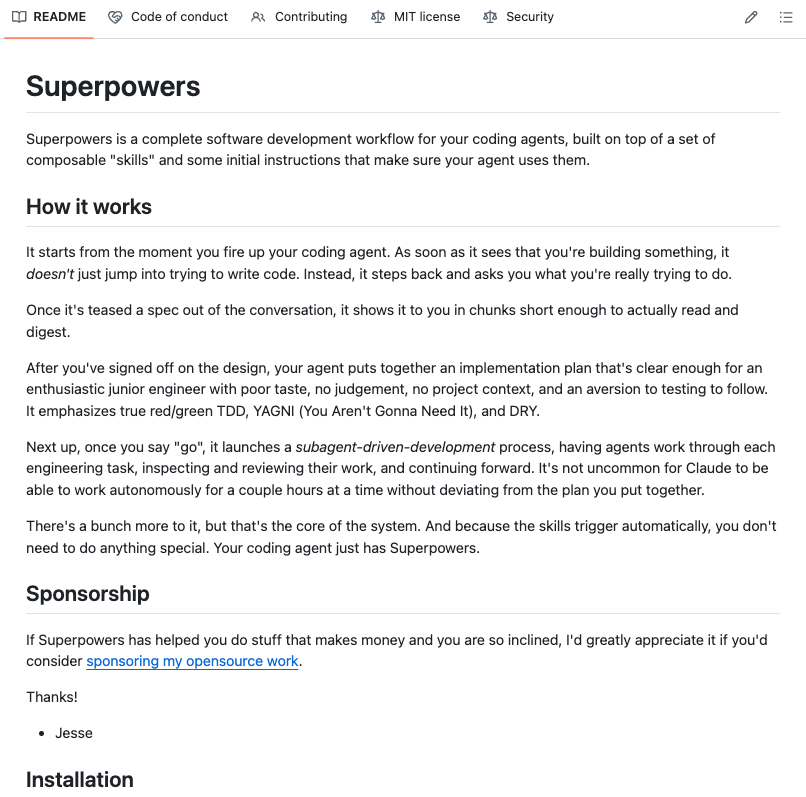
🚨 Holy shit...A developer on GitHub just built a full development methodology for AI coding agents and it has 40.9K stars on GitHub.
It's called Superpowers, and it completely changes how your AI agent writes code.
Right now, most people fire up Claude Code or Codex and just… let it go. The agent guesses what you want, writes code before understanding the problem, skips tests, and produces spaghetti you have to babysit.
Superpowers fixes all of that.
Here's what happens when you install it:
→ Before writing a single line, the agent stops and brainstorms with you. It asks what you're actually trying to build, refines the spec through questions, and shows it to you in chunks short enough to read.
→ Once you approve the design, it creates an implementation plan so detailed that "an enthusiastic junior engineer with poor taste and no judgement" could follow it.
→ Then it launches subagent-driven development. Fresh subagents per task. Two-stage code review after each one (spec compliance, then code quality). The agent can run autonomously for hours without deviating from your plan.
→ It enforces true test-driven development. Write failing test → watch it fail → write minimal code → watch it pass → commit. It literally deletes code written before tests.
→ When tasks are done, it verifies everything, presents options (merge, PR, keep, discard), and cleans up.
The philosophy is brutal: systematic over ad-hoc. Evidence over claims. Complexity reduction. Verify before declaring success.
Works with Claude Code (plugin install), Codex, and OpenCode.
This isn't a prompt template. It's an entire operating system for how AI agents should build software.
100% Opensource. MIT License.
DON'T VIBE CODE YOUR PROJECTS PLS!!
Recently, I got a project from a client who had vibe coded his entire web platform. Everything was hosted, and it seemed to work fine until he decided to scale it and make it production ready.
He came to me and said, “We need to do this and that. Let me know when you’re done.”
The problem was that the project had multiple artifacts, all vibe coded, spread across different tech stacks. The codebase was huge and inconsistent.
It took me four days just to set it up locally, and there are still parts of the code that I can’t fully understand.
I have a little over one year of experience, and this situation made me doubt myself. I started wondering whether I am capable of writing and understanding a project like this.
So please, don’t vibe code. It may work initially, but it creates serious problems when it’s time to scale or go production ready.
I have seen significant concern regarding the CDC’s announcement of their investigation into the link between autism and vaccines.
I would have imagined that this type of research would be celebrated.
I am genuinely curious about the perspectives of those who disagree with this research. Can someone here help me to understand the backlash against this investigation?
HashMap Puzzle:
What will be the output of this code?🚀
Map < String, Integer > map = new HashMap < > ();
map.put("A", 1);
map.put("B", 2);
map.put("C", 3);
map.put("A", map.get("A") + 5);
System.out.println(map.get("A") + map.getOrDefault("D", 0));
Drop you answers below!👇
@Yosef6914660152 Nope (learned that) but constant reps at building things that matter and avoiding shiny objects in the world of ignorant young engineers reproducing crap pattens we already learned sucked years ago again and again.
@tillkruegerDEV Neither, pick an actual language and learn the dimensions of programming. Teaching people JS/TS first in booot camps and code schools is the most damaging thing for the craft and their careers
@_trish_07 It is how they fooled new generation investors, there is no such. It is just marketing to so that; when it crashes you don’t have control, can’t fix it, have to wait for us, try to blame us only to find you didn’t read the SLA right and now your organization holds you to the fire
@iamsaquibdev There are a lot of factors to slow start, especially in the cloud with, highly virtualized environments, over provisioned compute clusters, and slow underlying hardware. It isn’t always the framework, there are many factors at play, many of which today you have no control over.
During a deployment, you notice your Spring Boot application’s startup time is too slow. What could be causing this, and how would you optimize it? ✅
- Lazy Initialization: Enable lazy initialization (spring.main.lazy-initialization=true) to defer bean creation until they’re actually needed.
- Remove Unused Auto configurations: Exclude unnecessary auto-configurations using @ SpringBootApplication(exclude = {...}) to prevent Spring Boot from loading unused configurations.
- Optimize Database Connections: Check for slow database connections or misconfigured connection pools, which can delay startup. Use HikariCP for efficient connection pooling.
- Reduce Classpath Scanning: Limit component scanning by specifying only the necessary packages, which reduces the number of beans that Spring needs to initialize.
- Profile-Based Configurations: Use profiles to load only the required beans and configurations per environment.