

Hodel wizard
32.6K posts

Hodel wizard
@Hodelwizard
Web3 Enthusiast | Community Builder | Growth Strategist |Building connections & scaling communities.
web3 Se unió Nisan 2022
3.8K Siguiendo2.6K Seguidores

Blockchain performance is not only about producing block faster.
It is also about how efficiently those block move across the network.
Flexnodes are built to solve that challenge.
As part of the @get_optimum Network, they help accelerate data propagation by receiving block information, generating RLNC-encoded equation and forwarding them immediately. Instead of waiting for a complete block to arrive, information can start moving through the network right away.
This approach creates a major advantage.
Rather than sending identical copies of data, Flexnodes continuously generate new encoded combinations. That gives validator more opportunities to reconstruct the original block, even when packets are lost or network conditions are less than ideal.
The result is a network that can:
• Reduce propagation delays
• Improve validator synchronization
• Use bandwidth more efficiently
• Increase reliability during data transmission
As blockchain networks continue to scale, communication becomes just as important as computation.
Flexnode represent an important part of that future by helping information reach the right place faster, making the entire network more efficient and resilient.
CM @shariaronchain

English

Optimum Shows Why Blockchain Scaling Needs a Faster Networking Layer
Most conversations around blockchain scalability usually focus on rollups, execution speed, gas costs, or consensus upgrades.
But Optimum’s latest Hoodi Testnet results highlight something equally important:
How fast data moves across the network.
And the results are impressive.
Optimum’s mumP2P protocol achieved an average block propagation latency of around 150ms across 30 globally distributed nodes on Ethereum’s Hoodi Testnet.
That is a major improvement compared to the roughly 1 second latency often seen with traditional Gossipsub propagation.
In simple terms, blocks can reach the network much faster.
And that matters more than many people realize.
When data propagation becomes faster, the entire network benefits:
✅ Nodes stay more synchronized
✅ Transactions can move through the system more efficiently
✅ Congestion risks are reduced
✅ Validators have more time to receive, verify, and attest blocks
✅ Overall network performance becomes stronger
For validators, this can be especially valuable.
Lower latency means fewer missed opportunities, better participation, and improved economic efficiency. In a system where milliseconds can matter, faster propagation can create real advantages.
The key innovation behind this is RLNC = Random Linear Network Coding.
Instead of simply repeating the same data across the network, RLNC helps optimize how information is transmitted. This reduces unnecessary redundancy and allows data to flow more efficiently, even at scale.
What makes Optimum’s results even more meaningful is that the test was not done in a small, isolated setup.
It involved 30 globally distributed nodes on Ethereum’s Hoodi Testnet, making the results much closer to real-world infrastructure conditions.
For me, the biggest takeaway is clear:
Blockchain scalability is not only about processing more transactions.
It is also about making sure critical information reaches every participant faster, more reliably, and more efficiently.
Optimum is showing that the networking layer is one of the most important, yet often overlooked, parts of blockchain innovation.
And if these results are any indication, faster data propagation could become a major foundation for the next stage of Ethereum scalability.
@get_optimum
@aqccapital
@blockchainjeff
@ada_pegasus
Nana@Nana_03nn
Latency Is No Longer Just a Technical Metric, It Is Becoming a Revenue Layer for Ethereum Validators In Ethereum staking, every millisecond matters. For a long time, network latency was mainly seen as an infrastructure issue. But as the staking market grows into a massive and highly competitive ecosystem, latency is becoming something much more important: a direct factor in validator revenue, MEV capture, and overall network performance. Optimum’s research highlights a powerful idea: reducing block propagation latency does not only make Ethereum faster, it can make validators more profitable. 1️⃣ Why Latency Matters in ETH Staking Ethereum validators earn rewards through two main layers: • Consensus Layer rewards, such as attestations and block proposals • Execution Layer rewards, including transaction fees and MEV opportunities To perform well, validators need to receive and share information quickly. When a block propagates slowly, validators have less time to react, attest correctly, or select the best available MEV bid. In simple terms, lower latency gives validators more usable time inside each slot. That extra time can become real economic value. 2️⃣ More Usable Slot Time Means Better Decisions Every Ethereum slot is time-sensitive. Validators must balance two goals: • Propose early enough so the block reaches the network safely • Wait long enough to capture better MEV bids If latency is high, validators are forced to act earlier to avoid risk. But if propagation becomes faster, validators can wait slightly longer while still staying within safe timing limits. This is where Optimum’s latency optimization becomes important. By reducing propagation delay, validators gain extra usable slot time. Even an improvement of 50 to 150 milliseconds can create measurable APR gains for large validator operators. 3️⃣ MEV Bid Selection Is the Biggest Value Driver One of the most important insights from the research is that MEV bid selection is highly sensitive to timing. Builders often submit better bids later in the slot. If a validator has to cut off bid selection too early, they may miss a higher-value bid that arrives just milliseconds later. With lower latency, validators can stay in the bidding window longer and potentially select more valuable payloads. According to the analysis, an additional 50 to 150ms of usable slot time can lead to around 13% to 16% average uplift in MEV bid value. That may sound small in time, but at Ethereum scale, it can become a meaningful amount of additional revenue. 4️⃣ Latency Also Improves Head Vote Accuracy Latency does not only affect block proposers. It also affects validators when they act as attesters. For an attestation to be rewarded properly, a validator needs to vote for the correct head of the chain and do so on time. If block arrival is delayed, validators may attest to the wrong head or submit too late. Optimum’s research shows that reducing latency can improve network-wide head vote accuracy. This is important because better head vote accuracy means stronger consensus performance, more reliable rewards, and a healthier Ethereum network overall. 5️⃣ Small Technical Improvements Can Create Large Market Effects The most interesting part of this research is how small latency improvements can scale across a massive staking market. A 50ms improvement may look tiny from a user perspective. But for validators, builders, and MEV systems, that time can decide whether a higher-value bid is captured or missed. This shows that Ethereum’s next phase of optimization may not only come from better financial strategies, but also from better networking infrastructure. Faster data propagation creates better validator performance. Better validator performance creates stronger staking economics. And stronger staking economics makes the network more competitive and efficient. 6️⃣ Why Optimum’s Approach Stands Out Optimum’s mump2p protocol uses RLNC-coded gossip to improve how data moves across the network. Instead of relying on traditional uncoded gossip, RLNC helps data spread more efficiently by reducing redundancy and making better use of network paths. This matters because Ethereum’s performance is not only about computation or capital. It is also about how quickly information reaches the right participants. From my perspective, this is what makes Optimum’s work exciting. It focuses on a hidden but extremely valuable layer of blockchain performance: the speed of information. Ethereum staking is becoming more competitive, and validator operators will increasingly look for every possible edge. Optimum’s research makes one thing clear: latency reduction is not just a technical improvement. It is a financial advantage. Faster propagation can help validators capture better MEV bids, improve attestation performance, increase APR, and contribute to a more efficient Ethereum network. In a market worth billions, milliseconds are no longer @get_optimum @aqccapital @blockchainjeff @ada_pegasus
English

𝐅𝐫𝐨𝐦 𝐋𝐚𝐭𝐞𝐧𝐜𝐲 𝐭𝐨 𝐋𝐢𝐠𝐡𝐭𝐧𝐢𝐧𝐠 𝐒𝐩𝐞𝐞𝐝. 𝐓𝐡𝐞 𝐍𝐞𝐱𝐭 𝐆𝐞𝐧 𝐨𝐟 𝐁𝐥𝐨𝐜𝐤𝐜𝐡𝐚𝐢𝐧 𝐈𝐧𝐟𝐫𝐚𝐬𝐭𝐫𝐮𝐜𝐭𝐮𝐫𝐞.
Whenever we interact with Web3 networks, our priorities are simple: speed and security. However, as decentralized networks scale, they inevitably hit a major bottleneck—block propagation delays, commonly known as network lag or latency. When nodes take too long to sync, transactions slow down, and critical security vulnerabilities emerge.
This is exactly the core issue that @
@get_optimum is tackling head-on. By introducing RLNC (Random Linear Network Coding), they are entirely rewriting the rules of blockchain resilience.
How RLNC is Upgrading Web3 Infrastructure
Instead of relying on traditional, linear data transfers that choke under heavy loads, RLNC optimizes how data is coded and transmitted across nodes. Looking closely at the architecture breakdown, Optimum delivers on four massive pillars:
1/Faster Propagation: No more waiting around. It eliminates packet bottlenecks to achieve maximum throughput with minimal lag.
2/Better Synchronization: Real-time block delivery ensures that all nodes across the ecosystem stay updated simultaneously.
3/Stronger Security: Resilient by design and secure by default. There are no loose ends left for malicious actors to exploit.
4/Greater Network Resilience: Even under extreme network traffic or sudden volume spikes, the infrastructure maintains top-tier performance without breaking a sweat.
The Golden Rule: Faster Coordination = Stronger Security
In a truly decentralized ecosystem, communication speed equals safety. The faster the nodes can coordinate, the harder it is for the network to be compromised. Optimum Network isn’t just building another chain; they are establishing a bulletproof, lightning-fast foundation for the future of DeFi and decentralized scaling.
@get_optimum
@shariaronchain

English

Who can use Optimum?
If you're running a validator or operating a node, Optimum is built for you.
For validators, every reward matters. Optimum helps ensure you can efficiently capture all available reward streams from consensus issuance and transaction fees to MEV opportunities.
For node operators, the benefits go beyond rewards. By reducing bandwidth requirements and improving node synchronization, Optimum helps lower operational costs while keeping infrastructure running smoothly.
The best part? Integration is seamless, allowing operators to improve network efficiency without disrupting their existing setup.
Whether you're securing a public blockchain network or managing node infrastructure at scale, Optimum helps you do more with less.

English

THE ECONOMICS OF DATA PROPAGATION @get_optimum RLNC FAST LANE
In high performance blockchain networks, latency directly dictates a node's ability to secure block rewards. Relying solely on standard data propagation methods which act as the network's base lane often results in missed consensus deadlines and lost revenue due to unpredictable network congestion.
Optimum is introducing a structural solution to this latency problem through its RLNC powered fast lane. This architecture functions as a parallel data toll road operating alongside the standard network. By utilizing advanced Random Linear Network Coding, $Optimum provides validators with the absolute maximum probability of fast data decoding.
This parallel infrastructure ensures that critical data shards reach their destination strictly on time. For node operators, this translates directly to capturing the exact percentage of consensus rewards that would otherwise be lost to base lane latency. It is a calculated, necessary infrastructure upgrade for maximizing node efficiency.
#Optimum #RLNC @aqccapital @shariaronchain @tgogayi

English

A validator cannot agree on data it has not received yet.
That is one reason @get_optimum pays attention to networking.
A blockchain can have strong consensus, but still struggle if data moves poorly.
That is where Optimum focuses its work: the networking layer.
Consensus decides which data becomes part of the chain.
Networking decides how quickly that data reaches the nodes that need it.
These two parts are connected, but they solve different problems. Consensus is about agreement.
Networking is about communication. If communication is slow, validators may receive blocks and transactions at different times.
Some nodes can move forward quickly. Others may still be waiting for the same data.
This creates delay across the system, even when the consensus design is technically strong.
@get_optimum focuses on networking because many blockchain performance limits start before consensus even begins.
Before validators can verify a block, they need to receive it. Before they can stay synchronized, data needs to propagate efficiently.
Before throughput can improve, the network must reduce repeated and wasted transmission.
This is where efficient data propagation becomes important.
Instead of only forwarding the same data again and again, Optimum looks at how data can move in a more useful way between nodes.
Network coding helps by turning data into encoded pieces. Each piece can help reconstruct the original information.
Nodes do not always need one exact packet from one exact peer. They need enough useful data to rebuild and verify what was sent.
A simple comparison is a team trying to make a decision. Consensus is the final agreement.
Networking is how fast everyone receives the information needed to agree.
If the information arrives late, the decision slows down.
That is why @get_optimum focuses on networking instead of trying to replace consensus.
Better communication makes existing blockchain systems more efficient at the layer where data actually moves.

English
High-Frequency DeFi → Why Network Speed Matters
Most traders focus only on TPS fee & execution.
But in reality market advantage often depends on how fast data reaches the network.
→ The Hidden Problem
Traditional P2P gossip systems create delays between nodes. Even milliseconds matter because price information arrives late & opportunitie disappear instantly.
→ How Modern Infrastructure Changes Trading
Platforms like @get_optimum are designed to reduce propagation delays with sub-millisecond data movement.
This helps DEX participants receive market updates faster & react before the broader market catches up.
→ Why Synchronization Is Important
When liquidity & pricing data stay synchronized across the network:
• Arbitrage gaps shrink
• Trading accuracy improves
• Bots react more efficiently
Latency + Delay = Lost Opportunity
Speed + Accurate Data = Better Execution
→ Infrastructure For Automated Trading
So basically
Low latency & synchronized data are becoming the real edge in DeFi.
The future is not just faster blockchain it’s instant information flow powering smarter & faster execution.

SHUVO@shuvo6519848199
The Hidden Side of Blockchain Most people only focus on TPS fees & execution speed when discussing blockchain performance. But before a validator confirm anything, the data must first reach the network. If data moves slowly → the entire system feels slower. → Why Data Movement Matters Most blockchain networks still spread data by repeatedly broadcasting it between nodes. It works but as networks grow bigger, it can lead to: → Higher bandwidth usage→ Slower propagation→ Network congestion Real efficiency is not just about speed.It is about how smartly data travels. → What @get_optimum Is Solving Instead of changing consensus itself, Optimum focuses on improving how blockchain data moves across participants. Using advanced network coding research, the goal is to make data transmission more efficient & reliable across the network. → Simple Logic Massive Impact A validator cannot verify data it never received. Faster propagation → smoother block distributionSmoother distribution → stronger blockchain performance → Final Learning Some of the biggest blockchain innovations happen quietly in the background. The real game changer is often the infrastructure layer that helps the entire network run faster smoother & more efficiently. @cryptooflashh @aqccapital @ada_pegasus
English


How does network coding differ from traditional peer to peer transmission?
@get_optimum utilizes network coding technology to improve how blockchain data moves across decentralized networks. While traditional peer to peer transmission focuses on forwarding individual packets between nodes, network coding introduces a different approach that can improve efficiency and reliability during propagation.
1. Traditional Peer to Peer Transmission:
Most blockchain networks distribute information by passing data packets from one node to another until the entire network receives the information.
Packet Dependency: Each packet must be delivered successfully for the receiving node to reconstruct the original data.
Retransmission Requirements: If packets are lost during transmission, additional requests are often needed to recover missing information.
Propagation Delays: As data moves through multiple network hops, latency can accumulate and slow overall distribution.
This approach has powered blockchain networks for years but can become less efficient as network activity and scale increase.
2. Network Coding Changes the Transmission Process:
Instead of forwarding original packets individually, network coding combines and encodes data before transmission.
Encoded Packets: Each transmitted packet contains information derived from multiple pieces of the original data.
Flexible Reconstruction: Nodes can recover the original information once they receive a sufficient number of encoded packets, regardless of the order they arrive.
Reduced Dependence on Specific Packets: Missing a particular packet does not necessarily prevent successful reconstruction of the original data.
This creates a more adaptable transmission process that can better tolerate packet loss and network instability.
3. Optimum's Network Coding Architecture:
Optimum integrates Random Linear Network Coding (RLNC) into its data acceleration layer to optimize blockchain propagation.
Efficient Distribution: Encoded data can be transmitted across multiple network paths simultaneously.
Improved Reliability: Nodes can recover information without waiting for specific packets to arrive.
Faster Synchronization: Information can spread throughout the network more efficiently, helping participating nodes remain synchronized.
Scalable Communication: The system is designed to support growing network demand while reducing communication bottlenecks.
@get_optimum by moving beyond traditional packet forwarding, network coding introduces a more resilient method for distributing blockchain data across decentralized networks.

English

Most networks struggle when data packets are delayed or lost.
That’s where RLNC (Random Linear Network Coding) changes the game.
Instead of sending data in the traditional way, RLNC encodes information into multiple coded pieces, allowing nodes to recover the original data even if some packets never arrive.
The result?
🔹 Faster data propagation
🔹 Better bandwidth efficiency
🔹 Higher reliability
🔹 Lower latency for blockchain networks
This is one of the key innovations behind @get_optimum vision for scalable and real time Web3 infrastructure.
Smarter networking may be just as important as smarter blockchains.

English

What if AI agents could operate continuously without human intervention?
This is one of the core ideas behind Ritual.
On most chains, smart contracts remain inactive until someone triggers them.
Ritual introduces native scheduling, autonomous execution, and programmable agent behavior.
An agent can hold its own keys.
It can access external information.
It can execute AI models.
It can schedule future actions.
And it can continue operating as long as resources remain available.
This shifts blockchain from passive applications toward active systems.
Instead of waiting for users, software begins acting on its own.
The implications are significant for trading systems, data infrastructure, automated businesses, and AI-powered applications.
The future may not simply be smart contracts.
It may be autonomous entities capable of reasoning, acting, and evolving directly onchain.
@ritualnet || @ritualfnd || @Jez_Cryptoz

English

Finally completed another artwork(#6) inspired by @get_optimum
Optimum is focused on improving communication between networks making systems more efficient scalable & connected without adding unnecessary complexity.
This artwork is my small tribute to that idea.


English

Why alignment comes before growth
Growth is easy to see.
Alignment is not.
Yet every strong network is built on alignment before growth.
Because growth without alignment creates noise.
Growth with alignment creates momentum.
The difference is not size.
The difference is direction.
When participants share information, they begin to share understanding.
Shared understanding creates alignment.
Alignment enables coordination.
Coordination drives growth.
And sustainable growth builds resilience.
shared information
↓
shared understanding
↓
alignment
↓
coordination
↓
growth
↓
long term resilience
Without alignment:
misunderstandings increase
↓
coordination weakens
↓
growth slows
↓
trust declines
↓
resilience fades
The strongest networks are not the ones growing the fastest.
They are the ones moving in the same direction.
Because lasting growth is not built on scale alone.
It is built on shared goals, shared information, and coordinated action.
Alignment may be invisible.
But its results are not.
Healthy growth.
Stronger coordination.
Long term trust
Resilient networks.
A network does not become stronger simply by becoming larger.
It becomes stronger when its participants remain aligned.
Growth is the outcome
Alignment is the foundation
@get_optimum

English

When people talk about blockchain scalability, most of the attention goes to execution.
Faster blocks.
Higher TPS.
Cheaper transactions.
But there’s another layer quietly carrying the whole system.
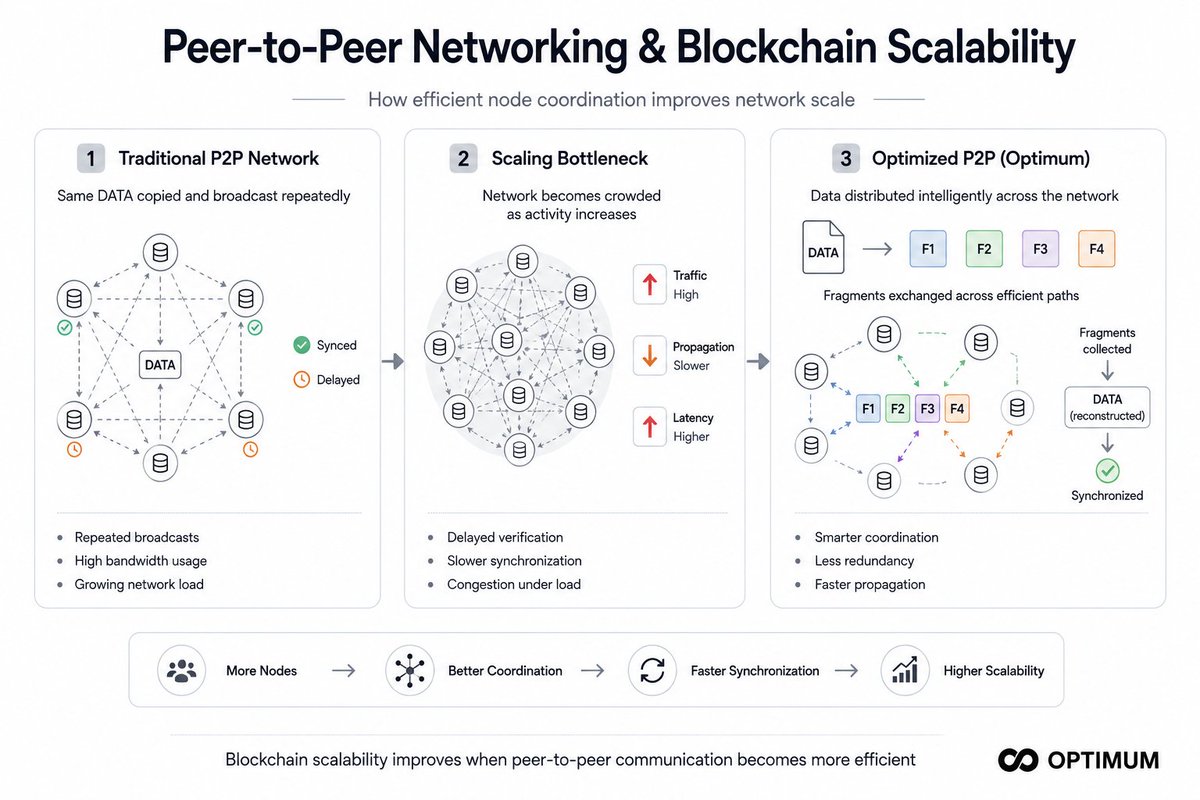
Peer-to-peer networking.
Because blockchains do not run from a central server.
Every validator and node depends on receiving information from other nodes across the network.
Blocks.
Transactions.
State updates.
Synchronization messages.
Everything moves through peer-to-peer communication.
At smaller scale, traditional P2P models work well.
Nodes receive data and forward it to others until the network becomes synchronized.
But as throughput grows, this model starts becoming expensive.
The same information gets copied and retransmitted again and again.
That creates unnecessary traffic.
More traffic means:
• more bandwidth consumption
• slower propagation
• delayed verification
• reduced efficiency under load
Eventually the network spends too much effort distributing data instead of processing it.
That’s why networking is becoming a scalability problem, not just an infrastructure detail.
The role of peer-to-peer networking is no longer simply connecting nodes.
It’s about coordinating information efficiently.
That means:
• reducing redundant transmission
• improving propagation paths
• keeping nodes synchronized faster
• delivering data with less overhead
Optimum explores this layer through optimized networking approaches.
Instead of relying only on repeated broadcasting, data can be distributed more intelligently across multiple paths.
Nodes exchange useful information instead of duplicating everything.
This helps the network stay coordinated even as activity increases.
Because blockchain scalability is not only about producing more blocks.
It’s also about helping those blocks move efficiently between thousands of participants.
English