Robert O'Kersevan

113.2K posts

Robert O'Kersevan banner
Robert O'Kersevan

Robert O'Kersevan

@KersevanRoberto

Physicist; Accelerators, Vacuum Science & Technology, Thin-Films, Synchrotron Radiation and Vacuum Modeling, Nuclear Transmutation, Nuclear Energy, and more...

Se unió Temmuz 2018
715 Siguiendo4.5K Seguidores
Tweet fijado
Robert O'Kersevan
Robert O'Kersevan@KersevanRoberto·
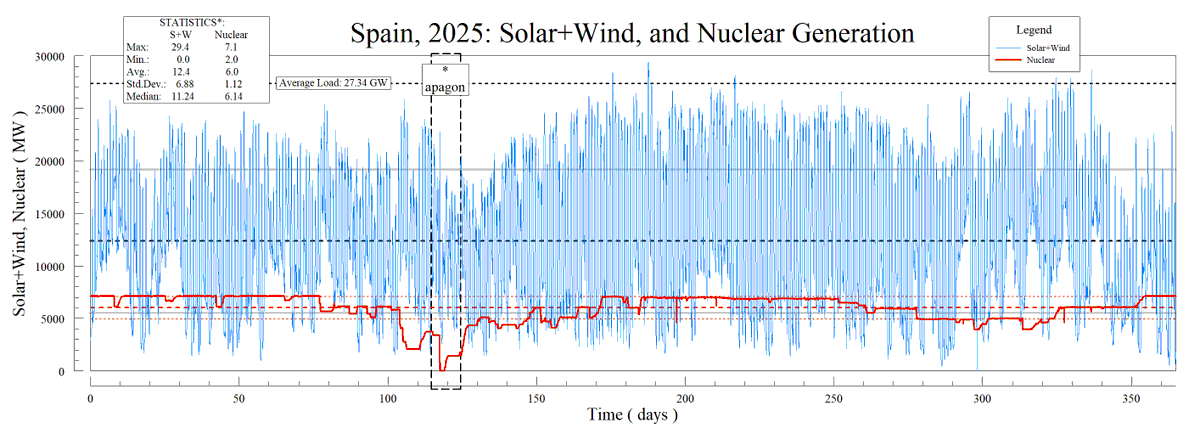
#nucleare Gli antinucleari de noantri, impossibilitati (salvo casi limite) a difendere la indifendibile Energiemerde🇩🇪, sono passati al role model Spagna. Qui stellare prestazione delle rinnovabili intermittenti solare+eolico in 🇪🇸, 2025 Ricordiamo il blackout mortifero, 28/4/25!
Robert O'Kersevan tweet media
Italiano
3
0
36
1.2K
Robert O'Kersevan
Robert O'Kersevan@KersevanRoberto·
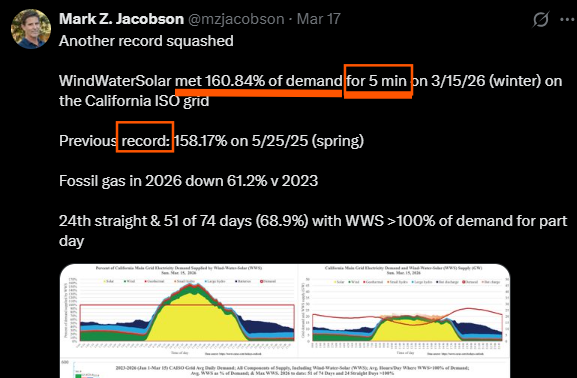
#jackassonate RECORD!!! RECORD!!! RECORRRRDDD!!! ... per CINQUE MINUTI!???🤣😂 Poi sto troll immondo vorrebbe anche essere preso sul serio??? Ma trovategli un circo!🤡
Robert O'Kersevan tweet media
Italiano
3
2
30
973
#DeportElonMusk &#NeverBuyATesla
@DocuVerite Rappel quotidien Nucléaire Comparaison des prix avec l'eolien Hinkley Point C (Nucleaire) £133/MWh Hornsea 3 (Eolien) £48.69/MWh Les phases plus récentes de Hornsea (projets 2, 3 et 4) sont environ 40 à 60 % moins chères que Hinkley Point C Ca met le nucleaire 3 fois plus cher
Français
5
0
1
193
Robert O'Kersevan retuiteado
Documentaire et Vérité
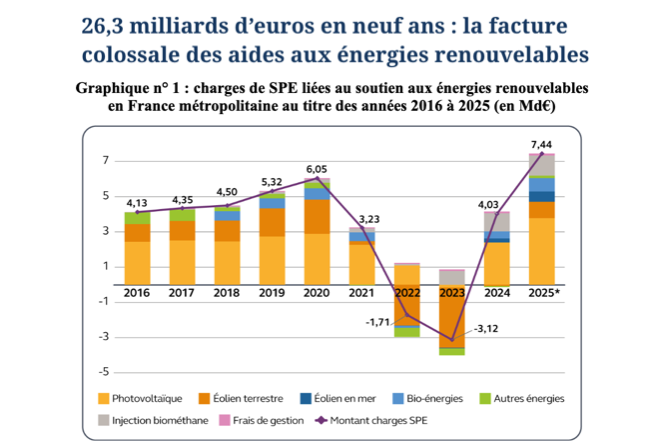
Le titre « 26,3 milliards d’euros en neuf ans : la facture colossale des aides aux EnR » donne l’apparence d’une addition définitive. Pourtant ce chiffre ne désigne pas le coût de ces énergies, mais seulement une fraction spécifique, comptable et budgétaire. Les 26,3 milliards correspondent exclusivement aux charges de service public de l’énergie (SPE), c’est-à-dire aux compensations versées par l’État pour garantir les tarifs aux producteurs. Ce chiffre ne capture qu’un seul mécanisme, le soutien direct. Or, comme le reconnaît la Cour, le rapport « ne couvre pas la totalité des coûts induits par le déploiement des énergies renouvelables » Dès lors, ce chiffre brandi ne saisit qu’une surface. Il laisse hors champ tout ce qui fait système : les investissements dans les réseaux nécessaires pour intégrer des productions dispersées et intermittentes, les coûts d’équilibrage qu’impose leur variabilité, les charges indirectes répercutées sur les consommateurs via les tarifs d’acheminement... À cela s’ajoutent les engagements futurs déjà contractés, ainsi que des coûts plus diffus encore (coûts d’opportunité, rigidités induites, choix énergétiques contraints... ) qui ne figurent dans aucune comptabilité immédiate. Si l’on cherche malgré tout à reconstituer un ordre de grandeur plus réaliste, l’addition change d’échelle. Aux 26,3 milliards de soutien direct passés, il faut ajouter, au minimum, plusieurs dizaines de milliards de coûts de réseau, d’intermittence et d’effets système. Sans prétendre à une exactitude impossible faute de comptabilité consolidée, on peut raisonnablement estimer que le coût élargi engagé sur la période récente se situe non plus autour de 26 milliards, mais plutôt dans une fourchette de 50 à 70 milliards d’euros. Et si l’on y ajoute les engagements futurs déjà inscrits hors bilan (87 milliards d’€ fin 2024), on comprend que la question n’est plus celle d’une dépense ponctuelle, mais d’une architecture financière de long terme. Car ici réside la limite méthodologique essentielle : seuls les flux monétaires directs de l’État sont comptabilisés. Tout ce qui transite par les consommateurs, les marchés ou les opérateurs disparaît de l’analyse centrale. Le chiffre de 26,3 milliards donne ainsi l’illusion qu’on peut circonscrire le coût, le mesurer, le maîtriser. Alors qu’en réalité, on est face à un système diffus, aux effets multiples, dont une grande partie échappe à la comptabilité publique... Le problème n’est donc pas que ce chiffre soit faux, il est qu’il soit présenté comme suffisant. Car l’enjeu n’est pas seulement celui du montant, mais celui de la lisibilité. Une politique dont le coût réel ne peut être appréhendé qu’indirectement tend, avec le temps, à se soustraire au débat qu’elle devrait pourtant éclairer... ccomptes.fr/fr/publication…
Documentaire et Vérité tweet media
Français
15
200
349
19.6K
Michele Grassi
Michele Grassi@mgrassi14·
@micheleboldrin Facciamo il confronto con il Nucleare? La centrale Flamanville 3 in Francia produce 13 TWh/anno. E’ costata €19 miliardi e ci sono voluti 17 anni per costruirla. La Spagna ha aumentato la generazione di Solare di 30 TWh/anno, spendendo “solo” €30 miliardi, in appena 5 anni.
Italiano
5
1
5
4.4K
Michele Boldrin
Michele Boldrin@micheleboldrin·
Almost as good as France, but not quite. By going nuclear France had already lowered that percentage to 7% of the total hours in 2021. If one takes into consideration the geography and climate of most European countries it should be quite clear which is the right path to energy independence in the EU: 2/3 nuclear, 1/3 🌞 and 🌬️. @ora_italia
Jan Rosenow@janrosenow

Spain's renewables build-out has structurally decoupled its electricity prices from gas markets. Gas now sets the price in only 15% of hours, compared to 90% in Italy. Countries that invested early in clean power are far less exposed to fossil fuel price shocks.

English
8
15
240
30.7K
Robert O'Kersevan retuiteado
Giuseppe Zollino
Giuseppe Zollino@GiZollino·
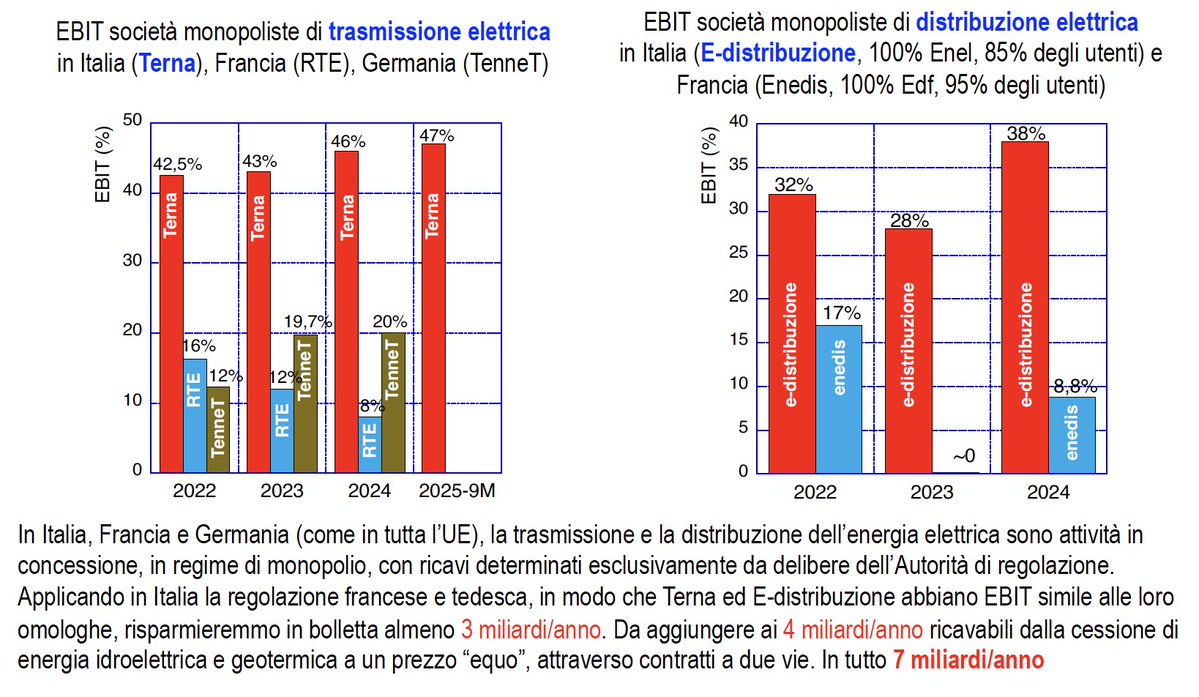
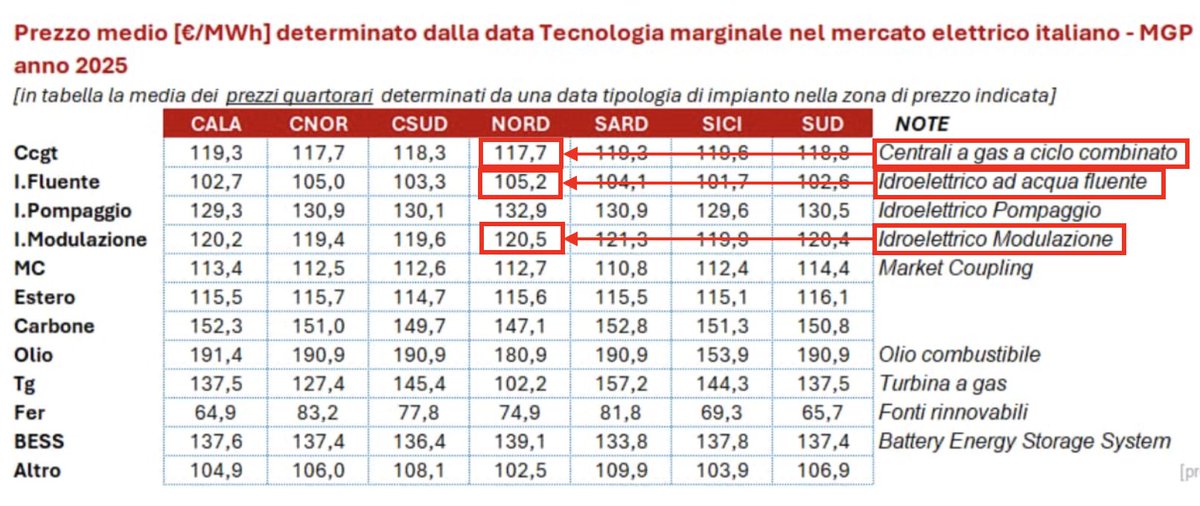
Grande @CarloCalenda. Per la cronaca, qui sotto trovate i dati che tutti potete leggere sui bilanci pubblici delle società citate: il risultato operativo (EBIT) di e-distribuzione (gruppo Enel) è stabilmente ben più alto (nel 2024 il quadruplo) di quello di enedis (gruppo EDF, francese). È urgente che @ARERA_it riveda profondamente e ugentemente il sistema regolatorio. Per quanto riguarda il prezzo di vendita dell'energia idroelettrica, è vero che "lo determina il mercato"; pertanto, quando il prezzo marginale in borsa lo fa il gas (il 52% delle ore nel 2025), l'energia idroelettrica è remunerata come fosse prodotta a gas 🤷‍♂️. Quindi -dicono i gestori- non è colpa nostra se è alto. Ma se credono d'esser furbi, cascano proprio male. Guardate nella tabella in basso a dx il prezzo offerto in borsa nel 2025 dai concessionari dei grandi impianti idroelettrici quando sono stati proprio loro a determinare il prezzo marginale (nel 17,5% delle ore, nel 2025): in Zona Nord (dove si trovano la maggior parte degli impianti), il prezzo offerto è stato o appena il 10% inferiore a quello delle centrali a gas o addirittura il 2,5% superiore! Chissà come mai... e se i concessionari insistono coriacemente a sistenere di non poter "sopravvivere" con prezzi più bassi (con buona pace di quelli che "le rinnovabili abbassano il prezzo dell'elettricità"), allora l'unica soluzione è mettere a gara le concessioni in scadenza, prevedendo la remunerazione con un contratto per differenze (esattamente come si fa per tutti i nuovi impianti eolici e fotovoltaici), con offerte al ribasso... e scommetto che si chiuderebbero a non più di 60-65 €/MWh (guardate in Svezia quanto costa l'energia idroelettrica)!
Giuseppe Zollino tweet mediaGiuseppe Zollino tweet media
Carlo Calenda@CarloCalenda

Cattaneo parla dei “distributori” senza ricordare che Enel ha l’85% della distribuzione. Concessione rinnovata senza gara con previsione di eventuale pagamento a carico dei cittadini in bolletta. Ovviamente sugli utili astronomici di Enel distribuzione (regime regolato) Cattaneo percepisce lauti bonus. Questo tipo prende per fessi cittadini e imprese. Spero davvero che @GiorgiaMeloni non lo rinnovi. Altrimenti continuare a parlare di “controllo degli speculatori” fa ridere i polli. PS e ha talmente strizza della verità che ogni volta che parlo di questo si un giornale si precipita a pretendere un’intervista e/o minacciare di togliere la pubblicità.

Italiano
2
39
132
12.7K
Marcello
Marcello@MarcNico26·
@LuMo71 @KersevanRoberto La cosa bella dei social è che c'è gente molto preparata che si atteggia in maniera semplice e cerca di spiegare, senza per forza passare all'ironia da bar. Certo è difficile trovarli ma qualcuno c'è.
Italiano
1
0
0
24
Luigi Moccia
Luigi Moccia@LuMo71·
Volete il disaggregato per fonte e solo nell'UE? Eccovi accontetati Nell'ultimo quarto di secolo: Fonti con maggiore *decrescita*: Nucleare -200 TWh/a Carbone - 530 TWh/a Fonti con maggiore crescita: Eolico +450 TWh/a Solare +367 TWh/a Tu chiamalo se vuoi decadimento nucleofossile
Luigi Moccia tweet media
Robert O'Kersevan@KersevanRoberto

@LuMo71 @PaoloVivani 3. Continui con la ciliegia che è il grafico delle REN, tutte assieme, contro il nucleare? Ma tu, che vivi in Europa, lo sai qual'è la prima fonte da tanti anni, quella che ANCHE ADESSO ti manda in Italia un paio di GW puliti, a basso costo, no? Rosica pure, giggi'!🤡

Italiano
2
1
11
721
Redux
Redux@retrtretertr·
@_Cereme_ Lol le foutage de gueule de dire que le nucléaire n'est pas soutenu alors que l'état a sauvé Areva de la faillite et se retrouve même à devoir détourner le livret A pour éviter la faillite d'EDF.
Français
3
0
2
73
Robert O'Kersevan retuiteado
Cérémé
Cérémé@_Cereme_·
🎰Hier la Cour des Comptes, aujourd’hui la CRE : en 2025, 20% du productible solaire a été effacé car inutile, et les producteurs compensés par l’Etat ! ▶️En somme, les ENRi surproduisent, sans débouchés, au crochet de notre budget... Le nucléaire, quand il est modulé de force, n’est lui pas soutenu financièrement. Cette gabegie doit cesser. cre.fr/actualites/tou…
Français
8
137
189
2.9K
Robert O'Kersevan retuiteado
Curiosity
Curiosity@CuriosityonX·
Inside a fusion reactor built by Tokamak Energy, a company based in the United Kingdom. The streaks of green come from ionized lithium injected into the plasma.
English
29
77
688
59.9K
Robert O'Kersevan retuiteado
Shanaka Anslem Perera ⚡
Helium is the only element that escapes Earth’s atmosphere permanently. Once released, it rises through the troposphere, passes the stratosphere, and leaves the planet. It cannot be manufactured. It cannot be synthesised at industrial scale. It accumulates over billions of years in the same geological reservoirs as natural gas. And one third of the world’s supply just went offline because Iran hit the facility that extracts it. Qatar produced roughly 63 million cubic metres of helium in 2025, accounting for 30 to 36 percent of global supply from a total of approximately 190 million cubic metres. QatarEnergy’s three large helium purification plants at Ras Laffan form the world’s biggest helium production base. When LNG production stopped after Iranian drone strikes on March 2 and the subsequent missile damage on March 19, helium extraction stopped automatically because helium is recovered during natural gas liquefaction. You cannot produce helium without producing LNG. The byproduct dies with the primary product. Spot helium prices have roughly doubled since the crisis began. Industry consultants warn that prolonged disruption could push contract prices toward $2,000 per thousand cubic feet. A major industrial gas supplier has already begun assessing customers a helium surcharge. Phil Kornbluth, the most cited helium market consultant, stated the assessment directly: the world cannot compensate for the loss of a third of its helium supply. South Korea imports 64.7 percent of its helium from Qatar. SK Hynix and Samsung operate high-volume fabs producing the DRAM and high-bandwidth memory that power every AI accelerator, every data centre GPU, and every cloud computing cluster on Earth. Helium cools silicon wafers during fabrication. It serves as a carrier gas in deposition and etching tools. It enables leak detection in vacuum systems. Modern extreme ultraviolet lithography requires helium-cooled environments for precise temperature control. Without helium, the fabrication process degrades or stops. SK Hynix and Samsung hold two to three months of helium inventory. Two to three months is not a buffer. It is a countdown. If Ras Laffan remains offline beyond that window, South Korean memory production faces rationing. TSMC in Taiwan is somewhat more diversified but still uses Qatar-linked supply chains. The entire AI hardware supply chain, from HBM3E memory stacks to advanced logic chips, sits inside helium-dependent ecosystems. Beyond semiconductors, helium cools the superconducting magnets in more than 14,000 MRI machines operating worldwide. It pressurises rocket fuel tanks and purges propulsion systems in aerospace. CERN’s Large Hadron Collider depends on helium cryogenic systems. There is no substitute for helium in any of these applications at industrial scale. The United States and Qatar together account for more than 70 percent of global production. The US federal helium reserve and private suppliers offer partial relief, but global prices and spot availability are still governed by Qatar’s market share. Japan’s Iwatani has drawn on US reserves. Canada and the Rockies are seeing renewed investor interest. None of this replaces 63 million cubic metres in weeks. The war hit uranium first. Then oil. Then nitrogen. Then water. Then plastic. Then medicine. Then sulfur. Now helium. Eight layers. Each one deeper. Each one closer to the infrastructure that sustains modern civilisation. The chip that processes your data, the magnet that scans your body, and the rocket that launches your satellite all depend on an atom that leaves the planet when you lose it. open.substack.com/pub/shanakaans…
Shanaka Anslem Perera ⚡ tweet media
English
149
1.1K
3.7K
590.6K
Robert O'Kersevan retuiteado
J Stewart
J Stewart@triffic_stuff_·
🚨BOMBSHELL: STARMER & MILIBAND'S NET ZERO FANTASY SHATTERED – ENERGY CEOs REVEAL BILLS WILL STAY SKY-HIGH EVEN IF WHOLESALE POWER COSTS ZERO! 💣 🤯 MUST WATCH‼️ Energy Suppliers Plead With Government To Scrap Green Levies Forcing Bills Through The Roof , Testimony Straight From Parliament Demolishes All Labour Net Zero Claims⚡️💡 In a devastating blow to Keir Starmer and Ed Miliband's net zero dream, Britain's major energy suppliers laid bare the harsh reality in Parliament on 15 October 2025: Labour's green policies are driving household bills relentlessly upward, regardless of what happens to global gas or wholesale prices. Ed Miliband has repeatedly insisted that high energy bills stem purely from volatile global fossil fuel markets. That narrative has now been comprehensively demolished by the very industry executives Labour claims to champion. Chris Norbury, CEO of E.ON UK, delivered the killer line that exposes the whole net zero con: "Some of the modelling that we have suggests that you could get to a position by 2030 where if the wholesale price was zero, bills would still be the same as they are today because of the increase in those non-commodity costs." This means astonishingly even if wholesale costs fell to zero, bills would STILL not fall, and could even rise further, due to the explosion in policy-driven charges. Rachel Fletcher, Director of Regulation and Economics at Octopus Energy, piled on the pressure with equally brutal warnings: "If we continue on the path we’re on now, electricity prices are going to be 20% higher in 4 or 5 years time than they are now. And that’s even if wholesale prices halve." "Non-commodity costs are adding about £300 onto a typical bill." "The country as a whole at the moment, is paying over £20 billion a year on their electricity bills for policy costs. The projections are that that is going to increase. That will add another £100 to bills over the next four years." These non-commodity costs, green levies, renewable subsidies, network upgrades for electrification, and constraint payments to turn off excess wind power, are the direct result of the net zero agenda pushed by Miliband and Starmer. Energy bosses are effectively pleading with the government to scrap or reform the green levies that are forcing bills through the roof. This testimony, straight from the suppliers' mouths in a formal parliamentary session, fully demolishes Labour's claims that net zero will deliver cheaper energy for families. The evidence is undeniable: net zero isn't saving money, it's baking in permanently higher bills, even in a dream scenario of free wholesale power. Scrap net zero now!!
J Stewart@triffic_stuff_

🚨BOMBSHELL! STARMER’S GREAT BRITISH ENERGY SCAM EXPOSED! CHAIR ADMITS: NO BILL CUTS, JOBS MAY TAKE 20 YEARS! 💣💥 Shocking Admission: No Timeline For £300 Bill Cuts, 20,000 Jobs Could Take Two Decades With Zero Guarantees 😳 🤨 Great British Energy Chair Jürgen Maier has been caught in a devastating real time admission exposing Keir Starmer and Ed Miliband's supposedly groundbreaking new state energy company for what it is , a failure that will deliver nothing like what was promised. Repeatedly pressed on when energy prices will fall by the pledged £300 , he could not give any answer. He admitted it is outside the company's remit and offered no timeline whatsoever. On the jobs front , he conceded they will be nowhere near what was promised. The 20,000 green jobs could take up to twenty years to create , and even then he stopped short of guaranteeing they will actually materialise. Weve been sold a complete lie to justify the extremely costly and damaging net zero agenda. No savings for hard working families , hardly any jobs created. What a f*cking farce. Scrap the lot now and drill, drill, drill!🛢️

English
75
1.6K
2.8K
111.2K
Robert O'Kersevan retuiteado
James Hopf
James Hopf@HopfJames·
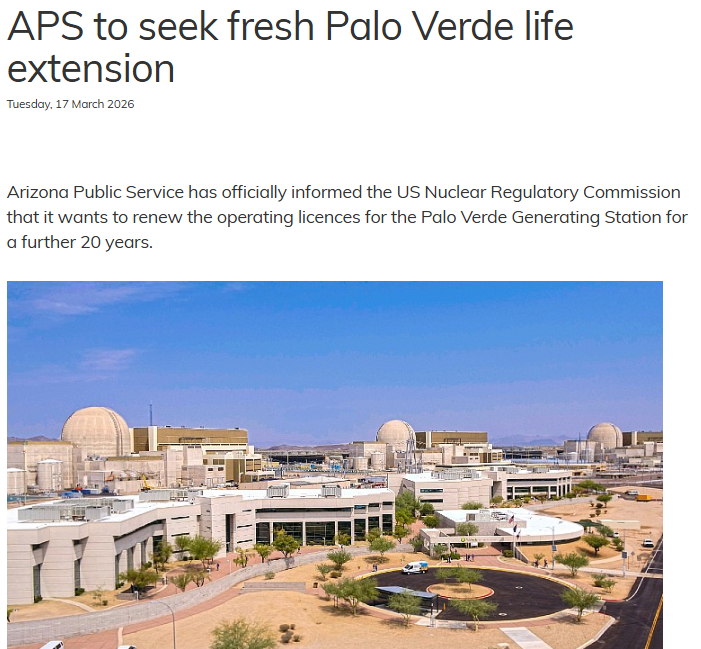
The Palo Verde plant's opersator is seeking an NRC licence extension to 80 years. It will allow the (relatively young) plant to operate until 2067!! Article link in reply. Interesting that they're applying ~21 years before the end of their existing (60 year) license. The 3-unit, 4.2 GW Palo Verde plant was the largest nuclear plant in the US, until the Vogtle plant's 4th unit entered operation in 2024. Palo Verde is the only US nuclear power plant that lies in a desert and is not near any significant water source. It has been using regional waste water. Its long-term operation shows that nuclear plants can operate in arid regions.
James Hopf tweet media
English
3
9
50
4.3K
Robert O'Kersevan retuiteado
Datenfuzzi ™
Datenfuzzi ™@datenfuzzi_de·
Electricity consumption mix and CO₂ intensity by country #Europe
English
9
18
55
5.2K
Robert O'Kersevan retuiteado
Giuseppe Zollino
Giuseppe Zollino@GiZollino·
Oggi pomeriggio sono intervenuto al Festival Euromediterraneo dell'Economia #feuromed quest'anno in tema di Energie per la Crescita. "Solare ed eolico vanno installati solo sino al punto di ottimo, oltre il quale non servono più, perchè fanno aumentare la bolletta elettrica con i loro costi indotti". A noi serve al più presto una "solida quota di baseload nucleare: non è un mia opinione, ma quella dei numeri"... ma non voglio anticipare troppo: buon ascolto!
Italiano
0
15
65
2.7K
Robert O'Kersevan
Robert O'Kersevan@KersevanRoberto·
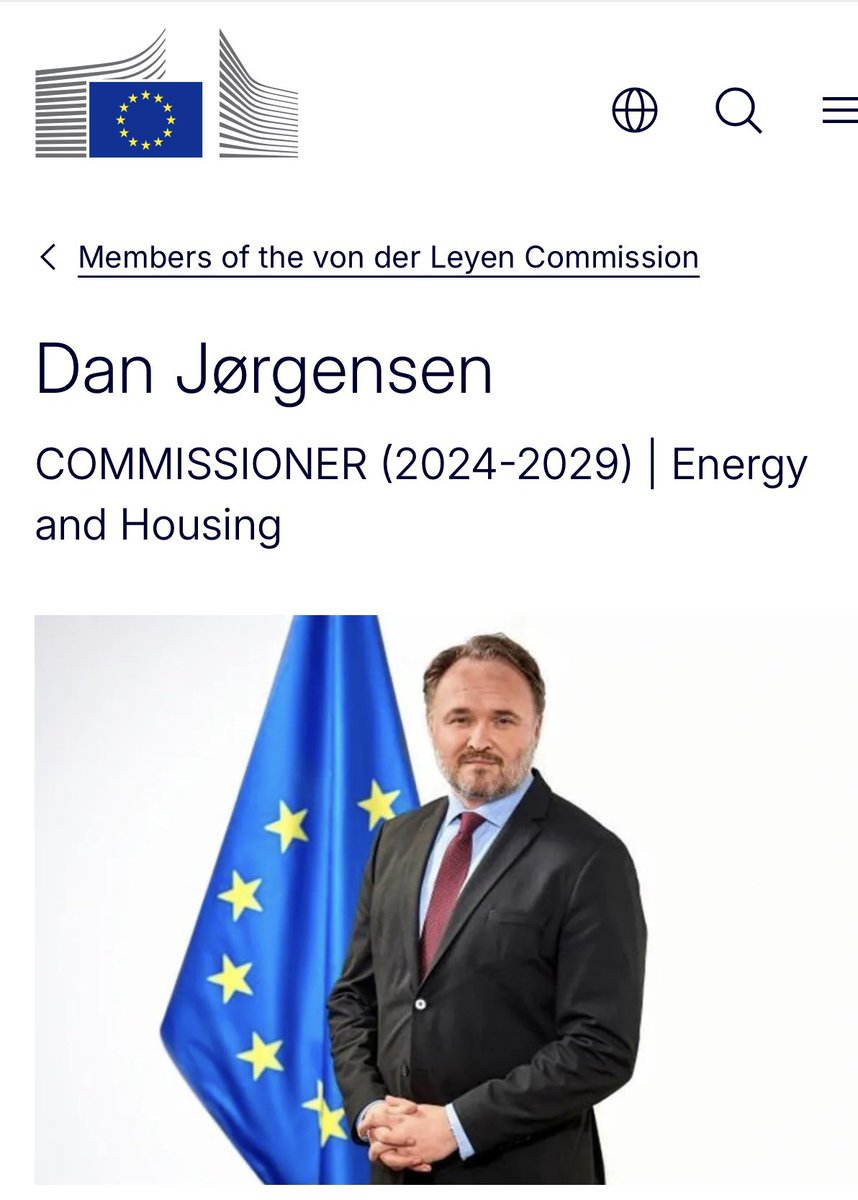
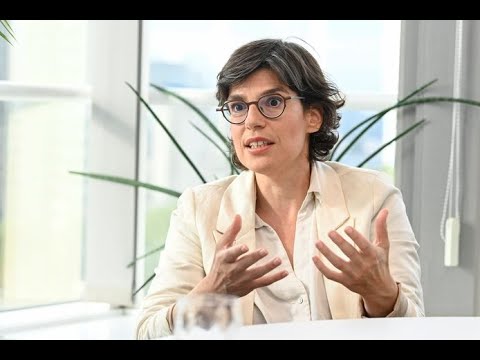
@LuMo71 Anche greenpiss e i suoi infiltrati nei vari ministeri, come no? Il portaborse dell’antinucleare Timmermans? Ex greenpiss, un posto innocuo no? E questa qui, quanti danni ha fatto in Belgio? Voleva gas al posto del nucleare, adesso il Qatar dice 0 gas al Belgio Il troll danese?
Robert O'Kersevan tweet mediaRobert O'Kersevan tweet media
Italiano

0
0
0
29
Luigi Moccia
Luigi Moccia@LuMo71·
@KersevanRoberto Continuate così, a credere che se siete in decrescita è per un complottohh di greenpeacee. Rimanete in questa illusione, che così la decrescita continua ancora più forte.
Italiano
3
0
0
44
Robert O'Kersevan retuiteado
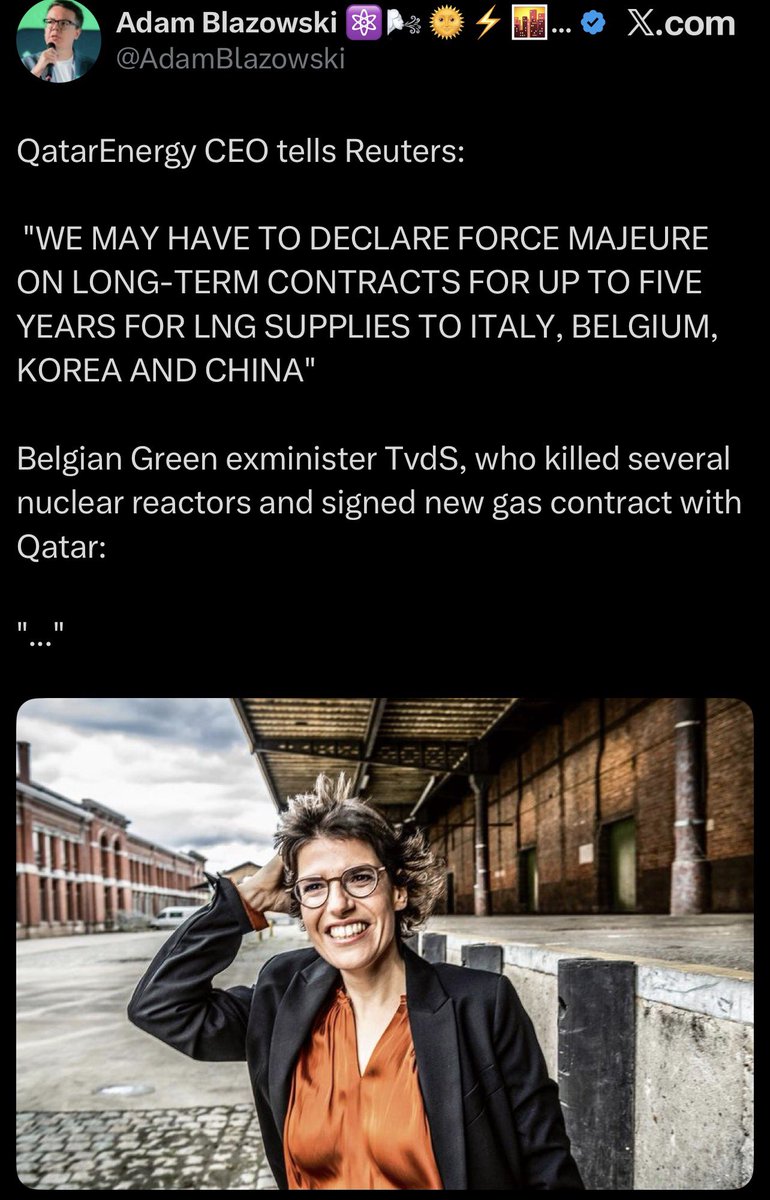
Adam Blazowski ⚛🌬🌞⚡🌆🛡🦌🌲
QatarEnergy CEO tells Reuters: "WE MAY HAVE TO DECLARE FORCE MAJEURE ON LONG-TERM CONTRACTS FOR UP TO FIVE YEARS FOR LNG SUPPLIES TO ITALY, BELGIUM, KOREA AND CHINA" Belgian Green exminister TvdS, who killed several nuclear reactors and signed new gas contract with Qatar: "..."
Adam Blazowski ⚛🌬🌞⚡🌆🛡🦌🌲 tweet media
Gdansk, Poland 🇵🇱 English
49
250
1K
61.8K