Substack

8.9K posts

Substack banner
Substack

Substack

@Substack

The antidote to brainrot. Follow for a curated selection of the best writing, video, and podcasts from the Substack app. Tweets by @TorontoLinda

San Francisco Se unió Haziran 2017
173 Siguiendo139.3K Seguidores
Tweet fijado
Substack
Substack@Substack·
For Father's Day weekend, six recent posts on fatherhood that readers loved: 1/ "When you become a parent, you meet your child. And then you meet your child again. And again, every day after that. You will never stop meeting your child." Derek Thompson @DKThomp's personal reflection on fatherhood derekthompson.org/p/three-reason…
English

2
2
12
10.5K
Substack retuiteado
kasra
kasra@kasratweets·
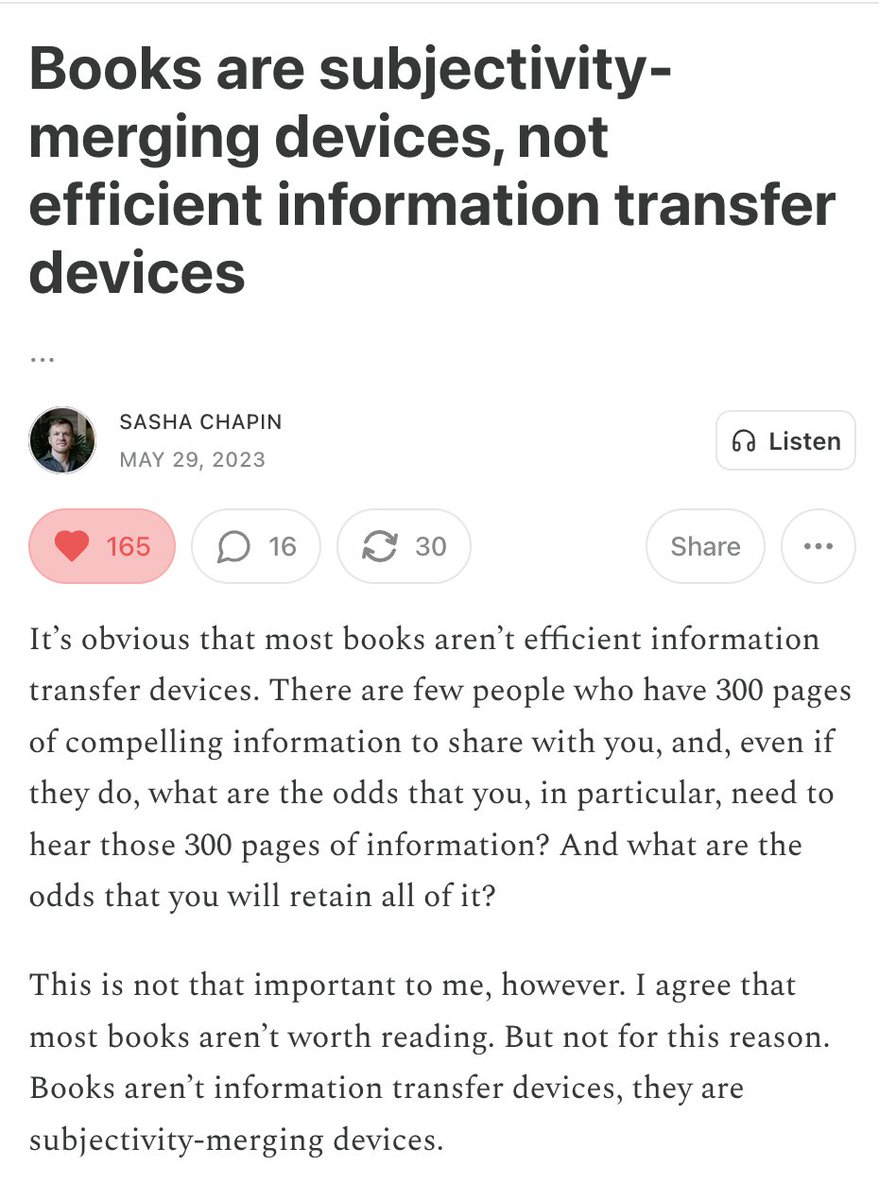
now that AI makes information consumption and transformation easier than ever I would like to bring back this old banger by Sasha Chapin about how books are not information transfer devices but subjectivity-merging devices in fact I would say content consumption in general is more about subjectivity-merging than information transfer, which is why I am generally much more interested in writing by humans than by AI
kasra tweet media
English
27
112
1.4K
122.8K
Substack retuiteado
Michael Pettis
Michael Pettis@michaelxpettis·
Few things seem to confuse economists more than the concept of "comparative advantage". Comparative advantage exists only for those sectors of the economy that are relatively more efficient than other sectors of that same economy, and this comparative advantage remains in place whatever the level of the currency (adjusting for import prices). This means by definition that a country cannot have a comparative production advantage in "almost everything". Instead, a country can only have a comparative advantage in producing roughly half of what it consumes and invests, and a comparative disadvantage in producing the rest. This is why trade is supposed to maximize output – a country produces more of those goods in which it has a comparative production advantage than it can consume domestically. It does this so that it can export the excess in order to pay for imports of those goods in which it has a comparative production disadvantage. That is arithmetically the only way to maximize production. But if a country exports not in order to pay for imports but in order to acquire foreign assets, this is the classic definition of mercantilism, under which the benefits of comparative advantage do not exist. In that case what the county has is "competitive" advantage, and this competitive advantage can be eliminated simply by allowing the currency to appreciate to its fundamental level. Note that in Ricardo's famous example, Portugal had a competitive advantage in producing both wine and textiles, but a comparative advantage only in producing wine. That is why Ricardo was able to prove that total production would rise if Portugal produced only wine and England only textiles, with each selling part of what it produced to the other in order to acquire what it didn't produce. Had Portugal instead done what surplus countries do – suppress domestic consumption in order to sell both wine and textiles to England, while getting paid in the form of a net acquisition of English assets – total production would have declined, not risen. There are many problems with the concept of a country specializing in its area of comparative advantage, but in general it results in a rise in global production and global demand. When a country specializes in gaining across-the-board competitive advantage, however, it reduces global production by suppressing domestic demand and externalizing the consequences. Keynes explained how this happens perfectly well at Bretton Woods. For those who are interested, I explain this further here: michaelpettis858496.substack.com/p/comparative-…
Foreign Affairs@ForeignAffairs

“In effect, China is trying to do what economic theory says no country should be able to do: retain comparative advantage in almost everything.” Read @shoumitro_c and @arvindsubraman on the consequences of the “China squeeze”: foreignaffairs.com/china/china-pu…

English
18
65
310
31.8K
Substack retuiteado
Alice Evans
Alice Evans@_alice_evans·
I have some suggestions for how we can do gender history with greater empiricism and openness
Alice Evans tweet media
English
3
6
36
2.8K
Substack retuiteado
Stefan Schubert
Stefan Schubert@StefanFSchubert·
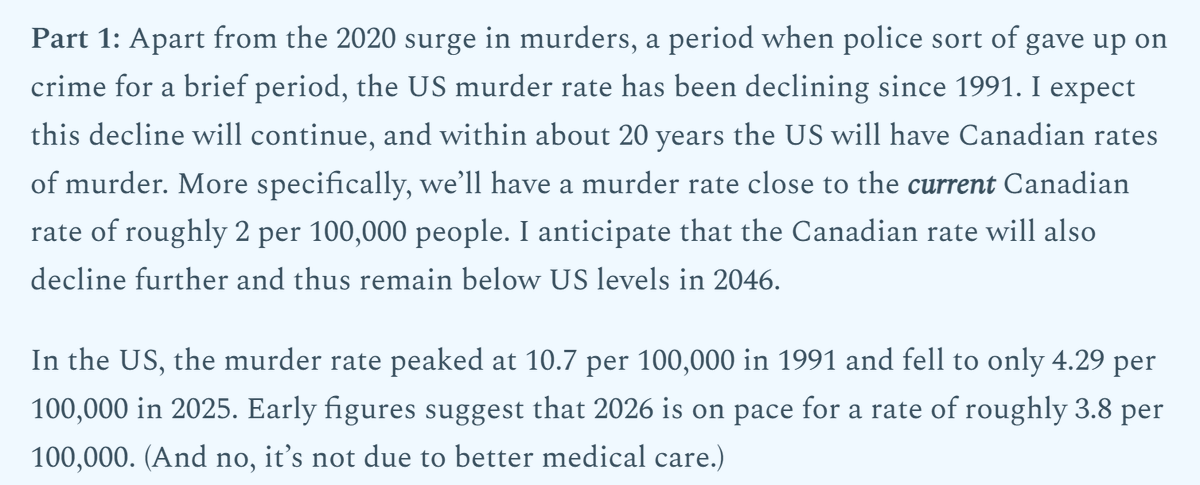
Scott Sumner: "The US murder rate has been declining since 1991. I expect this decline will continue, and within about 20 years the US will have [Canada's current] rates of murder." Plausible, and very welcome.
Stefan Schubert tweet media
English
7
3
36
6.6K
Substack retuiteado
Substack
Substack@Substack·
"I suspect that if I’d been around in the year 1950, it would have been obvious to me that India would succeed and China would not... So what happened? Why did China get rich, and India didn’t?" David Oks @davideoks on how China won
Substack tweet media
English
3
2
14
4.2K
Substack retuiteado
Richard H Thaler
Richard H Thaler@R_Thaler·
My buddy Cass asked his friend Claude to ask JS Mill what he thinks of Nudge. Very interesting reply! Thrilled that both read our book! Why do authors want to prevent AI from reading their work? open.substack.com/pub/casssunste…
English
1
2
19
6K
Substack
Substack@Substack·
6/ "Make a life where you're free as possible from the forces of dogma and bureaucracy." Susan Cain @susancain shares the seven things her father taught her by example every year, on his yahrzeit (the anniversary of his death) thequietlife.net/p/seven-things…
English
0
0
1
682
Substack
Substack@Substack·
For Father's Day weekend, six recent posts on fatherhood that readers loved: 1/ "When you become a parent, you meet your child. And then you meet your child again. And again, every day after that. You will never stop meeting your child." Derek Thompson @DKThomp's personal reflection on fatherhood derekthompson.org/p/three-reason…
English
2
2
12
10.5K
Substack retuiteado
Roger K. Horn
Roger K. Horn@EMInvestors·
Francis Fukuyama recently shared a compelling piece titled “The Myth of Authoritarian Efficiency” by political scientists Jørgen Møller and Svend-Erik Skaaning (Aarhus University / V-Dem project). The article dismantles the popular notion that authoritarian regimes—particularly China—are simply better at “getting things done.” Drawing on historical data and comparative evidence, the authors argue that democracies consistently outperform autocracies over the long term across critical domains: • Military effectiveness: Democracies have won more than 80% of wars since 1815. Greater legitimacy enables citizens to make greater sacrifices, and democratic alliances prove more durable. • Economic performance: While autocracies can drive catch-up growth to middle-income levels, they struggle to transition to innovation-driven, knowledge economies that require rule of law, intellectual property protection, and open debate. High-quality democracies show a modest but robust long-run growth advantage. • Avoiding catastrophe: Autocracies periodically produce large-scale man-made disasters (Mao’s Great Leap Forward, Soviet collectivization). Institutional checks and public scrutiny in democracies make comparable failures rare. • Crisis management & environment: Transparency, independent science, and accountability lead to better outcomes on pandemics, climate policy, and environmental indicators. China’s zero-COVID flip-flop and overstated economic statistics illustrate the risks of centralized, unaccountable decision-making. The authors acknowledge democracies can be slow and messy, but emphasize that self-correction mechanisms ultimately make them more resilient and effective than systems that concentrate power without feedback loops. Francis Fukuyama, author of the landmark book The End of History and the Last Man, continues to spark important conversations about the enduring strengths of liberal democracy in an era of renewed authoritarian confidence. Full article (highly recommended): persuasion.community/p/the-myth-of-… What’s your take—do you see evidence of this “myth” playing out in emerging markets or great-power competition today? #Democracy #Geopolitics #China #EmergingMarkets #InternationalRelations #PoliticalEconomy
English
49
360
830
90.8K
Substack
Substack@Substack·
Procrastination is the parent of productivity
Substack tweet media
English
1
4
15
1.5K