

@NighthawkTradez @KingJames Stock would move up more from LeBron gojng to Warriors than any amount of GW that Dan could announce 😂
English
UNREAL
140 posts
@Unreal_Machine
Envisioning the future to guide investments


Adding to my thoughts on the AI supercycle vs dot-com "bubble" comparison... Despite the pullback (mainly driven by BoA, PCE), this week is showing exactly why the comparison falls apart. > $MU just guided $50B revenue for Q4 with 86% gross margins. They have $100B in multi-year contracted revenue. CEO said market tightness is "locked in beyond 2027." > $CBRS reported Q1 revenue up 94% YoY. Announced a $20B multi-year deal with OpenAI. Cloud services revenue up 167%. > $AAPL and $MSFT just raised prices on consumer hardware because of memory chip costs. > $725B+ in hyperscaler capex this year, funded by their own cash flow, not speculative VC money. In 1999, the dot-com bubble was driven by companies with ZERO revenue trading on speculation. Today, we have multi-trillion dollar backlogs, supply shortages so severe that companies are rationing capacity. Huge difference this time around.



$TSLA: Turning a Hardware Lead into a Data Advantage At first glance, TSLA's market caps is a staggering 1.47T + future CEO compensation dilution. The market cap seems to price-in ridiculous growth in EVs, Energy Storage and even FSD. Why do so many people believe this adamantly in TSLA? I worked in self driving at ArgoAI which peaked at 7b valuation before going bankrupt so I deeply understand the challenges to self driving and robotics. I later worked at Tesla's Palo Alto office but not in the self driving division. First, we need to understand at a fundamental level the difference between neural networks vs traditional programming. Traditional Programming All traditional programming constructs - recursions, exceptions, async, generics, virtual methods, lambdas, finite state machines - they all break down into some form of branching, memory access, and arithmetic at the CPU microcode level. This means that all these human made abstractions exist to combine and organize megabytes of basic very operations. Writing increasingly complex programs means wrangling with increasingly complex dependencies between different abstractions. Companies attempt to solve this by hiring more engineers. However, to write a program 3x more complex, hiring 3x more engineers doesn't cut it. After like 15 engineers, the 16th engineer is often useless. Companies attempt to scale this by dividing a program into different components for different teams. However, there are only so many teams you can have in an org before everyone looses track and coordination on a single program tapers out. Neural Networks Neural Networks handle complexity by increasing the number of parameters. To increase the number of parameters, you need three things: more data, more GPUs, and ML research on how to better compress the data into the parameters. The ChatGPT Breakthrough By Nov 2022, the three things needed to scale neural networks were all ready. The internet was the ready collection of data. $NVDA advanced another generation of GPU compute. Top ML researchers congregated at top labs like DeepMind and OpenAI. Because the internet is public, as long as a company has funding for GPUs and are able to hire top researchers, they have a chance to compete for frontier LLMs. LLMs are an all out race between many companies OpenAI, Anthropic, Google, Meta, xAI, SSI, Poolside and Chinese companies. This devolves into an escalated war of burning money. Full Self Driving And Generalized Robotics The difference between LLMs versus full self driving and generalized robotics is there there is no public corpus of data like the internet for those. The moat here will not be about burning money but who has access to the most data. Companies who use traditional methods of programming will be stuck where Boston Dynamics got stuck. Waymo seems to be ahead today but towards a final scalable solution, Tesla is far ahead in data collection with their increasingly large fleet of EVs collecting data daily. Tesla is then using this data to design the software factory to produce each version of FSD. And what's most important is that Tesla will re-use components of their FSD factory to build the software factory for Optimus software. Both FSD and Optimus require evaluations on open loop predictions. Both need tuning in real world simulators. These simulators themselves are made from neural networks and are much more complex than physics simulators. Many other components will be re-used including the inference hardware design. Waymo What Waymo has done for autonomous rides in Phoenix, SF, etc without first having a huge fleet of EVs is nothing short of a miracle. This miracle was made possible by a fragile architecture of combined model model ensembling and discrete logic. I don't mean fragile in the sense of reliability in a geofence areas but fragility in the architecture's ability to scale. Now, there are signs that Waymo's method is reaching it's limits in scaling. For example Waymo published an research paper on end-to-end networks, the method that Tesla is using (1). If Waymo doesn't move to an end-to-end network, it's scaling will be logarithmic (more and more flat) while TSLA will increase it's rate of scaling. If Waymo does moves to an end-to-end network that means that Waymo will have to throw away most of it's current work and train an end-to-end neural network from a much smaller amount of data than Tesla. Waymo can leverage it's current fleet to collect data but it's fleet size is way smaller. Lidar People misunderstand why Tesla is not using lidar. It's not about the cost! Lidar data is unordered, super sparse, irregularly spaced with closer object having more points and each frame is variable in size! Thus lidar cannot be used to train an end-to-end neural network! However, the scaling breakthrough for AI is end-to-end neural networks and not lidar! If you had to choose one, you would pick end-to-end neural networks over lidar! Conclusion From an engineering standpoint, Tesla will be the run away leader in scaling full self driving and robotics. End-to-end neural networks seem to be slow out the gate, but with Tesla's data advantage they will lap everyone else. When FSD surpasses Waymo then it will be obvious that Tesla will also scale Optimus hardware production and turn it's hardware advantage into a data advantage in robotics as well.


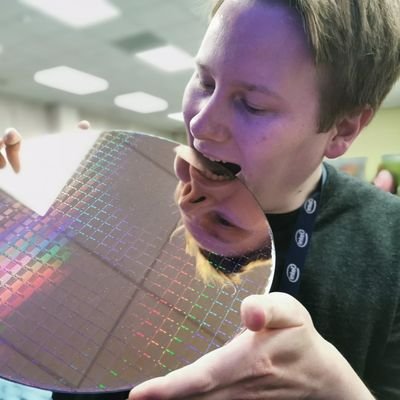
Actual number of printed features on this chip that are “sub-1 nanometer” = ZERO This naming convention makes absolutely no sense and is highly misleading.


Europe accelerates 6-inch photonic chip output to boost semiconductor independence interestingengineering.com/innovation/asm…

Welcome to Dub Nation, @IREN_Ltd 👏 Golden State and IREN announced today a landmark multi-year global partnership that will include the IREN badge on all Golden State Warriors jerseys beginning with the 2026-27 season.


Why would Intel, a foundry, hire the former CEO of a memory company like SK Hynix? Not to break into the HBM business. Seok-hee Lee reports directly to Lip-Bu Tan, overseeing advanced packaging, system integration, and back-end process and manufacturing. One phrase deserves your attention: advanced packaging. If you've followed Intel for a while, you'll remember the EMIB-versus-CoWoS war. EMIB (Embedded Multi-die Interconnect Bridge) skips the full silicon interposer that CoWoS lays down, and instead buries a small silicon bridge only where two dies need to connect. Round one went to CoWoS. Flagship GPUs from Nvidia and AMD wanted maximum bandwidth and minimum latency, and EMIB, limited by the bridge's area and routing density, couldn't keep up. It lost the socket. After that, EMIB lived mostly inside Intel's own CPUs. The technology didn't fail. It lost the fight to become the GPU standard. Then the game changed. In 2026, the bottleneck isn't the wafer. It's the package. CoWoS is capacity-short and, thanks to that large interposer, expensive. EMIB walks straight into the gap. Put the bridge only where you need it, and you get a cheaper package, freedom from reticle-size limits, and an edge on large multi-die designs. Google is evaluating EMIB for its 2027 TPU v9, and Meta is weighing it for MTIA. The explosion of custom ASICs and inference accelerators is EMIB's stage. Intel won't beat TSMC at the leading node anytime soon. But packaging is a younger layer, less locked in, and above all, something Intel is genuinely good at. If there's a front where Intel can land a blow on TSMC, it's packaging, not the node. In that light, hiring SK Hynix's former CEO reads as a challenge aimed squarely at TSMC, which holds the heart of GPU-plus-HBM integration. The hardest part of AI packaging is HBM integration and mass-producing it at high yield, and Lee is the man who pulled exactly that off in the HBM era. Spin packaging out as its own business unit reporting straight to the CEO, and the org chart becomes the statement of intent. Of course, the CoWoS-locked volume at Nvidia and AMD won't move overnight. But the direction is unmistakable: make packaging a standalone weapon. So here's the picture. TSMC's real moat isn't the leading node alone. It's the node-plus-CoWoS bundle: the AI accelerator and its HBM coming from a single house. What Intel's next-generation packaging is after is breaking that bundle apart. TSMC's base die, SK Hynix's DRAM, someone else's logic. Wherever each piece is made, Intel does the final integration. That's the goal.


$IREN it’s over even $CBRS gets the deals 🙏🏼😭