Tweet fijado
J (OAM)
28.9K posts


J (OAM)
@bigchefjay
my personality is who I am, my attitude depends on who u are! *atheist, throws hands
Se unió Mayıs 2013
9.6K Siguiendo9.6K Seguidores

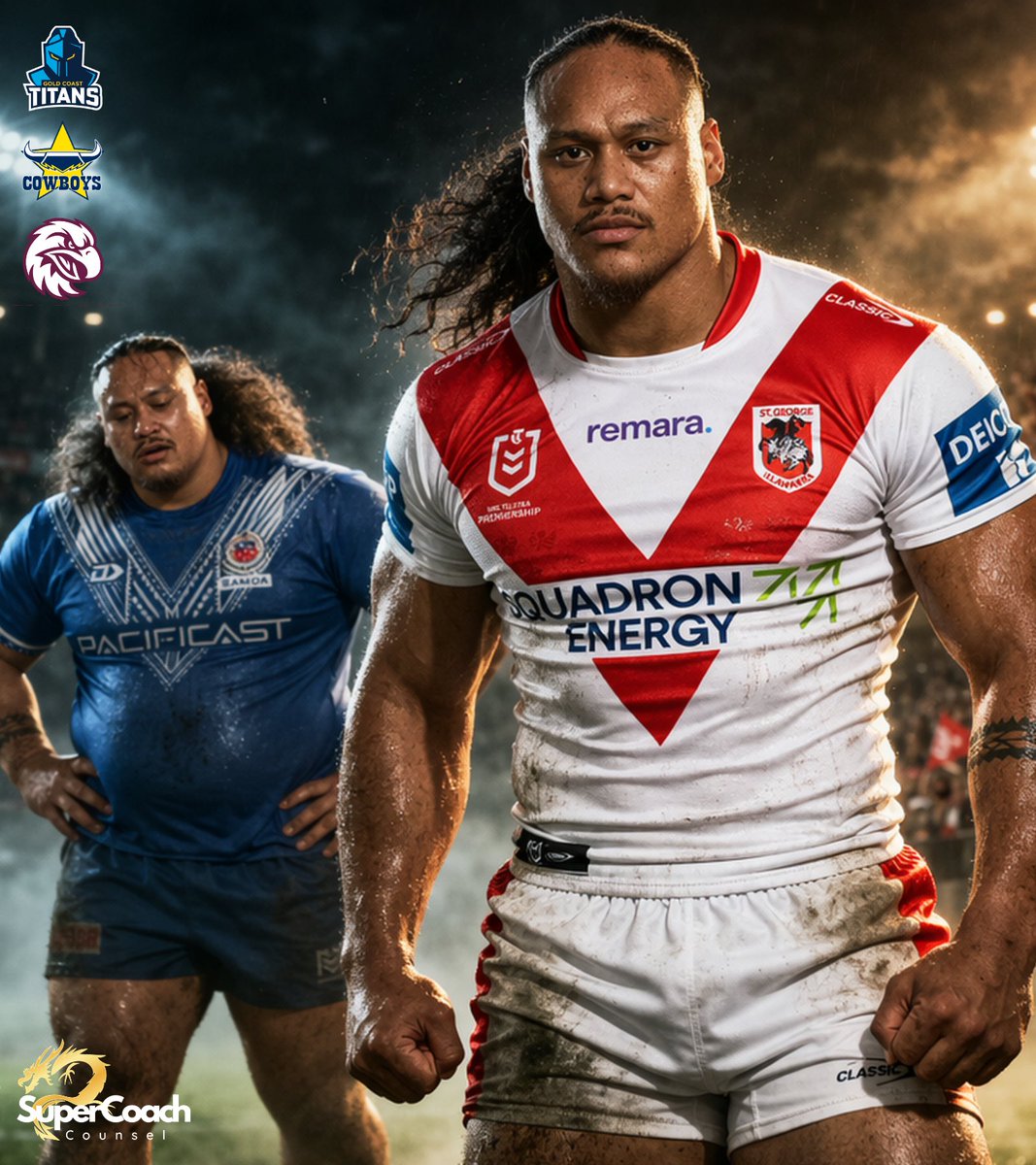
🐉 Luciano Leilua | 2RF | $475.9k
I’ll be honest, after hearing about Luc’s 12-15kg weight loss over the off season, I was intrigued yet skeptical about his prospects coming into 2026. A near 30year old suddenly dropping weight and becoming SuperCoach relevant felt a bit optimistic. I had to see it first.
A month on, the fact is the work rate we’re seeing now is far superior to what it was last season. The base power is up to 63ppg and he’s smashing out an effective 66 minutes. Looks good, more involved and only 3% owned.
Dragons have just come through quite a tough schedule to start the season, playing the Las Vegas fixture and facing a couple of the competition heavyweights. The matchup this week is a big one. He’ll be attacking the Titans right edge of Hau, Jojo Fifita (no knock) and Faeamani. There are points there. We know Luciano isn’t just a power runner - he’s got skill, he can pass, he can offload and when the Dragons are on the front foot he tends to find attack.
Looking at the upcoming run - Titans, Cowboys, Sea Eagles, Rabbits, Roosters. There’s honestly not a game there where I’d be scared to play him. The Dragons are far from an elite attacking side, but they also shouldn’t be getting blown off the park in most of those games and as long as they’re competitive, Luciano should get his base and gives himself every chance of some attacking stats.
With everything going on at 2RF currently - Tino underperforming, Lisate injury, Couchman suspension, Mooney suspension, not everyone can jump to the 600k-700k guns. Luciano at 475k with a BE of 1 is a very handy bridge option while we wait for things to settle down over the next 4-5 weeks. He also covers major byes RD12/18 so holding until conclusion of Origin is also an option.
The other factor here is minutes. With Couchman out, I’d expect Luciano to be pushed to his minute ceiling on that edge. Hamish Stewart spelled him last week and I expect that to continue, but with his improved fitness I wouldn’t be surprised to see him push 70mins at some point.
Success would be an average of 65+ over the next 6 weeks and then reevaluating in the lead up to Origin.
#NRLSuperCoach #SuperCoachNRL #SuperCoachCounsel #NRLTitansDragons
English

ARE YOU A SUPERCOACH FANATIC??
👑 Currently 999 FOLLOWERS & we are so close to the 1,000 milestone 👑
Would appreciate your help by hitting the FOLLOW button or sharing the page.
Heaps of FREE #NRLSupercoach strategy, stats, updates and loads of help with your team decisions.
GIF
English


Let's see what happens when they realise that Africa, Asia and eastern Europe are actually the ones controlling the conversation
Nikita Bier@nikitabier
Starting Thursday, we'll be updating our revenue sharing incentives to better reward the content we want on X: We will be giving more weight to impressions from your home region—to encourage content that resonates with people in your country, in neighboring countries and people who speak your language. While we appreciate everyone's opinion on American politics, we hope this will disincentivize gaming the attention of US or Japanese accounts and instead, drive diverse conversations on the platform. We invite creators to start building an audience locally. X will be a much richer community when there's relevant posts for people in all parts of the world.
English
Shanaka Anslem Perera ⚡@shanaka86
JUST IN: The Strait of Hormuz is open. It has been open every day since February 28. The IRGC never closed it. What the IRGC did is convert 21 miles of international waterway into a permissioned gate with a toll booth, a vetting process, and a guest list. Traffic has collapsed 70 to 80 percent. But the handful of tankers that transit each day do so with IRGC clearance, paid in yuan or USDT, at $2 million to $4 million per vessel. The process is now documented. A tanker operator contacts an IRGC-linked intermediary. The operator submits vessel ownership, flag state, cargo manifest, destination, crew list, and AIS transponder data. The IRGC runs background checks: no US-linked ownership, no Israeli cargo, no flagging to aggressor states. If approved, a toll is negotiated. Payment is executed in cash, Chinese yuan, or USDT on the Tron network. The IRGC issues VHF radio clearance with a specific time window and route through Iranian territorial waters near Larak Island, where IRGC Navy performs visual confirmation. The vessel transits. No physical escort is provided. The “protection” is the removal of the interdiction threat. You are safe because the entity that would attack you has decided not to. China passes. India passes. Pakistan, Turkey, Malaysia, Iraq, Bangladesh pass. Shadow fleet operators aligned with Russia pass. Not all pay the full toll. Some receive exemptions through government-to-government arrangements. Some pay reduced rates. Some pay nothing because the geopolitical alignment is payment enough. The system is not a blockade. It is a membership club with a cover charge denominated in currencies that are not the US dollar. And here is what nobody is covering. Lloyd’s of London and the international insurance market have withdrawn standard hull and machinery coverage for Hormuz transits. War-risk policies now carry premiums of up to 5 percent of vessel value, $5 million for a $100 million tanker, per voyage. But the actuarial models that price those premiums now incorporate IRGC vetting status as a risk-reduction variable. If a vessel can prove it has paid the toll and received VHF clearance, the probability of loss drops from above 20 percent to below 5 percent. The same models that price hurricane risk and earthquake exposure are now pricing IRGC compliance as a safety factor. The insurance industry has done something no government intended: it has formalised IRGC authority over the strait in actuarial mathematics. A tanker that pays the toll is insurable. A tanker that does not is stranded. Dozens of vessels sit outside the strait right now, unable to transit because no underwriter will cover them. The insurance withdrawal is not a market reaction. It is a structural enforcement mechanism that makes IRGC permission the prerequisite for commercial shipping. Every toll paid in yuan is a barrel that settled outside the dollar system. Every USDT transaction on Tron is a 3-second settlement bypassing SWIFT and sanctions. Iran’s parliament is drafting legislation to formalise the toll as “security compensation.” If that bill passes, ad-hoc extortion becomes sovereign law, and the precedent for chokepoint monetisation enters the international legal framework. Gold watches from the side. Spot prices muted at $5,000 to $5,400 by dollar strength and rising yields, while central banks in China, Russia, and India quietly accumulate on every dip. The short-term safe-haven has not fired. The long-term de-dollarization trade is loading. The strait is open. The molecules move. But only for those who pay the toll, in the currency the toll booth accepts, after the vetting the toll booth requires. The rest wait. The clocks tick. Saturday arrives. open.substack.com/pub/shanakaans…
QAM
It’s not for everyone, and I’m happy about that…
He may be back next week, he may also miss another week or two depending on severity. Potential limited output on return may see a slight drop in minutes or avg. if he drops down to a 60-70 avg for 5 weeks I can achieve that avg with other options for significantly less cash. Cash saved that I can make multiple upgrades to my entire squad in multiple positions that many coaches are running weak in.
It’s not without risk, loads of ways this could run out that favour or go against me but I see an angle and I’m taking it.
English
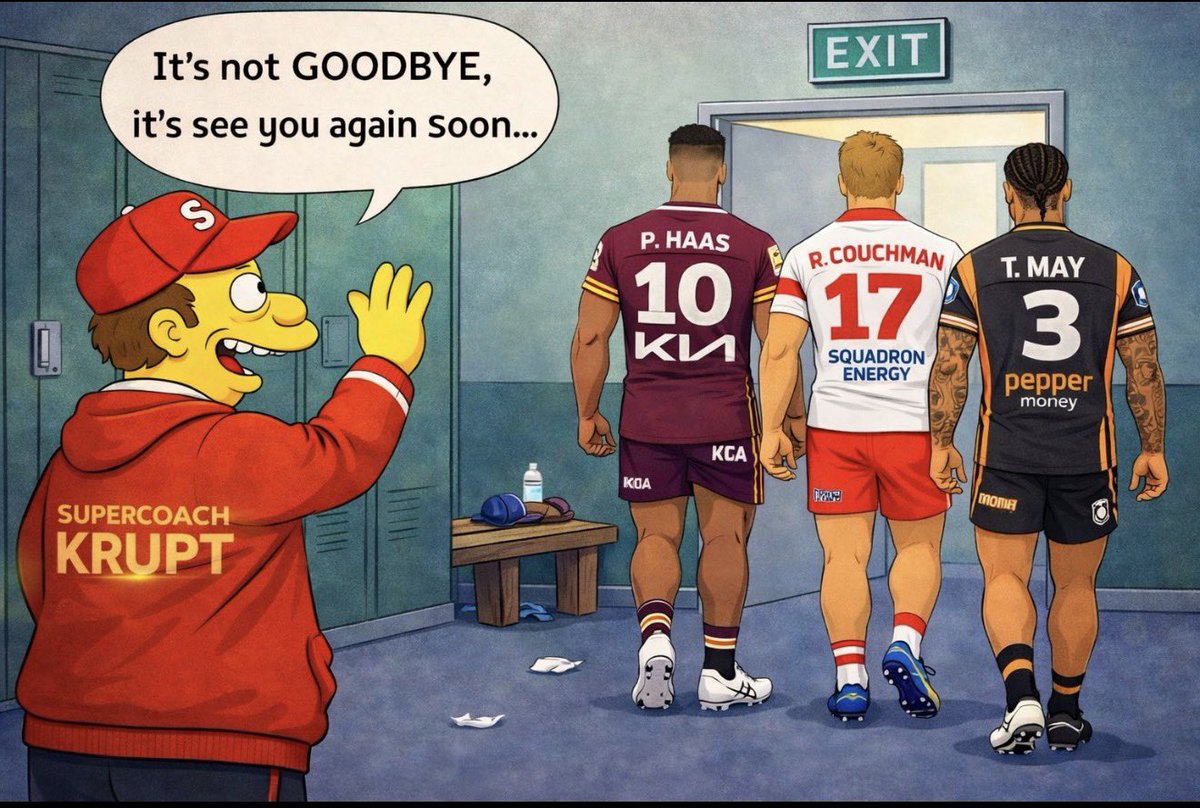
💔 It’s not GOODBYE, its see you again soon…
Due to 10 players breaking out in red dots 🔴, SuperCoach Krupt sadly today has had to have three very tough conversations… 😢
#NRLSupercoach
English

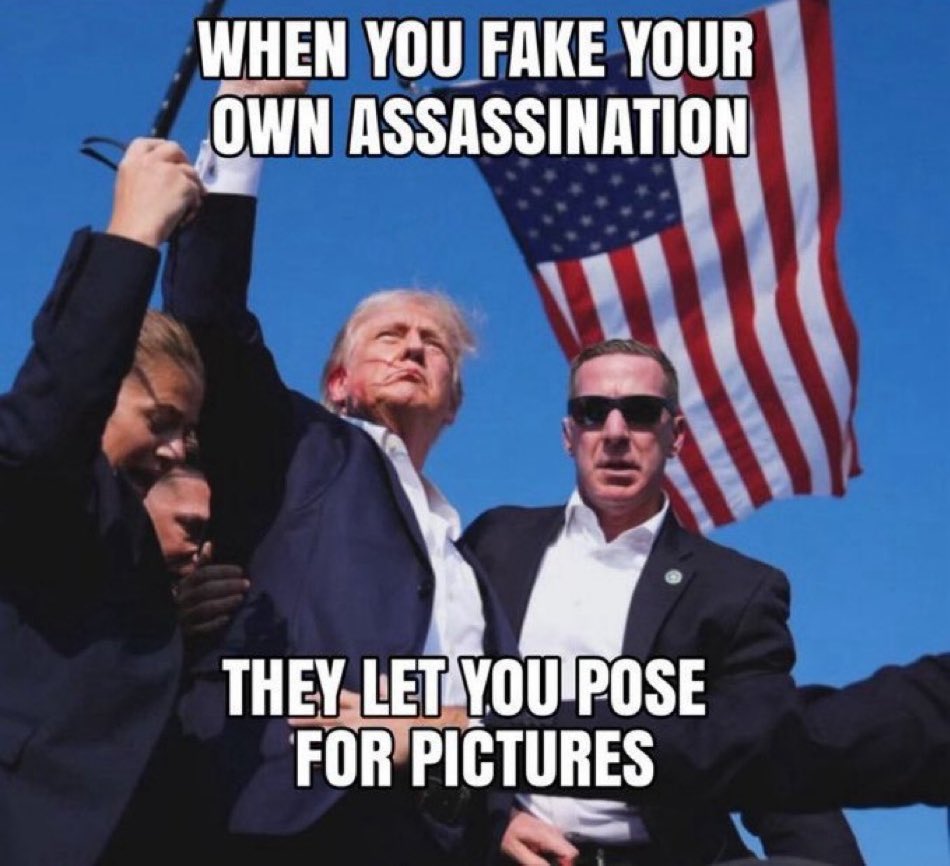

Jesse Ventura suggest that Donald Trump may have faked his assassination attempt.
Piers Morgan: Well, when he got shot, Jesse, to be fair to Trump, when he got shot, he got back up and said "fight, fight, fight."
Jesse Ventura: "Oh yeah, right, right, right. You ever hear of a blade job?"
Piers Morgan: What, you think it was fake?
Jesse Ventura: "I don't know. Where's his scar today?"

English
@antonposa @PS3223567097342 Is it a given that metcalf actually starts?
I mean, rd 7 was his due back rd, and even if he is a mad healer, there's no need to rush him
English
@PS3223567097342 Metcalf won't take kicking duties back after an ACL. Boyd has a better career percentage off the tee also.
English

What are the ramifications for SuperCoach owners if Metcalf returns and takes goal-kicking duties? How would that affect Boyd-losing easy points, relying more on trys/try-assists, and possibly dropping his floor? Would he still be worth trading in this week? 🧐 #NRLSuperCoach
English
J (OAM) retuiteado

“They Looked Iranian”: Security Footage Shows Trump Negotiating With White House Patio Umbrellas for Six Hours
theshovel.com.au/2026/03/25/the…
English
Yep, living up to your name alright.
Women Being Awful@WomenBeingAwful
Just a reminder that Sydney Sweeney is mid af
English
@MrPitbull07 @MustBeLeah With Taylor, I'd put her up against ANY person, past, present or future, and tell you that she is a better human than ALL of them!
Remember, even Gandhi was a wife beater, and mother Theresa was an out and out cunt!
English

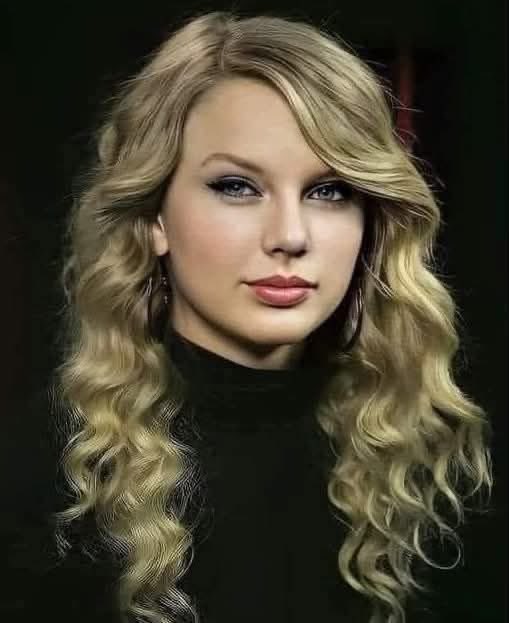
This is probably going to tick some people off, and I hope it does. But I’m going to keep on sharing it and saying it. And once again, I am not a Swiftie, but I am a human being, a Dad AND, a Monstrous Football fan.
I am extremely disappointed in so many of you who think that "not being a fan" of someone means you're entitled to shit all over them.
I want to remind you of something.
Your children are watching you complain about Taylor Swift sitting at a football game, being happy, and cheering for a man she loves in what appears to be a very loving, respectful relationship.
Your Children are watching you judge a woman for literally just EXISTING and taking up space happily.
And you know what? Ms. Swift has won 324 awards? How many do you have?
She brought $5 BILLION dollars in consumer spending and boosted the U. S. economy so significantly, that leaders from other countries actually beg for her to play there?
Did you know that there are over 20 college courses about her skills as an artist, lyricist, and musician - including at places like Harvard, Stanford & UC Berkeley?
Did you know that Taylor Swift quietly donates mass amounts of money to local food banks in every city she performs in?
AND DID YOU KNOW …
That Taylor Swift was sexually assaulted by a radio DJ, and she got him fired? When he sued HER for over $3 million for defamation, she counter sued for a symbolic $1 in a court case that took 2 YEARS for her to win. And, she did that just to show women that fighting for what's right has no price tag & to never be silent in the face of oppression.
WELL IF YOU DON’T CARE BY NOW, YOU SHOULD.
Because your daughters, nieces, and your nephews are watching you run your mouth. And they are seeing the world hate a woman who does so much good, simply because she exists in their line of sight.
DO BETTER PEOPLE.
Teach your boys to respect women. Teach your girls that as women - they are ALLOWED to take up space.
Fix it. Become aware of your words. Because we all have the ability and the obligation to fight for the future of our children with simple moments. And we need to consciously choose to be better for them.
English
@HendoWest @NRL_SC_Addicts Can't agree....Boyd and Ford are on hot hands, and like Vegas, don't leave the table when you're hot.
Both have $$ to be made.....and scores to post.
English

@NRL_SC_Addicts Just a little worried Ford might be a trap with Barnett lurking, worried about a drop in minutes. Still gonna buy him though, straight in for Hopgood
English

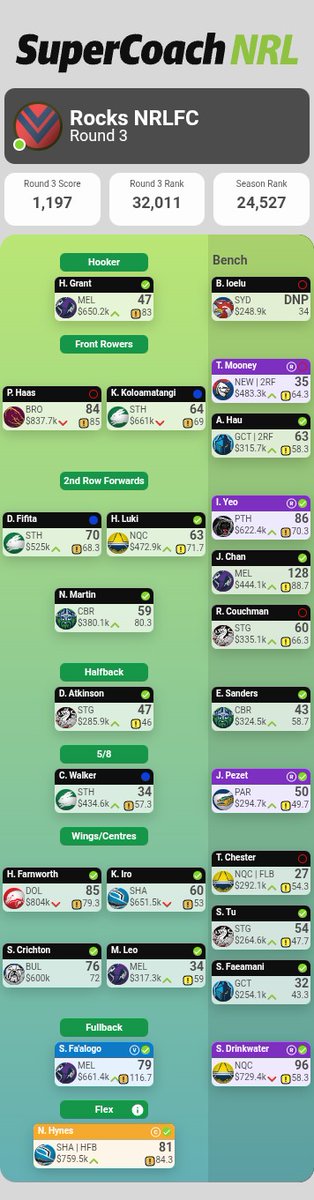
My plans
Couchman to Ford
Sanders to makasini
Walker to Purdue
Unless im missing something. Keen to see other opinions. 444k itb
English
@RLSCTrotter Do whatever gets the most players on the field....let the scores look after themselves from there
English

There’s a lot to consider going into Round 4:
- Trade or keep Lisati
- Trade or keep Rouchy (4 game suspension)
- Trade Chester or keep until next round to see if he keeps his spot
- Keep Tino due to the fact most of us can barely field a team
- Trade Latrell onto another gun
- Upgrade to Cleary?
- Trade Haas/Mooney?
- Get on Jackson Ford?
Have I missed anything? Thoughts on any of this coaches?
English

If my husband ever posts about what a whore I am I hope he also mentions I’m wild in bed. Then the insult won’t sting so bad.
English