SCRIBE 🖋️

5.5K posts

SCRIBE 🖋️ banner
SCRIBE 🖋️

SCRIBE 🖋️

@imscribe

jack of all spades ♠️ multi-hyphenate

Memepool Se unió Nisan 2023
1.2K Siguiendo4.5K Seguidores
Alex 🥷
Alex 🥷@Shilllin·
Taking the account private Who can still these tweets
English
73
0
229
6.4K
SCRIBE 🖋️
SCRIBE 🖋️@imscribe·
The irony that Iran doesn’t even need nuclear capabilities to cause catastrophic damage to global economies & massive loss of life…is not lost on some of us. That’s the Epic Fury narrative, but a weaponized Strait of Hormuz + targeted desalination plants is equally destructive. Millions could be without drinking water. Billions could face unprecedented energy costs. That also means Electricity restrictions, Livestock shortages, & Agricultural degradation. Throughout recorded history, warring Kings have brought ruin to civilizations in pursuit of power and control.
English
0
0
1
147
SCRIBE 🖋️
SCRIBE 🖋️@imscribe·
I miss Saturday morning cartoons.
English
0
0
1
176
Polymarket
Polymarket@Polymarket·
JUST IN: Beef processing giant Cargill is reportedly using AI to extract millions of dollars worth of "extra meat off the bone" in its slaughterhouses.
English
279
301
3.4K
1.2M
🪖
🪖@JBTHEPLUG1·
Gun pointed at your head, name a wood.
English
9K
947
27K
6.4M
naiive
naiive@naiivememe·
name one thing you had in 1994 but not 2026
English
131
7
65
12.9K
SCRIBE 🖋️
SCRIBE 🖋️@imscribe·
Last year I built a sick ass holder chat forum with privacy-preserving cold wallet verification, a comprehensive creator toolkit, and community analytics for all the top collections. But Ordinals are down so bad who cares.🫤 Cool tech 🤷
SCRIBE 🖋️@imscribe

Maybe not the best week to use X articles for an announcement. 🤪 Did it anyway. Introducing @badger_plus Token-Gated group chats and public Threads for Bitcoin Collectibles: Ordinals, Runes, BRC-20, and Alkanes Skip the long read and get the TLDR here: 👇

English
0
0
2
212
SCRIBE 🖋️ retuiteado
klöss
klöss@kloss_xyz·
let me explain the ramifications of this… → 150,000 people just got locked out of their own cars… across 46 states… for 6 days straight and counting → not a software bug. not a glitch. not AI permissions gone wrong. → hackers flooded Intoxalock’s servers and all these vehicles just stopped starting… → these are court ordered breathalyzer devices… people who messed up in the past but have been doing everything right since (hopefully)… and now they can’t drive to work because someone else’s security system failed wild connect the dots… your electric car talks to a server to start. one breach and it’s a 50,000 dollar paperweight your insulin pump syncs to a server. your pacemaker data lives on a server. one breach and it’s not a car that stops working… it’s a body your smart home lock runs through a server. one breach and your front door either won’t open or won’t close now zoom out… Gartner projects $2.5 trillion going into AI this year… only $240 billion into securing the systems it runs on. that’s a 10 to 1 bet that nothing goes wrong the four biggest tech companies (Alphabet, Microsoft, Meta, and Amazon) are rumored to spend $700 billion on AI infrastructure this year alone… while cybercrime is projected to cost the world $10.5 trillion now imagine this happens to Tesla. to a hospital network. to the power grid… every new AI integration is a new attack surface. every API is a new door. every device that “talks to the cloud” is one more thing that can be turned off by someone you’ll never meet and I’m not saying every one of these systems will experience something who really knows what’s secure or isn’t but if you’re building right now… security isn’t the last layer you add. it’s the first one. → 150,000 people have just found out what happens when nobody prioritizes that… archaic government systems and legacy businesses are likely first on the chopping block I hope the rest of us continuously learn from it instead of living it the weakest link in every system is the one nobody bothered to secure like what wild system vulnerability will we see next? does someone hack Area 51?
Polymarket@Polymarket

BREAKING: Cyberattack against American breathalyzer test company locks out drivers across 45 states.

English
120
1.5K
4.3K
285.7K
SCRIBE 🖋️ retuiteado
The Hacker News
The Hacker News@TheHackersNews·
🚨 WARNING - A new #iOS exploit kit, DarkSword, has been active since late 2025 across multiple threat groups. It targets #iPhone on iOS 18.4–18.7, chaining zero-days to gain full access and rapidly extract data—files, messages, credentials, and crypto wallets—then wipe traces within minutes. 🔗 DarkSword details here → thehackernews.com/2026/03/darksw…
The Hacker News tweet media
English
10
173
498
267.7K
Tuki
Tuki@TukiFromKL·
🚨 Do you understand what this man just pulled off.. > a guy from North Carolina used AI to generate hundreds of thousands of songs.. uploaded them to Spotify, Apple Music, Amazon.. then botted billions of streams on his own tracks and walked away with $8 million > 660,000 fake streams per day.. spread across thousands of AI songs so nobody noticed.. $1.2 million a year.. for music no human ever actually listened to real artists are out here grinding for 0.003 cents per stream.. promoting on TikTok.. begging for playlist placements.. and this guy just had AI make the music AND the audience first-ever criminal streaming fraud case.. he's paying back $8 million.. but the playbook is out there now.. and AI just got better since he started the music industry spent 10 years fighting piracy.. now they have to fight songs that don't exist being listened to by people who don't exist.
FearBuck@FearedBuck

The first criminal case of streaming fraud where a North Carolina musician who used AI to make songs, then streamed them billions of times himself making $8 million

English
741
7.1K
47.5K
7.7M
SCRIBE 🖋️
SCRIBE 🖋️@imscribe·
Oil shortages are precursors to a louder EV narrative. Stocks will pump. Production will spike. But I bet you won’t see EV’s on the battlefield anytime soon, where a targeted EMP makes a military vehicle a paper weight.
English
0
0
0
42
SCRIBE 🖋️ retuiteado
Shanaka Anslem Perera ⚡
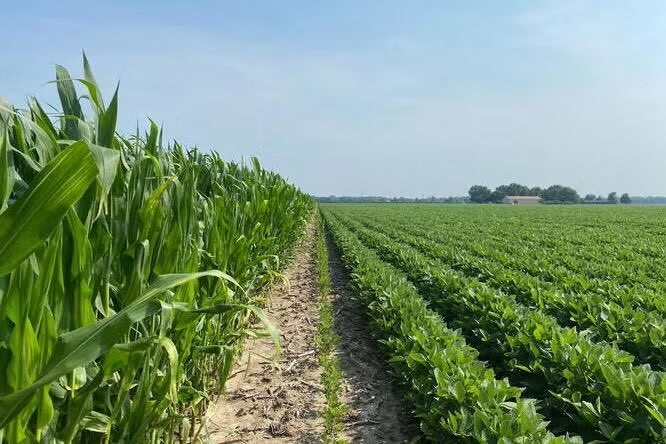
JUST IN: The most irreversible consequence of this war is not happening in Tehran. It is happening in a barn in Iowa. A farmer is standing over a kitchen table looking at two seed catalogues. One is corn. One is soybeans. Corn needs 180 pounds of nitrogen per acre. Nitrogen costs $610 per ton on the CBOT March futures settlement as of yesterday, up 35 percent in a month. Soybeans fix their own nitrogen from the atmosphere through root bacteria called rhizobia. They need nothing from the Strait of Hormuz. The farmer is choosing soybeans. Millions of acres are choosing soybeans. And once the planter rolls into the field, the choice cannot be reversed until next year. USDA projected corn at roughly 94 million acres for 2026, down from 98.8 million. Soybeans at 85 million, up from 81.2 million. Those projections were published February 19, before urea surged past $683 at New Orleans. The actual shift will be larger. USDA Prospective Plantings reports March 31. By then the seeds will be in the ground. This is the transmission channel the world is not watching. A 21-mile strait enforced by provincial commanders with sealed radio orders just rewrote the planting economics of 90 million acres of the most productive farmland on Earth. Not through sanctions. Not through diplomacy. Through the price of a single molecule that corn cannot grow without and soybeans do not need. Now follow the cascade. The Renewable Fuel Standard mandates 15 billion gallons of corn ethanol annually. That consumes roughly 43 percent of the entire US corn crop. The mandate is set by the EPA. It does not flex when corn acres shrink. It is inelastic demand consuming a fixed share of a declining supply. When supply tightens against a fixed mandate, the remaining corn reprices upward. Corn above $5 per bushel compresses every margin downstream. The US cattle herd stands at 86.2 million head, a 75-year low per USDA NASS. Poultry and pork operations face compression from higher corn prices. Feed is the single largest cost in livestock production. When feed reprices, protein reprices. When protein reprices, every grocery shelf in America absorbs the increase. This is the protein cascade. Corn to feed to meat to eggs to dairy to the checkout counter. Each link tightens because the link before it tightened. The originating cause is a urea molecule that cannot transit a strait because a provincial commander’s sealed orders say it cannot. The farmer did not start this war. The farmer cannot end it. The farmer responds to the price on the screen and the biology of the two crops in front of him. Corn needs the molecule. Soybeans do not. At $610 the arithmetic is settled. The planter rolls. The season is locked. Israel just authorised the assassination of every Iranian official on sight. The US has spent $16.5 billion. South Pars is burning. The Fed is holding rates because oil inflation will not break. Gold touched $5,000. Bitcoin is bleeding. China is running exercises near Taiwan. Sri Lanka shut down on Wednesdays. And underneath all of it, a man in a barn is making the decision that determines whether four billion people pay more for food this year. He has never heard of the Mosaic Doctrine. He does not know what a sealed contingency packet is. He knows what nitrogen costs. And he is planting soybeans. Full analysis - open.substack.com/pub/shanakaans…
Shanaka Anslem Perera ⚡ tweet media
Shanaka Anslem Perera ⚡@shanaka86

Right now, in barns and equipment sheds across the American Midwest, farmers are making the most consequential decision of this war. Not generals. Not senators. Farmers. At $683 per ton urea, corn economics have collapsed. Nitrogen is the single largest input cost for corn production. At pre-war prices a farmer could justify 180 pounds per acre and expect a margin. At $683 the math breaks. Soybeans fix their own nitrogen from the atmosphere through root bacteria. They do not need the molecule trapped behind the Strait of Hormuz. The seed decision is being made this week across roughly 90 million acres of American cropland. Once the planter rolls into the field, the choice is irreversible. Corn seed in the ground stays corn. Soy seed stays soy. The acreage allocation locks in. USDA Prospective Plantings reports March 31. That report will tell the world how American agriculture responded to the Hormuz blockade. But the decisions it captures are being made now, in conversations between farmers and agronomists and seed dealers who are looking at nitrogen prices and making the rational economic choice: plant the crop that does not need the input you cannot afford. Every acre that shifts from corn to soybeans tightens the corn balance sheet for the rest of the year. Corn feeds livestock. Corn feeds ethanol. The Renewable Fuel Standard mandates 15 billion gallons of corn ethanol annually, consuming roughly 43 percent of the US corn crop regardless of price. That demand is inelastic. If acres shift and production falls while the mandate holds, corn prices spike. Feed costs spike. The protein cascade reverses. The US cattle herd sits at 86.2 million head, a 75-year low. Poultry and pork margins that were benefiting from cheap feed compress when corn crosses $5 per bushel. This is how a naval blockade 7,000 miles from Iowa reaches the American grocery shelf. Not through oil. Not through shipping. Through nitrogen. The farmer cannot afford the molecule. The molecule cannot transit the strait. The farmer plants soy instead. The corn supply tightens. The ethanol mandate consumes its fixed share. The remaining corn reprices. The feed reprices. The meat reprices. The grocery bill reprices. The decision is not political. It is arithmetic performed on a kitchen table by a person who needs to plant in three weeks and cannot wait for a ceasefire, an escort convoy, or an insurance normalisation that the Red Sea precedent says takes years. The deepest penetrator in the American arsenal cannot reach a sealed Iranian doctrinal packet. But the fertiliser price it failed to resolve is reaching every planting decision on 90 million acres of the most productive farmland on Earth. The war’s most irreversible consequence is not happening in a bunker. It is happening in a barn. And by the time USDA publishes the data on March 31, the seeds will already be in the ground. Full analysis in the link. open.substack.com/pub/shanakaans…

English
293
1.7K
4.9K
1.2M
Bold
Bold@boldleonidas·
A.I. gives everyone a hammer, but not a nail.
English
115
43
599
31.2K
Athenaeum Book Club
Athenaeum Book Club@athenaeumbc·
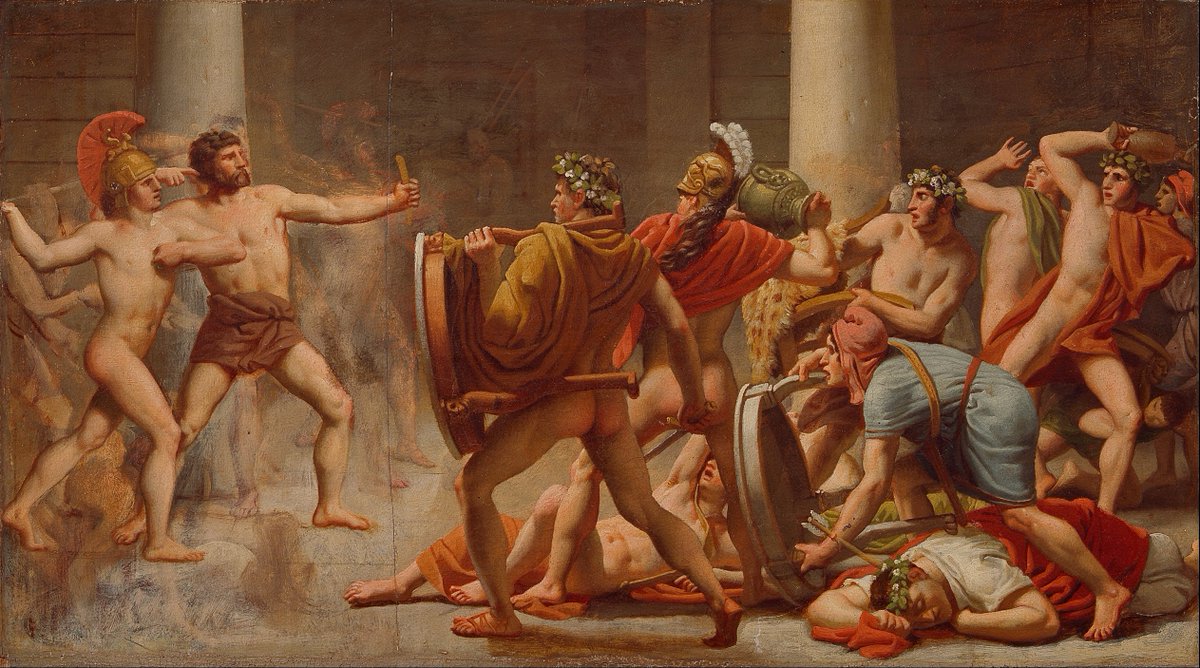
A powerful scene in the Odyssey happens when Odysseus finally returns to Ithaca after twenty years of war and wandering. You would expect the story to end with celebration, with the hero coming home, the family reunited, and order restored. Homer does something far stranger. Odysseus arrives disguised as a beggar, because Athena warns him that the palace has been taken over by more than a hundred suitors who have been living there for years, eating his food, drinking his wine, and pressuring his wife Penelope to marry one of them. They believe Odysseus is dead and in their minds the kingdom is already theirs. So the king of Ithaca walks through his own halls dressed in rags while the men stealing his house sit comfortably at his tables. They mock him, throw scraps at him, and one of them even strikes him, and Odysseus takes it. That is the remarkable part, because the same man who blinded the Cyclops and survived twenty years of disasters now stands quietly while strangers insult him in his own home. Homer tells us his heart burns inside his chest and that he wants to attack them immediately, yet he restrains himself and waits. Instead of striking, Odysseus studies the room carefully. He counts the men, watches their habits, and quietly observes which servants remain loyal and which have betrayed him. The hero of the Odyssey does something most people cannot do, which is delay revenge until the moment is right. Eventually Penelope announces a contest and brings out Odysseus’ great bow, declaring that she will marry the man who can string it and shoot an arrow through twelve axe heads lined up in a row. One by one the suitors try and fail, because none of them can even bend the bow. Then the beggar asks for a turn. The suitors laugh at first, but the bow is eventually handed to him. Odysseus takes it in his hands and strings it effortlessly. Homer says the sound of the bowstring tightening rings through the hall like the note of a swallow. Then he places an arrow on the string and sends it cleanly through all twelve axe heads. In that moment the beggar disappears. Odysseus turns the bow toward the suitors and reveals who he is. What follows is one of the most brutal scenes in Greek literature. The doors are sealed and the suitors realize too late that they are trapped inside the hall. Odysseus, his son Telemachus, and two loyal servants begin killing them one by one. There is no escape, no mercy, and no negotiation. The men who spent years consuming another man’s house die inside it. It is a violent ending, but Homer wants you to understand something important. The real danger to Odysseus was never just the monsters and storms on the long journey home. It was the possibility that someone else might take his place while he was gone. When Odysseus finally returns, he reminds everyone in Ithaca of a simple truth: a man’s home is not truly his unless he is willing to fight for it.
Athenaeum Book Club tweet media
English
1.8K
12.4K
69.3K
27.9M