

Roy Scott
1.3K posts

@sickdotdev Love this, super practical stack for getting an MVP out fast and cheap. Claude does the heavy lifting, Supabase + Vercel handle infra, and Stripe keeps the lights on. Solid list!
English

If you want to build a startup:
- Claude = coding. ($20/mo)
- Supabase = backend. (Free)
- Vercel = deploying. (Free)
- Namecheap = domain. ($12/yr)
- Stripe = payments. (2.9%/transaction)
- GitHub = version control. (Free)
- Resend = emails. (Free)
- Clerk = auth. (Free)
- Cloudflare = DNS. (Free)
- PostHog = analytics. (Free)
- Sentry = error tracking. (Free)
- Upstash = Redis. (Free)
- Pinecone = vector DB. (Free)
Total monthly cost to run a startup: ~$21
Still any excuses?
English
@sickdotdev Or, hear me out: have a skill set that is valuable in the market. Every jackass is using AI to create a useless startup right now. You will fail
English


This is a wild take -- and I'm a big Alex Finn fan, let me just preface this rant with that.
Suggesting people pay $1,000 a month in this economy is ludicrous.
I pay for:
> ChatGPT Plus ($20)
> Claude Pro ($20)
> MiniMax Highspeed Token Plan ($40)
I'm seriously considering throwing in another $10 for a @NousResearch portal subscription for the immense value it brings to Hermes users.
This is more than enough inference for 99% of the people using AI agents right now.
Unless you're doing some really deep shit, spending $1,000 a month on API fees is just insane.
Remember, this is coming from an influencer with almost half a million followers here and a thriving YouTube channel.
$1k a month likely isn't hurting Alex's wallet a bit.
But for many of you reading this, it's just flat out not necessary.
Especially for smaller businesses who don't have or don't want to spend an extra 1k a month.
On a side note, I'm really surprised to see Alex still riding the OpenClaw wave as hard as he is.
Hermes is a superior product. He uses it, so he can't deny that fact.
Kinda feels a bit irresponsible to be still plugging OpenClaw so hard when there's no argument as to which is a better option for 99.9% of the people watching his videos.
Alex, I doubt you'll see this (or even care if you do)...
I'll still keep watching your videos, but I'd really love to see you start covering Hermes more, brother.
Do your subscribers that favor.
The views will still keep rollin' in.
(Spoiler alert: building a mission control dashboard doesn't count as doing really deep shit either, by the way. Save those premium tokens and build something useful, folks.)
/EndRant 🙃
Alex Finn@AlexFinn
Here's the truth people are afraid to admit: Even if using Opus 4.7 with OpenClaw costs you $1,000 a month through the API, you still need to be paying for it When it comes to OpenClaw there's simply no second best model ChatGPT is completely useless for OpenClaw. Doesn't complete tasks, actively deletes and messes up files, has no idea how to use tools Every night before I go to bed I pray ChatGPT 5.5 matches Claude at OpenClaw usage. OpenAI has been a lot more consumer friendly when it comes to limits and oauth use But at the moment there is no dodging the truth. Claude is the only way to go for OpenClaw I look at it like this: OpenClaw with Opus 4.7 is a super intelligent employee that works 24/7 without complaint Even if I pay $1,000 a month for API usage ($12,000 a year) that's still a steal compared to hiring humans I'd be paying over $100,000 a year if I hired an actual person. And they wouldn't be working 24 hours a day and they wouldn't be immediately responding to my telegram chats and they'd file HR complaints if I talked to them the way I talked to my Claw I'm confident OpenAI is training their new models for OpenClaw usage, but in the meantime, there's simply no 2nd best. Pay for the API.
English
@tonysimons_ @trentster Human in the loop won’t be phased out for a VERY long time
English
@trentster Human in the loop will be necessary for the foreseeable future.
I predict we get phased out by Christmastime next year.
English
@manzombie_eth @tonysimons_ Except it’s not. Why? It’s generating unmaintainable slop that a human has to deal with. It’s far more expensive at the end of the day
English

I don't think Alex is saying everyone should pay $1k.
He's saying if your work demands that much compute, it's still cheaper than a human.
That's a proportionality argument, not a spending recommendation.
You can't hold an influencer responsible for how people misread basic logic.
English
@tonysimons_ @Josh_is_regen Is he? He’s using the exact same approach as countless AI hype dipshits I see on here
English
@Josh_is_regen He’s a genius when it comes to driving the hype train.
English
@tonysimons_ Anyone following Alex Finn is a true moron. He’s simply an AI hype influencer, nothing more. He makes money off the AI hype grift and has zero integrity
English
@TaskPoolAI @itsolelehmann 🤣🤣🤣 no you aren’t. You’re just running the same overly optimistic, ambitious grift as the rest. Fuck off with your pathetic marketing attempt
English

@itsolelehmann Biggest vibe shift nobody's talking about yet ...
AI agents still can't do anything in the real world
We're fixing that 🌊 @TaskPoolAI
English

if you've been paying attention, you know there's been a serious vibe shift in AI this month
3 major AI labs (anthropic, openai, amazon) all just went hard into biology.
they're literally telling you this is where the next wave of ai value capture is
here's what happened:
English
@itsolelehmann Nope. You’re just reading into it and trying to drum up hype as usual
English
@stevemordue @sukh_saroy Prompt structuring natural language in JSON is simply fucking stupid
English

@sukh_saroy Tell that to the 99% of vibers who don’t know what JSON is
English

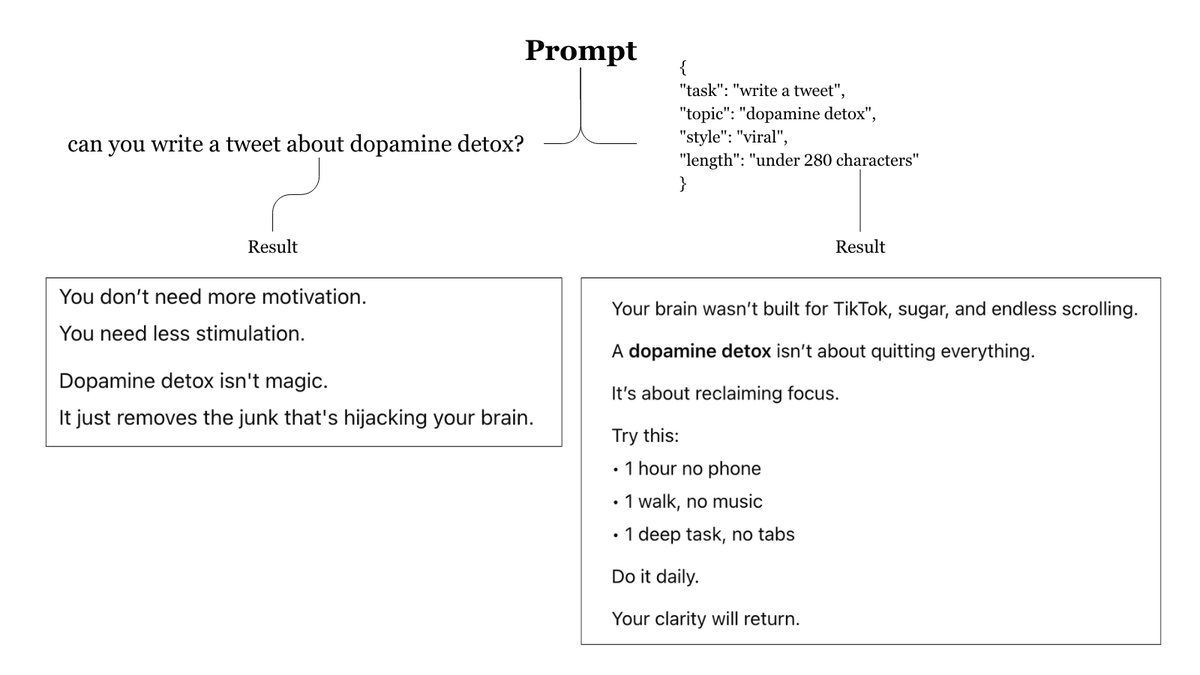
Prompt engineering is dead.
Nobody is writing english to chatbots anymore.
The best outputs are coming from people who write prompts like code.
It's called json prompting. and once you see it, you can't go back:
English
English

@MakJoris @sukh_saroy that prompt vibe feels off... but you're onto something there
English
@Tomas_Zubiri @sukh_saroy Absolutely. What he’s aiming for here is actually more work than structuring a more complete natural language prompt
English

@sukh_saroy There's more text in their training data than json.
English
@sukh_saroy This is no more effective than effectively articulating in natural language. You are a dumbass
English
Now watch what happens when you switch to json:
{
"task": "write a tweet",
"topic": "dopamine detox",
"style": "viral",
"length": "under 280 characters",
"tone": "punchy and contrarian"
}
Same request. zero ambiguity. the model stops guessing and starts executing.
English


I sequenced my genome at home, on my kitchen table.
I wrote up exactly how I did it - the equipment, protocol, theory, and cost:
iwantosequencemygenomeathome.com
English
@SpityGonzalez @SethSHowes This was such a juvenile description you just pointed out. JFC, there are waaaay too many people demonstrating Dunning-Kruger effect due to AI use
English
@logicwins @SethSHowes That’s sad. You really aren’t finding much to read
English

@SethSHowes This is the coolest article ive read on X in a long time. Thanks for posting it
English
@realarmaansidhu @SethSHowes 🤮 write your own comments you fucking loser
English

Someone just sequenced their own genome on their kitchen table.
This would have cost $3 billion and required specialized facilities in 2003. It can now happen at home.
This is biotech democratization that most industry commentary misses.
Here's what actually changed to make this possible.
Oxford Nanopore released MinION portable sequencers. Device costs approximately $1,000. Consumables per sequencing run cost $500-1000. Complete home genome sequencing runs approximately $2,000-3,000 total.
Compare to historical benchmarks. First human genome: $3 billion. First commercial genome sequencing: $10 million in 2007. Commercial sequencing 2015: $5,000. Home sequencing 2026: $2,000.
The cost curve has followed Moore's law-adjacent trajectory across 25 years.
For biotech industry specifically, the implications matter substantially.
Illumina dominates commercial sequencing with premium-priced instruments and consumables. Oxford Nanopore provides lower-cost alternatives that enable home and field sequencing.
The competitive dynamic favors democratization. Lower-cost alternatives capture specific market segments Illumina can't efficiently serve.
Commercial sequencing services (23andMe, Ancestry, specific medical sequencing) face long-term pressure as home sequencing becomes viable for technically inclined users.
For DIY biology movement, this represents specific capability advance.
Biohacking community has been building toward accessible biotech for years. Home PCR, basic genetic engineering, specific diagnostic capabilities have been developing.
Genome sequencing at home represents specific milestone. Previous limitations on scale and equipment have been overcome.
This doesn't democratize all biotech. It democratizes specific capabilities.
For medical implications, specific considerations matter.
Home sequencing produces data without clinical interpretation infrastructure. Specific medical decisions require professional analysis regardless of sequencing source.
Insurance coverage, medical record integration, and specific regulatory frameworks don't accommodate home-sequenced data smoothly.
The capability exists. The healthcare integration lags substantially.
For privacy implications, home sequencing has specific advantages.
Commercial sequencing services have been associated with specific privacy concerns. Data sharing with pharmaceutical companies. Law enforcement requests. Specific breach events.
Home sequencing keeps data local by default. Privacy protection depends on user choices rather than corporate policies.
For individuals with specific privacy concerns, home sequencing offers advantage commercial services can't match.
For research implications, democratized sequencing creates specific opportunities.
Citizen science projects can access sequencing capability previously restricted to institutional research. Specific research questions become accessible to non-institutional researchers.
Community-level genomic monitoring becomes possible. Specific disease tracking, environmental monitoring, and local research projects can proceed with community funding rather than institutional grants.
For the specific individual who sequenced their genome at home, practical value depends on specific context.
Personal curiosity: substantial satisfaction from scientific self-knowledge.
Medical purpose: limited value without professional interpretation infrastructure.
Technical learning: substantial educational value in the process itself.
Privacy protection: specific advantage over commercial alternatives.
Different motivations produce different actual value.
For investors watching biotech industry, specific dynamics matter.
Companies positioned for democratization (Oxford Nanopore, specific consumables manufacturers) benefit from expanding accessible market.
Companies dependent on premium-priced institutional sales (specific traditional sequencing providers) face structural pressure.
Services companies (interpretation, consultation, specific clinical integration) may benefit as democratization expands data availability.
The industry structure evolves. Specific winners and losers emerge from democratization.
For consumers, home sequencing represents specific option with specific tradeoffs.
Cost: $2,000-3,000 plus time investment to execute correctly.
Privacy: substantial advantage over commercial services.
Capability: comparable to commercial sequencing for basic applications.
Limitation: no professional interpretation included.
If these tradeoffs align with your priorities, the option now exists.
For the broader technology pattern, home sequencing represents specific democratization instance.
Previous decades democratized computing, publishing, manufacturing, broadcasting, financial services. Biotech democratization follows similar trajectory with specific biological industry characteristics.
The pattern suggests continued capability expansion to individual level across traditionally institutional domains.
For specific applications in your own situation, consider whether home sequencing serves your specific purposes.
Most people don't need genome sequencing for immediate practical purposes. Those who do have specific medical, research, or curiosity motivations now have accessible option.
The accessibility matters regardless of whether most people use it. Specific populations with specific needs benefit from the democratized capability.
Seth Howes's kitchen table genome sequencing is specific example of broader democratization pattern. Appreciate the technical achievement. Recognize the broader implications.
Biotech capability is expanding beyond institutional control. This matters for industry economics, medical practice, privacy protection, and individual capability.
Apply the framework to your evaluation of biotech industry and your personal health decisions accordingly.
English
@hullalulu @Throrf @SethSHowes Yet here you are, along with OP, posting in a social media platform gobbling up your data for free to corporations. 🤣🤣🤣🤣🤣
English

@Throrf @SethSHowes wasn't the whole point of it not giving his data away to corporations?
English
@SethSHowes … but why? You can pay many companies to do this for dramatically less money, because they do it at scale. This is silly
English