
Sreeram Narayan
11.2K posts


Sreeram Narayan
@sreespace
Tweets/ RT on AI, #ProductManagement, Tech & Startups. CXO. Finance. 💙 Cricket. Not here to give/ take offence. All commentary personal.
Delhi Inscrit le Haziran 2009
2K Abonnements624 Abonnés


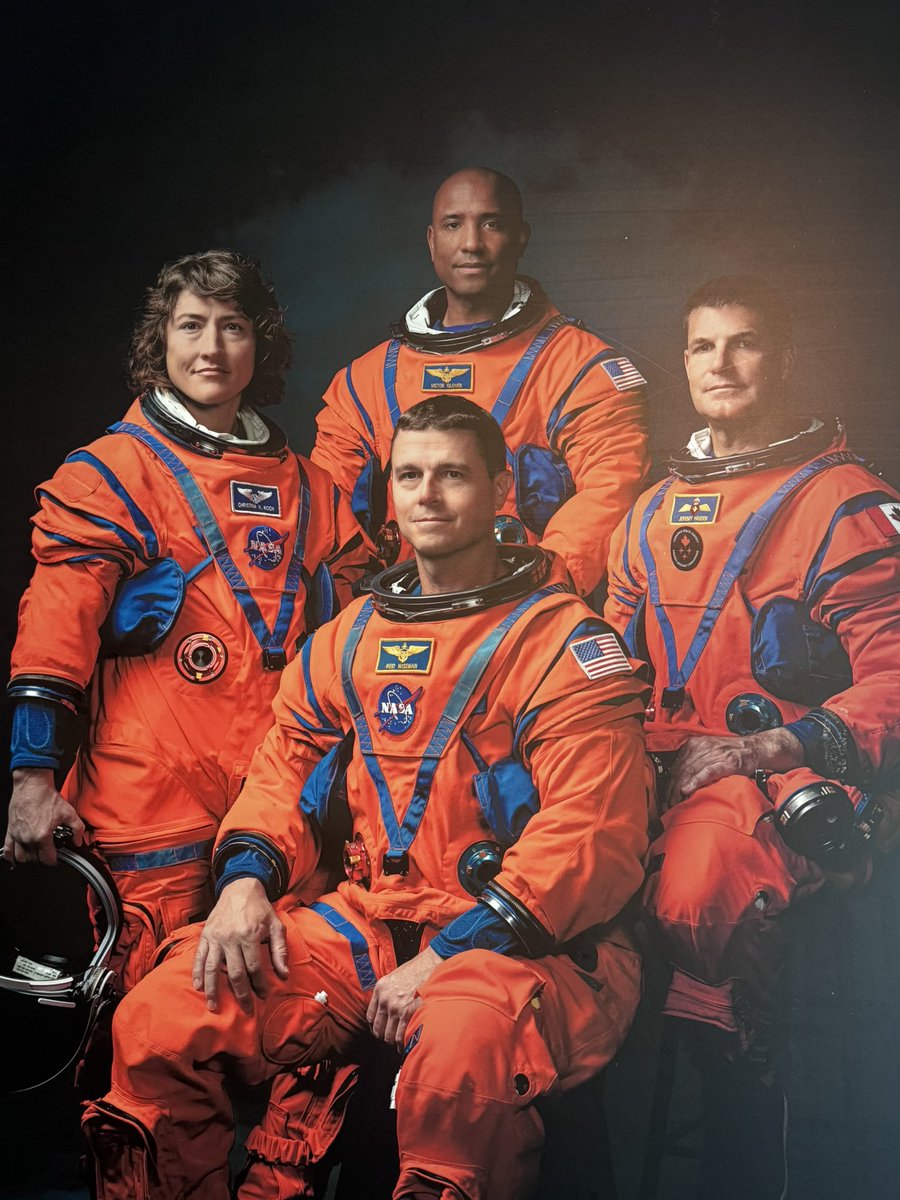


Put up in New York, Orlando and Atlanta for next 2 weeks. Any start up/ product guys / techies / AI enthusiasts - happy to connect. Coffee on me #Productmanagement
English
@sukh_saroy Still working on prompts? PM need to go deeper into build, execution and release with Claude Code
English

Claude is insane for product management.
I reverse-engineered how top PMs at Google, Meta, and Anthropic use it.
The difference is night and day.
Here are 10 prompts they don't want you to know (but I'm sharing anyway):

English

Severe weather on March 16 will likely disrupt travel across Eastern North America. If you're traveling through the area, we have flexible options for you to adjust your flights in the Delta app or at delta.com delta.com/us/en/advisori…
English
Sreeram Narayan retweeté

If Iran wins, it's the end of five eras.
1991-2026: the unipolar era
1974-2026: the petrodollar era
1945-2026: the postwar era
1776-2026: the union era
1492-2026: the Western era
Specifically, the end of the petrodollar (1974) would also be the end of the unipolar moment (1991) and the postwar order (1945). It would mark the moment when Eurasian powers were once again dominant over Western powers (1492). Finally, a rapid crash in the dollar's purchasing power coupled with military defeat could well break apart the American union (1776).
Few seem to viscerally understand just how dependent America is on money printing. But the end of the petrodollar is the end of Keynesianism as we know it.
And if there's a sudden cost-of-living spike on top of pre-existing levels of political polarization, which are already near Civil War levels...we could see the scenarios that Dalio, the Fourth Turning, and Turchin have described.
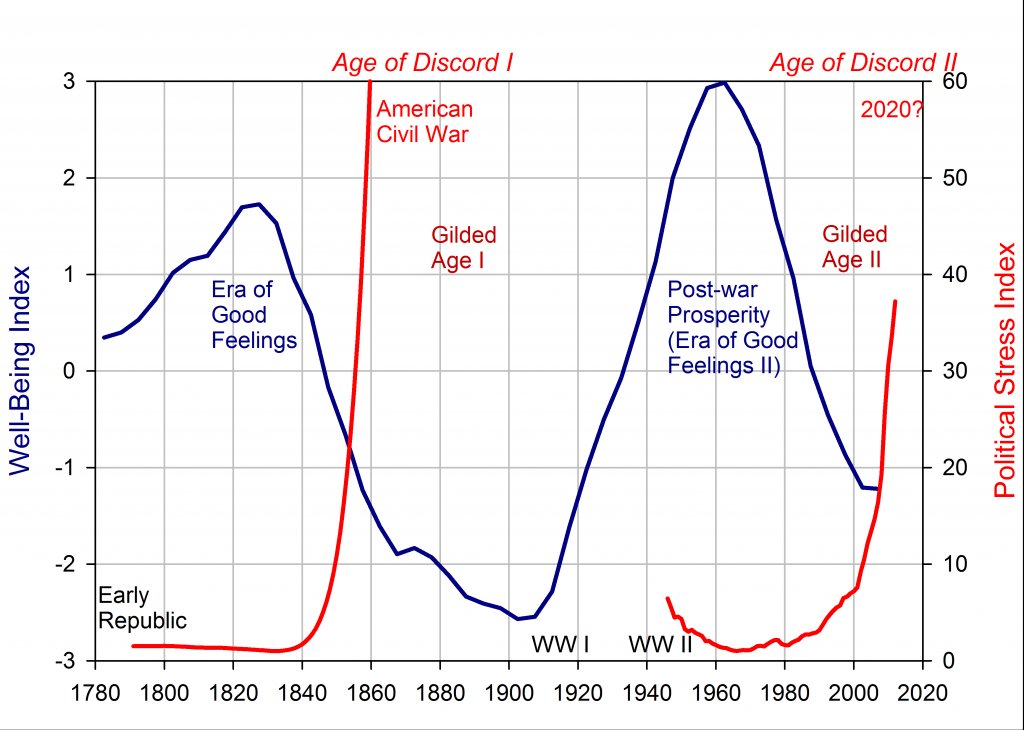
English
Sreeram Narayan retweeté

Agentic software engineering adoption is on fire at @Uber. 1,800 code changes per week are now written entirely by Uber's internal background coding agent, and 95% of our engineers now use AI every month across all the tools we track.
This is a real reset moment for engineering; it's one of the most exciting times to lead. This shift requires builders to be curious and hands-on. I’m incredibly lucky to be surrounded by a team that’s doing exactly that.
The best part is that the strongest adoption isn’t being pushed top down from leadership announcements; it’s coming from engineers who are quietly experimenting, quietly shipping, and quietly pushing things forward.
I love spending time with those engineers because there’s no substitute for being close to the work.
Over the last few months, we leaned in hard, and the results have been phenomenal.
The bigger shift: going agentic.
84% of AI users are now working with agent-style workflows, not just tab completion. Claude Code usage nearly doubled in 2 months (32% → 63%), while IDE-based tools have largely plateaued.
Engineers are moving from accepting suggestions to delegating tasks. Even within traditional IDEs, ~70% of committed code is now AI-generated.
Background agents are writing code autonomously.
Our internal background coding agent went from <1% of all code changes to 8% in just a few months. There is zero human authoring. Engineers review and approve, but the code is written entirely by AI agents.
The role of the engineer is shifting - from writing every line to architecting systems and reviewing AI-generated code.
More to come from the @UberEng team in the coming days.
English
Over half the BSE 500 is now trading below its 3-year average valuation. Cement is at 100% below 3-year averages! IT stocks are 80% below their 3-year valuations. However, 60% of stocks still trade above their 10-year averages, meaning we’re cheaper but not at generational lows. Nearly three out of four stocks are below their 200-DMA
English
English

Rest assured that the team is working on rebooking the flights for all our guests, and you will receive the updated flights as soon as possible. Otherwise, you can also contact our reservations team for assistance. You can either contact them over the phone or via chat; you will be able to find the contact numbers based on the country and chat with them via this link: spr.ly/6016B6DlGC. We are currently experiencing a significantly high volume of calls and chats. We appreciate your patience as it may take longer than usual for your calls or chats to be answered. Thank you. *Levi
English
The crude oil surge has hammered the rupee to an all-time low of ₹92.33 per dollar. RBI is actively intervening (selling dollars at 91.30–91.35 levels) to limit damage. The 10-year bond yield has climbed to 6.77%, which means borrowing costs are rising. This is a triple whammy for India: expensive oil + weak rupee + rising yields.
English
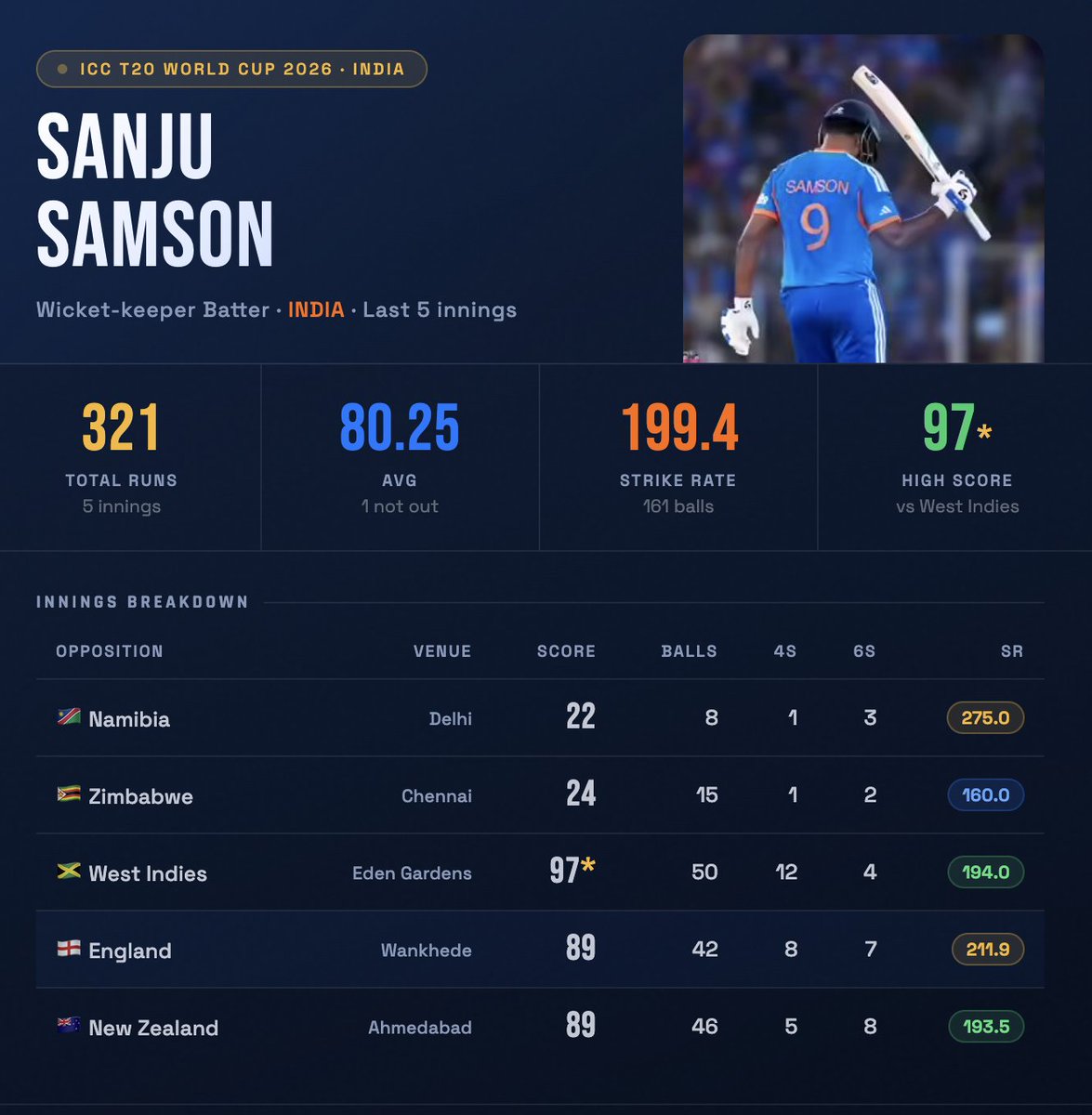
For every fan who never stopped believing — Sanju Samson in a World Cup, on home soil, in Year 10. This one's for us. Sanju Samon in last 5 innings in #ICCMensT20WorldCup2026 #SanjuSamson #INDvNZ #IndiaVsNewZealand
English
English

English
@archie_elmore @etihad Check their site for full refund claim for flights up to 21 March
English
@cricketingvieus @Rajiv1841 @ashwinravi99 Exactly the entire NZ squad was just waiting for this to plan their strategies 😝
English

@sreespace @Rajiv1841 @ashwinravi99 Even if it's of 10 percent more reach its a win. If not reach he's just dumb. The argument of NZ would have already decoded doesn't make sense. What is they didn't noticed it yet. A little bit of common sense he would have waited to atleast post it today or later
English

@cricketingvieus @Rajiv1841 @ashwinravi99 Silly to assume that Ashwin is looking for reach from a tweet when he has millions of views on his YouTube channel is and widely respected as a Cricket thinker and expert
English
@sreespace @Rajiv1841 @ashwinravi99 But still why he chose just before final, that too of our inform player. Why not analyse on finn allen, glen Philips?? He knows that would've got him this much reach.
English
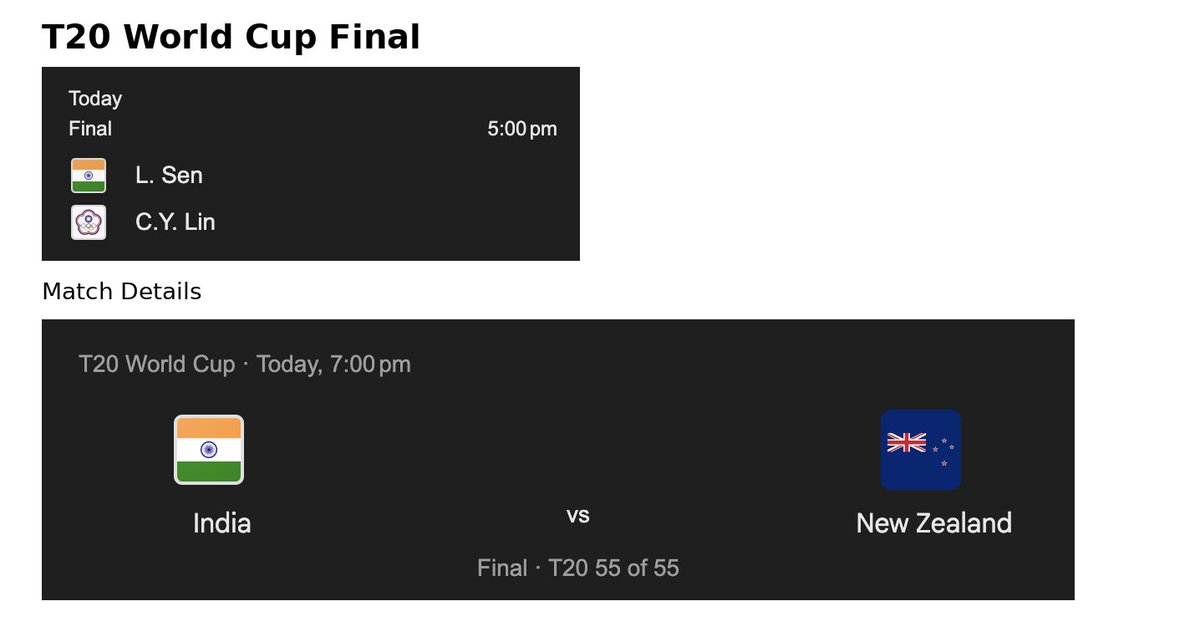
India, We need to be cheering for 2 final sporting clashes today. The first and most exciting one starts at 5 PM today. #LakshyaSen #ICCT20WorldCup2026
English
India, We need to be cheering for 2 final sporting clashes today. The first and most exciting one starts at 5 PM today. #LakshyaSen #ICCT20WorldCup2026


English
#NewBlog The Evolving Role of the Engineering Manager
Leading People, Process, and Outcomes in the Age of AI
Engineering Managers have never been individual contributors with a title upgrade. At their core, they exist to bring together people, process, and outcomes — ensuring teams ship high-quality releases on time while clearing every obstacle in the way, from inter-pod dependencies and partner coordination to tech reviews and release management.
“Engineering Managers are the multipliers of the engineering world. They don’t ship features — they make sure features get shipped.” — Glen Thomas
Spotify popularised this thinking at scale through its squad-tribe model, where autonomous cross-functional squads of 6–12 people own features end-to-end, while Tribe Leads and Chapter Leads provide the connective tissue for alignment and craft excellence across squads. Blinkit echoed this philosophy in the Indian context, defining EMs as the glue between product vision and engineering execution — people who own delivery accountability without dictating implementation.
The Three Pillars of Engineering Management
1. PEOPLE
Hiring, coaching, 1:1s, career growth, morale
2. PROCESS
Planning, execution, scope, velocity, quality
3. OUTCOMES
Business alignment, delivery, stakeholder value
AI-powered development tools are no longer experimental. GitHub Copilot, Claude Code, Cursor, and agentic AI workflows are fundamentally reshaping how code gets written, reviewed, and deployed. The 2025 State of Engineering Management report by Jellyfish found that 67% of engineering leaders predict at least a 25% productivity increase from AI by 2026, with real-world data consistently showing 30–50% faster throughput for AI-enabled engineers.
Five Shifts Every EM Must Make
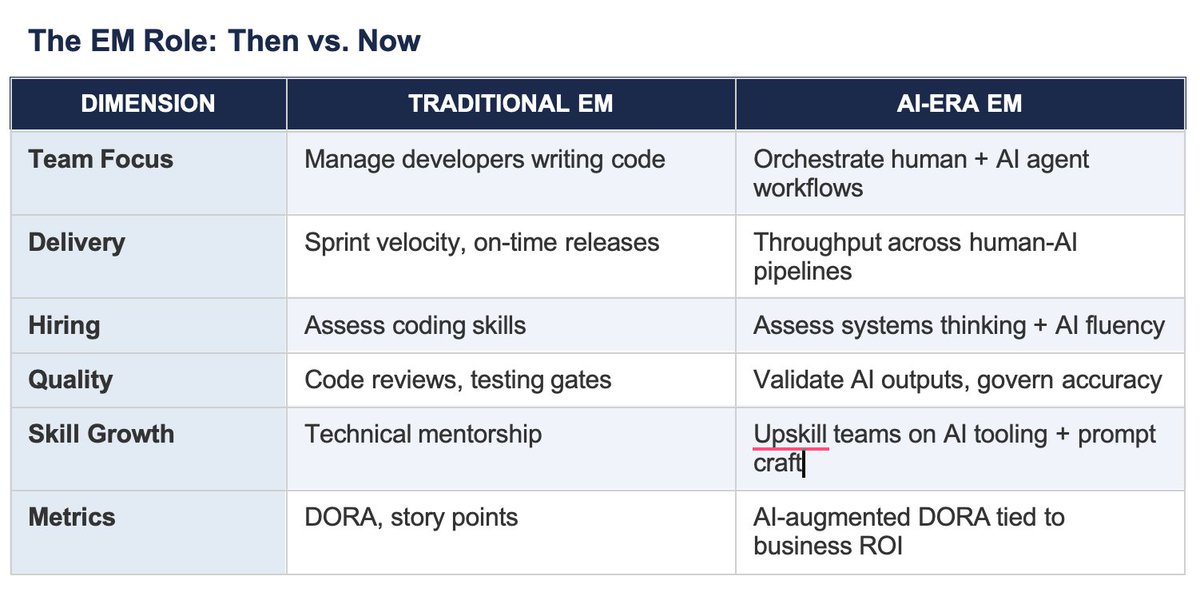
01From Task Allocator to Workflow Architect
Design hybrid human-AI workflows. Decide which tasks are AI-delegated, which need human judgment, and where review checkpoints sit. Think of yourself as managing a blended workforce of people and agents.
02From Code Reviewer to Output Curator
AI-generated code needs validation for security, maintainability, and business alignment. EMs must build review frameworks that treat AI outputs as first drafts requiring human curation, not finished products.
03From Headcount Planner to Capability Designer
Team planning shifts from “how many engineers do I need?” to “what capabilities does my team need?” This includes AI tooling budgets, prompt engineering skills, and the ability to evaluate and orchestrate multiple AI agents.
04From Shield Against Chaos to AI Governance Lead
EMs must now own AI ethics, bias monitoring, and compliance within their teams. Gartner emphasises that clear responsibility across DevOps, DataOps, and ModelOps cycles is a new EM mandate.
05From Career Coach to Reinvention Partner
Junior engineers face the biggest disruption — the traditional “learn by coding” path is compressing. EMs must redesign growth frameworks where juniors learn by validating, contextualising, and challenging AI outputs rather than just writing boilerplate.
Patterns Emerging From the Front Lines
Across the industry, three distinct operating patterns are surfacing among organisations that are successfully navigating this transition. Each offers a lens for how EMs can reposition themselves.
Pattern 1: The AI-Native Culture
Some organisations have made AI tooling a non-negotiable part of every engineer’s workflow — providing unlimited token access, internal LLM proxies, and even using interns as the tip of the spear to push boundaries of what AI-assisted development can achieve. In these environments, EMs are expected to be technically fluent enough to evaluate AI-generated work at depth, not just manage timelines. The EM becomes a craft quality gatekeeper in an AI-accelerated pipeline.
Pattern 2: The Autonomous Squad Model
Organisations that already decentralised decision-making to small, cross-functional squads find themselves naturally suited for AI augmentation. Here, the EM equivalent — often a Chapter Lead or Engineering Lead — shifts focus from hands-on code guidance to setting AI adoption standards and ensuring craft excellence across autonomous teams. The role becomes less about directing work and more about curating how AI tools are used consistently and responsibly.
Pattern 3: The Single-Threaded Ownership Model
In this model, one leader owns one mission end-to-end with full accountability. When teams are augmented by AI agents that can execute multi-step tasks autonomously, clear ownership becomes even more critical to avoid diffusion of responsibility. The EM here acts as the single accountable human in a loop where multiple AI agents and human contributors intersect — the person who decides what gets delegated, what gets reviewed, and what gets shipped.
The Bottom Line
The Engineering Manager role isn’t shrinking — it’s expanding in scope and strategic importance. As pure coding work gets compressed by AI, the human skills that EMs have always championed — context, judgment, alignment, and people development — become the highest-leverage capabilities in any engineering organisation.
“We’re not in a model race. We’re in a context race.” — The organisations that win will be those whose EMs build the deepest integration between AI capabilities and business context.
The future EM is part workflow architect, part AI governance lead, part capability designer, and still — always — a people-first leader. The tools have changed. The mission hasn’t.
English