creator stack AI

214 posts

creator stack AI banner
creator stack AI

creator stack AI

@CreatorStackAI_

Helping people make money with AI tools Daily AI tips & online income ideas Follow to learn digital income

शामिल हुए Mart 2026
113 फ़ॉलोइंग9 फ़ॉलोवर्स
creator stack AI
creator stack AI@CreatorStackAI_·
@NainsiDwiv50980 Most people are using Claude like ChatGPT. The top builders are using it like an operating system. Hooks. Agents. MCP tools. Automation loops. That’s where the leverage is. ⚡
English
0
0
0
3
Nainsi Dwivedi
Nainsi Dwivedi@NainsiDwiv50980·
Claude might be the best LLM right now. But most people are still using it like ChatGPT. The top builders are using Claude Code — with hooks, agents, MCP tools, and full automation workflows. That’s where the real power is. This guide shows exactly how they’re doing it. I’ll DM it only first 4500 How to get it: • Follow me (must so I can DM) • RT + Like • Comment "guide" If you're still just prompting, you're already behind.
Nainsi Dwivedi tweet media
English
22
15
38
2.2K
creator stack AI
creator stack AI@CreatorStackAI_·
@Nithin0dha On World Water Day we talk about scarcity. But the real story in India is communities rebuilding water systems themselves. When villages manage groundwater locally, resilience follows. 💧
English
0
0
0
5
Nithin Kamath
Nithin Kamath@Nithin0dha·
Every March 22, we observe World Water Day, the focus being on making water and sanitation accessible to all by 2030. However, the UN recently put out a report calling this an era of "global water bankruptcy." Dramatic framing, but hard to argue with when you look at what's actually happening. India is particularly exposed. Rivers, lakes, and groundwater are all under stress, and in many parts of the country, water scarcity has simply become the default condition. A lot of the interesting solutions are coming from the ground, owned by communities themselves. @GramVikasIN has been working across 1,900+ villages in Odisha and Jharkhand to build what they call Water Secure Gram Panchayats. A few things they've done that stand out: Water Passbooks that help farmers understand actual groundwater levels before deciding what to plant. Local youth trained as Jal Bandhus who map water sources and work with village bodies to manage them. And a lot of focus on land restoration, planting trees, grasses, and plants that slow runoff and let water percolate back into the ground. When water becomes more reliable, other things follow. About 23,000 homes now have functional tap connections. Farmers who were entirely dependent on rain are diversifying into livestock, agroforestry, and small businesses. The scale of the problem is huge, and this kind of work takes time. But what stands out is that this hasn’t been done by one organisation alone, it’s driven by the people who actually live there. @RainmatterOrg has been supporting @GramVikasIN for a while now because this is the kind of long-term, ground-up work that doesn't get enough attention. Link to the video in comments.
Nithin Kamath tweet mediaNithin Kamath tweet mediaNithin Kamath tweet mediaNithin Kamath tweet media
English
20
16
226
14.7K
creator stack AI
creator stack AI@CreatorStackAI_·
@its_hipolita A list of facts feels like lore. An interconnected system feels like a world. That’s why Dune still stands out decades later. 🌍
English
0
0
0
23
creator stack AI
creator stack AI@CreatorStackAI_·
@dvassallo Previous generations struggled for access. Our generation struggles with focus. Same opportunity. Different challenge. ⚡
English
0
0
0
8
Daniel Vassallo
Daniel Vassallo@dvassallo·
When I got interested in computer programming in the 90s, there were no programming books in my country. I had to wait for our yearly family vacation. We'd connect through London and I'd rush to Oxford Street to buy whatever books I could. A few minutes, once a year, to decide what I'd study for the next 12 months. And they had to fit in my 20kg luggage. Now education is free and accessible to everyone. Anyone with motivation can learn whatever they want. What a revolution!
Mark Cuban@mcuban

I’m going to tell you how much worse it was at the start of the PC Revolution for white collar workers trying to adapt, vs today with AI Today, presumably every white collar worker has access to a smart phone and/or a PC/laptop. Back then, a PC cost $4,995 , an off brand was $3,995. 5k in 1984 is about $16k today. It was really expensive. The only reason I could learn how to code and support software is because my job let me take home a PC to learn. By reading the software manual. Literally. RTFM. Or pay to go to training. Classes that started at hundreds of dollars then. It was expensive. It absolutely limited who could get ahead. Today, ANYONE can go to their browser, to the AI LLM website of their choice, and type in the words “I’m a novice with zero computer background, teach me how to create an agent that reads my email and …” That concept applies to LEARNING ANYTHING Think about what this means. Any employee of any company can say “ I need to learn how to xyz for my job , which is to do the following: Tell me what more information do you need to help me be more efficient, productive and promotable”. Or “ what new skills can you teach me that will help me reduce my chances of getting laid off “. Or “what suggestions do you have for me to communicate to my boss, who I barely know, to help my chances of staying employed “ These aren’t great prompts. But they are a start that anyone can take. Think about how incredible that is. Back in the day was so much harder for white collar workers. It was harder for new grads because unless they took comp sci, they probably had never used a PC. Big Companies are going to cut jobs. No question about it. Small companies is are going to need more and more AI literate thinkers who can help them compete or get an edge What I tell every entrepreneur, and it’s more crucial today. “ when you run with the elephants there are the quick and the dead. Adopt tech quickly , you can out maneuver big companies. “

English
19
3
148
13.3K
creator stack AI
creator stack AI@CreatorStackAI_·
@BillAckman The precedent here matters more than the payout. If investors believe the government can sweep 100% of profits after recovery, private rescue capital disappears in the next crisis.
English
0
0
0
152
Bill Ackman
Bill Ackman@BillAckman·
A number of press reports have characterized our and other shareholders’ efforts on behalf of Fannie and Freddie (F2) as seeking a ‘gift’ or ‘handout’ from the government. We, the shareholders of F2, seek no such thing. Hundreds of financial institutions were bailed out during the GFC by the U.S. Treasury. Nearly all of the financial institution bailouts during the GFC involved an injection of capital in the form of senior preferred stock by Treasury at an interest rate of 5%, plus warrants to acquire common stock in an amount equal to 15% of the face amount of the preferred with an exercise price at the then-current stock price of the rescued institution. For example, Treasury’s preferred stock investment in Goldman Sachs was in an amount of $10 billion and, in addition, Treasury received warrants on $1.5 billion of GS' common stock at its then market price. The bailout terms for F2 were materially more burdensome and expensive, with a higher interest rate and substantially more warrant coverage, than that of every other financial institution (other than those of AIG whose terms were similar). Despite the F2 bailouts’ massively more burdensome terms, shareholders are not complaining about the original terms. Treasury invested $193 billion in F2 in the form of senior preferred stock (SPS), including funding for $2 billion of commitment fees, with a 10% coupon (twice that of the banks). Treasury also received warrants on 79.9% of both companies’ outstanding shares. Fannie and Freddie have since repaid Treasury $301 billion, which includes interest on the SPS at a blended rate of 11.6%, an interest rate which is 160 basis points more per annum, and have returned the entire $193 billion of outstanding principal, $25 billion in excess of what was contractually owed. In summary, the F2 SPS has been fully repaid according to its original contractual terms plus an extra $25 billion. Despite the fact that the SPS has been more than repaid in full, Fannie and Freddie have not accounted for these payments on their respective balance sheets, and the $193 billion of SPS remains an outstanding liability as if no principal payments had ever been made. How can it be, you might ask, if indeed F2 have repaid $301 billion to Treasury when only $276 billion was due could there be any remaining balance of the SPS on the F2 balance sheets? The answer relates to something called the ‘Net Worth Sweep (NWS).’ During the second term of the Obama administration, on August 12, 2012, two quarters after F2 returned to profitability, Treasury announced that it was unilaterally amending the terms of the SPS stock to provide that Treasury would take 100% of the profits of F2 each quarter in lieu of the 10% annual dividend rate. This was not a negotiated resolution with F2. It was a unilateral amendment of the original terms of the SPS that was done in bad faith. The supposed rationale for the amended terms of the SPS was akin to the IRS garnishing the wages of someone who will never be able to pay the taxes that they owe. That is, the Treasury said F2 will never be able to pay the 10% coupon, let alone the SPS’ $193 billion principal balance, so it decided instead to ‘settle’ for 100% of F2’s profits forever. In discovery, shareholders learned that the stated justification for the amendment was false. In mid 2012, the Obama administration had come to learn that both companies would soon be reversing tens of billions of reserves on their balance sheets as housing values had increased and the reserves taken during the GFC had been excessive. The NWS was instituted by Obama to forestall F2 from forever being able to recapitalize and be released from conservatorship. The NWS was not a ‘settlement’ for a lesser amount of future payments. It was the outright theft of the forever profits of both companies. Never before or since has the government ‘swept’ 100% of the profits of any company, let alone a financial institution in conservatorship, a form of government intervention where the goal is rehabilitation of the institution, and where the hierarchy of corporate claims has always been respected. The accounting for the NWS payments while it was in effect (until Secretary Mnuchin terminated the NWS in Trump’s first term) was also unusual. The NWS was treated by F2 as a quarterly adjustment to the dividend rate on the SPS such that the dividend amount owed was made equal to the after-tax profits of F2 for that quarter with no limitation. In other words, regardless of the amount of profit F2 generated for the quarter – whether or not it was in excess of the original 10% annual dividend – the dividend payable under the NWS was made equal to the quarterly profit. The absurd terms of the NWS sweep therefore made it impossible for any partial or full repayment of the SPS to take place as every dollar paid to the Treasury on the amended terms of the SPS was considered a dividend payment, even if the amount was massively in excess of the original contractual SPS terms. The absurdity of the NWS was made clear just two quarters after the NWS went into effect. Fannie Mae generated a profit of $59 billion in the first quarter of 2013, and the SPS dividend rate for that quarter was set at $59 billion so the entire amount was swept to the government, more than 10 times the contractual dividend rate. I had the opportunity to discuss F2 and the NWS with Warren Buffett about a decade ago and he said that he “couldn’t believe what the government had done.” In short, the shareholders of F2 are simply asking the government to respect the original and highly burdensome terms of the SPS. There is no dispute that Treasury has received more than the original 10% coupon and full repayment of principal of the SPS, that is, an extra $25 billion. We and the millions of other shareholders of F2 are simply asking the administration to honor the original SPS terms and properly account for the $301 billion of payments, thereby eliminating the SPS liability from both companies’ balance sheets. Shareholders have not asked for the extra $25 billion to be returned to the two companies. Treasury can decide whether to keep those funds or return them to the companies. Accounting for the repayment of the SPS has other important implications. Namely, it is critically important that conservatorships respect the rule of law, in particular, the contractual terms of corporate instruments and the hierarchy of claims. Otherwise, no financial institution that gets into trouble will be able to raise rescue capital in the private markets. Notably, the treatment of F2 in conservatorship explains why Silicon Valley Bank and other recent large bank failures since the GFC were unable to raise private capital and avoid government intervention or a forced sale to J.P. Morgan. If the government with the stroke of a pen during conservatorship can at a whim wipe out common and preferred shareholders, no one is going to step in to try to save a financial institution that gets into trouble, and only the top few banks will be possible rescuers of big banks that fail. Furthermore, because of F2’s history, their reputation in the capital markets has been greatly damaged. F2 raised $22 billion of preferred stock in the year or so prior to conservatorship as the government pressed both companies to raise capital. Institutions were willing to invest billions of dollars of capital into both institutions before they failed because, based on all precedent conservatorships, the contractual terms of all financial instruments and the hierarchy of claims had been preserved. Unfortunately, in light of the precedent of the net worth sweep, no investor can be confident that they won’t be wiped out in a future conservatorship so none has been willing to take the risk. Some have proposed that Treasury simply convert the SPS into junior preferred and common stock and massively dilute shareholders. Putting aside the potential legal challenges to this approach, the result will be that Treasury will at best own something approaching 95% of both companies rather than 79.9%. While the government’s percentage ownership stake would be larger in the SPS conversion approach, the value of the government’s larger stake would be considerably lower as the companies would become un-investable. Who would invest in F2 alongside the government when they just wiped out the previous owners? In the SPS conversion scenario, the government’s stake, at best, if it could be sold, would trade at a massively discounted valuation, well below the value of the government's stake if Treasury retained only its contracted for 79.9% stake and respected the original terms of the SPS. In other words, a slightly smaller ownership stake of much more highly valued companies would equate to considerably more value for Treasury and taxpayers. In a public letter to Rand Paul after his first term in November of 2021, President Trump recognized that the net worth sweep was theft from the shareholders of Fannie and Freddie. He wrote: “Another Obama/Biden scam in legal trouble was when they allowed the Federal Housing Finance Agency (FHFA) to steal the retirement savings of hardworking Americans who had invested in Fannie Mae and Freddie Mac…The idea that the government can steal money from its citizens is socialism and is a travesty brought to you by the Obama/Biden administration. My Administration was denied the time it needed to fix this problem because of the unconstitutional restriction on firing Mel Watt. It has to come to an end and courts must protect our citizens.” I couldn’t have said it better than President Trump. Now that you have the time, Mr. President, let’s Stop the Steal!
English
158
221
1K
249.6K
creator stack AI
creator stack AI@CreatorStackAI_·
@stevenmarkryan The interesting pattern with Musk projects isn’t the announcement. It’s how quietly they reshape supply chains 2–3 years later. 👀
English
0
0
1
38
stevenmarkryan
stevenmarkryan@stevenmarkryan·
Elon Musk Reveals TERAFAB (Tesla & SpaceX Project) Watch the full announcement. ► Silences removed (to save you time) ► Boosted audio (for easier listening) 🤯🤯🤯
English
18
74
476
19.9K
creator stack AI
creator stack AI@CreatorStackAI_·
@EMostaque Feels like the shift isn’t “AI replacing physicists.” It’s AI compressing decades of theory exploration into months. That changes who contributes — and how fast history moves. 🚀
English
0
0
0
7
creator stack AI
creator stack AI@CreatorStackAI_·
@nireyal I’ve noticed luck increases every time I step outside my routine. New people = new ideas New places = new chances Staying comfortable quietly reduces luck. 🎯
English
0
0
0
1
Nir Eyal
Nir Eyal@nireyal·
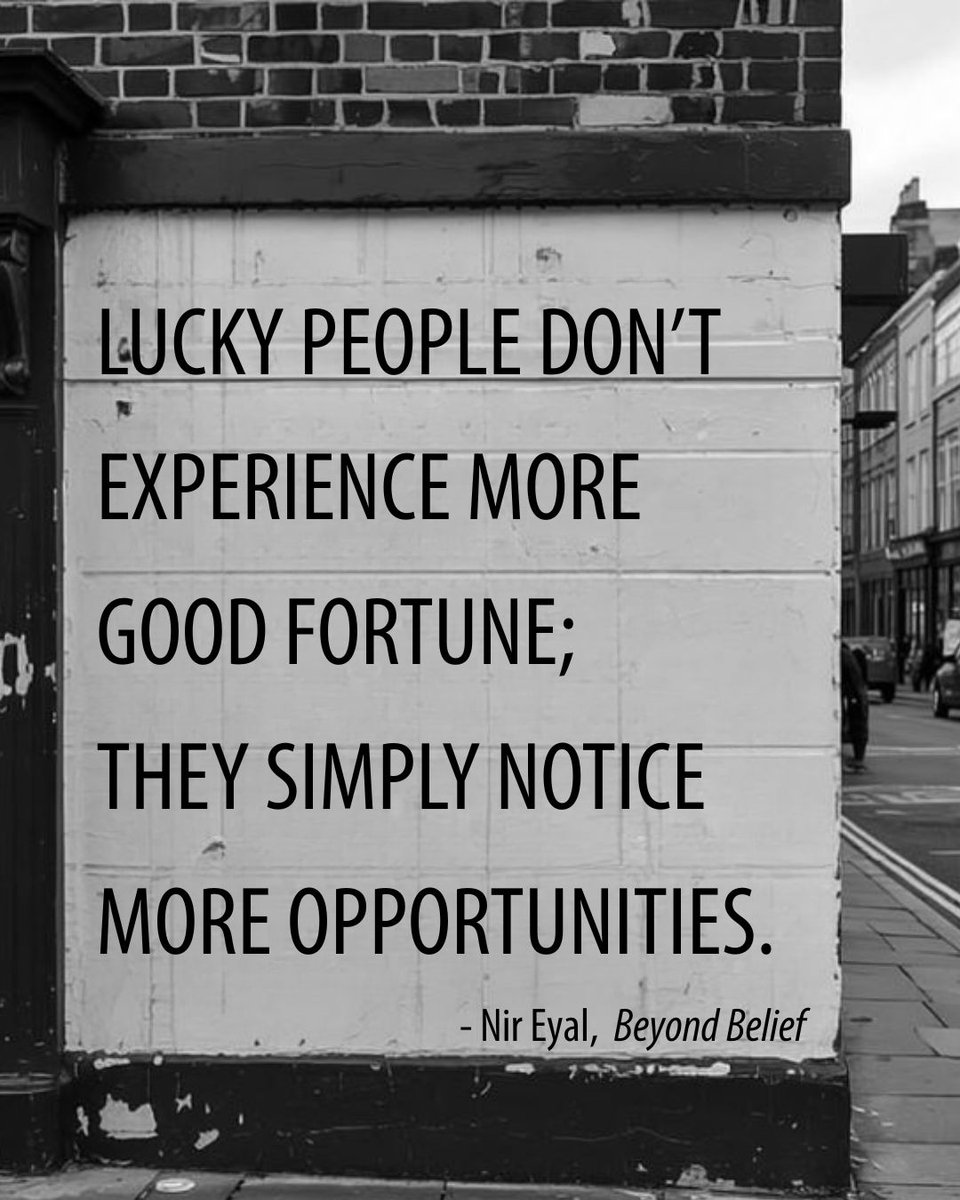
Engineering your own luck is easy when you understand the following: • Luck isn't "chance" • Luck favors those who step beyond the familiar - Into new places, new people, and new experiences. • So‑­called lucky individuals don’t actually experience more good fortune; they simply see more of it • Lucky people consistently disrupt their routines. Start by asking: • What beliefs helped you get where you are today? • Which ones still open doors? • Which might be quietly closing them? • Where are you playing it too safe? • Are you doing enough to “provoke luck”? To learn more, grab a copy of my new book Beyond Belief today! geni.us/beyondbelief
Nir Eyal tweet media
English
2
5
24
988
creator stack AI
creator stack AI@CreatorStackAI_·
@george__mack If consumption alone created skill, YouTube would be full of Michelin chefs, Netflix would be full of stand-up legends, and every NBA fan would be dunking. Learning starts when you build, not when you watch. 🚀
English
0
0
0
5
George Mack
George Mack@george__mack·
If consumption is how you learn, you’d be a professional chef, with a comedy special on Netflix, and dunking in the NBA.
English
27
39
351
16.8K
creator stack AI
creator stack AI@CreatorStackAI_·
@packyM This is the most modern version of expense-driven behavior change. The moment a tool shows up in your company spend dashboard… it stops being “something you’re testing” and starts being something you’re accountable for using.
English
0
0
0
10
creator stack AI
creator stack AI@CreatorStackAI_·
@marcrandolph Most people think great companies start with great ideas. They usually start with movable ideas. The companies that win aren’t the ones that were right on day one— they’re the ones that stayed in the game long enough to change direction without quitting.
English
0
0
0
1
Marc Randolph
Marc Randolph@marcrandolph·
Every successful company I can think of started out doing something that bares only a passing resemblance to what they eventually became successful with. Twitter began life as Odeo, a podcasting platform. Airbnb was originally conceived as a solution for conference attendees. PayPal started as a way to beam money between handheld personal organizers. Netflix, for example, started out as a video-rental-by-mail (with due dates and late fees) before eventually morphing into a subscription service, and then (9 years after launch) to a streaming company. None of these companies could have gotten to where they are – which they did by twisting and turning their way to eventual success – if they had never taken that first step and collided their initial idea with reality and got testing. Ideas, Fear, Idea Validation, Failure, and then if you’re persistent and a little lucky, Success.
English
55
48
467
21.5K
creator stack AI
creator stack AI@CreatorStackAI_·
@stijnnoorman This is actually a solid framework. Tweets build attention. Replies build relationships. DMs build opportunities.
English
0
0
1
18
Stijn Noorman
Stijn Noorman@stijnnoorman·
Tweet like a pro. Reply like a bro. DM like a CEO.
English
80
9
159
3.4K
creator stack AI
creator stack AI@CreatorStackAI_·
Nobody tells you this: The hardest part about growing on Twitter is posting when nobody is watching.
English
0
0
1
10
creator stack AI
creator stack AI@CreatorStackAI_·
@levelsio That’s usually the first real shift. You stop posting just to share something… and start posting with intent. Once your thinking changes before you hit publish, your voice starts compounding.
English
0
0
2
20
@levelsio
@levelsio@levelsio·
My strategy is and has been the same for the last 10+ years Don't spend, but save up everything, invest it, and try live off the 4% returns 4% is the "safe withdrawal rate", this is the percentage of your investment portfolio you can withdraw each year without running out of money over a given time horizon, as in your balance stays the same even after inflation I have many friends who spend most of their money on expensive purchases of things tha depreciate in value (and I too have a Tesla Y that does that 😂) but if you do that you'll never get to any state of FIRE (retire early) where you can live off of your investments Many people in FIRE have relatively humble goals: $600K means $2,000/mo from your investments to live off forever, multiply that and $6M means $20,000/mo forever There's obviously caveats: do investments like ETFs keep returning forever or not, nobody knows. Diversifying your investments into other things like commodities (gold), real estate, and some angel investing also can work! The point is to spend less, invest more and then spend from what you take out of your investments
@levelsio@levelsio

So Daniel Radcliffe aka Harry Potter instead of spending his money, actually invested his money And now he makes $660,000/mo just from investment returns (probably ETFs) Essentially a perfect FIRE (financial independence retire early) story Great work 10/10 👏

English
89
70
2K
313.1K
creator stack AI
creator stack AI@CreatorStackAI_·
Still figuring this out, but the biggest change so far is how I think before posting.
English
0
0
1
6
creator stack AI
creator stack AI@CreatorStackAI_·
9 days of posting on Twitter. Here’s the truth: Getting followers is slow. But improving your thinking and writing? That happens daily.
English
1
0
1
13
creator stack AI
creator stack AI@CreatorStackAI_·
@benhylak SF is exciting if you’re chasing the frontier. But if you’re chasing depth—art, culture, history, or different kinds of ambition—it can feel strangely narrow. Great cities feel layered. Frontier cities feel focused.
English
0
0
1
45
creator stack AI
creator stack AI@CreatorStackAI_·
@ItsKieranDrew I’ve noticed this too. People spend hours editing AI output to match their voice… when that effort alone could’ve produced the original post. AI should reduce friction. Not replace your thinking.
English
0
0
1
7
creator stack AI
creator stack AI@CreatorStackAI_·
@DeryaTR_ Same observation. Codex GPT-5.4 is strong at structure and logic… but frontend taste still comes from references, constraints, and iteration—not raw generation. AI can write UI. Design sense still has to be guided.
English
0
0
1
45
creator stack AI
creator stack AI@CreatorStackAI_·
@bgurley Paid marketing works. But it quietly trains teams to stop thinking. The moment growth depends on budget instead of ideas, creativity becomes optional—and dependency becomes permanent.
English
0
0
1
22
creator stack AI
creator stack AI@CreatorStackAI_·
@AnishA_Moonka This makes sense. Your brain can’t replay negative loops while it’s busy reacting to a threat on screen. Sometimes controlled fear interrupts uncontrolled thinking.
English
0
0
21
2.7K
Anish Moonka
Anish Moonka@AnishA_Moonka·
Your brain has a “wandering mode” that kicks in when you’re not focused on anything. In depressed people, this mode gets stuck on repeat, looping the same negative thoughts over and over. A 2025 brain scan study found that horror movies temporarily break that loop. Researchers scanned the brains of 84 people with depression before and after showing them horror clips. The part of the brain responsible for replaying bad thoughts disconnected from the part that decides what to pay attention to. The bigger the disconnect, the more the person actually enjoyed the movie. Your brain can’t replay your worst memories when something on screen is trying to eat someone. But scarier isn’t always better. The same team tested 216 people and found a sweet spot. Fear and enjoyment rise together, but only to a point, then enjoyment drops off. People with moderate depression needed a harder scare to hit that sweet spot. People with severe depression barely felt anything at all. A 2021 study surveyed 310 people during the first COVID lockdown. Horror fans reported less depression, less anxiety, and better sleep than non-fans, even after the researchers accounted for personality differences. People who watched zombie and apocalyptic movies specifically said they felt more prepared for the pandemic. Margee Kerr, a sociologist at the University of Pittsburgh, put brain sensors on 100 people before and after sending them through an extreme haunted house. About half came out in a better mood. Their brains had calmed down the same way a runner’s brain calms down after a long run. When you get scared, your body dumps dopamine (the “reward” chemical), endorphins (natural painkillers), and adrenaline all at once. When the scare ends, the comedown feels good. Mathias Clasen, who runs the Recreational Fear Lab in Denmark (yes, that’s a real lab), splits horror fans into three types: people who watch for the adrenaline rush, “white knucklers” who push through fear to prove something to themselves, and “dark copers” who straight up treat horror movies like medicine for their anxiety or depression. The catch: you have to choose to watch. That’s the whole thing. Being forced into a scary situation doesn’t help, it makes things worse. People with severe anxiety can become more jumpy, not less. A University of Wisconsin study found kids under 14 who watched horror had a higher chance of developing anxiety as adults. 93% of 1,600 Danish kids enjoy at least one scary activity according to a 2025 study, but the line between helpful fear and harmful fear comes down to one thing: whether you’re the one holding the remote.
Creepy.org@creepydotorg

Recent studies suggest that horror movies help with depression and anxiety, as well as decrease negative thoughts.

English
11
212
2.1K
219.3K