Fred G. Harwood

11.7K posts

Fred G. Harwood

Fred G. Harwood

@HarMath

Maths teacher, mentor teacher, ed consultant fascinated with discovery learning and inquiry, problem solving, assessment, visualization & making a difference.

Richmond, BC शामिल हुए Temmuz 2009
970 फ़ॉलोइंग1.5K फ़ॉलोवर्स
Fred G. Harwood
Fred G. Harwood@HarMath·
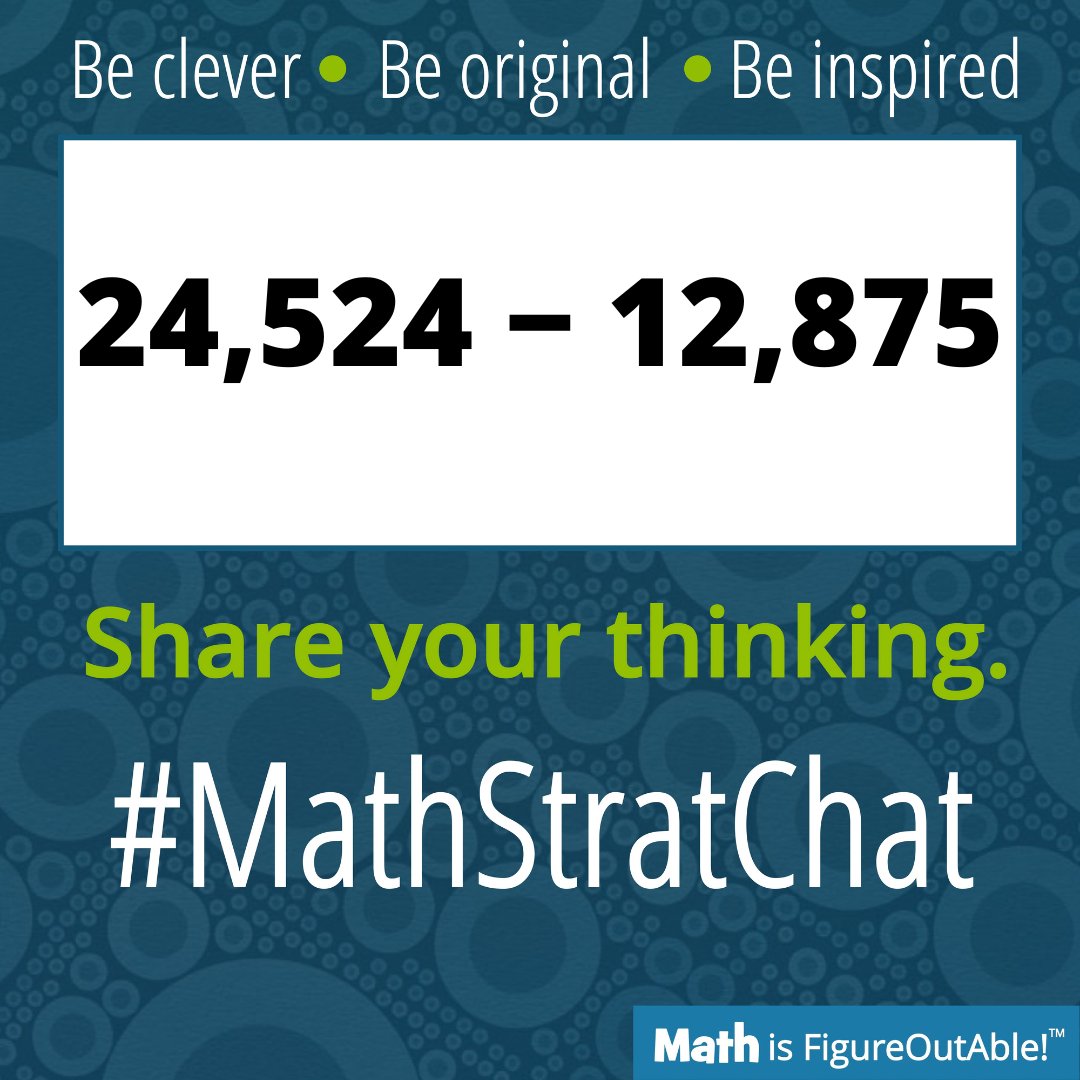
@pwharris 24524–12875 --> 24649 – 13000 = 11,649 Solved by pushing each up 125 as a constant shift has an identical difference.
English
1
0
3
30
Fred G. Harwood
Fred G. Harwood@HarMath·
@mrdardy @dmarain Pt. 2 Now I'm curious what either of your approaches might change by recording the data in this way for a specific rectangle. Would the emerging patterns lead to a generalization?
English
0
0
0
11
Jim Doherty
Jim Doherty@mrdardy·
@dmarain David can you give me some insight into why the (8-x+1)*(8 - y +1) formula gives me the number of x by y rectangles on the chessboard?
English
3
0
0
21
Jim Doherty
Jim Doherty@mrdardy·
In Calc BC yesterday I posted a picture of a chessboard and asked for how many squares there would be. We worked our way through to the answer. I then posed the question of how many x by y rectangles there would be. One student proposed (8-x+1)*(8-y+1) 1/2
English
1
0
1
90
Fred G. Harwood
Fred G. Harwood@HarMath·
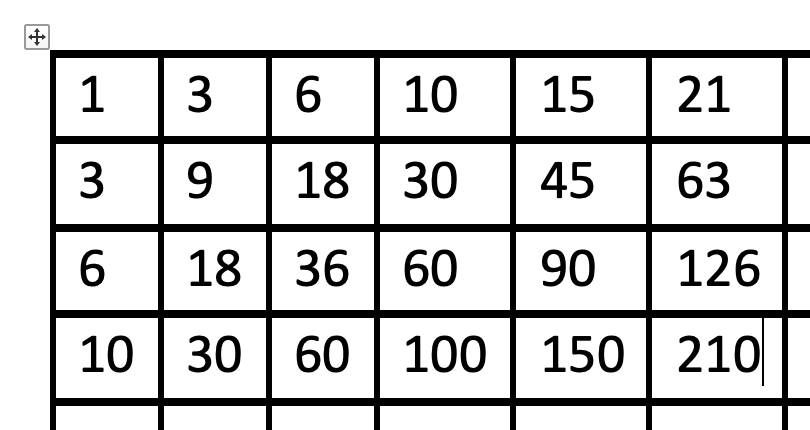
@mrdardy @dmarain When I had extended the squares question on a checkerboard, I asked, "How many rectangles of any size is on an m x n grid?" The students started with simple cases, organized counting and then one had a breakthrough by organizing the data on a grid. A 6x4 has 210 rectangles Pt.1
Fred G. Harwood tweet media
English
0
0
0
11
Fred G. Harwood
Fred G. Harwood@HarMath·
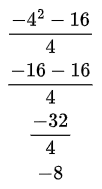
@MickeyCootes @MathGuyTFL This is the correct approach. Those stating PEMDAS need to see that - 4^2 has the 4^2 taking priority and then being multiplied by the -1. (-4)^2 =16 but -4^2 = -16 Even the platforms AI knows this.
English
0
0
0
12
Math Guy TFL
Math Guy TFL@MathGuyTFL·
Solve.
Math Guy TFL tweet media
English
425
10
254
32.5K
Fred G. Harwood
Fred G. Harwood@HarMath·
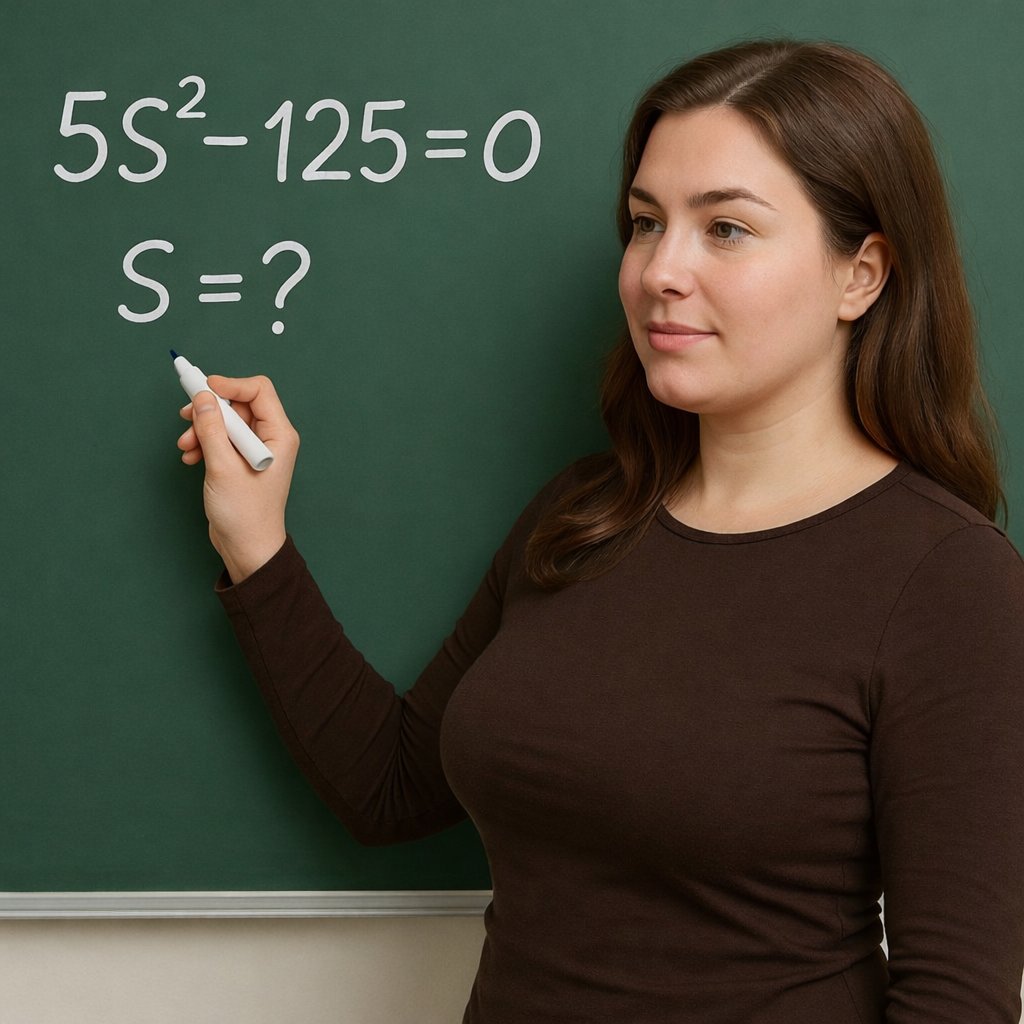
@RHSTUDYZONE 5(s^2 – 25) = 0 (s^2 – 25) = 0 (s + 5)(s – 5) = 0 so either s + 5 = 0 or s – 5 = 0 then s = -5 or 5
English
0
0
0
113
Fred G. Harwood
Fred G. Harwood@HarMath·
@Matt_Pinner I like that some will do a x b + a. Others will do a x (b+1). Then the fight starts until equivalence is discovered.
English
0
0
0
12
Fred G. Harwood
Fred G. Harwood@HarMath·
@howie_hua Reduce 30% to 3/10, then multiply both by 25 to get 75/250. 250 is the total that 75 is 30% of.
English
0
0
0
15
Howie Hua
Howie Hua@howie_hua·
It's Mental Math Monday! How would you mentally calculate this: 75 is 30% of _____?
English
719
16
320
297.1K
Brad Ballinger
Brad Ballinger@BradBMath·
@pwharris I'll bite the double-and-halve bait: 150×24=300×12=3600. Or 100×24=2400. Half again as much: 2400+1200=3600. Russian Peasant for kicks: Halve & floor: 24, 12, 6, 3, 1. Double: 150, 300, 600, 1200, 2400. First list mod 2, times second list, then summed: 0+0+0+1200+2400=3600.
English
1
0
0
25
Fred G. Harwood
Fred G. Harwood@HarMath·
@KarenCampe @pwharris I had just sent this partial factoring to @KarenCampe and then continued looking through other answers. I love taking things they already know well and invoking them in the strategies.
English
0
0
1
30
Karen Campe
Karen Campe@KarenCampe·
@pwharris 150 x 24 Think money! 150 is 6 quarters & 4 quarters is 1 dollar. 6 x 25 x 4 x 6 6 x 100 x 6 3600 #MathStratChat
English
1
0
0
51
Fred G. Harwood
Fred G. Harwood@HarMath·
@ccampbel14 @pwharris Your partial factoring could be: 6x25 x 4 x 6 = 25x4 x 6x6 = 100 x 36 Love the richness of your solutions.
English
0
0
0
13
Fred G. Harwood
Fred G. Harwood@HarMath·
@pwharris Missed the last few weeks with busy Wednesday nights. 150 x 24 --> I'd multiply by 100 and add half of that answer since 50 is half of 100. 2400 + 1200 = 3,600. Double/halving works too. I love doing percentages this way. 12% of something is 10% + 1% + 1% 15% is 10% + 5%
English
0
0
0
14
Fred G. Harwood
Fred G. Harwood@HarMath·
@dmarain @howie_hua @RaminKhosravi4 @mATH_e_matics @ybgoi 1206 is the first multiple of 9 (by digit sum) so 1205 ÷ 9 has remainder 8 & 1207 has remainder 1. Using this data, count down to 1201 and up to 1210, we see to add 9 repeatedly; 1201, 1210, 1219, 1228, 1237, 1246, 1255. I like the use of time as a 'time constraint'.
English
0
0
1
43
Fred G. Harwood
Fred G. Harwood@HarMath·
@dmarain @howie_hua @RaminKhosravi4 @ybgoi @mATH_e_matics I like the way you've arranged the problem for younger grades. Always adding 1/2 in new ways by subdividing the previous. It's Halloween and the Blue Jays are in it! I think an interesting visual pattern might emerge but haven't sought it ... yet. Odd terms are whole. Ninth = n
English
0
0
1
204
David Marain
David Marain@dmarain·
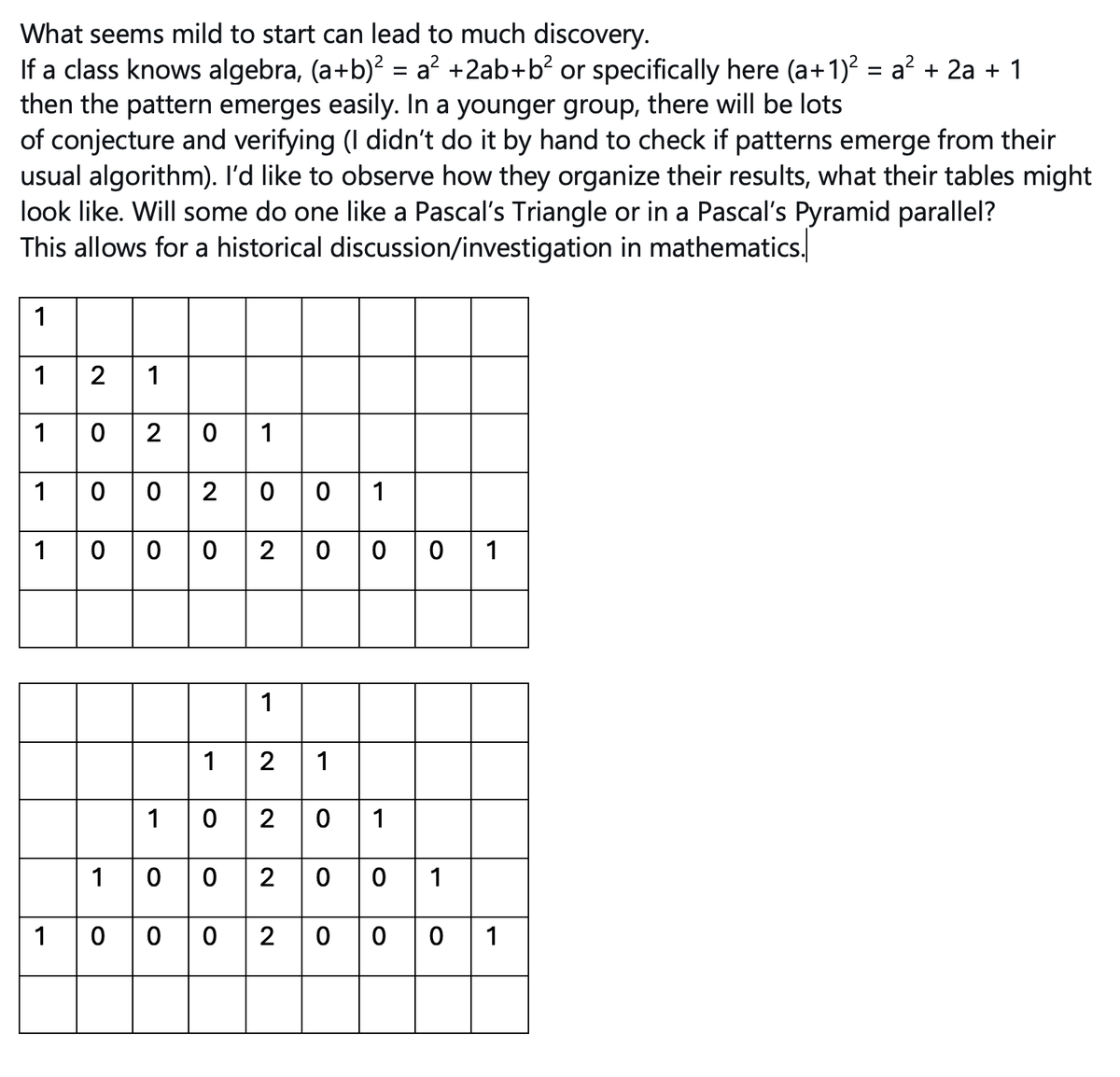
Who Is Tim Smit? 11^2=121; 101^2=10201 (a) Without computing, make conjectures about 1001^2; 10001^2 (b) Calculate by hand and then verify with calculator (c) Describe the general patterns of 0's, 1's, and 2's (d) Alg? @HarMath @howie_hua @RaminKhosravi4 @ybgoi @mATH_e_matics
English
1
0
3
78
Fred G. Harwood
Fred G. Harwood@HarMath·
@mrdardy @dmarain Odd, even term? The parity allows a formula to develop for the 10n+3 increases and which terms are just +3.
English
0
0
1
14
Jim Doherty
Jim Doherty@mrdardy·
@HarMath @dmarain Fred - thanks for the reply. I am trying to remember where I found this question or what I was thinking when I assigned it. What tip could I give to my students about thinking of the 75th term?
English
1
0
0
11
Jim Doherty
Jim Doherty@mrdardy·
@HarMath @dmarain I wrote a HW problem and I cannot remember what I was thinking when I wrote it! Consider the sequence: 24, 37, 40, 63, 66, ... a) Is this arithmetic, geometric, or neither? b) Is 189 in the sequence? c) What is the 75th term in the sequence? Any elegant ideas?
English
1
0
0
24