
पिन किया गया ट्वीट
33
5.9K posts


33
@XRPapiCrypto
You have power over your mind, not outside events. Realize this, and you will find strength. -Marcus Aurelius
शामिल हुए Aralık 2020
500 फ़ॉलोइंग899 फ़ॉलोवर्स

😂😂😂
110 you say? In crypto, this is 32... lol
HOLD!!!
$FLR
Bifrost Wallet@BifrostWallet
110-year-old Turkish grandma shares her secret to a long life: "I earn yield with my XRP"
English
First $10k in trading volume is the cap on their free tier.
Having money/crypto on exchanges isn't for everyone but I usually have some money sitting on exchanges, so I'm giving it a shot.
Let's see how we do. (right now I'm buying as much $FLR as I can without any 🚩🚩 from the wife 🤣)
Arch Public@tryarchpublic
Real stories from Arch Public users: With @lucataormina6, @Daron_W_LeBlanc, and @XRPapiCrypto
English

English


A couple of weeks ago I had the opportunity to move into AI and I turned it down.
I believe AI is probably the biggest opportunity in the world and will shape how our species evolves. But I also believe we need more people building solutions that expand freedom, and for that, crypto is a crucial part of the answer.
That is why I’m betting on Flare to become a key part of the financial plumbing of the future. Beyond that, I devote my personal time to advancing my own efforts with Web3 Matters and ProofRails.
ShipYard by Web3 Matters creates opportunities for education and entrepreneurship for anyone building in crypto x AI. ProofRails creates opportunities for organizations that want to adopt crypto with trust.
I have no plans to stop, and all of my work across these projects is driven by a really long-term horizon.
I’m grateful to everyone who supports my work, and to my collaborators around the world. The door is open to anyone who believes in this mission.
English
33 रीट्वीट किया

Arch Public is proud to be a trusted partner of @Gemini
Whether you're deploying automated, advanced trading strategies for $BTC, $ETH, $XRP, or $SOL, or accumulating crypto within your IRA, Arch Public and Gemini have you covered!
English

I do so like thinking about radical ways to turn the industry upside down.

English

TLDR this is recursive self-improvement, but one level deeper.
Not just learning better answers, but learning better ways to learn better answers.
Hyperagents are AI agents that do not just get better at a task, but also get better at the way they improve themselves.
Jenny Zhang@jennyzhangzt
Introducing Hyperagents: an AI system that not only improves at solving tasks, but also improves how it improves itself. The Darwin Gödel Machine (DGM) demonstrated that open-ended self-improvement is possible by iteratively generating and evaluating improved agents, yet it relies on a key assumption: that improvements in task performance (e.g., coding ability) translate into improvements in the self-improvement process itself. This alignment holds in coding, where both evaluation and modification are expressed in the same domain, but breaks down more generally. As a result, prior systems remain constrained by fixed, handcrafted meta-level procedures that do not themselves evolve. We introduce Hyperagents – self-referential agents that can modify both their task-solving behavior and the process that generates future improvements. This enables what we call metacognitive self-modification: learning not just to perform better, but to improve at improving. We instantiate this framework as DGM-Hyperagents (DGM-H), an extension of the DGM in which both task-solving behavior and the self-improvement procedure are editable and subject to evolution. Across diverse domains (coding, paper review, robotics reward design, and Olympiad-level math solution grading), hyperagents enable continuous performance improvements over time and outperform baselines without self-improvement or open-ended exploration, as well as prior self-improving systems (including DGM). DGM-H also improves the process by which new agents are generated (e.g. persistent memory, performance tracking), and these meta-level improvements transfer across domains and accumulate across runs. This work was done during my internship at Meta (@AIatMeta), in collaboration with Bingchen Zhao (@BingchenZhao), Wannan Yang (@winnieyangwn), Jakob Foerster (@j_foerst), Jeff Clune (@jeffclune), Minqi Jiang (@MinqiJiang), Sam Devlin (@smdvln), and Tatiana Shavrina (@rybolos).
English

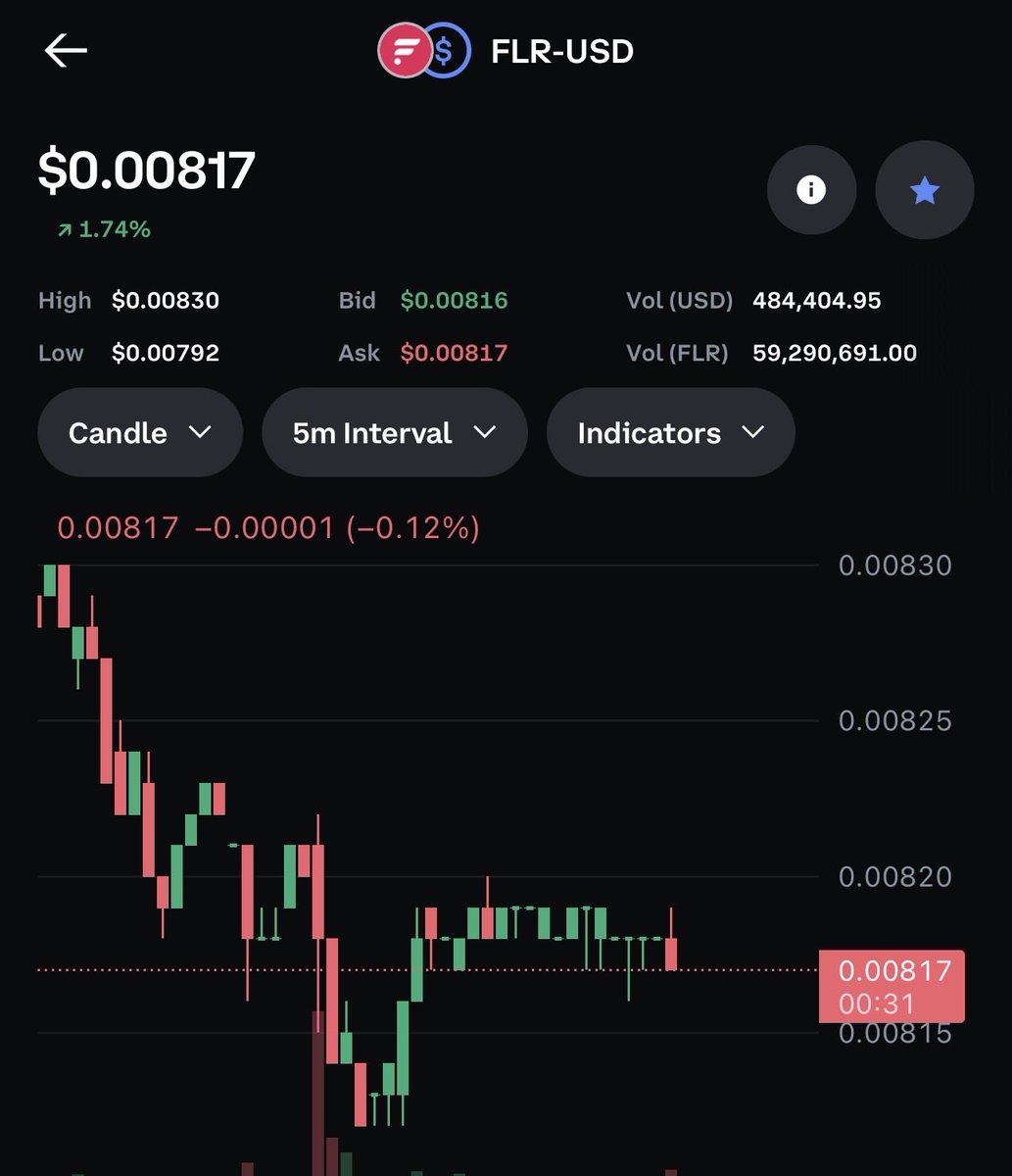
Call me delusion idc, but when the market turns the tokens with solid utility, tvl, and thin books will move explosively to the upside $FLR.
NFA
English

"The vault is the fund. The model is the manager. The chain is the back office."
😮💨
Jesus Rodriguez@jrdothoughts
English
I do love watching Flare FUD reach fever pitch over geopolitical instability.
Others, bigger (cough cough Coinbase), have tried but Flare is the only project that has successfully turned XRP into collateral at meaningful scale.
Flare is going to repeat that with BTC and then other coins whilst at the same time building private compute for RWAs and AI.
And you doubt the future Anon?
English