

Stephen Chou
1.9K posts

Stephen Chou
@stephenschou
Tech, consumer — business models, strategy, and what’s next | fmr banker, investor, CFO | runner, gamer, and aspiring dog-walker
शामिल हुए Ocak 2013
789 फ़ॉलोइंग722 फ़ॉलोवर्स

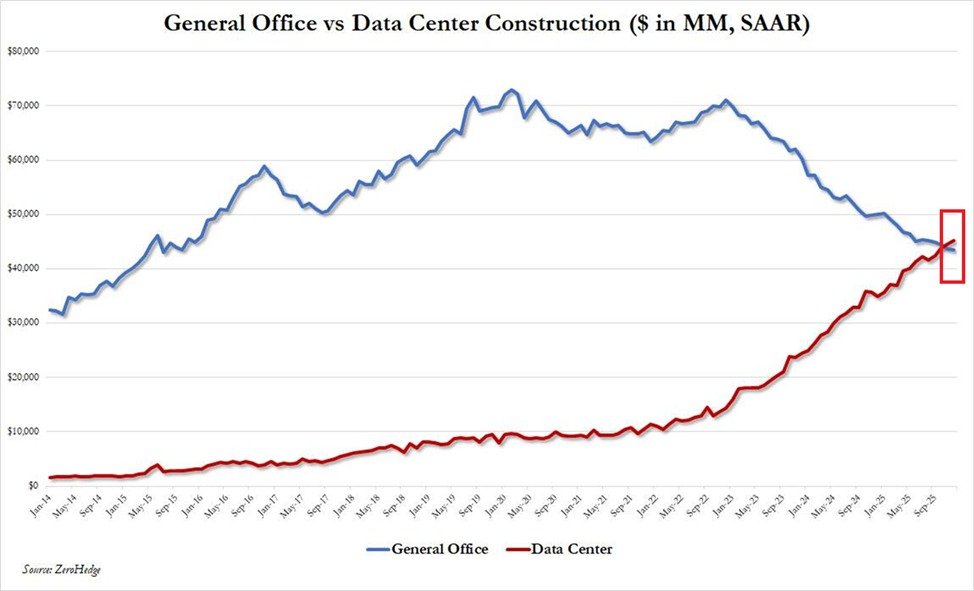
BREAKING: The value of US data centers under construction has officially surpassed the value of office buildings under construction for the first time in history.
Data centers under construction are up+29% YoY, to a record $45.1 billion.
Meanwhile, the value of offices under construction are down -13%, to $43.5 billion, the lowest since October 2015.
Since November 2022, when ChatGPT was launched, data center construction is up +228%.
Over that same period, office construction is down -38%.
AI is reshaping the US economy.
English

🚨🇫🇷 NEW: The location of the French aircraft carrier, FS Charles de Gaulle, has been given away by a sailor using Strava whilst jogging on the ship deck
[@lemondefr]

English

If you've been following me for a while, you probably know I used to own $UBER shares and I was urging @dkhos (CEO of Uber) to buy $RIVN and accelerate its own plans for autonomy and control the full stack (from vehicle manufacturing to ride-sharing).
This partnership announcement is NOT that. It's good for $RIVN, but it's only ok for $UBER. Here's a quick summary and my thoughts:
* Rivian immediately gets $300 Million from the deal. Good for Rivian.
* If Rivian achieves autonomy by 2028, Uber or its partners are committed to buying 10,000 R2 vehicles. Assuming a $50K price point, that's ~$500 Million in vehicle sales by 2028. This is the part that's ok for Uber. More on this below.
* If various other undisclosed milestones are hit, Uber will invest another $950 Million in Rivian and buy up to another 40,000 R2 vehicles through 2031.
So who is this deal good for?
From Rivian's Perspective:
The extra cash, guaranteed vehicle sales and additional motivation to solve autonomy is great! Unless there are non-compete clauses in this agreement that prevent Rivian from operating its own ride-sharing business, which is doubtful but possible, there is no downside for Rivian. It gets some needed cash, more demand for R2 and more motivation to get autonomy solved!
From Uber's Perspective:
Uber has bet the future of autonomy on the multi-partner strategy where it counts on potentially dozens of autonomy partners to compete with each other to create the best autonomy service and drive costs down as much as possible. Partnering with Rivian and helping them achieve L4 Autonomy just adds another partner to the mix, which should help drive costs down long-term.
My View:
Uber's strategy is flawed. @travisk (Uber Founder) understood that he needed to own the full stack, which is why Uber under Travis was building its own autonomy tech. Dara cancelled Uber's autonomy group to cut costs when he focused Uber on profitability. Probably a great decision at the time. However, fundamentally, in my opinion, Uber needs to own both the autonomy tech AND the manufacturing of vehicles in order to control its destiny and be able to compete with $TSLA. Otherwise, the company that can iterate through vehicle design, AI hardware and software, the fastest for the lowest cost, will eventually win. Right now, Tesla is the only company in that game.
Rivian can also enter the game in the future.
RJ Scaringe@RJScaringe
I’m excited to announce a partnership with @Uber. As part of this, Uber plans to invest up to $1.25 billion in Rivian and deploy up to 50,000 R2 robotaxis. This partnership accelerates our path to Level 4 autonomy and supports our goal of building one of the safest autonomous platforms in the world—across both shared and personally owned vehicles. The combination of Rivian’s rapidly growing data flywheel, our in-house RAP1 inference platform (800 TOPS), and our multi-modal perception stack provides a powerful foundation to scale autonomy quickly and responsibly over the next couple of years.
English


Rivian says it no longer expects to achieve “adjusted core profit” in 2027 as it ramps up research and development spending to accelerate its autonomous driving roadmap.

English
@wholemars Works out to $25k per vehicle, not bad compared to a Robotaxi. I hope it works out, but autonomous is hard.
English
Rivian has raised $1.25 billion from Uber
RJ Scaringe@RJScaringe
I’m excited to announce a partnership with @Uber. As part of this, Uber plans to invest up to $1.25 billion in Rivian and deploy up to 50,000 R2 robotaxis. This partnership accelerates our path to Level 4 autonomy and supports our goal of building one of the safest autonomous platforms in the world—across both shared and personally owned vehicles. The combination of Rivian’s rapidly growing data flywheel, our in-house RAP1 inference platform (800 TOPS), and our multi-modal perception stack provides a powerful foundation to scale autonomy quickly and responsibly over the next couple of years.
English

I’m excited to announce a partnership with @Uber. As part of this, Uber plans to invest up to $1.25 billion in Rivian and deploy up to 50,000 R2 robotaxis.
This partnership accelerates our path to Level 4 autonomy and supports our goal of building one of the safest autonomous platforms in the world—across both shared and personally owned vehicles.
The combination of Rivian’s rapidly growing data flywheel, our in-house RAP1 inference platform (800 TOPS), and our multi-modal perception stack provides a powerful foundation to scale autonomy quickly and responsibly over the next couple of years.
Rivian@Rivian
A fleet of R2 Robotaxis is coming exclusively to @Uber. ⚡🌿 Today, we announced a partnership to help both companies accelerate their autonomous vehicle plans across 25 cities in the US, Canada and Europe by the end of 2031. rivn.co/uber
English
This is a good, milestones-based deal.
Uber gets a potential fleet of up to 50,000 cars to add to the supply on the network.
Rivian needs the capital. $300m at signing, and up to $1.25B.
Maths out to be ~$25,000 per Rivian R2, which is within the ballpark of Tesla's Robotaxi at ~$30,000.
RJ Scaringe@RJScaringe
I’m excited to announce a partnership with @Uber. As part of this, Uber plans to invest up to $1.25 billion in Rivian and deploy up to 50,000 R2 robotaxis. This partnership accelerates our path to Level 4 autonomy and supports our goal of building one of the safest autonomous platforms in the world—across both shared and personally owned vehicles. The combination of Rivian’s rapidly growing data flywheel, our in-house RAP1 inference platform (800 TOPS), and our multi-modal perception stack provides a powerful foundation to scale autonomy quickly and responsibly over the next couple of years.
English

I'll go a step further: Horizon Worlds being shut down is the best news possible for consumer VR
Meta's insistence to both own the platform (Quest + OS) and the first-party content (Horizon Worlds) created a palpable COI and routinely undercut third-party devs (i.e. the groups making the ecosystem successful)
With Horizon Worlds out of the way, hopefully Meta aligns its own interests with that of 3p devs (to the end of producing more content users are actually interested in)
John Dagdelen@jmdagdelen
Need to check Kevin here. Meta is not shutting down their metaverse project. Horizon worlds is just getting focused on mobile and desktop, like Roblox. Moreover, they are continuing their VR work and they plan to keep investing more in the coming years. All they are doing is turning off the VR version of their Roblox competitor.
English

VR’s narrative is being set by people who don’t build in VR, don’t spend time in VR, and don’t see the small teams quietly winning.
VR’s best news happens in huge Discord servers, not on social or news articles.
Jump into the culture for the good news.
English
I always grimaced when I encountered these kind of companies at the A or sometimes B. The mess of cleaning it up and to figure out PF ownership sometimes is just not worth digging in.
For companies the speed in the beginning is great. But if the business go sideways and need to raise below the cap, that extra dilution from the discount will be rough.
You should do a priced round when you can, usually when you have a clear traditional lead VC (>50% of the round with ability to follow the next one). The additional diligence and clean structure is appreciated. It sets the company up well for the future.
English
i've seen a few rounds now where the founders reject a priced round (i.e. every new investor pays the same entry price) to raise on SAFEs with rapidly ascending valuation caps. they end up securing more capital with less (future) dilution than if they had taken the priced round:
> early priced rounds being put on the back burner. more net dilution (sometimes) + more admin headache (sucks for VC markups!)
> fundraising is a live auction atm
> being an auction, priced round term sheets box in how much a company can raise (and at what cost), limiting how much a company can leverage its "hotness" factor to raise cheap capital
feels like something needs to be fixed here:
> priced rounds are absurdly archaic (administratively) and much too slow/painful vs SAFEs (I'm always bemused it takes a couple of months to go from signed TS to closed round i.e. wired capital). As a pre-seed investor, I'm also not unhappy about founders raising their seed rounds on SAFEs as it kicks the can down the road on my dilution (i.e. potentially better for DPI) = very little incentive to do priced rounds from both sides
> schizophrenic VC behavior that disregards the entry price (i.e. paying 2x vs what the VC before me paid yesterday) under the pretense that "wHaT IF its THe nexT FaCeBoOK" is financially irresponsible and unsustainable as fudiciaries of LP capital
English
@omooretweets For ads to work, they need to figure out how to keep people engaged longer, without burning lots of tokens. I think this is achievable.
But they also need to figure out how to reach more people. Can they get to 2B DAU like Meta or Google?
English

A big story that most people are missing in the AI race for the consumer (ChatGPT vs Claude) is ads.
Right now, most consumer AI revenue is coming from power users who are willing to pay high cost subscriptions. This currently skews positive for products like Claude - but this will not be the end state.
Google makes ~$460/ user/year in the U.S., mostly on ads. Meta makes around ~$250. I would argue ChatGPT’s ad-based ARPUs will be even higher as they will ultimately have deeper / more frequent user engagement.
Even at the $460 level - monetizing everyone in the U.S. via ads is $152 billion in annual revenue. By contrast, if you’re able to monetize even 5% of the population on a $200/month subscription (which is a stretch!), that’s only $40 billion 🤔
I suspect this will be even more drastic outside the U.S. where users are even less willing or able to pay directly for subscriptions. And, the earliest data from a very small rollout shows ChatGPT ads are already outperforming Meta in effectiveness - this just gets better over time.
TL;DR - I would not count ChatGPT out on consumer AI revenue. Once ads start working, that can quickly become a massive machine.
English
@justinryanio I used to read The Verge, Engadget, even Gizmodo. I miss those days.
English

The Verge has lost its way.
Several months ago, they interviewed me for 45 minutes about Apple Vision Pro. I spent 43 minutes talking about what I love, and 2 minutes on what I’d change.
They twisted parts of those 2 minutes and cut everything positive I said.
To make it worse, the author opened the interview by saying they were biased against headsets.
I miss the old Verge. The one that was fun. The one that spotlighted tech instead of throwing shade.
The Verge@verge
Nvidia’s DLSS 5 is like motion smoothing for video games, but worse theverge.com/entertainment/…
English
You want to build the Pokémon Pokopia of VR and move headsale sales. $NTDOY up 10% since its release.
English
This needs to be said again. In a risky and still unproven space, the only way to have any control is to build something that will move the market current. It’s a tall, tall task.
When I was a VC in the space, this was the #1 thing I looked for.
Ryan Engle | GOLF+@Rengle820
If you're building for VR, build something so good that people buy a headset purely to use your thing.
English

If you're building for VR, build something so good that people buy a headset purely to use your thing.
English
@aakashgupta What is run rate? Does it mean it generated $375k in its most recent month and x12?
So around $90/mo per active company?
English

$4.5 million run rate. One founder. Zero employees. Two months old.
To put that in context: NVIDIA generates $4.4 million in revenue per employee. Apple generates $2.38 million. The median private SaaS company generates $130,000. Polsia matches NVIDIA’s efficiency ratio with a headcount of one. NVIDIA needed 29,600 people and a $3.4 trillion market cap to get there.
Now scale that.
Polsia charges $49 per month. At $4.5M run rate, roughly 7,600 people are paying for an AI system to build and run companies on their behalf. Each subscriber gets a web server, database, GitHub, email, Stripe, and Meta ads accounts. A “CEO agent” wakes up nightly, evaluates the business state, sets priorities, and delegates to specialized agents handling engineering, marketing, and customer support. Users send 15 messages a day to their AI co-founder. The 65% DAU/WAU ratio beats most consumer social apps.
The growth curve tells the real story. $200K run rate to $2M in two weeks. Then $2M to $4.5M over the next six weeks. Ben gave his AI his own inbox to run the fundraise. It replied to 90 investors. 18 wanted in.
And here’s the part nobody’s talking about: the platform also takes 20% of revenue from the companies its AI builds. The top earner on the entire platform currently makes about $50 a month. So the $4.5M is almost pure subscription revenue. The AI companies are still pre-revenue. The 20% rev share is a dormant asset sitting on top of 3,000 active companies.
Ben spent five years as Global GM at CloudKitchens under Travis Kalanick. That company’s model: charge restaurants rent for ghost kitchen infrastructure while taking a cut of delivery revenue. Polsia runs the same playbook. Digital infrastructure instead of physical square footage. Subscription covers costs. Revenue share is the long bet.
The real signal here is what one person can operate at scale when AI handles engineering, marketing, support, and ops simultaneously. A $4.5M business with zero payroll, margins north of 80%, built in 60 days. Five years ago that required a 40-person Series A company. Two years ago it required at least a small team. Today it requires one founder and a Claude API key.
The question was never “can one person build a $5M company.” The question is what happens when ten thousand people try it at once.

Ben Cera@Bencera
About to hit $4.5M run rate. Still 1 founder + AI. Zero employees. Honest moment: this past week almost broke me. No one prepares you for what PMF actually feels like. Every infra partner hitting rate limits. Every bug that could happen, happened. Investors throwing big numbers at me. Customers flooding every channel. All at once. I went silent. Stopped tweeting, stopped LinkedIn, stopped podcasts, stopped growth. Just me and my AI agents, fixing things one by one. Here's what I learned: everything is solvable with AI. Every single thing. I'm building Polsia so every solopreneur gets access to the same tools keeping me alive right now. If I can survive this alone, I can package it for everyone. The future is solopreneur + AI. I'm living at the edge so you don't have to.
English
@jmdagdelen The size of VR is not size.
Meta has 2 billion DAU across its properties. The ARPU of VR needs to be yuge.
English

Even if Horizon Worlds had achieved the same success of the top social VR app, VRChat, my guess is that it would have been labeled a failure at Meta.
"Only 150k concurrent users today?? My A/B test of a new button color on Facebook has 10x!"
English
English

The 747 gift from Qatar to Trump could be one of the best investments of all time.
(& completely fd up)
Rapid Response 47@RapidResponse47
English
@Kellblog Love that they’re able to make bold bets like this. One of them will work.
Though if I was a major shareholder, it might be hard to not wonder where the business would be today if it was still called Facebook.
English

Oh the mistakes you can make when you get what really matters right.
Autism Capital 🧩@AutismCapital
🚨 NEW: Meta finally pulls the plug on “The Metaverse”
English
@bmfshow Going to assume it’s negligible cost to keep it accessible, given mobile is still receiving investments, for now.
English

I'm very surprised that Boz announced Meta changed their mind and is keeping Horizon Worlds access around in VR for the foreseeable future. Sounds like it will just be a standalone app and be optional like it was originally which is great for those who don't use it.
English