The Real RCT

791 posts

The Real RCT banner
The Real RCT

The Real RCT

@TheRealRCT

Medical Student | Sharing evidence-based insights to help you live longer, move better, and think sharper.

Lost to follow-up Bergabung Haziran 2025
203 Mengikuti382 Pengikut
Tweet Disematkan
The Real RCT
The Real RCT@TheRealRCT·
Most people who lose a lot of weight end up weaker, slower, and “skinny fat.” But a new wave of medicine is aiming for something different: Lose fat. Build muscle. Here’s why that matters—and how it could change your health forever 🧵👇
The Real RCT tweet media
Crémieux@cremieuxrecueil

Eli Lilly just showed that you can lose tons of fat while barely losing any muscle using their activin type-II receptor inhibitor, bimagrumab. We are approaching a golden era of weight loss, where everyone can easily be muscular and skinny. Prepare for hordes of hot Americans.

English
1
0
8
1.2K
Eric Topol
Eric Topol@EricTopol·
The #1 cause of death in women is heart disease. A new report makes the case for treating women with statins who have a high inflammation marker (hs-CRP) but no traditional risk factors academic.oup.com/eurheartj/adva…
Eric Topol tweet media
English
14
110
433
47K
The Real RCT me-retweet
Crémieux
Crémieux@cremieuxrecueil·
One of the most cited, esteemed Alzheimer's and Parkinson's researchers, Eliezer Masliah, was found to be a fraud. He headed the National Institute of Aging neuroscience division, controlled billions in funding, and set the field back by decades. He should be executed.
Crémieux tweet media
FilmLadd@FilmLadd

Every time I see a story like this I have renewed rage for Sylvain Lesné, a neuroscientist and associate professor at the University of Minnesota, who faked research into the cause of Alzheimer's and wasted 15+- years' effort to cure such diseases.

English
89
429
4K
225.6K
The Real RCT
The Real RCT@TheRealRCT·
@cremieuxrecueil Great breakdown. Most of the concerns I hear aren’t about genetics but about side effects. Nausea, constipation, fatigue, etc. are the main barriers, but the data shows they’re usually mild, temporary, and preventable with simple adjustments. 🧵👇
The Real RCT@TheRealRCT

Ozempic. Wegovy. Mounjaro. The weight loss looks effortless. But the side effects? Most people only hear horror stories or marketing. Here’s what the data actually says about which fears are real vs completely overblown. 🧵👇

English
0
0
1
195
Crémieux
Crémieux@cremieuxrecueil·
You really have to hand it to GLP-1RAs: They've killed every last excuse for being fat. I'm going to go through common excuses in this thread. The first one is MC4R mutations. These are the top genetic cause of obesity, but tirzepatide works just as well for carriers:
Crémieux tweet media
English
29
28
586
92.9K
near
near@nearcyan·
my bar for 'competent doctor' has gone up so much due to genAI that i seldom bother seeing humans anymore
English
22
3
308
19K
The Real RCT
The Real RCT@TheRealRCT·
@EricTopol I dug into how GLP-1 drugs were developed and what makes them different. From the first gut hormone experiments to today’s semaglutide vs tirzepatide showdown 🧵👇
The Real RCT@TheRealRCT

Ozempic, Wegovy, Mounjaro. You’ve heard the names. But where did they come from? These drugs didn’t appear overnight. They were decades in the making—from gut hormones to $100B blockbusters. Here’s the wild history of GLP-1 meds 🧵

English
1
1
7
1.6K
Eric Topol
Eric Topol@EricTopol·
Why does Zepbound (tirzepatide) lead to more weight loss than Ozempic (semaglutide)? The dual receptor (GLP-1+ GIP) has more pronounced effects in the brain cell.com/cell-metabolis…
Eric Topol tweet media
English
13
172
667
61.6K
The Real RCT
The Real RCT@TheRealRCT·
@MWeintraubMD Losing too much lean mass on GLP-1s can slow your metabolism, make weight regain more likely, and worsen long-term health. Here’s how new drugs + training strategies are changing that, so you lose fat while keeping (or building) muscle 🧵👇
The Real RCT@TheRealRCT

Most people who lose a lot of weight end up weaker, slower, and “skinny fat.” But a new wave of medicine is aiming for something different: Lose fat. Build muscle. Here’s why that matters—and how it could change your health forever 🧵👇

English
0
0
0
405
The Real RCT
The Real RCT@TheRealRCT·
Saying dreams have "no real meaning" isn't a scientific claim, it's a philosophical presupposition. Science can explain the how and what of dreams: neural activity, memory processing, threat simulation, etc. But it can't answer why questions about meaning or purpose. That's simply outside its scope. More importantly, meaning depends on perspective. From the first-person view, or the perspective of a clinician, dreams can be deeply significant. People wake up shaken by nightmares, find insight in symbolic dreams, process grief, trauma, and emotional conflict through dreaming. To dismiss them as "random" or "meaningless" is to ignore the subjective dimension entirely. Your claim assumes a reductionist materialist worldview, which is itself a philosophical stance, not something science can prove. Using it to deny meaning in dreams is circular reasoning: you're assuming your metaphysics and trying to use it as evidence.
English
0
0
3
80
Dr. Julie Gurner
Dr. Julie Gurner@drgurner·
Hate to break your heart, but there is no real meaning to dreams. Dreams are random neural firings. Your brain makes up a story to make sense of it - using memories, experiences, fears, concerns, etc. Dreams have functions (memory, threat simulation, etc.) but no real meaning.
Fernando@perushka

@drgurner @SchrodingrsBrat People: "Dreams have hidden meanings." Also people: "First we were on a ship, but then it was suddenly the parking lot of the office, and then one of the cars suddenly turned into Tom Cruise, and he was holding a matcha, but in some kind of bag made out of potatoes…"

English
3.5K
372
7.3K
7M
Dr. Spencer Nadolsky
Dr. Spencer Nadolsky@DrNadolsky·
1. GLP-1 supplements are a scam 2. Resistance training is more important than protein for not losing muscle when losing weight. 3. GLP-1 meds are meant to be taken long-term but not everyone will need them long-term. 4. You’re not a failure if you need medicine to lose weight. 5. Like it or not, GLP-1 medicine with lifestyle is about 3-4x more effective than lifestyle alone for losing weight. If looking at long-term weight loss that increases by a lot.
English
19
22
264
21.6K
David Sinclair
David Sinclair@davidasinclair·
Agreed. GLP-1RA drugs have paved the way for target aging like we’ve targeted obesity
Peter Fedichev@fedichev

We are witnessing a revolution: GLP-1 drugs (like Ozempic, Wegovy, and related semaglutides) are storming the markets, generating over $40 billion in annual sales for Novo Nordisk alone in 2024, with the broader GLP-1 market projected to exceed $50 billion by 2025 as demand surges. This has moved food company stocks downward—think snack giants like Mondelez and Hershey seeing dips amid shifting consumer habits—creating an economic and cultural force. Another striking feature of these drugs is their ability to reduce risks and mortality from diseases not directly tied to diabetes or obesity (their primary indications). The effects are measurable but modest—around 20-30% risk reduction in cardiovascular events, for instance, which might translate to a few extra years under the Gompertz law of mortality. This isn't entirely surprising, as early diabetes can rob 6-8 years of life, so controlling it could extend lifespan. Remember the promise of the TAME trial? It's the ambitious idea of testing metformin against aging in a massive Phase III-like study, hinting at broader longevity potential. In a way, GLP-1 drugs have fulfilled the geroscience dream for the first time in a practical sense: creating a medication that hits levers behind multiple age-related diseases at once, from heart disease to potentially neurodegeneration. As the dust settles, interesting questions pop up. Developing GLP-1 drugs was hard but didn't require alien-level tech. The more people reflect, the more comments surface suggesting that one of the biggest barriers was cultural: to many, obesity was a choice rather than a disease. This perception, fueled by stigma and misconceptions, led to hurdles like delayed regulatory approvals (regulators were cautious, imposing stricter criteria and slower pathways, as seen with Ozempic's initial diabetes-only approval before weight loss extensions), limited insurance coverage (insurers often denied claims for weight loss use, viewing it as non-essential despite the medical necessity), and slowed research and development (pharma investments lagged due to the 'personal failing' narrative, reducing incentives for new treatments). That apparently slowed development—potentially by years or even decades, as obesity wasn't formally recognized as a disease by bodies like the American Medical Association until 2013, which finally spurred more focused R&D and approvals. Does this sound familiar? It may be: look at drug discovery against aging—same issues here. Aging isn't classified as a disease by regulators like the FDA, so longevity biotech companies often pivot to targeting specific age-related diseases (including metabolic health, of course!) to get funding and approvals (this is a thread, see below). 1/2

English
14
27
322
48.9K
Eric Topol
Eric Topol@EricTopol·
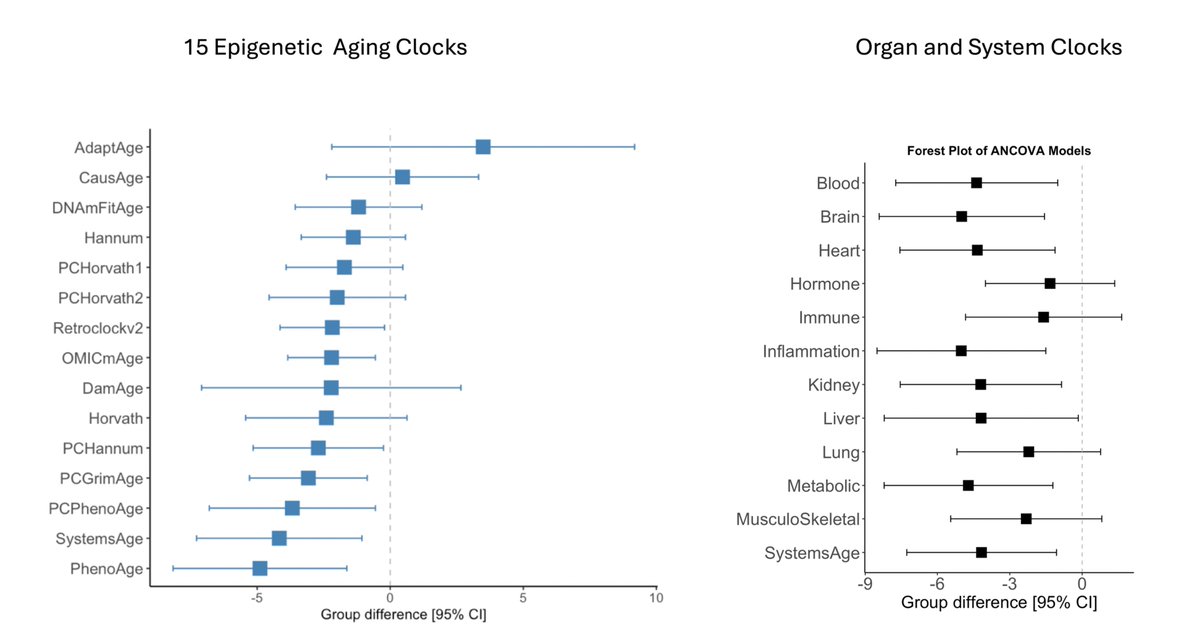
In a randomized, placebo-controlled trial, semaglutide (Ozempic) slowed epigenetic aging and the pace of aging across 11 organ and system clocks medrxiv.org/content/10.110… (preprint)
Eric Topol tweet media
English
36
264
1.3K
178.5K
Leddy
Leddy@LeddyLLC·
Men’s testosterone is 40% lower than it was in 1980. Sperm counts are collapsing. No one wants to talk about the cause... But here is what the best studies say actually works🧵:
English
23
45
330
316.2K
The Real RCT
The Real RCT@TheRealRCT·
🔁 TL;DR • GLP‑1 drugs: lean mass loss at rates of ~25%, similar to other interventions, but up to 40% in some groups • Bimagrumab & similar drugs: increase lean mass and reduce fat mass • COURAGE & EMBRAZE: combinations can preserve most of your muscle • Functional improvements so far are mixed The next frontier in obesity treatment may be true body recomposition: Lose fat while preserving—or even gaining muscle mass.
English
2
0
1
185
The Real RCT
The Real RCT@TheRealRCT·
Most people who lose a lot of weight end up weaker, slower, and “skinny fat.” But a new wave of medicine is aiming for something different: Lose fat. Build muscle. Here’s why that matters—and how it could change your health forever 🧵👇
The Real RCT tweet media
Crémieux@cremieuxrecueil

Eli Lilly just showed that you can lose tons of fat while barely losing any muscle using their activin type-II receptor inhibitor, bimagrumab. We are approaching a golden era of weight loss, where everyone can easily be muscular and skinny. Prepare for hordes of hot Americans.

English
1
0
8
1.2K