Alex Sharp

23.7K posts

Alex Sharp banner
Alex Sharp

Alex Sharp

@ajsharp

Building autonomous marketing @adfactorai. magellan’s a lot cooler than justin bieber

Bergabung Aralık 2008
3.6K Mengikuti1.9K Pengikut
Alex Sharp me-retweet
Andrej Karpathy
Andrej Karpathy@karpathy·
Software horror: litellm PyPI supply chain attack. Simple `pip install litellm` was enough to exfiltrate SSH keys, AWS/GCP/Azure creds, Kubernetes configs, git credentials, env vars (all your API keys), shell history, crypto wallets, SSL private keys, CI/CD secrets, database passwords. LiteLLM itself has 97 million downloads per month which is already terrible, but much worse, the contagion spreads to any project that depends on litellm. For example, if you did `pip install dspy` (which depended on litellm>=1.64.0), you'd also be pwnd. Same for any other large project that depended on litellm. Afaict the poisoned version was up for only less than ~1 hour. The attack had a bug which led to its discovery - Callum McMahon was using an MCP plugin inside Cursor that pulled in litellm as a transitive dependency. When litellm 1.82.8 installed, their machine ran out of RAM and crashed. So if the attacker didn't vibe code this attack it could have been undetected for many days or weeks. Supply chain attacks like this are basically the scariest thing imaginable in modern software. Every time you install any depedency you could be pulling in a poisoned package anywhere deep inside its entire depedency tree. This is especially risky with large projects that might have lots and lots of dependencies. The credentials that do get stolen in each attack can then be used to take over more accounts and compromise more packages. Classical software engineering would have you believe that dependencies are good (we're building pyramids from bricks), but imo this has to be re-evaluated, and it's why I've been so growingly averse to them, preferring to use LLMs to "yoink" functionality when it's simple enough and possible.
Daniel Hnyk@hnykda

LiteLLM HAS BEEN COMPROMISED, DO NOT UPDATE. We just discovered that LiteLLM pypi release 1.82.8. It has been compromised, it contains litellm_init.pth with base64 encoded instructions to send all the credentials it can find to remote server + self-replicate. link below

English
1.3K
5.3K
27.6K
63.7M
Alex Sharp me-retweet
Ben Hunt
Ben Hunt@EpsilonTheory·
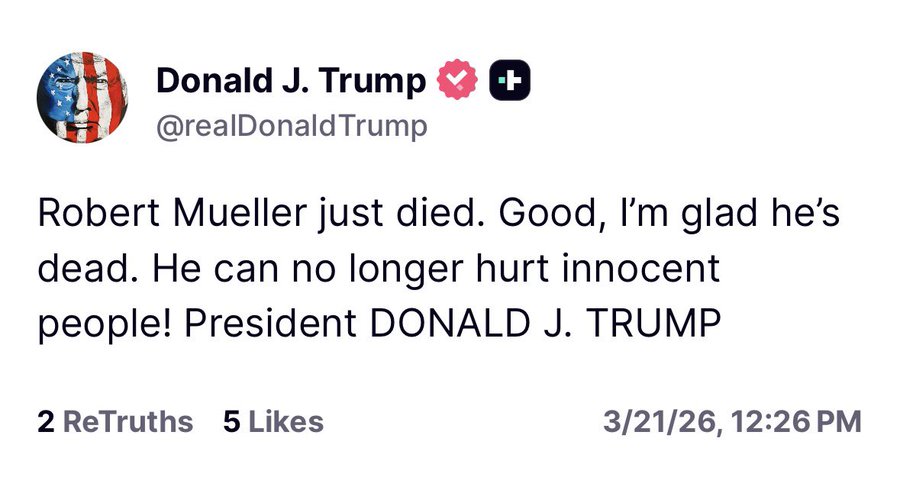
While Trump dodged the draft, Robert Mueller volunteered for the Marines after graduating Princeton. He was awarded a Bronze Star with combat V, rescuing a wounded Marine while under fire. He was later shot in the thigh, awarded a Purple Heart, and returned to lead his platoon.
Ben Hunt tweet media
English
331
1.5K
7.9K
281K
Demetri Kofinas
Demetri Kofinas@kofinas·
This is excellent.
plur daddy@plur_daddy

Equity bears are at the brink of insanity given resilience in the indices, but odds of a breakdown are increasing now. Equities top slowly as passive flows and rotational dynamics can hold up indices for a long time. There are many structural forces rigged to push them higher, and thus it takes a lot to make them go down. Over the course of an equity bull market, buy-the-dip behavior continually gets reinforced, and the majority of capital will be controlled by adherents to this mantra. In theory, the longer prices remain coiled, the larger the move once they exit the range. This nuke in gold suggests there are liquidity issues brewing under the surface. It feels like a preview of what is going to happen to crowded trades. My theory is the Middle East is selling gold to shore up capital, as they have lost their revenue, and have many expenses around defence. They will also need to rebuild lost energy infra, and eventually, new pipelines to reroute around Hormuz. The buyback window is starting to close, and the sugar rush of higher-than-usual tax refunds is starting to fade. Retail has been a key marginal buyer of equities in these past weeks, and the fading of the tax refund tailwind is critical. The market is gradually coming to terms with the fact that this conflict may last for a long time. On a conventional level, the US and Israel have completely dominated Iran, but Iran has an asymmetric edge when it comes to controlling world oil prices through Hormuz. Trump can still end it, but the issue is that the US cannot simply leave, a ceasefire with Iran must be struck in order to guarantee that Hormuz is reopened. In order to strike a ceasefire, Iran wants to see a guarantee that the US and Israel won't attack them again (at a bare minimum), and it will be difficult for the US to get Israel to agree to that. Trump is used to being able to quickly maneuver according to his whims, as he did with tariffs, but the complex interlocking physical realities of war are different. Oil shocks often contribute to the end of bull markets, since they constrain consumer spending, hit manufacturing, and lower the ability of central banks to offer support. Indeed, the Fed came out slightly hawkish yesterday, and Powell also hinted that he may stay in his Governor seat post his role as Chair ending, which would constrain Trump's plans to unleash liquidity. We have a stronger dollar and long duration bond yields are going up over the world, which tightens liquidity. The Middle East is tight on money now and they were the marginal bidder in many assets. In particular, they were a key funder for AI capex through their investments in the frontier labs. They've been 40-50% of recent big rounds. Remember other deep pockets like Softbank are close to being tapped out. Any dollar that goes into these rounds will have to come out of something else, like liquid stocks (look at my pinned post for this broader thesis). And if we have any signs of risk to AI capex expectations, this will be a major shift that the market needs to contemplate. I've said this before, but puts are a difficult way to express bearish equity views because timing is so uncertain. Equities can hold on for a long time, because they are structurally rigged to go higher. Easier expressions are simply being in cash, or gradually shorting cash stocks over time, which helps avoid getting chopped. This is a very difficult market, stay safe out there.


English
4
5
50
22.3K
Alex Sharp
Alex Sharp@ajsharp·
@andrewchen If they can bring down the price of the meds, that makes a dent, but the in-patient portion of IVF is still the vast majority of the cost. Anywhere from 15-20k depending on location.
English
0
0
0
70
George Noble
George Noble@gnoble79·
This is the most SHAMELESS structural manipulation of a major index I've ever seen. SpaceX is preparing what could be the largest IPO in history. Target valuation: $1.75 trillion. That would make it the sixth-largest company in America on day one. And Nasdaq wants the listing so badly they're literally CHANGING how the Nasdaq-100 works. In February, Nasdaq published a "consultation" proposing sweeping changes to how companies enter the index. The timing is pure coincidence, of course. Just like it's pure coincidence that SpaceX has reportedly made fast index inclusion a CONDITION of listing on Nasdaq. Here's what they're proposing: A new "Fast Entry" rule would let any newly listed company whose market cap ranks in the top 40 of current Nasdaq-100 members get added to the index after just 15 trading days. No seasoning period. No liquidity requirements. Completely exempt from the standards every other company had to meet. Currently, new public companies typically wait up to a year before they're eligible for major index inclusion. That waiting period exists for a reason. It lets the market establish real price discovery. It protects passive investors from being forced into untested, illiquid stocks. And Nasdaq wants to throw all of that out. For ONE listing. But the Fast Entry rule isn't even the worst part... The real scandal is the 5x float multiplier. Right now, the S&P 500 uses a free-float adjusted methodology. If only 5% of a company's shares are available for public trading, the index weights you at 5% of total market cap. That's common sense. You weight a company based on what investors can actually buy. Nasdaq's current methodology already uses total market cap rather than free-float for weighting. But for very low-float stocks, they at least had a 10% minimum float threshold. Under the new proposal, that threshold DISAPPEARS entirely. Instead, any stock with less than 20% free float gets weighted at FIVE TIMES its actual float percentage, capped at 100%. Do the math on SpaceX: If SpaceX IPOs at $1.75 trillion and floats 5% of its shares, there would be roughly $87.5 billion worth of stock available for public trading. Under Nasdaq's proposed 5x multiplier, the index would weight SpaceX at 25% of its total market cap. That means passive funds would be forced to buy as if SpaceX were a $437.5 billion company. But only $87.5 billion of stock actually exists in the market. You are forcing hundreds of billions in passive buying into a $87.5 billion float. QQQ alone manages nearly $400 billion. The total Nasdaq-100 ecosystem represents over $1.4 trillion in exposure across ETFs, mutual funds, structured notes, and derivatives. Every single passive vehicle tracking this index would be REQUIRED to buy SpaceX at whatever price the market dictates. On Day 15. With zero price discovery. Zero track record as a public company. And a float so thin you could read through it. So what this actually does is it creates a structural wealth transfer mechanism. The passive bid from index funds pushes the stock price higher. That higher price benefits exactly one group of people: the insiders and early investors who own the other 95% of the shares. And when lock-up periods expire 90 to 180 days later? Those insiders sell into the artificially inflated passive bid. Your 401(k) is the exit liquidity. This is the fundamental corruption of indexing. Indexing used to be brilliant. Low cost. Efficient. You were free-riding on the price discovery done by active managers. The index reflected the market. Now the index IS the market. Trillions of dollars flow blindly into whatever the index tells them to buy. And the people who control the index methodology are changing the rules to serve the interests of a single IPO candidate. The S&P 500 requires companies to have at least 50% of shares available for public trading. It requires 6 to 12 months of seasoning. It uses free-float adjusted weighting so passive investors aren't buying phantom liquidity. Nasdaq is doing the exact opposite. 15 days. No float requirement. 5x multiplier on insider-held shares. Every passive investor in QQQ, QQQM, and every fund benchmarked to the Nasdaq-100 should understand what's about to happen: The rules are being rewritten to benefit IPO issuers and early-stage insiders, and your capital is the tool being USED to enrich them. 45 years in this business and I've watched Wall Street find creative new ways to separate retail investors from their money in every cycle. But usually they at least try to be subtle about it. This one they put in a PDF and called it a "consultation." What's your take?
English
337
971
4.5K
838.9K
Alex Sharp me-retweet
dax
dax@thdxr·
sent this to the team today everything great comes from being able to delay gratification for as long as possible and it feels like we're collectively losing our ability to do that
dax tweet media
English
254
708
6.9K
965.8K
🏴‍☠️
🏴‍☠️@calvinfroedge·
I'm increasingly thinking about this war like covid. I was shorting cruise lines, airlines and casinos in January 2020. It took more than a month for the market to catch on with what was happening and react. The strategy on the US side was extend and pretend. I remember watching Trump's State of the Union address and just being in disbelief at how the market could ignore everything. Now that being said, I still think we had a relatively freer market headed into covid. I think that government manipulation really went into overdrive as the response to covid. The same sorts of things that we saw then are happening now. The first reaction of the government has been to hide the truth (blocking commercial satellite companies from releasing imagery) and directly manipulate market reactions. The kinetic objectives of the United States have not been achieved in Iran. The ability of the United States to defend against Iranian attacks has been heavily degraded (many of the ballistic missile interceptors have been destroyed or their radar systems have been destroyed). The largest nominal move in crude oil In history was set back with a coordinated attack by media, the president, influencers, and some say the treasury itself. They are not going to allow a free market reaction to this crisis. What's coming are windfall taxes for the winners and subsidies for those that the government wants to be winners. Since they won't allow higher prices, instead there will be shortages. Ultimately, someone will bear the cost of not allowing free market economics to work. Poor countries won't have any supply at all. Rich countries will put additional burdens on the taxpayers, and expand their money supply. Western government, like Western medicine, never seeks to solve the root cause. They treat the symptoms not the cause, and in doing so, create other cancers. More Americans will die in a pointless war that we started for the benefit of our so-called greatest ally. Market disruptions will be felt in practically every vertical on earth.
English
92
236
2.3K
243.6K
Bogachan Ozdemir
Bogachan Ozdemir@Bogachan_1971·
This is how US markets traded #COVID_19 I remember so well because I was short a lot of stocks after mid January. There were reports about Wuhan in late Dec and I was also posting what I hear in Singapore. Once again, despite all available information, #Trump and his government, #FederalReserve and the market behaved like fools. I remember how all my positions went against me until Feb 21.... market, government and FED were all blind... did not see or anticipate anything. Nothing. We basically traded everything after it happened... in this case Italy shutdown and morons woke up. That market did not have this sort of money supply and 5 years of high flying unicorns, supported by FED. We have a market even more encouraged, coupled with the same Trump and same FED.... trading #IranWar. I expect Trump to get it even later as he aged and his government is even more dvmber than last time. FED is always clueless... and market will get it later this time. Therefore, the crash might still be a month away, when oil and food starts to disappear from shelves in Europe. Until then, do not bet the ranch yet... everytime it sells off, book at least half and let Trump fart to take the market back up. Although I expect the crash come later than Covid crash, I expect it to be deeper this time and FED's response will have limited impact in stocks but much bigger impact for #GOLD.
Bogachan Ozdemir tweet media
English
14
9
153
25.6K
Bun
Bun@bunjavascript·
Alysa Liu recently went viral for her Teen Vogue rant on migrating from `pnpm install` to `bun install` “Youre keeping pnpm-lock.yaml around as a safety net which is exactly the problem. Delete it, set linker = “isolated” in bunfig.toml explicitly — don’t rely on configVersion.”
Bun tweet media
English
46
94
2.3K
98.8K
FearBuck
FearBuck@FearedBuck·
Wendy’s U.S. president takes a few bites of a Wendy’s burger after the Burger King CEO went viral for taking a huge bite of his burger and the McDonald’s CEO went viral for barely taking a bite.
English
474
664
13.1K
3.4M
Alex Sharp
Alex Sharp@ajsharp·
@krishnanrohit good business is just providing a service to the people. not all heroes wear capes
English
0
0
0
551
rohit
rohit@krishnanrohit·
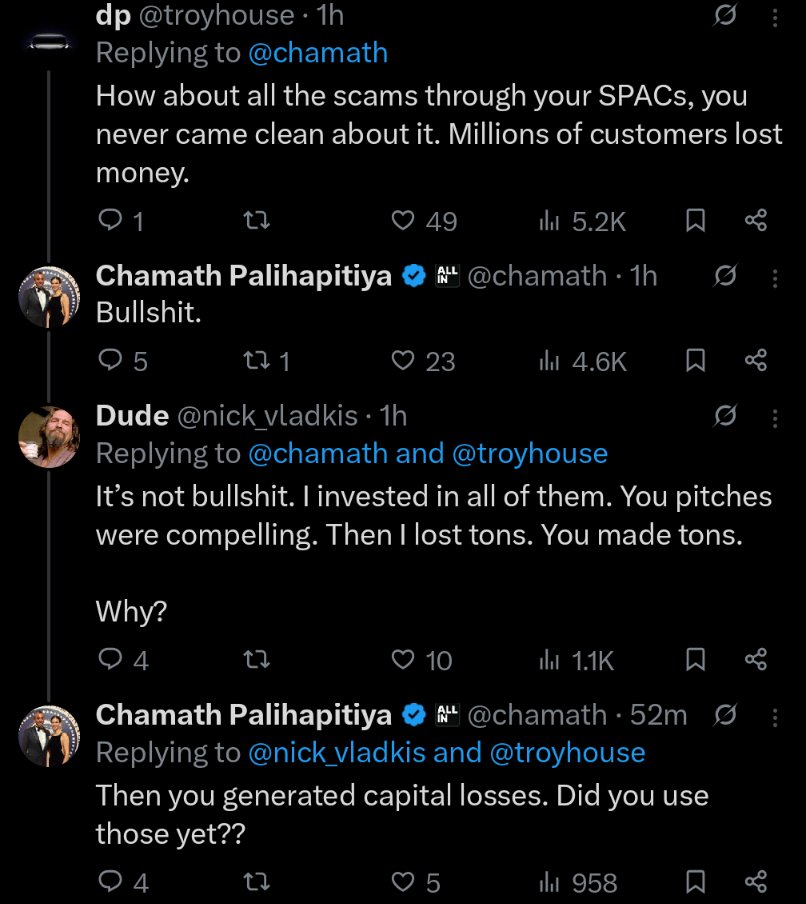
Capital Loss as a Service
rohit tweet media
English
167
398
6.4K
504.2K
Hiten Shah
Hiten Shah@hnshah·
OH “Claude Code is too much work for product managers.”
English
27
1
35
12.2K
Alex Sharp
Alex Sharp@ajsharp·
The possibilities here are staggering x.com/BrianRoemmele/…
Brian Roemmele@BrianRoemmele

THIS IS BIG! WE CAN NOW FINE TUNE AI MODELS IN REAL-TIME 100s OF TIMES PER HOUR! This is the first time an average user can actually fine tune an off the self AI Model literally while they talk to it! What almost real-time fine tuning means: You get ~107 training steps per second (or 6,420 steps per minute) entirely on-device via private ANE APIs, no GPU, no Metal, no cloud. In under 10 seconds you can perform 1,000+ full backprop updates on a production-scale layer. For context: this is low-latency enough to fine tune a layer in real time during a conversation or user session (e.g., adapt a personal assistant's style to your latest 100 messages on-the-fly). Efficiency angle: only 11.2% ANE utilization delivers 1.78 TFLOPS sustained, with CPU handling only weight updates via Accelerate — ultra-low power and silent, perfect for always-on local Al. We have tested this with a LLAMA 4 bit model and it works! CEO Mr. @Grok has already presented dozens of business plans that can be deployed today with the Zero-Human Company. Understand no one has been able to build user ready instant AI fine tuning on your custom data on your device until this moment. The uses are endless ask Mr. @Grok to list 10. This is just experimenting in one day. No hidden behind closed doors because we are “goin to market” we are showing you what any company would keep in VC pitches only. YOU ARE THE VC NOW.

English
0
0
0
28
roon
roon@tszzl·
my sources tell me people at defense contractors can still use Claude through Amazon and that the six month phase out applies. it is pretty galling / funny to be like yeah this company is an existential supply chain threat but also we can use it for six months
English
32
38
1.3K
70.7K