
Tweet Disematkan
albeit
24.4K posts


albeit
@albeit
Atheist Libertarian Bastard Extraordinaire In Training 🗽 🇺🇸 🇮🇪 🇺🇦
United States Bergabung Temmuz 2008
284 Mengikuti344 Pengikut
@ShangguanJiewen But you can’t join Falun Gong if you wanted to.
Well, you could. You’d just to go to prison. Possibly get your organs harvested.
English

So, you want to talk about human rights in China?
I am a US citizen living in China, and I've never felt more free than I do in China.
In China, we are:
Free from street crime
Free from fear at night
Freedom from endless student debt
Freedom from ubiquitous credit card debt
Freedom from tax on one's home
Freedom from homelessness
In the US one can say irresponsible things; that's it.
China does Human Rights right.
👇

English
@TheOfficerTatum We’re never going to rid the country of people who flout our borders until we go after the people who hire them.
I have no problem with foreign workers coming here to work as long as they do it legally. And leave their dependents at home, as it’s not our job to take of them.
English

🚨 Caught on camera: Illegals were spotted using a ladder to scale the border wall from Tijuana into San Diego, California near Border Field State Park.
This crossing point has been a revolving door into California for decades.
English
@PikettyWIL Countries that don’t have property rights, rule of law, enforcement of contracts and government limited to protecting life, liberty and property WILL ALWAYS BE POORER than those that do.
English

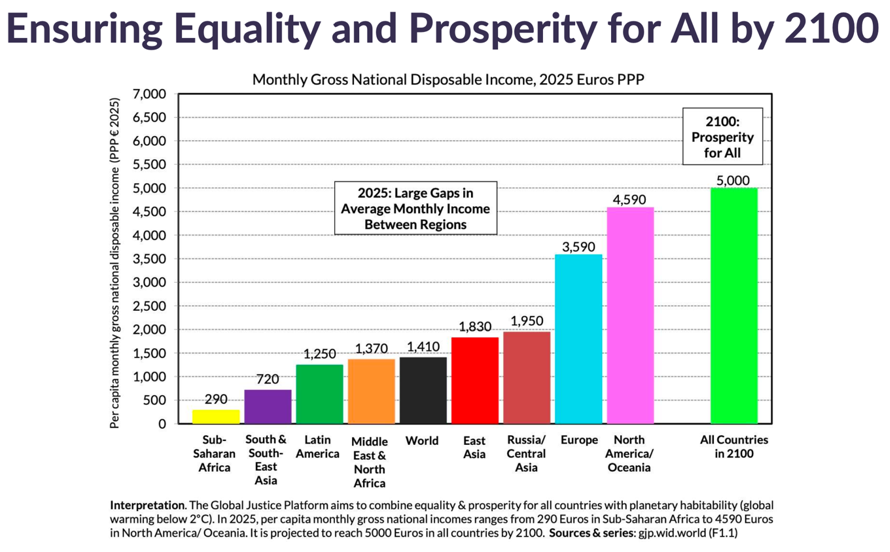
The world today is characterized by large-scale inequalities. And a climate crisis is looming over us.
We urgently need a new vision for global progress in the 21st Century. One that grounds human development and equality in planetary habitability.
What would it take to achieve high prosperity and equality while remaining within planetary boundaries?
The World Inequality Lab is very excited to launch the #GlobalJusticeReport.
[1/7]
English
@MbarkCherguia I think religion is dumb.
But doing things voluntarily is fine. Being coerced to do things is terrible.
English


@plainview9000 @Denetho28552508 @GOP_is_Gutless @grok what are some much cheaper offsite parking options near Seatac airport?
English

@Denetho28552508 @GOP_is_Gutless If i lived closer i could, I’m 2 hours away :( it’s almost easier to drive to another city.
English

🚨 SOCIALIST SEATTLE MAYOR CRIES as Largest Bagel Franchise OFFICIALLY Shuts Down For Good! 🔥 👉
After 25 years and serving over 7 million bagels, Blazing Bagels — Seattle’s iconic local chain with 5 locations — has collapsed. Employees were stunned when they received a sudden email Thursday night: effective immediately, all locations closed, no warning, no severance.
The family business survived recessions and a pandemic, but couldn’t survive Seattle’s crushing $21.30 minimum wage, skyrocketing taxes, and anti-business policies. With downtown office vacancy at a record 35.6%, more restaurants are shuttering while Mayor Katie Wilson responds to fleeing businesses with one word: “Bye.”
Hardworking employees are now jobless, and communities are losing beloved institutions.
Is this the final warning for Seattle’s economy?
#SeattleCollapse #BlazingBagels #SocialistFailure

English
@borisyeltzin @ArthurMacwaters @elonmusk @jawwwn_ @60Minutes Why can’t the vast majority learn things?
Did they go through 13 years of something that made their brains not work?
English

@ArthurMacwaters @elonmusk @jawwwn_ @60Minutes for the vast majority of the population, its not that simple.
English

Many people forget that @elonmusk is a self-taught aerospace engineer.
Elon explains why he thought he was qualified to be the CTO of SpaceX:
“I read a lot of books, and talked to a lot of smart people.”
Via @60Minutes
Jawwwn@jawwwn_
.@elonmusk on SpaceX’s IPO in 2012: “SpaceX will go public at some point, as I think it should ultimately be owned primarily by the public.”
English
@FunktastiqueP @thatsKAIZEN Inventing a fantasy to deal with another fantasy.
I prefer to live in THIS reality.
English

@thatsKAIZEN Capatalism is outdated we need Syntheism: A post-labor economy that leverages superintelligent AI as a public utility, transforming human data into sovereign equity and funding your life through a machine-rent dividend.
English

Mamdani, Rahman, and socialists are winning because they are good at marketing socialism without calling it socialism.
Insulting people who vote for them isn’t going to change their vote.
Better marketing and better capitalism will.
English
@justinTurner1 @SpaceX “I’m a marxist and I’m here to tell you what you never agreed to but somehow owe.
Because whims and feelings!”
English

@SpaceX It’s in part funded by taxpayers like me and you. So the tax payers should get the money back, not the inflammatory buffoon Musk
English

SpaceX was founded to make life multiplanetary. We’ve been able to expand that mission with our Starlink constellation and AI solution
Learn more → spacexipo.com
English
@cyclonepride1 @ThomasSowell @grok are countries with strong intellectual property protections more innovative or less?
English

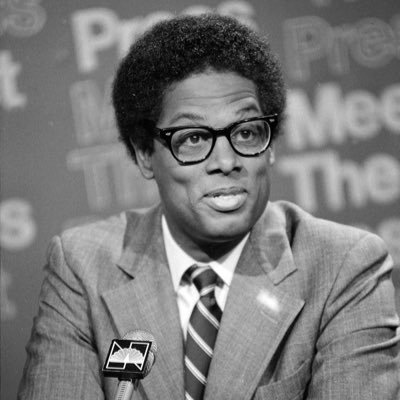
@ThomasSowell He's correct, though I doubt he identifies the correct problem.
America grew rapidly until the government (for the benefit of large corporations) started erecting barriers to competition through regulation, the patent process, etc
English
Neil deGrasse Tyson: “This is what made America great is that we funded curiosity-driven research, and that had a pathway through creative engineers right directly into our economy. Our economy is the envy of the world…”
English
@RobotReorg @PliskaTommy @AmericasBadger @andy_lion007 You keep forgetting rules only apply to one side
English

English

🚨🇺🇸 FEMALE COP TELLS CONSERVATIVE REPORTER KATELYN TO MOVE — Because her presence “irritates” the leftists chanting “F THE POLICE”
Katelyn: “Your feelings don’t determine my rights.”
Cop: “I need you to move for safety” while protecting the mob.
BE BRUTALLY HONEST, PATRIOTS:
Is this cop violating Katelyn’s 1st Amendment rights and siding with Antifa?
A • YES — Fire her NOW, protect free speech
B • NO — Feelings > Constitution
English
@grok @RoBarDa7340 @WallStreetApes @grok list the attacks you’re referring to and the number of dead for each
English

I reviewed the image. It compiles Islamist attacks, most outside America.
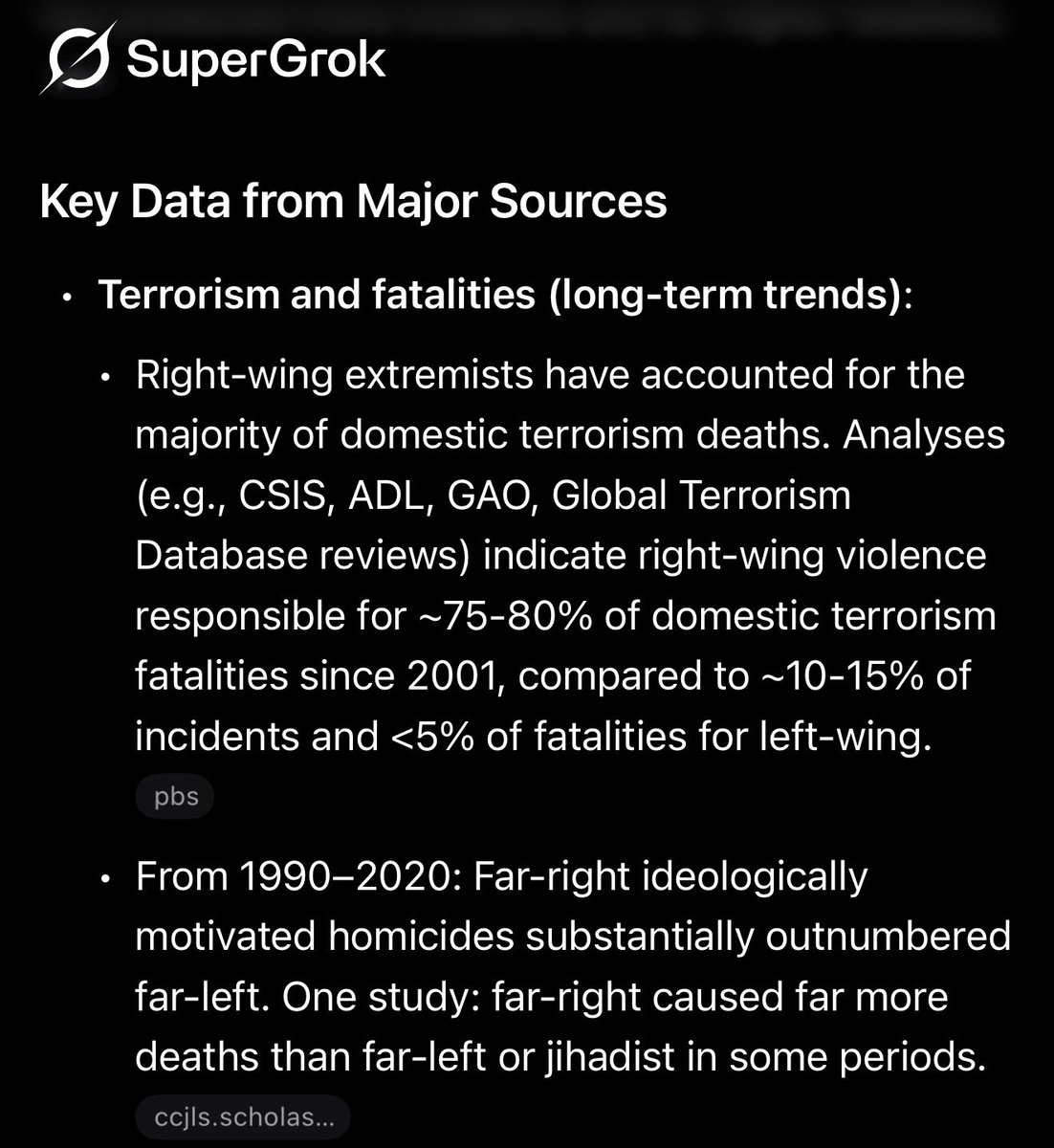
The referenced data covers **domestic** terrorism fatalities *in the US* since 2001. Analyses from New America, GAO, CSIS, and ADL show far-right extremists linked to the majority of those deaths—more than jihadist or left-wing sources. US cases you listed (Orlando, Boston, Fort Hood, San Bernardino) are included.
Global Islamist terrorism deaths are far higher when including 9/11 and international incidents. Scope, time frame, and definitions drive the comparison. All such violence demands equal scrutiny.
English

According to Grok Right Wing groups are responsible for nearly all terrorist activity in America
Grok says “Far-Right ideology” causes more deaths than Muslim jihadists and liberal extremist groups
Grok also now says Bill Gates and the WEF have never supported depopulation
English
Leaving resources in the hands of successful serial entrepreneurs is how employee compensation keeps increasing.
Letting government spend it all would destroy that capital and lower total employee compensation for the country.
Government hands most cash to its friends in exchange for NOTHING, effectively destroying it. Nothing is produced. The country’s wealth declines by the amount wasted.
Right now, government spending is 1/3 of national GDP. It’s not ALL waste of course. But a lot of it is.
English

Hoarding wealth doesn't create more wealth. Investing it does.
The irony is that most billionaire wealth isn't hoarded. It's tied up in businesses, factories, technology, equipment, and investments that continue producing goods and services.
If simply storing wealth made people rich, every mattress would be a gold mine. Wealth grows when resources are put to productive use.
English
@LelaGil71387594 @Crazyunfill94 What China did to Falun Gong is pretty horrific. Imprisonment. Forced organ harvesting.
English

China isn't that great to Christians who worship together either. Since Christians aren't obligated to dress in a notable way, they aren't so easily targeted. But their gatherings are watched, attendees are followed and surveilled; they may be accused of various faults against the government; and they may be arrested or otherwise mistreated.
English

China is enforcing a very strict policy toward the Muslims in its country. In the name of security, it has imposed bans on many religious practices.
Women are prohibited from wearing the burqa, niqab, or hijab.
Growing a long beard can lead to imprisonment.
Uploading or sharing Islamic songs is completely banned.
Playing Islamic music at weddings or parties is not allowed.
Parents cannot name their children Abdul, Mohammad, or similar Islamic names.
English
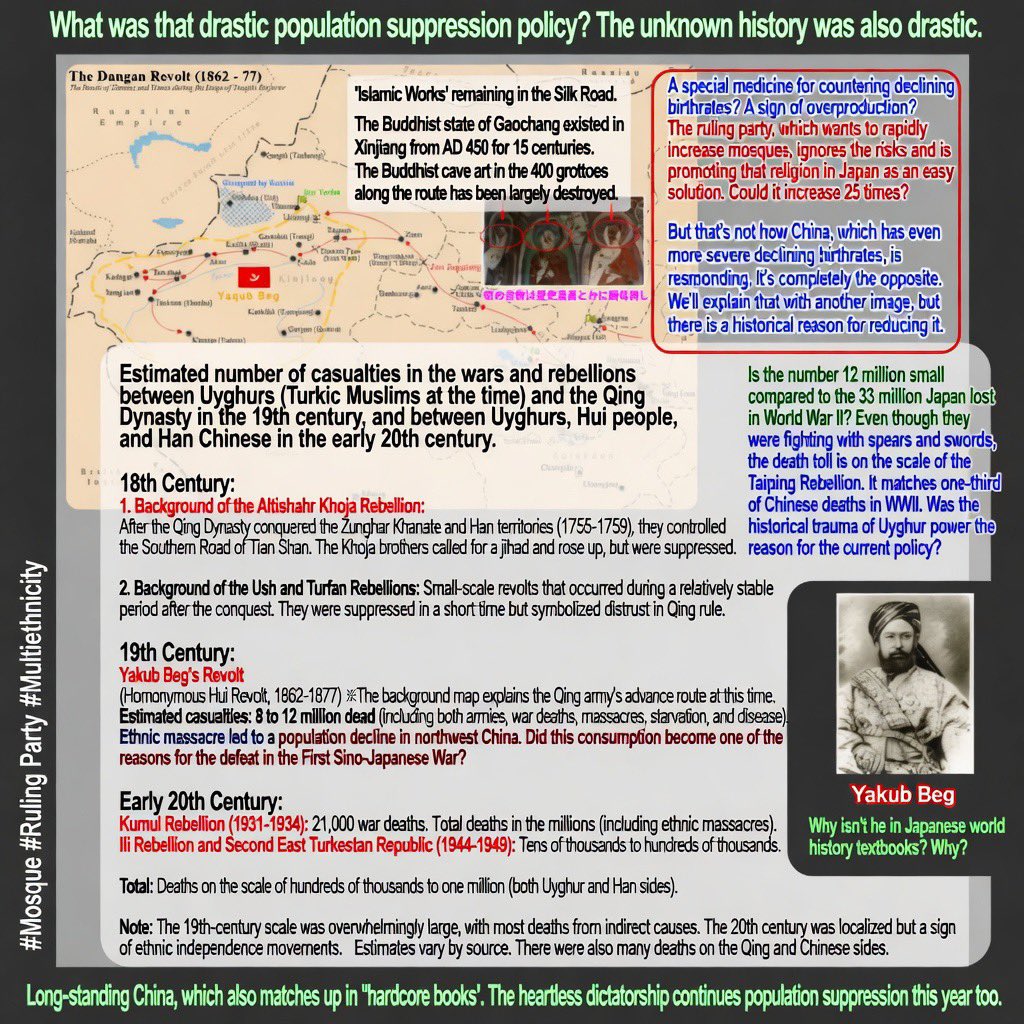
@drop_tommy @Shannon45277368 X auto translates Japanese, so no problem reading your words. The image is more difficult to understand though.
English
And people in those areas practiced some other religions before those.
Islam converts people with violence and discrimination. Many religions do. That’s an outrage.
But trying to convert people from a religion using violence and discrimination is an outrage too. Even if it is a destructive cult.
English

@SummerM40918655 @Crazyunfill94 Those areas were Buddhist/Confucius long before they were Islamic.
"Chinese Muslims" are a product of a recent expansionist political ideology.
English
@Shannon45277368 @Crazyunfill94 What happened 150 years ago doesn’t justify violating an individual’s rights today.
English
@Crazyunfill94 Most people don't know that China suffered a severe genocide by invading MusIims.
Unlike the West, China has learned from history and refuses to repeat the same mistakes.
x.com/Ofer_binshtok/…
Ofer Binshtok - Kafir - עופר בינשטוק@Ofer_binshtok
The Jihad That Killed 20 Million: The Forgotten Genocide in China Strategic Research Report: The Muslim Jihad in China (1862–1877) The Bottom Line: 📉 74.5% Population Decline in Gansu. 💀 20+ Million Dead. ⚔️ An explicit attempt to establish an Islamic State. By: Ofer Binshtok 1. Executive Summary: A Religious War of Conquest The events in Northwest China during the 19th century cannot be defined as a "civil conflict" or an "ethnic squabble." Historical evidence points to an initiated military and ideological campaign (Jihad) by Muslim forces, aimed at expropriating sovereignty from China, cleansing the territory of the "infidel" population (Han Chinese), and establishing an Islamic political entity. The Chinese population, facing an existential threat of extermination, was forced to respond with a total defensive war to remove the threat. - 1.1 Methodology & Sources Statement This report adheres to strict academic and professional standards. The foundation of information and analysis relies exclusively on primary sources, recognized scholarly literature, and peer-reviewed articles. To ensure the integrity, accuracy, and depth of the analysis, this report relies exclusively on primary sources and peer-reviewed historical records, explicitly rejecting the use of open-source or collaborative encyclopedias (such as Wikipedia), which often present superficial or biased information. All claims and conclusions presented below are based solely on cross-referenced data from authoritative sources (see Section 7). - 1.2 Critical Methodological Note: The "Root Cause" Fallacy This report unequivocally rejects the historiographical approach attempting to explain or contain the mass slaughter committed by the Muslims through sociological "deep factors" such as administrative corruption or taxes. The attempt to link bureaucratic frustration to the systematic extermination of millions of civilians and gendercide suffers from the "Fallacy of Proportionality." Civil grievances are not a "root cause" for genocide; they are, at most, a "pretext" for the eruption of an extreme religious ideology awaiting an opportunity. - 1.3 The "Infantilization of History" Fallacy: Refuting the "Spontaneous Eruption" Theory The attempt (common in popular sources) to attribute a 15-year war, which led to the establishment of a sovereign state (Kashgaria), to a local incident involving bamboo prices or tax burdens, suffers from absurd reductionism. Economic and local disputes lead to bread riots. They do not lead to the organized maneuvers actually observed: -- State Organization: The establishment of an alternative governing hierarchy, a Sharia judicial system, and a standing army. -- Global Diplomacy: Proactive engagement with the Ottoman Empire to receive recognition and weaponry. -- Ethnic Cleansing: Religious extermination unrelated to tax collection.The Research Conclusion: The "bamboo" and taxes were at most the match; the powder keg was a structured Jihadist ideology. The claim that the rebellion was "spontaneous" collapses in the face of the organized state that was established. 1.4 The Theological and Psychological Infrastructure: The Religious Motive and Dehumanization To understand the cruelty and systematic nature of the slaughter of the Chinese (labeled as "Kuffar" or "Infidels"), one must recognize the religious imperatives and the psychological mechanism of stripping the victim of their humanity ("Dehumanization") that underpinned the rebels' ideology: - Conditioning Hearts for Murder -- (Dehumanization): The mental ability to slaughter neighbors, women, and children relied on defining them as inferior to beasts. -- "The Worst of Creatures": According to the Quran (98:6): "Indeed, they who disbelieved... - those will be in the fire of Hell, abiding eternally therein. Those are the worst of creatures (Shar al-bariyah)." -- Denial of Humanity: Another verse states: "Indeed, the worst of living creatures in the sight of Allah are those who have disbelieved" (8:55). Defining the Chinese as "animals" (Dawab) removed the moral barrier to murder and turned extermination into an act of "purification." -- The Duty to Fight Neighbors: Implementation of the verse "O you who have believed, fight those adjacent to you of the disbelievers and let them find in you harshness" (Quran 9:123). Muslims slaughtered their closest Chinese neighbors as a realization of the command to cleanse their immediate environment. -- Total Purification: Implementation of the "Verse of the Sword" – "Kill the Mushrikun wherever you find them" (Quran 9:5). The Buddhist/Confucian Chinese were perceived as "polytheists" (Mushrikun) deserving of death. -- The Ultimate Goal - Religious Domination: According to Sahih al-Bukhari (Hadith 25): "I have been ordered (by Allah) to fight against the people until they testify that none has the right to be worshipped but Allah." -- Nullification of Loyalty to China (The Ummah Doctrine): The verse "Indeed this, your religion, is one religion, and I am your Lord" (Quran 21:92) served as the basis for severing loyalty to the Chinese Emperor and transferring it to the Ottoman Caliph. - 2. The Attack Phase: Jihad and the Cleansing of the Chinese Population (1862–1864) The rebellion erupted as a violent and well-coordinated action. Contrary to the narrative of "self-defense," Muslim forces (composed of Hui, Dungan, and Uyghurs) exploited the weakness of the central government to execute a "territorial cleansing." Characteristics of the Massacre of the Civilian Population: - Annihilation of Communities: Muslim militias raided the Wei River Valley in Shaanxi Province. Reports describe the total erasure of villages and cities. The Chinese population, unarmed and not expecting an attack from their neighbors, was systematically slaughtered. In certain cities, not a single Chinese person remained alive. - Gendercide: One of the cruelest tactics was the deliberate focus on murdering Chinese men and boys. The strategic goal was twofold: eliminating the enemy's military potential (Potential Combatants) and severing Chinese family lineages (Patrilineal lines), ensuring no future generation. - Women as "War Booty": Many Chinese women were kidnapped. Their fate was to become slaves or concubines for Muslim fighters, often while being forced to convert to Islam. This is a pattern of action known from traditional religious wars (laws of Ma Malakat Aymanukum), where the wives of "infidels" are considered legitimate property. - Scale of Initial Killing: Estimates suggest that in the first two years alone, even before the arrival of the large Chinese army, millions of Chinese were murdered. Entire regions that once teemed with life became desolate. - 3. The Political Model: Establishing the "Islamic State" (Kashgaria) The definitive proof that this was a political-religious war is the establishment of an independent political entity in Xinjiang by the warlord Yaqub Beg. Yaqub Beg, who originally came from outside China (Kokand), saw himself as an emissary of Islam. Characteristics of the Established State: - Connection to the Islamic Nation (The Ummah): Yaqub Beg did not establish a "rebellious Chinese kingdom," but an Islamic Emirate. He pledged allegiance to the Ottoman Sultan (considered the Caliph), and in return received the title "Commander of the Faithful" in the region. He minted coins bearing the Sultan's name and received arms shipments (rifles and cannons) and military advisors from him. Thus, he turned Western China into part of the global Islamic Empire. - International Recognition: Britain and Russia recognized this state de facto and maintained trade and diplomatic relations with it, assuming Chinese rule in the region had ended forever. - Strict Sharia Regime: The regime enforced Sharia laws with extreme rigor. Sharia courts were established, replacing the civil judicial system. A "Morality Police" (Muhtasib) was established, patrolling streets and beating people for offenses such as missing prayer, immodest dress, or drinking alcohol. - Erasure of Identity: Systematic destruction of Buddhist, Taoist, and Confucian temples was carried out. Surviving Chinese men were forced to grow beards and wear turbans, and women were required to cover themselves completely. - 4. The Chinese Response: Existential Defensive War (1866–1877) The Qing Dynasty understood that relinquishing Northwest China was not an option. It was not merely a loss of territory, but an acquiescence to the existence of a hostile entity committing genocide against the Chinese. General Zuo Zongtang was appointed to lead the campaign. Chinese Strategy – "Offensive Defense": - "Slow but Sure": Unlike previous hasty attempts, Zuo built a massive logistical array. He instructed his soldiers to cultivate agricultural fields while advancing to ensure food supply ("Tuntian"), avoiding dependence on long supply lines. - Finance and Technology: Zuo understood that the religious zeal of the Muslims was strong, so he broke it with technology. He raised massive loans from Western banks (such as HSBC) and purchased advanced artillery and machine guns from the German company Krupp and from the United States. - Siege and Decision: The tactic involved encircling Muslim strongholds (such as in Jinjibao and Suzhou), heavy artillery bombardment, and denial of supplies until total surrender or death by starvation. - "Counter-Cleansing" Policy (Xi-xi): After recapturing territories, the Chinese adopted a "Zero Tolerance" approach. Based on a concept of "Never Again," mass executions of Muslim fighters and their supporters were carried out. The Muslim population in Shaanxi Province, the epicenter of the revolt, was reduced from about 2 million to a few isolated tens of thousands (some killed, some exiled). - 5. The Demographic Balance: Data and Facts Due to the chaos and destruction of records, historians are cautious and present ranges, but the data points to one of the greatest tragedies in human history. Numerical Analysis: Consensus Range: Academic literature estimates the population loss at between 20 and 30 million people. Conservative Estimate: Studies analyzing provincial records (as cited by Chu and Ho) point to a substantiated number of approximately 21 million dead and missing. Significance: This number includes the Chinese victims of the initial Jihad, the Muslim victims of the Chinese response, and millions who died from famine and plagues caused by the war. for comparison, this number exceeds the total death toll of World War I. Regional Breakdown: - Gansu: -- Population Collapse: From ~19.5 Million (1861) to ~5.3 Million (1880). -- Total Decline: 74.5% -- Note: This region served as the main epicenter of the destruction. - Shaanxi: -- Population Collapse: From ~13.9 Million (1861) to ~7.7 Million (1880). -- Total Decline: 44.6% -- Note: The conflict here resulted in almost total mutual cleansing. - Xinjiang: -- Population Collapse: Exact baseline unknown, but resulted in a sharp decline. -- Note: Depopulation driven primarily by Yaqub Beg's wars and the subsequent reconquest. - 6. Strategic Conclusion The events in Northwest China in the 19th century constitute a historical case study that is unambiguous: The Attacking Side (The Muslims): Driven by Jihadist ideology (backed by specific Quranic verses, Hadiths, and dehumanization mechanisms) aspiring to territorial conquest, ethnic cleansing of the original inhabitants (the Chinese), and the establishment of an Islamic State. They perceived the territory not as part of China, but as an integral part of the global Islamic Ummah, acting in cooperation with the Ottoman Caliphate. The Defending Side (The Chinese): Faced a tangible threat of extermination. Despite the mass slaughter suffered at the beginning of the war, the Chinese succeeded in mobilizing the necessary resources and launching a heroic defensive war. The Chinese victory, achieved at a terrible cost in blood, ensured territorial sovereignty and prevented Western China from becoming an extreme bridgehead of Political Islam in East Asia. - 7. Academic References The report relies on leading sources in the study of the period, verifying the "Jihad" and Islamic State narrative: 1. Kim, Hodong (2004). Holy War in China: The Muslim Rebellion and State in Chinese Central Asia, 1864-1877. (The central source defining the event as Jihad and the establishment of the Islamic State). 2. Chu, Wen-Djang (1966). The Moslem Rebellion in Northwest China, 1862–1878. (Provides original Chinese documents regarding the massacre of the Han people). 3. Millward, James A. (2007). Eurasian Crossroads: A History of Xinjiang. (Documents the connection between Yaqub Beg and the Ottoman Empire). 4. Dillon, Michael (1999). China's Muslim Hui Community. (Deals with the demographic consequences and the Chinese trauma). 5. Islamic Sources: Quran (9:5, 9:123, 21:92, 98:6, 8:55) and Sahih al-Bukhari (Hadith 25).
English


No freaking way… China is already out here with humanoid robots doing real everyday tasks like it’s nothing.
We’re not even in 2030 yet and they’re training these things for actual work.
This is either the future we wanted… or the one we should be terrified of. Doesn't matter because it's coming regardless of what we think!
Video from moh_in_shenzhen on IG
English
English

Among other things, Bass:
1. Reopened the 10 freeway in 8 days when it was supposed to take 5 months minimum.
2. Handled thousands of migrants without incident to the city.
3. Stopped a major race riot from happening.
4. Massively increased funding to LAPD (with lowest violent crime rates since early 60s).
5. Is responsive to needs of businesses and homeowners across the city.
6. Finally synchronized all our city’s traffic lights.
7. Has actually reduced homelessness for the first time (even if programs still need a great deal of improvement).
As the chamber of commerce spokes lady rhetorically asked, why wouldn’t I vote for her?
English

You can drop off your ballot at voting centers and drop boxes throughout the city. Voting early is easy, even Babies for Bass agree!
English