Tweet Disematkan

BBC and the Internalisation of Islamic Republic Narratives
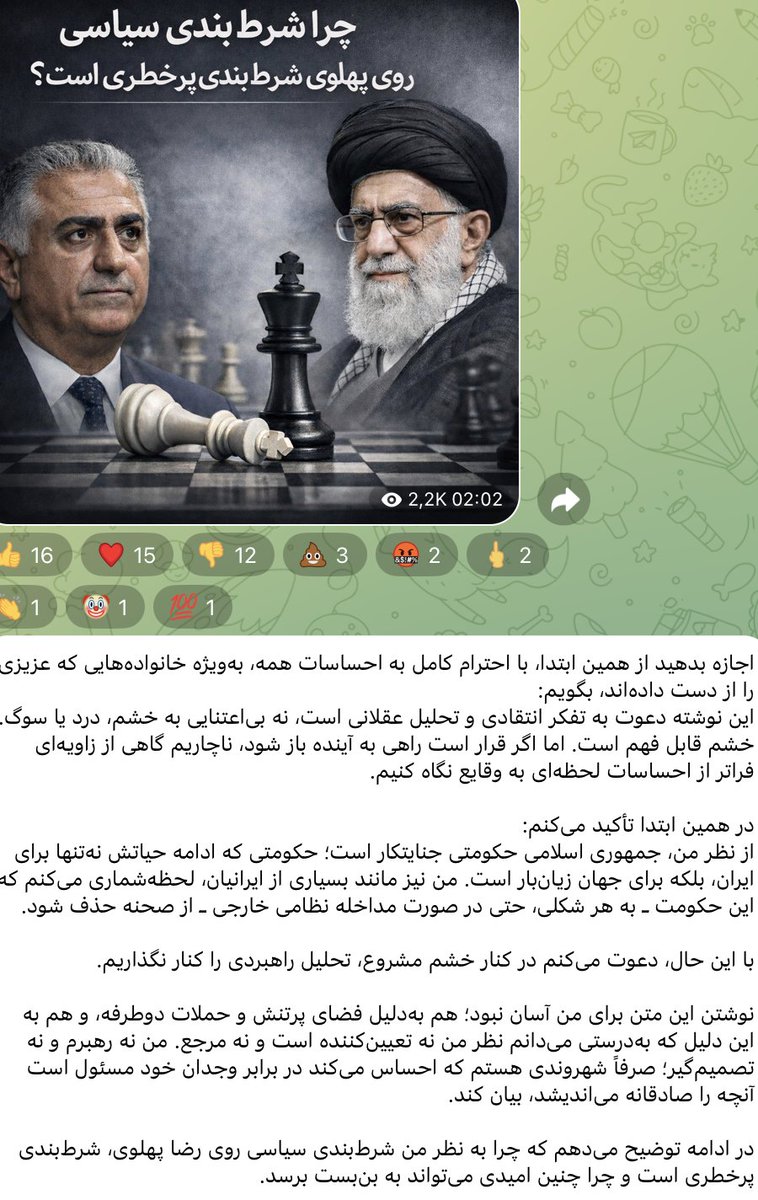
The line‑up of pundits who have worked – and in some cases still work – for the BBC @bbcworldservice, @BBCWorld, @BBCNews and now jointly speak out against Reza Pahlavi has become more or less complete: Nader Soltanpour @NaderSoltanpour, Siavash Ardalan @BBCArdalan, Panah Farhadbahman @PanahFB, Keyvan Hosseini @Kayvan_Hosseini, Mehrdad Farahmand @MRD_Farahmand, and Rana Rahimpour @ranarahimpour, who has published a text under the title: “Why placing a political bet on Pahlavi is a dangerous gamble?”
The title is an ironic allusion to one of Reza Pahlavi’s own remarks during the nationwide uprising of 2022 in Iran, when he addressed the regime’s repressive forces and told them: “Don’t bet on the losing horse.”
The “opinions” voiced by these current and former BBC staffers – namely that monarchists and their preferred option are “unsuitable” or “dangerous” – are, unsurprisingly, remarkably aligned.
They insinuate – without offering any serious evidence – that if Reza Pahlavi @PahlaviComms ever came to power, Iran would automatically slide into a new dictatorship. This is pure speculative alarmism, indistinguishable from the Islamic Republic’s own talking points: instead of grappling with actual programmes or behaviour, it teaches the audience to pre‑emptively fear any organised alternative and to see every path beyond the current regime as another route to tyranny.
Morgan Ortagus and the structural problem
Several years ago, former U.S. @StateDept spokesperson Morgan Ortagus @MorganOrtagus pointed quite directly to a structural problem at BBC in a live interview – a warning many inside the newsroom seem to have shrugged off, perhaps simply because she had worked in a Trump administration:
Link to the mentioned part of the interview in Persian: facebook.com/reel/251406870…
Yet her diagnosis was accurate. The conscious or unconscious internalisation of the Islamic Republic’s propaganda, and treating its premises as self‑evident, is at the heart of the problem on display in this new piece: a kind of political “taqiyya” (religious strategic self‑concealment and dissimulation): The result is a permanent regime of self‑limitation: you censor yourself, narrow your own life, and voluntarily give up rights and freedoms in advance, all to accommodate the dictator. Always calibrate your opposition, your slogans, and even your very presence to the regime’s red lines; hide your real objectives behind layers of caution, because “the dictator will never back down.” Show respect for what the Islamic Republic wants. When it channels the financial windfalls of sanctions relief under @BarackObama into further building up proxy militias in the Middle East, fuelling anti‑Israel campaigns, or prolonging slaughter and displacement in Syria, do not disturb it – stay in the nuclear deal at all costs.
Why BBC English reporting from Iran lacks real journalistic value
This is also why recent @BBCWorld reports and interviews from Iran – including Lyse Doucet’s @bbclysedoucet pieces – have little real journalistic value. They are produced under conditions that are structurally discriminatory against Persian‑speaking colleagues and shaped largely by terms dictated by the regime itself, as some BBC Persian staff have pointed out in the past.
That may satisfy editorial demand in London, but it does not amount to independent reporting from inside a dictatorship after many cases of mass murder. And even this is only the legal‑ethical side of the problem; it does not touch on the propaganda function such coverage performs for the Islamic Republic, by normalising its rule and presenting everyday life in Iran as if it were almost “ordinary.”
The argument about “dangerous links” to exiled figures
Rana Rahimpour’s text remembers Ortagus’ warning precisely at this point. She writes: “In such circumstances, any direct or symbolic link between protests inside the country and a specific figure abroad can multiply the cost of dissent for ordinary people. Once the name of an individual or a particular group is attached to a social movement, the regime can easily portray all protesters as foreign‑backed, security threats or external enemies – which, in practice, puts people’s lives at greater risk.”
Stripped of its rhetoric, the logic that Ortagus criticised – and which the former BBC presenter now reproduces in a different form – would today read as follows, conveniently forgetting that during the November 2019 massacre no one abroad had issued any “call” for protests: “If Reza Pahlavi had not called for demonstrations, the situation would never have escalated to the point of today’s massacre.” Yet the Islamic Republic has repeatedly gunned down unarmed protesters regardless of whether any exiled figure issued such a “call” – most starkly in November 2019, when no call from abroad existed at all.
Repeating the regime’s narrative about the opposition
On an analytical, social, and political level, this former BBC employee’s argument suffers from several fundamental flaws and ultimately reinforces the narrative that the Islamic Republic has been producing and recycling in Western media for years.
The text suggests that the opposition is reckless and without a plan, that it is a threat to Iran’s future, that exiled leaders are frivolous and irresponsible, and that the only ‘rational’ path is to lower expectations (see attached screenshot and the full text on Telegram: t.me/ranarahimpour1).
From “plurality” of leaders to paralysis
In practice, the piece also dresses up a demand for “plurality” at the leadership level, which, under the current balance of forces, simply means fragmenting the public around every actor with a tangible social base. Pluralism in parties and parliament is a democratic virtue; fragmenting symbolic leadership in the middle of an existential struggle is not pluralism, it is paralysis – precisely what certain so‑called “republican” factions in the diaspora have been doing for a couple of years.
The result, as we saw after the rigged 2009 “election” in Iran, is political deadlock: endless quarrels over collective leadership, internal struggles within would‑be leadership groups, and, in the end, the continuation of the Islamic Republic.
When the dictator sets the rules of “safe” dissent
By repeating and adapting the regime’s talking points, the BBC and its former or current employees help internalise the dictator’s preferred behaviour in the minds of protesters and dissidents. What the regime dictates becomes part of the very grammar of “criticism” and “opposition”, rather than what opponents themselves genuinely want and believe.
From this point onward, it is the dictator who defines the boundaries of the playing field, the permissible scope of protest, and the acceptable forms it may take – or at least shapes them as far as the opposition’s discourse allows. The failure of any attempt at serious protest or regime change begins exactly where everyone starts accommodating the dictator and adjusting themselves to him. That accommodation can take the form of clinging to the nuclear deal at any price – or of protesters moderating their demands and refraining from rallying around any recognisable leadership figure.
The constitutional fact that is never mentioned
Whether one is monarchist or not, one simple constitutional fact from before 1979 is usually airbrushed out of such commentary: absent the catastrophe of 1979 and its so‑called Islamic Revolution, the very person now cast as a “dangerous gamble” would, under the legal order that revolution overthrew, be the lawful head of state of Iran.
This is how far the mindset of some current and former BBC employees has drifted towards the Islamic Republic’s propaganda – to the point of internalising it and selling it back to the audience as cautious, reasonable “analysis.”
@Ofcom @UKParliament @CommonsCMS @TIME @Channel4News @PiersUncensored @piersmorgan @reuters @AP @TheAtlantic
#IranRevolution2026 #DigitalBlackoutlran #IranMassacre #R2PforIran
x.com/twittalisation… .

English