vasa

7.2K posts

vasa banner
vasa

vasa

@vasa_develop

👨‍💻 Co-Founder @openseapro (acq. @opensea) 🎓 @iitdelhi Physics

Bergabung Ağustos 2017
583 Mengikuti21K Pengikut
Tweet Disematkan
vasa
vasa@vasa_develop·
For the last few months, I have been spending my weekends exploring hard tech; specifically, synthetic biology. While a lot has been done in the last 2 decades in synthetic biology, it's still very much in its infancy. Compiling some of my notes here: synbio.sh/resources
English
15
3
77
15.9K
vasa me-retweet
Arc Institute
Arc Institute@arcinstitute·
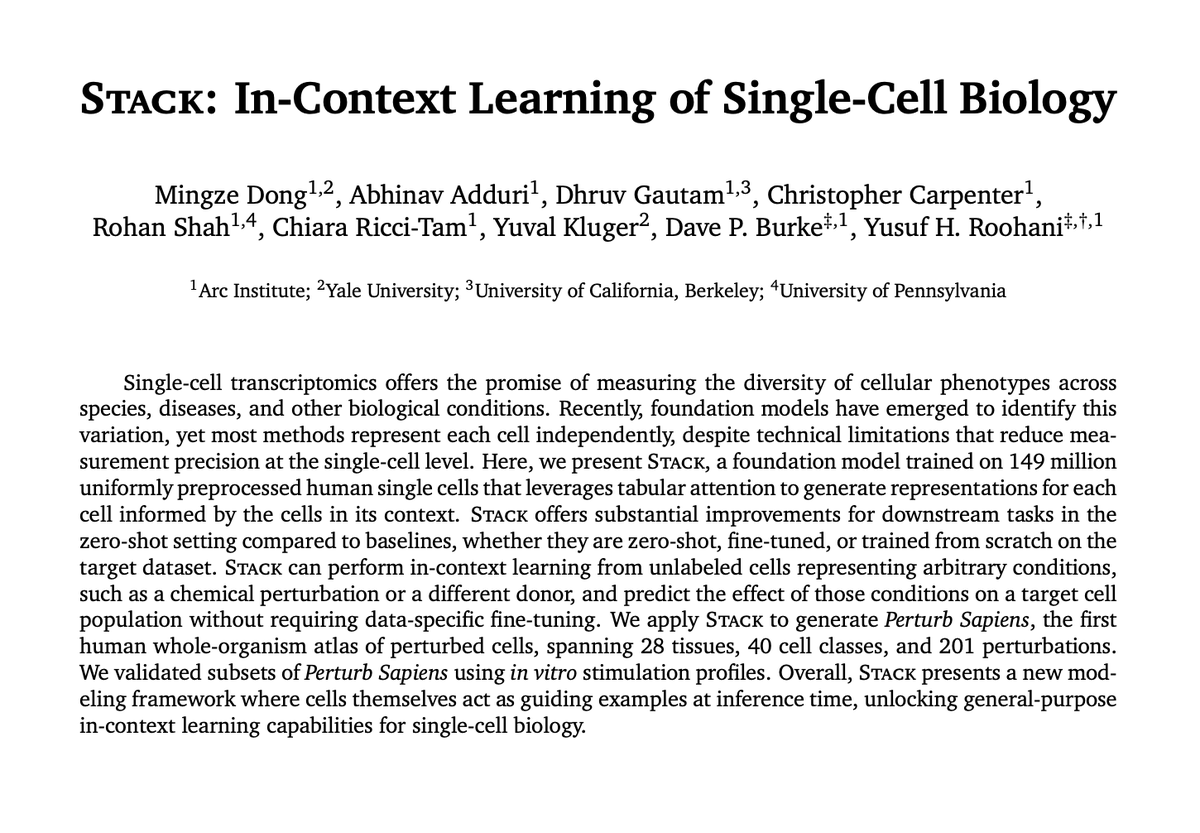
Predicting cell state in previously unseen conditions such as disease or in response to a drug has typically required retraining for each new biological context. Today, Arc is releasing Stack, a foundation model that learns to simulate cell state under novel conditions directly at inference time, no fine-tuning required.
Arc Institute tweet media
English
36
211
972
400.7K
vasa me-retweet
David Sinclair
David Sinclair@davidasinclair·
Fertilized human eggs made from skin cells progress through normal cell divisions, ultimately developing into embryos nature.com/articles/s4146…
English
61
221
1.2K
647.7K
vasa me-retweet
Blake Byers
Blake Byers@byersblake·
NewLimit paper just dropped @icmlconf showing our SOTA AI models can predict perturbed cell states. Helps to have the largest primary cell perturbation dataset in the world. Bonus points for one of the first demonstration of active learning in bio.
Blake Byers tweet media
English
14
51
339
195.3K
emo.eth
emo.eth@emo_eth·
where can i get historical reorg data for chains? dune? what would i query against?
English
2
0
2
499
Otim
Otim@otimlabs·
Mainnet is here. 📟 Introducing Otim—a digital asset operating system for every onchain account.
English
20
38
139
34K
Otim
Otim@otimlabs·
Tomorrow. See you on Mainnet. 📟
GIF
English
12
17
55
3.8K
vasa
vasa@vasa_develop·
@owl_posting People do want to live longer, healthier lives, but only if it doesn’t require them to do any additional work (consistently eat healthy and exercise). So, we just haven't found the right product yet (ozempic is a close one though)🙃
English
0
0
1
239
owl
owl@owl_posting·
my bet on biomedical sciences being the most important field to join — given that most people’s seemingly primary desire is to live longer, healthier lives — has turned to be a very foolish move in retrospect. what people really care about is AWS pricing optimization
English
33
44
888
47.6K
vasa
vasa@vasa_develop·
I'm new to this (so feel free to correct me), but even if we go by the approach of "deliver an inducible OSKM (or alternative factors) payload to the cell once and then activate its expression with a small molecule", won't we need to cycle the switch on/off periodically cause after each rejuvenation cycle, the cells will deteriorate after a while? Or are you saying that an individual rejuvenation cycle will need multiple periodic doses of mRNA/LNP modality whereas using the small molecule approach will just need a single dose for an individual rejuvenation cycle?
English
0
0
0
37
Yuri Deigin
Yuri Deigin@ydeigin·
At this point it appears that to get a long-lasting rejuvenation effect partial reprogramming needs to be periodic. That’s why I’m not a fan of the mRNA/LNP modality for it — I’d rather deliver an indicible OSKM (or alternative factors) payload to the cell once and then activate its expression with a small molecule than target the cell with mRNA LNPs on a regular basis.
English
2
0
15
1K
Yuri Deigin
Yuri Deigin@ydeigin·
A key question for the entire partial reprogramming field is how long the rejuvenating effect lasts after reprogramming is stopped. Some cause for optimism from @jacobkimmel and @byersblake during the latest progress update from @newlimit:
Jacob Kimmel@jacobkimmel

happy to share an update on our recent progress @newlimit feat. @brian_armstrong, @byersblake, Cathy O'Hare, & myself we're starting to see the first hints of viable therapeutics for aging through reprogramming. if this excites you, come join us!

English
3
6
44
4.2K
vasa
vasa@vasa_develop·
@0xKofi Yeah, I don’t think there’s any easy way to do it unless the wallets themselves share the stats 🤔
English
0
0
2
111
Kofi
Kofi@0xKofi·
@vasa_develop If the delegations haven't been executed onchain yet I'm not sure where find them 🤔 I need to read up on how they get propagated
English
1
0
2
147
Kofi
Kofi@0xKofi·
If one EOA - authorizes the Metamask Delegator account implementation on one chain - authorizes the Ambire account implementation on another chain would you count that as two EIP-7702 smart accounts or one?
English
9
1
18
2K
vasa me-retweet
Karl Pfleger
Karl Pfleger@KarlPfleger·
Poll: Is the SENS philosophy (not necessarily the original specifics) a viable approach for the aging field? SENS philosophy = divide & conquer rejuvenation that involves many infrequent therapies to reverse different age-related changes. (Epigenetic reprogramming is included.)
English
10
2
10
3.9K
vasa me-retweet
Ruxandra Teslo 🧬
Ruxandra Teslo 🧬@RuxandraTeslo·
This is an amazing paper from the groups of @anshulkundaje & Scott Boyd and an example of how AI can be used well in biology. Basically, they are able to predict disease status (e.g. lupus, Covid, HIV, influenza) from BCRseq and TCRseq. I think this has great implications.
Ruxandra Teslo 🧬 tweet media
English
11
53
237
29.9K
vasa me-retweet
Gautam Kedia
Gautam Kedia@thegautam·
TL;DR: We built a transformer-based payments foundation model. It works. For years, Stripe has been using machine learning models trained on discrete features (BIN, zip, payment method, etc.) to improve our products for users. And these feature-by-feature efforts have worked well: +15% conversion, -30% fraud. But these models have limitations. We have to select (and therefore constrain) the features considered by the model. And each model requires task-specific training: for authorization, for fraud, for disputes, and so on. Given the learning power of generalized transformer architectures, we wondered whether an LLM-style approach could work here. It wasn’t obvious that it would—payments is like language in some ways (structural patterns similar to syntax and semantics, temporally sequential) and extremely unlike language in others (fewer distinct ‘tokens’, contextual sparsity, fewer organizing principles akin to grammatical rules). So we built a payments foundation model—a self-supervised network that learns dense, general-purpose vectors for every transaction, much like a language model embeds words. Trained on tens of billions of transactions, it distills each charge’s key signals into a single, versatile embedding. You can think of the result as a vast distribution of payments in a high-dimensional vector space. The location of each embedding captures rich data, including how different elements relate to each other. Payments that share similarities naturally cluster together: transactions from the same card issuer are positioned closer together, those from the same bank even closer, and those sharing the same email address are nearly identical. These rich embeddings make it significantly easier to spot nuanced, adversarial patterns of transactions; and to build more accurate classifiers based on both the features of an individual payment and its relationship to other payments in the sequence. Take card-testing. Over the past couple of years traditional ML approaches (engineering new features, labeling emerging attack patterns, rapidly retraining our models) have reduced card testing for users on Stripe by 80%. But the most sophisticated card testers hide novel attack patterns in the volumes of the largest companies, so they’re hard to spot with these methods. We built a classifier that ingests sequences of embeddings from the foundation model, and predicts if the traffic slice is under an attack. It leverages transformer architecture to detect subtle patterns across transaction sequences. And it does this all in real time so we can block attacks before they hit businesses. This approach improved our detection rate for card-testing attacks on large users from 59% to 97% overnight. This has an instant impact for our large users. But the real power of the foundation model is that these same embeddings can be applied across other tasks, like disputes or authorizations. Perhaps even more fundamentally, it suggests that payments have semantic meaning. Just like words in a sentence, transactions possess complex sequential dependencies and latent feature interactions that simply can’t be captured by manual feature engineering. Turns out attention was all payments needed!
English
175
553
5.2K
1.3M
vasa
vasa@vasa_develop·
@laurashin @maxresnick bro sounds like trump...these L2s have been ripping us off and we need to tax them lol
English
1
0
1
241
Laura Shin
Laura Shin@laurashin·
Should Ethereum act like a business? @maxresnick imagines what it’d look like … and it starts with blacklisting all the L2s 😳
English
95
4
76
183.6K
vasa
vasa@vasa_develop·
@AspynPalatnick some folks are building AI toys for kids. Some if those can move around too (like miko.ai)
English
1
0
2
56
Aspyn 🟩
Aspyn 🟩@AspynPalatnick·
Is anybody doing interesting stuff with AI and roombas? Feels like there's more than meets the eye with what's possible
English
2
0
6
209
vasa
vasa@vasa_develop·
@crypto_pundit By “problems that you care about” I meant problems that you don’t enjoy solving/dealing with.
English
0
0
1
30
cryptoPundit
cryptoPundit@crypto_pundit·
@vasa_develop If you don't care about a problem, is it still a problem? 🙃 Even if u rid of this, it won't make any difference to your life
English
1
0
1
33
vasa
vasa@vasa_develop·
@surfcoderepeat More energy with better motor control
English
0
0
2
80
vasa me-retweet
U.S. FDA
U.S. FDA@US_FDA·
Today, the FDA is taking a groundbreaking step to advance public health by replacing animal testing in the development of monoclonal antibody therapies and other drugs with more effective, human-relevant methods. fda.gov/news-events/pr…
U.S. FDA tweet media
English
95
226
827
413.1K