
固定されたツイート
Blaz Bratovic
47.5K posts


Blaz Bratovic
@DeepShort7
Personal views. Interested in climate/energy nexus. Sometimes chess-related content. "Trust me, I am an engineer". https://t.co/L7A4Z1Fi5i
参加日 Haziran 2014
6.9K フォロー中972 フォロワー
@felschwartz @vonderburchard @diana_nerozzi @jacopobarigazzi Well, this shows, or points towards, two things @akoz33.
Trump is not a Russian asset and Putin thinks he might be just dumb enough to accept such a proposal.
English

Scoop: Russia offered to stop sharing intel with Iran if the US would stop doing the same with Ukraine. The Trump admin said no.
W/ @vonderburchard @diana_nerozzi @jacopobarigazzi
politico.eu/article/putin-…
English
Blaz Bratovic がリツイート

Though automakers have yet to report their sales figures for March, the first full month since the Persian Gulf conflict began, early signs point to Asian EV makers such as China’s BYD and Vietnam’s VinFast benefiting from the resulting surge in sales. bloomberg.com/news/articles/…
English
@RLHeinrichs Sad thing is, he apparently said a few points worthy of further discussion during the interview.
x.com/kvistp/status/…
Kvist@kvistp
Wtf happened to Tucker?
English

Although there’s a lot of focus on the antisemitism from this wing on the right, it’s really important to understand how they’re wielding it. It’s to speed along declinism and to turn the U.S. inward, accepting CCP power at our expense.
The Economist@TheEconomist
“The US is not going to defend and cannot defend Taiwan.” @TuckerCarlson tells @zannymb that America has reached the limits of its power and has to now share it with China. Watch the full Insider interview: econ.st/4dDjBlU
English
Spoiler alert: Fighting a conventional war with China, much less under the shadow of nuclear weapons and their delivery systems, won't be anything like picking up Maduro in Caracas.
Department of State@StateDept
PRESIDENT TRUMP: When we took Venezuela in a matter of minutes, put somebody on a helicopter that was well guarded with thousands of people with iron doors, we proved that we’re the greatest and strongest military in the world.
English
A bit of humour from Professor Georg.
Georg ‘Maverick’ Löfflmann@gloefflmann
The Donroe Doctrine explained: No more forever wars, but also I can go to war forever, but I don’t have to, because we already won this war, which also isn’t a war, but also is totally a war. We fight this war to destroy Iran’s nuclear programme that we obliterated in the last
English
Blaz Bratovic がリツイート

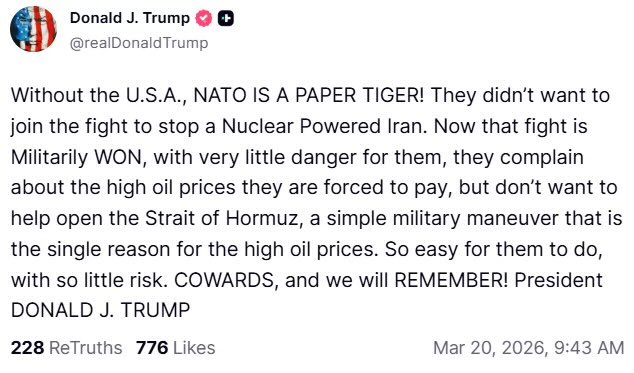
@ribeiro__2022 @AndreasShrugged @AlexGodofsky @lymanstoneky Ok, we condemn that as well. In the strongest terms.
English

@DeepShort7 @AndreasShrugged @AlexGodofsky @lymanstoneky There's already a UNSC resolution, voted 13-0, with Russia and China abstaining, that condemns Iran's attacks in the ME and the closure of the strait.
English

An important factor in the Hormuz situation is that under maritime law Iran is not "allowed" to close the strait, doing so is an act of war by Iran against the flags of the ships attacked or interdicted, and the US is not responsible or at fault for Iran's actions.
English
@ribeiro__2022 @AndreasShrugged @AlexGodofsky @lymanstoneky It seems there is a great time for UNSC resolution then! Maybe the US won't vote along the lines of Russia and North Korea in this case, perhaps.
English
Yes: the fact that International Law was broken when Iran was attacked doesn't give them the right to break it and hold the world's economy for ransom. And Iran, which has long been attacking the whole Middle East using both its proxies and directly using its missiles, doesn't have much to complain about when it comes to law breaking.
English
Blaz Bratovic がリツイート
Disrupting, deterring and degrading Russia’s shadow fleet - and starving Putin’s war machine of funds - is a priority for this government and we will continue to take action alongside our allies. (1/2)
Emmanuel Macron@EmmanuelMacron
We remain resolute. This morning in the Mediterranean, the French Navy intercepted and boarded another vessel from the shadow fleet, the Deyna. The war involving Iran will not deflect France from its support for Ukraine, where Russia’s war of aggression continues unabated. These vessels, which evade international sanctions and violate the law of the sea, are profiteers of war. They line their pockets while helping finance Russia’s war effort. We will not allow it.
English
@RLHeinrichs France, king of shadow fleet boarding. x.com/i/status/20349…
Emmanuel Macron@EmmanuelMacron
We remain resolute. This morning in the Mediterranean, the French Navy intercepted and boarded another vessel from the shadow fleet, the Deyna. The war involving Iran will not deflect France from its support for Ukraine, where Russia’s war of aggression continues unabated. These vessels, which evade international sanctions and violate the law of the sea, are profiteers of war. They line their pockets while helping finance Russia’s war effort. We will not allow it.
English
Estonia, king of minesweeping
Lazar Berman@Lazar_Berman
Estonia's FM @Tsahkna tells me - - Est is open to discussing joining US op in Hormuz, but needs to know precise aims - Est fully backs US-Isr campaign against Iran - Iran is an enemy of Europe - Est sees Isr as a key defense, cyber partner timesofisrael.com/estonia-is-rea…
English
@JMichaelWaller @EmpireEnjoyer3 Yes, and tariffs, which were intended to follow, as well as letter to the Norwegian PM, are all part of TDS.
English

This deployment indicates either supremely poor intelligence analysis on the part of Denmark and other European countries, a TDS attack by European leaders, or, most likely, both.
Visegrád 24@visegrad24
Soldiers from Denmark and several European countries keep arriving in Greenland for a military build up in the island
English
Blaz Bratovic がリツイート

Not only that: Schell is an expert in optical technologies, with a lot of cutting-edge industry knowledge. These technologies are essential for the production of semiconductors. Go figure.
Finbarr Bermingham@fbermingham
The head of the Heinrich Hertz Institute (HHI) of the Fraunhofer Society - one of Germany and Europe's most prestigious applied research organisations (funded by tax revenue and corporate contracts) has joined Huawei as director of R&D handelsblatt.com/politik/deutsc…
English
@M_Terhalle @SlawomirDebski And how will Putin seize that moment?
English
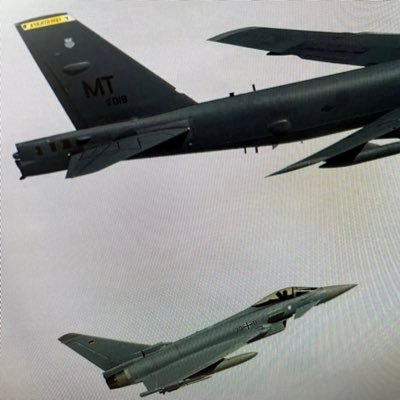
@SlawomirDebski Indeed. There will no longer be a Nato if Europeans gear it against the US, however inadvertently.
Lest we forget, Putin's and Xi's common goal is the psy disruption of the alliance. Once they sense a psy breakthrough, they will agree that Putin seizes that fateful moment.
English

My readers know I was not among Mark Rutte’s enthusiasts for the job. But the criticism now being thrown at him misses the point.
The Secretary General of NATO is not a commentator, nor a political influencer. He is, quite simply, the system’s maintenance mechanism. His primary task is to keep NATO alive - coherent enough to function, flexible enough to survive the political cycles of its members, and relevant enough to deter its adversaries. That is what he was hired to do.
In today’s conditions, this is an exceptionally difficult assignment. The Alliance is navigating diverging threat perceptions, electoral volatility, and a shifting transatlantic balance. In such an environment, rhetorical discipline and a degree of diplomatic accommodation are not signs of weakness; they are tools of institutional survival.
The real constraint is not the Secretary General’s tone, but the political will of member states themselves.
Blaming Rutte for not “taking sides” misunderstands the office. His role is not to satisfy audiences on social media or to correct the messaging of national leaders. It is to prevent fragmentation. And in that sense, he is doing precisely what the job requires- no more, no less.
Olivier Schmitt@Olivier1Schmitt
.@NATO has a SecGen problem. The carpet in human form that is @SecGenNATO keeps publicly praising whatever Trump does, being at odds with other NATO members. And this raises expectations in the White House about what NATO should do. But Rutte is supposed to make *all* the member states happy, not just Daddy.
English

@MKLan13 @visegrad24 Trump likes acts of war but not wars. And Congress would like that even less.
English

@visegrad24 😂
Why bother. If the US really wanted to take it, it would be taken.
Like it or not.
English

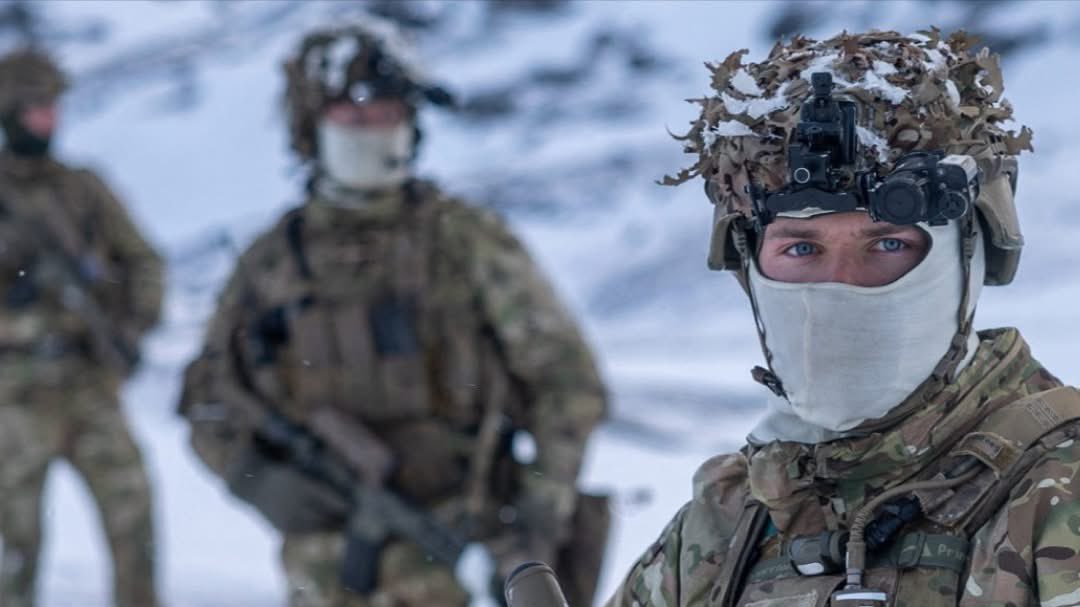
Denmark was ready to blow up Greenland runways if the USA invaded.
The Danish military sent explosives and blood supplies to Greenland in January as part of contingency planning for a US attack, as tensions with Trump escalated. 🇩🇰🇬🇱🇺🇸
English
Blaz Bratovic がリツイート

ASML's EUV scanners will be the last machines on Earth to lose helium. Party balloons will be the first to go. Helium is not manufactured. It is a byproduct of uranium and thorium decaying deep underground over billions of years. Vent it and it escapes to space. Permanently. A third of the global supply went offline when Qatar's Ras Laffan plant was hit on March 2. The rationing has already started. Here's what happens:
Day 1. Party balloons. Distributors cut retail supply immediately.
Day 7. Industrial welding and pressurization. National allocation kicks in. Switch to argon where possible.
Day 14. Routine fab leak detection switches to hydrogen. Ultra-sensitive qualification still needs helium.
Day 21. MRI machines. Older systems that vent helium cannot get refills. Elective scans delayed.
Day 45. Global buffer depletes. Fabs enter conservation mode. Non-critical depositions switch to nitrogen.
Day 60. Backside wafer cooling on older etch tools. Nitrogen conducts heat six times slower. Throughput drops.
Day 90. High-power etch. Advanced memory and logic nodes cannot run without helium-grade cooling. Wafer production drops.
Day 120. ASML's EUV lithography tools. $200 million scanners making the highest-value wafers on Earth. Leading-edge chip production stops.
Day 240. $700 billion in data centers are being built this year. Higher GPU prices, delayed cluster expansions, slower scaling.
Four months from birthday balloons to AI chip shortage.
Balaji@balajis
I'm going to make some obvious points. (1) Blowing up all the oil infrastructure in the Middle East is an insane idea, and may well result in a global economic crash and humanitarian crisis unrivaled in the lives of those now living. We're talking about the price of everything everywhere rising, from food to gas, at a moment when inflation was already high. All of that will be laid at the feet of the authors of this war. (2) The antebellum status quo of Feb 27, 2026 was just not that bad, but we're unlikely to return to it. Expect indefinite, long-term, ongoing disruptions to everything out of the Middle East. (3) Also assume tech financing crashes for the indefinite future. The genius plan to get the Gulf states caught in the crossfire has incinerated much of the funding for LPs, for datacenters, and for IPOs. Anyone in tech who supported this war may soon learn the meaning of "force majeure" as funding gets yanked. (4) Many capital allocators will instead be allocating much further down Maslow's hierarchy of needs, towards useful basic things like food and energy. (5) It's fortunate that all those progressives yelled about the "climate crisis." Yes, their reasoning about timelines was wrong, and much of the money was wasted in graft, but the result was right: we all need energy independence from the Middle East, pronto. It's also fortunate that Elon and China autistically took climate seriously. Now they're going to need to ship a billion solar panels, electric vehicles, batteries, nuclear power plants, and the like to get everyone off oil, immediately. (6) It's not just an oil and gas problem, of course. It's also a fertilizer problem, and a chemical precursor problem. Maybe some new sources will come online at the new prices, but it takes time to dial stuff up, particularly at this scale, so shortages are almost a certainty. That said, China has actually scaled up coal-to-chemicals[a,c] (C2C), and there's also something more sci-fi called Power-to-X[b] which turns arbitrary power + water + air into hydrocarbons. But all of that will need to get accelerated. I have a background in chemical engineering so may start funding things in this area. (7) Ultimately, this war is going to result in tremendous blame for anyone associated with it. It's a no-win scenario to blow up this much infrastructure for so many people. Simply not worth it for whatever objective they thought they were going to attain. But unless you're actually in a position to stop the madness, the pragmatic thing to do is: scramble to mitigate the fallout to yourself, your business, and your people. [a]: reuters.com/business/energ… [b]: alfalaval.com/industries/ene… [c]: reuters.com/sustainability…
English
English

English
Blaz Bratovic がリツイート

On Tuesday, I testified before the House Homeland Security Committee on China's strides in robotics and AI. I warned that we lost solar, batteries, and EVs -- now we're at risk of losing robotics and AI.
If that happens, it would irreversibly change the balance of power.
Five points:
1️⃣ China aims to win the next industrial revolution. PRC leaders believe history is shaped by industrial revolutions. The first, steam power, made Britain dominant. The second and third, electrification and mass manufacturing, made America dominant. China is determined to win the fourth.
2️⃣ In robotics, China is already winning. In 2024, China installed 300,000 new industrial robots. America installed 30,000. China now has over 2 million robots in its factories — five times more than the US. A decade ago, it imported 75% of its robots. Today it makes 60% domestically. This year alone, China may spend $400 billion on industrial policy. The entire US CHIPS Act provided $50 billion across multiple years. If we fall behind here, U.S. reindustrialization becomes farfetched.
3️⃣ In AI, we're ahead — but selling off the advantage. China has more energy, more talent, and makes the edge devices. But America still leads because of chips, according to China's own AI companies. US chips are 4-5x better than China's today. We are debating whether to surrender that edge.
4️⃣ We are inviting risks of cyberespionage and catastrophic cyberattacks. PRC law requires its companies to cooperate with intelligence services and never disclose it. Today's robots carry LiDAR, microphones, and cameras — they are mobile surveillance platforms. But the bigger risk is cyberattack. We know China has compromised our power, gas, water, telecommunications, and transportation infrastructure in preparation for cyberattack. We cannot deploy robots in sensitive facilities from the very country targeting those facilities.
5️⃣ Here's what we must do. Extend ICTS rules to cover Chinese robots. Direct CISA to audit where they're deployed in critical infrastructure. Ban federal procurement of Chinese robotics and AI. Strengthen semiconductor export controls. Stop treating American AI companies with more regulatory scrutiny than Chinese ones. And build allied scale in robotics—a trading bloc with preferential terms for the members that can rival China's scale in in the sector.
Thanks to @HomelandDemsIt and @HomelandGOP for the hearing on this topic, and grateful to join @MRobbinsAUVSI and colleagues from Scale and Boston Dynamics for a great discussion.
English
@BrunoTertrais He didn't really say what the tweet claims (and I "hate" JD Vance).
English

The moral depravation of this administration is beyond repair
Molly Ploofkins@Mollyploofkins
Vance says Americans should find comfort in the fact that our allies are "suffering more than we are" from high gas prices
English