Tzur lab

1.7K posts

Tzur lab banner
Tzur lab

Tzur lab

@LabTzur

Yonatan Tzur's laboratory @GeneticsDepart1 of @HebrewU focusing on #meiosis, #germline and genome engineering

Jerusalem, Israel 参加日 Ekim 2018
558 フォロー中610 フォロワー
固定されたツイート
Tzur lab
Tzur lab@LabTzur·
Please RT: The Tzur lab at the Hebrew University is looking to recruit post docs and graduate students to study germ cell development and fertility using C. elegans and human oocytes. Candidates can apply via: tzur-lab.wixsite.com/tzur-lab or email: tzur@mail.huji.ac.il
Tzur lab tweet media
English
1
47
46
0
Daniel Bar
Daniel Bar@DanielB66026256·
Our paper "Reversible and Causal Epigenetic Information Loss in Liver Aging and Disease" is out! Thanks to Roni and Naor for the hard work, and to our great collaborators @goldstein_lab and Noga Korenfeld. Links in the first reply
English
2
2
4
268
Tzur lab がリツイート
Philippos Papathanos
Philippos Papathanos@phiC32·
New preprint! 🦟🧬The key to engineering daughter-killing in mosquitoes isn't what X-linked gene you target with CRISPR. It's when during sperm development you cut it. X-poisoning in Anopheles at last. shorturl.at/T31TG
English
1
3
8
338
Eran Meshorer
Eran Meshorer@meshorer1·
It's finally out! @WalaaOweis work confirms Finkbeiner's observation that polyQ Inclusion Bodies are protective in iPSC-derived neurons, and identifies a key pathway for their formation involving ATF3. Check it out!👇🔥🔥🔥 @SpringerNature rdcu.be/fbjil
English
8
6
30
2.8K
Tzur lab がリツイート
Misha Teplitskiy | Science of Science
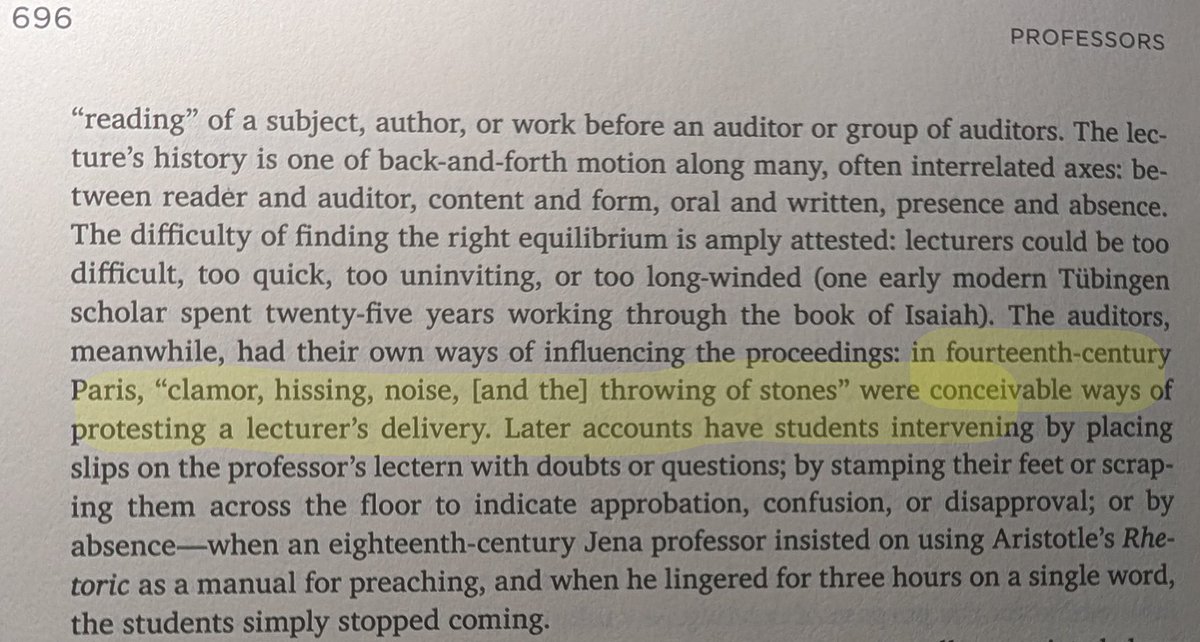
Professors today: "Wahh, wahh, my students gave me bad course evaluations and it hurt my feelings 😞😞😞" Professors in 14th century Paris: "I gave a bad lecture and the students threw stones at me"
Misha Teplitskiy | Science of Science tweet media
English
13
453
4.1K
101.1K
Tzur lab
Tzur lab@LabTzur·
Once again it took time and effort to show the community that a "weird C. elegans thing", is actually conserved in evolution.
Oded Rechavi@OdedRechavi

A new mechanism for “RNA memory”! 😱 Thrilled to share another crazy paper from the lab (can’t believe we posted 2 in 2 days!), summarizing >10 years of research: Work on transgenerational inheritance of small RNAs in the powerful model organism C. elegans changed how we think about what’s possible in inheritance and evolution, because it allows the most heretical thing: inheritance of parental responses to the environment! However, it’s still unclear whether RNAs are inherited across generations in other animals, largely because the RNA-dependent RNA polymerases that amplify heritable small RNAs and prevent their dilution in C. elegans are not conserved in mammals. In this new work, an amazing collaboration with the Rink and Wurtzel labs, we show that planarians establish long-lasting and heritable small RNA–based gene regulatory states despite lacking canonical RNA-dependent RNA polymerases and nuclear RNAi machinery (that are required in C. elegans). You might say “they are both worms…” BUT planarians are evolutionarily very distant from C. elegans (flatworms vs. roundworms, diverged more than 500 million years ago), making this particularly surprising. These are totally different animals. We find that ingestion of double-stranded RNA induces sequence-specific silencing that persists for months and survives repeated cycles of whole-body regeneration. Even more strikingly, RNAi can be transferred between animals, echoing James V. McConnell’s controversial “RNA memory” experiments from the 1970s (his lab was targeted by the Unabomber terrorist Ted Kaczynski, who sent McConnell a bomb. This and other controversies ended this line of experiments…) Mechanistically, we find that the response transitions from a transient systemic dsRNA-triggered phase to a stable, cell-autonomous post-transcriptional “memory phase” maintained by antisense small RNAs. Using a new luminescence reporter (transgenesis is currently impossible in planarians), we show that silencing spreads along the targeted gene and identify a weird type of planarian small RNAs with untemplated polyA tails. RNAi inheritance without canonical RdRPs establishes planarians as a powerful system for studying RNA-based regulatory inheritance beyond C. elegans and raises the possibility that RNA-mediated inheritance may be more broadly conserved in animals, potentially even in mammals. Here’s a video of a planarian that is treated by RNAi against β-catenin and develops multiple heads instead of just one. This is one of the phenotypes that is inherited. Another phenotype is “loss of eyes” (which we show is not only inherited across multiple regeneration cycles, but can also be transmitted between animals in transplantation experiments). Amazing work led by first authors Prakash Cherian and Idit Aviram (co-supervised by Omri and me). Please read the preprint, the link is in the next tweet, and share!

English
3
2
17
4.4K
Tzur lab がリツイート
Igor Ulitsky
Igor Ulitsky@IgorUlitsky·
Version of Record now out in @eLife elifesciences.org/articles/106846, after a great review process. Mega project by the mighty @AlanMonziani . I thought we're done with EPB41L4A-AS1, but reading the proofs gave me some more appetite, so who knows?
Igor Ulitsky@IgorUlitsky

New preprint 📜 from @AlanMonziani in the lab – EPB41L4A-AS1 long noncoding RNA acts in both cis- and trans-acting transcriptional regulation and controls nucleolar biology biorxiv.org/content/10.110… . A🧵 1/n

English
1
4
22
2.3K
Tzur lab がリツイート
Oded Rechavi
Oded Rechavi@OdedRechavi·
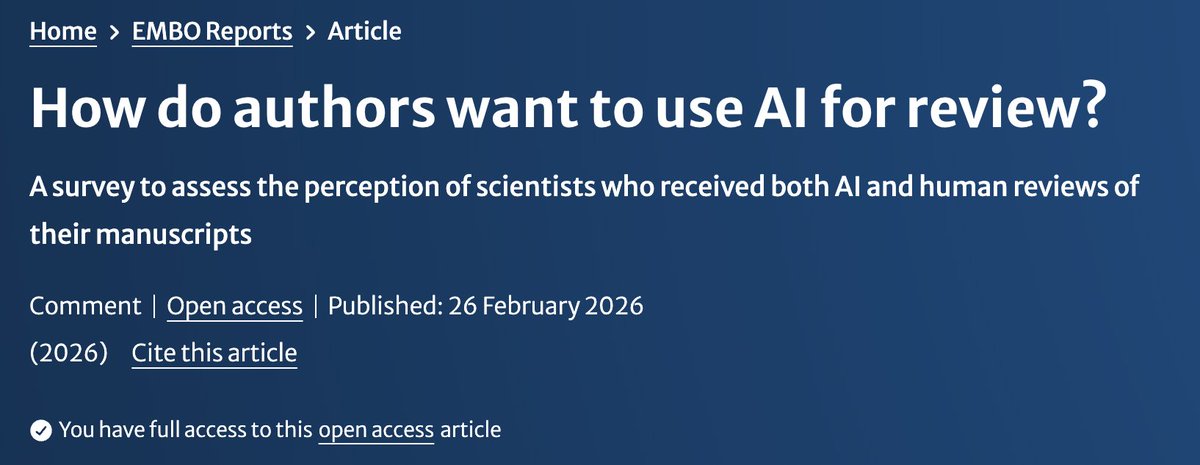
It’s finally out! Together with @EMBO and @ReviewCommons, we conducted a structured side-by-side comparison of human peer review and our AI scientific review. Here’s what we did: Authors whose manuscripts had already received journal-agnostic review at Review Commons were provided with an independent AI review generated by @qedScience. The AI analysis was compared to the combined feedback of multiple human reviewers, not to a single report, and had no access to those reviews. We then asked authors how they evaluate the strengths and limitations of both approaches, and how they would actually want to use AI. The conclusion was clear: Scientists want AI feedback to strengthen their work IN ADVANCE, under their control. Not as a gatekeeper, but as a tool for constructive input. That is exactly what we are building at q.e.d! We are on the authors' side. q.e.d. is not working in isolation; we are collaborating with leading pro-scientists organizations, including EMBO (and other journals), Review Commons, and OpenRxiv (@biorxivpreprint), and are working closely with researchers across fields. At the same time, we are building an alternative model that puts agency directly in scientists’ hands. Researchers should be the ones deciding when their work is ready to be shared. We are building the infrastructure to support that. A pleasure doing this with the great Thomas Lemberger @tlemberger and Niv Samuel Mastboim @nivmast
Oded Rechavi tweet media
English
5
64
222
34.9K
Tzur lab がリツイート
Scholarship for PhD
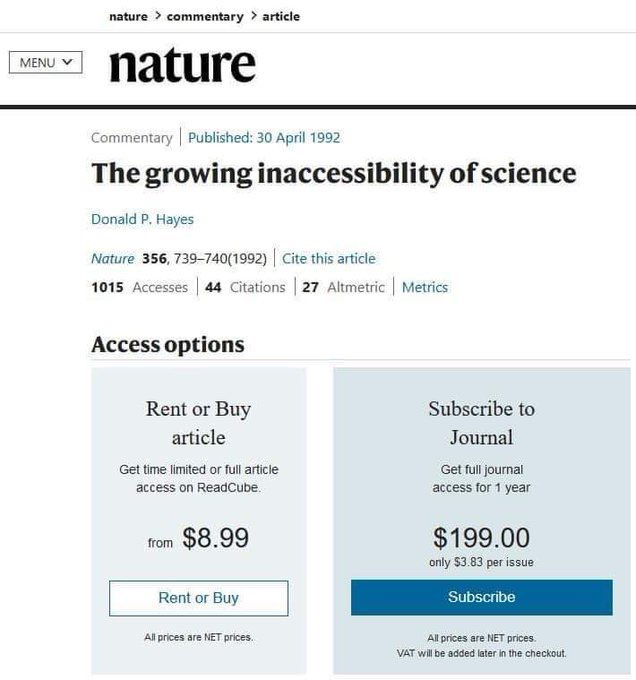
Scholarship for PhD@ScholarshipfPhd·
The irony
Scholarship for PhD tweet media
English
43
1.2K
5K
167.3K
Tzur lab がリツイート
Alper Akay
Alper Akay@alperakay_·
Our collaborative work with @DimitriadiLab is now out. Thanks for having us involved. “Widespread intron retention and exon skipping characterise alternative splicing changes in a C. elegans model of spinal muscular atrophy” academic.oup.com/hmg/article/do…
English
1
2
7
503