
Robert Koopman
2K posts
Robert Koopman
@RBKoopman
International trade and development economist. American University SIS, DC, former Chief Economist at the World Trade Organization & Graduate Institute, Geneva.
Washington, DC 参加日 Nisan 2017
275 フォロー中3.4K フォロワー

And, setting aside tonight's deadline/ the risk of an immediate oil shock to the extent possible, the facts here do suggest a need for urgency. China is getting 1.5 pp of growth from net exports (and export growth accelerated into the end of the year). That's a problem
/end

English
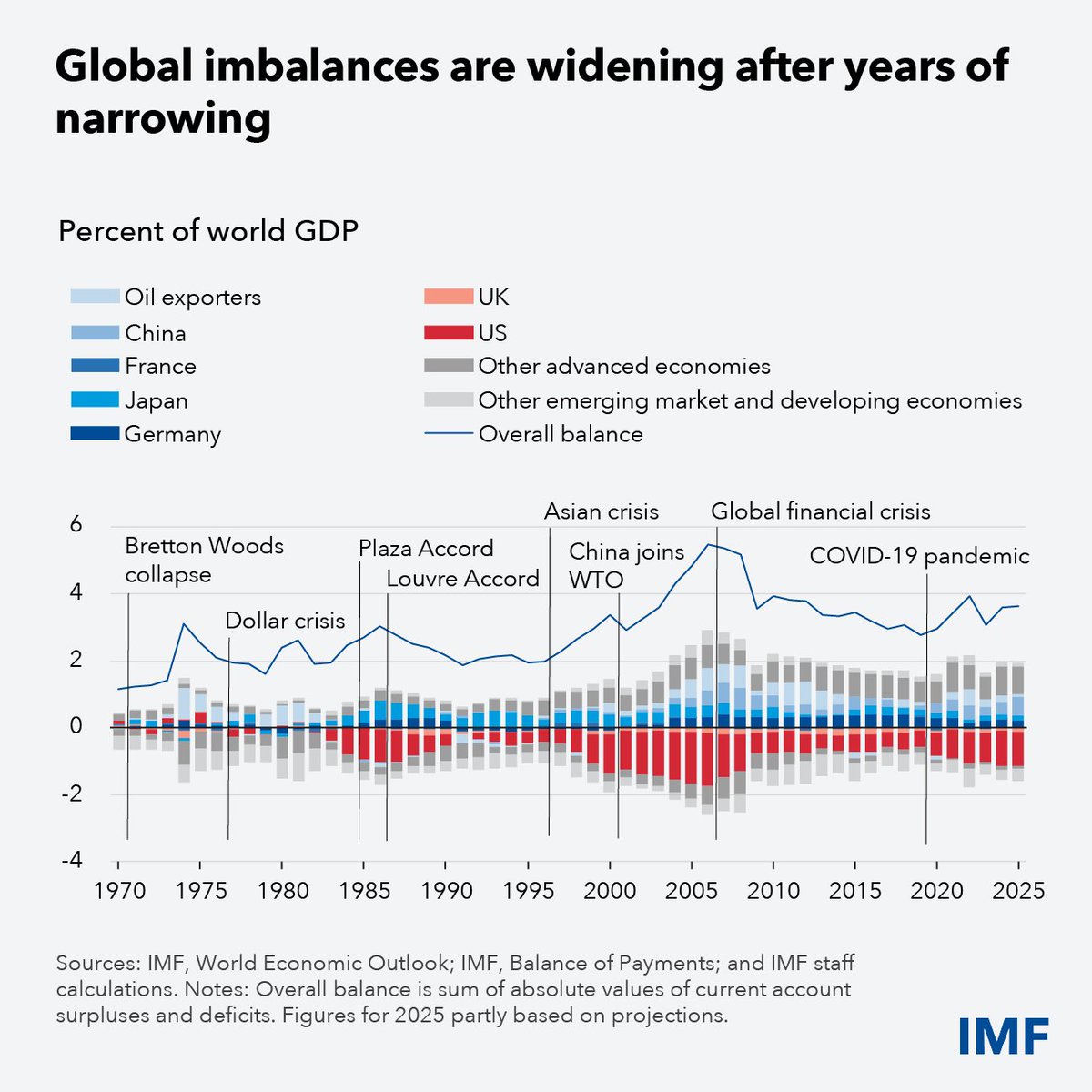
Happy to see the IMF has noticed the expansion of global current account imbalances --
And guess what, the IMF seems to have rediscovered the idea that currency manipulation can drive imbalances (though manipulation has been renamed "macro-industrial policy" ... )
1/ many
English
@HectorRTorres2 @PoderMentalX @danielkampel As we say in economics - everything is relative…we pick something as the point for a relative measure of those things? I don’t believe physics requires it to be stationary.
English

@PoderMentalX @danielkampel Pregunta de ignorante: Cuando uno se desplaza, se desplaza respecto de algo (que usamos de referencia para calcular velocidad, distancia y dirección). Pero cuando todo se desplaza en un universo infinito ¿cómo calculamos velocidad y distancia y dirección)nos parece inmóvil
Español

Mientras dormías anoche, completamente inmóvil en tu cama, nuestra galaxia se desplazó millones de kilómetros a través del cosmos. Te despertaste en la misma habitación, en el mismo planeta, pero inimaginablemente lejos de donde estabas la noche anterior.
La Vía Láctea no se desliza silenciosamente por el universo. Está corriendo a través del espacio a unos 600 kilómetros por segundo, llevando consigo miles de millones de estrellas, planetas y todo lo que hay en ellos en el viaje.
Es un buen recordatorio de que incluso cuando la vida parece inmóvil, siempre estás en movimiento.
Español
@michaelxpettis The real problem is the IMF-WTO institutional silo — macro surveillance that never informs trade rules, and trade disciplines that ignore S-I fundamentals. A solution is coherence architecture between these institutions, not a new mandate for one that was never designed for it.
English
9/9
what kinds of trade imbalances are positive for global growth and what kinds are negative, and to arrange its work around supporting the former and constraining the latter. Otherwise it is just a bureaucracy that benefits no one.
English
1/9
The FT argues that the WTO was further wounded in the recent Yaoundé meeting. This was probably inevitable. Unless the WTO arranges a transformation of its role in global trade, it is hard to see its continuing relevance.
ft.com/content/24894a…
English
@michaelxpettis I think Pettis correctly diagnoses the macro-trade interface failure — WTO-compliant behavior can still be globally harmful. But the fix isn't asking the WTO to relearn Keynes. The IMF already has the surplus/deficit assessment tools (EBA, ESR). 1/2
English
@NOIweala @dartmouth Congratulations @wto, @NOIweala and Bob Staiger - critical time for global trade cooperation and members to think out of the box and start the process of creating the WTO for purpose in the 21st century.
English
A big welcome to our new WTO Chief Economist Prof Bob Staiger who started work today. Prof Staiger, one of the foremost economists in international trade policy, joins us from Dartmouth @dartmouth where he is the Loren M Berry Professor of Economics.


English
Strange as it may seem, Sahara dust makes for wonderful Swiss sunsets
🔗 meteoswiss.admin.ch/weather/weathe…

English
@NOIweala Thank you for your support of this work Ngozi - and for your continued efforts to ensure the multilateral trading system remains central to global commerce - and adapts effectively to a changing global economy.
English
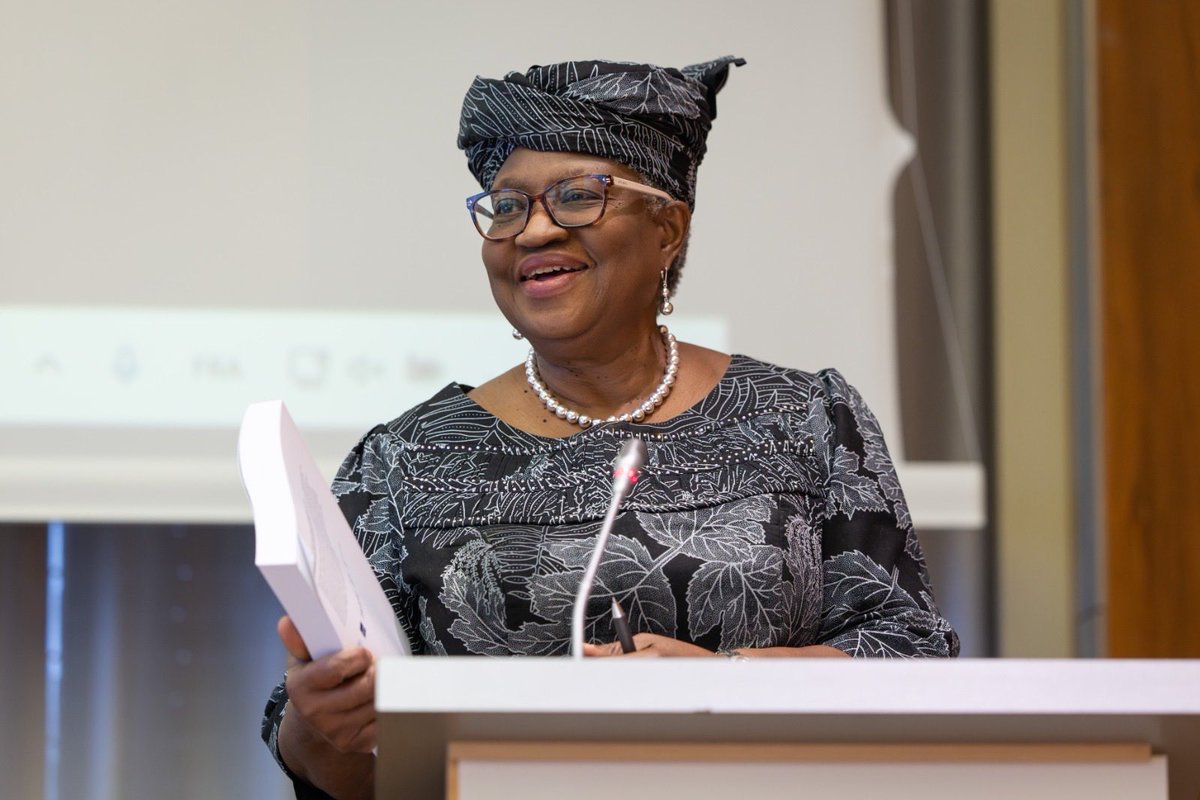
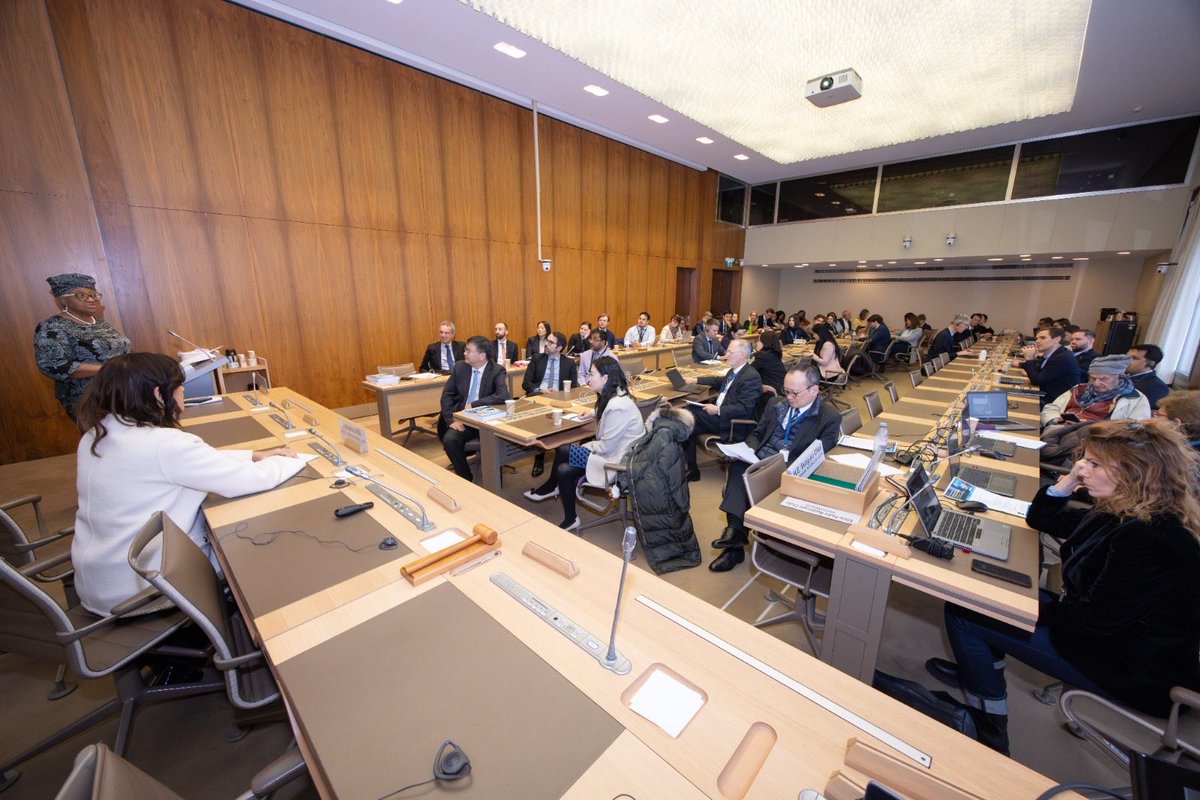
Participated in the launch of the important 2025 Global Value Chain Development Report to which the WTO has been a contributor since inception in 2017. Together with our partners, the Asian Development Bank, University of International Business and Economics in Beijing (UIBE), and the Institute of Developing Economies (@ide_jetro_eng), Japan. Many thanks to our former Chief Economist Robert Koopman @RBKoopman of the American University, Washington, DC, who served as the Editor in Chief of the report. Thanks to Albert Park, Chief Economist of @ADB_HQ, Zhao Zhongxiu, President of UIBE, and Fukunari Kimura, President of IDE-JETRO, for their participation. The report‘s key finding is that Global Value Chains are evolving in response to economic, technological and geopolitical pressures but they remain the backbone of the world economy with the GVC share in total trade registering just a small decline from its 2022 peak of 48% to 46.3% in 2024.

English
Please do join us in person or online for this report launch. Trade remains reslilient. We show how and why.
WTO@wto
📘 Launch of the Global Value Chain Development Report 2025 Join us on 15 December to explore how technological change, the green transition & geopolitics are reshaping global value chains. Opened by DG @NOIweala. Registration & programme: bit.ly/3KzQoMT
English
Want to learn about how global trade and gvcs are re-wiring in a changing global economy? Join us on Dec 18 at American University for the launch of the Global Value Chain Development Report 2025. Here is the registration link for the event - eventbrite.com/e/washington-l…
English
The Washington DC launch of the Global Value Chain Development Report 2025 - Rewiring GVCs in a Changing Global Economy will be on December 18 at 1 pm @ AU's School of International Service as part of AU's Trade Today program. Bookmark the date & look for the reg. link soon.

English
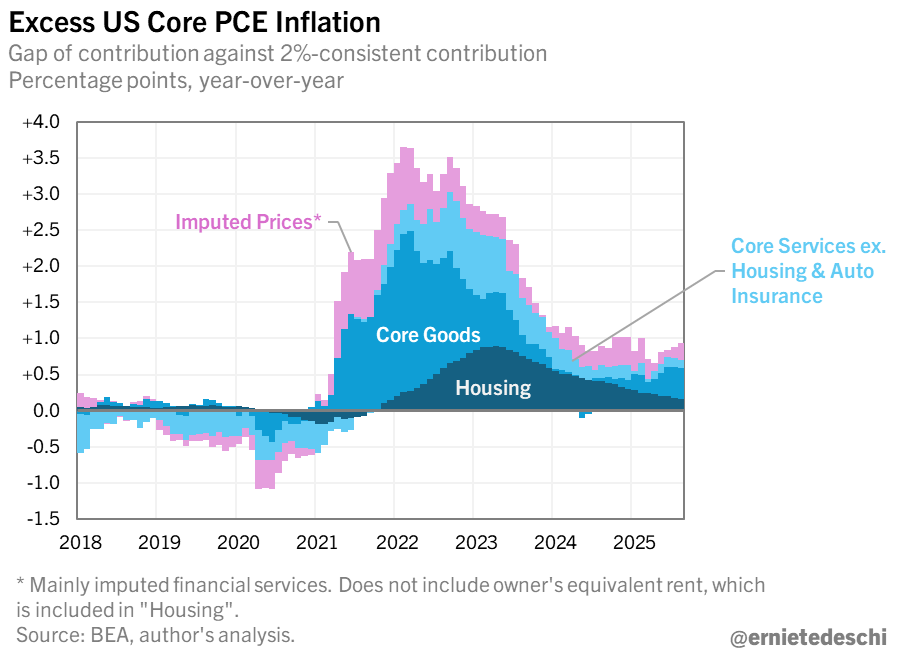
@ernietedeschi @davidjlynch So the bigger surprise is the reacceleration in goods prices, which had been the main disinflation engine? Goods are now contributing almost half a percentage point of excess inflation, or about ten times what they contributed last year. Gee, wonder what’s causing that?
English

Core services ex housing is firmer than normal; ~2/3 of its excess 35bps contribution to core PCE inflation comes from imputed prices like financial services, which are highly market sensitive.
By contrast, ~40-45bps of excess inflation stems from core goods, vs ~5bps a year ago.
English
@LucaFornaro3 I have long argued that rapid Chinese growth and productivity gains adversely affected growth in other countries - particularly developing countries. That said the negative growth impacts are small and represent a possible headwind on growth not an actual decline.
English
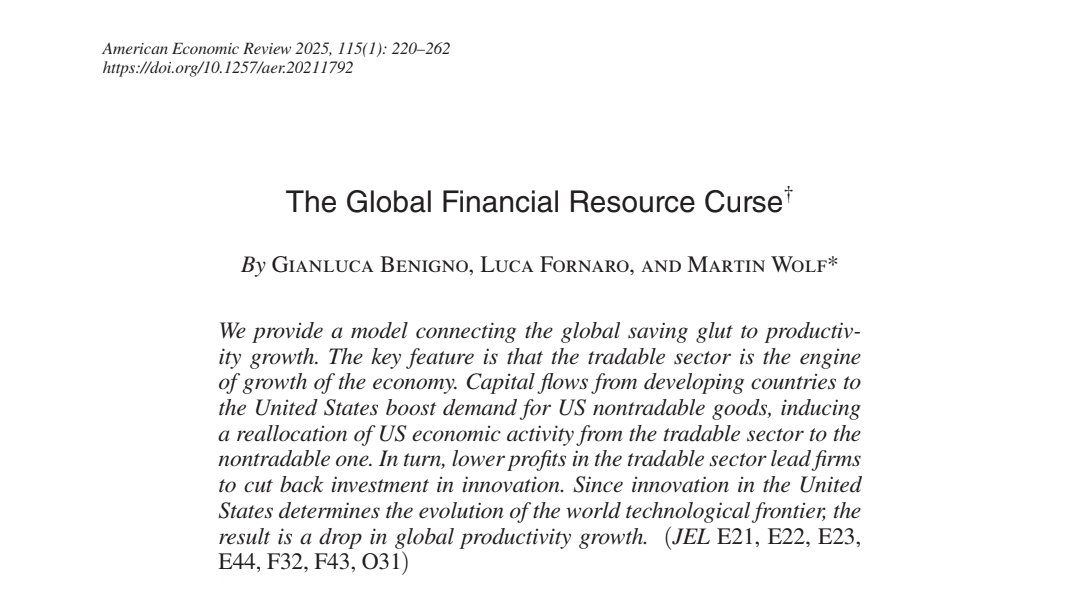
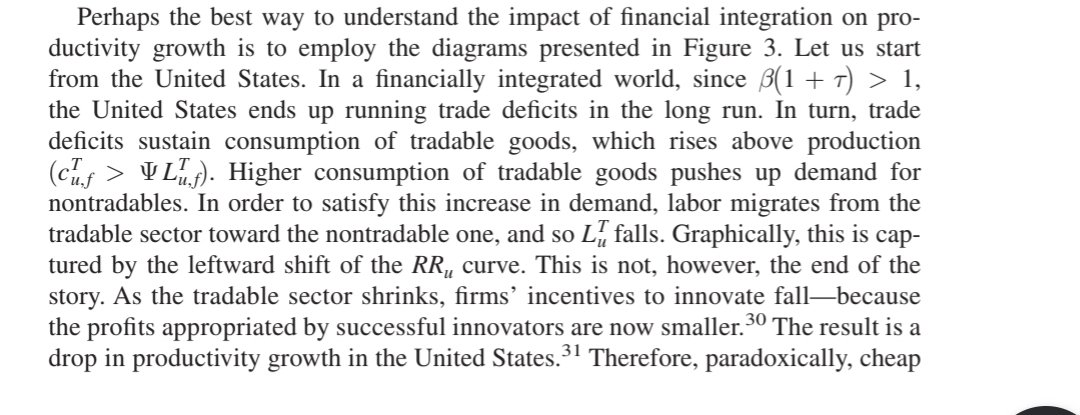
Here's a possible explanation. Higher exports from China crowd out production of high-tech goods and innovation in the rest of the world. Over the medium term, GDP in the rest of the world drops because of lower productivity growth.

Greg Ip@greg_ip
1/ Fascinating and important report from Goldman Sachs. They have upgraded long-term GDP of China because of increased exports, but see this as reducing, not increasing, rest of world GDP. Chinese displacement of domestic manufacturing swamps any positives from cheaper goods.
English
I will also participate in a World Bank panel on November 20 celebrating the 5th anniversary WDR2020 report on GVCs. worldbank.org/en/events/2025…
English
I will participate in a discussion panel at the IMF 13th Statistical Forum on 19-20 November 2025, which is devoted to the topic of “Measuring Cross-Border Economic and Financial Linkages in a Dynamic World”.
Register and join us here: imf.org/StatsForum
#StatsForum #IMFData
English

@RBKoopman @ModeledBehavior @ericadyork I had always assumed that the rent sharing was a mistake by people who didn’t understand the economics of quotas. But you’re saying it was intentional statecraft?
(Not disputing, just trying to learn.)
English

One interesting bit of history on the question of whether Reagan was a free trader is the Voluntary Export Restraints placed on cars from Japan in the early 1980s.
You might be tempted to see this as proof Reagan wasn't a free trader. But its important to ask a few questions. First, why was the restraint VOLUNTARY, meaning it was imposed by the Japanese and not the US? Second, why not just use tariffs which would be equivalent but raise revenue for the US government instead of allowing the higher prices of reduced quantities to benefit Japanese automakers?
The reason was because Reagan himself believed that even asking Japan explicitly for a quota would violate his free trade principles. In his memoirs Reagan wrote that he "wondered if there might be a way in which we could maintain the integrity of our position in favor of free trade while at the same time doing something to help Detroit and ease the plight of its thousands of laid-off assembly-line workers."
This lead the Reagan admin to try hard as the could to communicate to Japan they wanted a quota without actually saying they wanted it or how much it should be. They tried to portray themselves as playing "good cop" and heading off much worse protectionism in congress.
Its undeniable VERs represented a violation of free trade principles. You can't dismiss that at all. But its important to understand that Reagan was trying to square this with his free trade principles, not just loudly rejecting his principles. I don't think he succeeded, but it shows how important he himself saw the principles of free trade.
Stephen Cohen has a great detailing of this how played out: nsarchive2.gwu.edu/japan/scohenwp…
And if you want to understand the economic effects, here is my long essay on this: eig.org/myths-and-less…
English
@DaveEvansPhD Much of my career was telling US policy makers what they needed to hear - not what they wanted to hear.
English
@DaveEvansPhD It is absolutely necessary. And not just for that institution.
English

"An independent research function at the World Bank isn’t a luxury; it is a necessity for the integrity, learning, and credibility of the institution."
Charles Kenny@charlesjkenny
The World Bank Group is planning to reorganize its research functions. The results could be even uglier than the powerpoint: an end to independent research at the institution and conflicts of interest all over... New blog with @eeshani, link in reply.
English
@BaldwinRE @FabioGhironi Exactly. Was discussing this in class the other night. This wild array of different tariffs on different goods, with more likely coming, takes us back to Corden and many classics.
English
Trump admin rediscovers “Effective rate of protection” theory:
➡️💥Raising tariffs on inputs lowers protection of downstream goods💥
👉 DoC it was hiking steel & aluminum tariffs on numerous auto parts
🤷♂️Now plans to offset the resulting disincentive to assemble in USA👇
👉 DoC planned an “import adjustment offset” equal to 3.75% of the retail price for US assembled vehicles

English