Cloud Labs
11.1K posts

@cloudtechvn
🧑💻 I’m a Web3 Dev OG – Project Pioneer, Early Investor, and Node Operator!🚀💻 🤝 Magnitude at @SeismicSys


Gmic Fam 👋 I created a legendary Seismic card and named it "Keeper of the Key." This artwork represents the power, creativity, and energy of the @SeismicSys community. If you like “Keeper of the Key” and want to be part of it, send me your PFP and I’ll turn it into your own Seismic card in this style. Let’s fill the Seismic universe with new Keepers of the Key. @NoxxW3 @xealistt @lyronctk @heathcliff_eth

What is Utexo? Put simply I don’t see @utexocom as a new chain, but rather as an execution and settlement layer for stablecoins on Bitcoin. Instead of selling the infinite 🟢TPS narrative🟢, it seems to focus on something much more practical: helping operators process stablecoin payments with more predictable costs. In simple terms: ✅ Bitcoin is the security/settlement anchor ✅ RGB is the asset layer ✅ Lightning is the fast payment layer ✅ Utexo is the layer in between, bringing everything together into infrastructure that is easier to integrate for payments ✍️ Personally, I think this is a fairly pragmatic approach. It doesn’t overpromise. Instead, it goes straight to a more important question: If stablecoins are meant to become truly usable for payments, then what kind of infrastructure can make costs stable enough and operations simple enough? Utexo seems to be trying to answer that question by building on top of Bitcoin, rather than away from it.



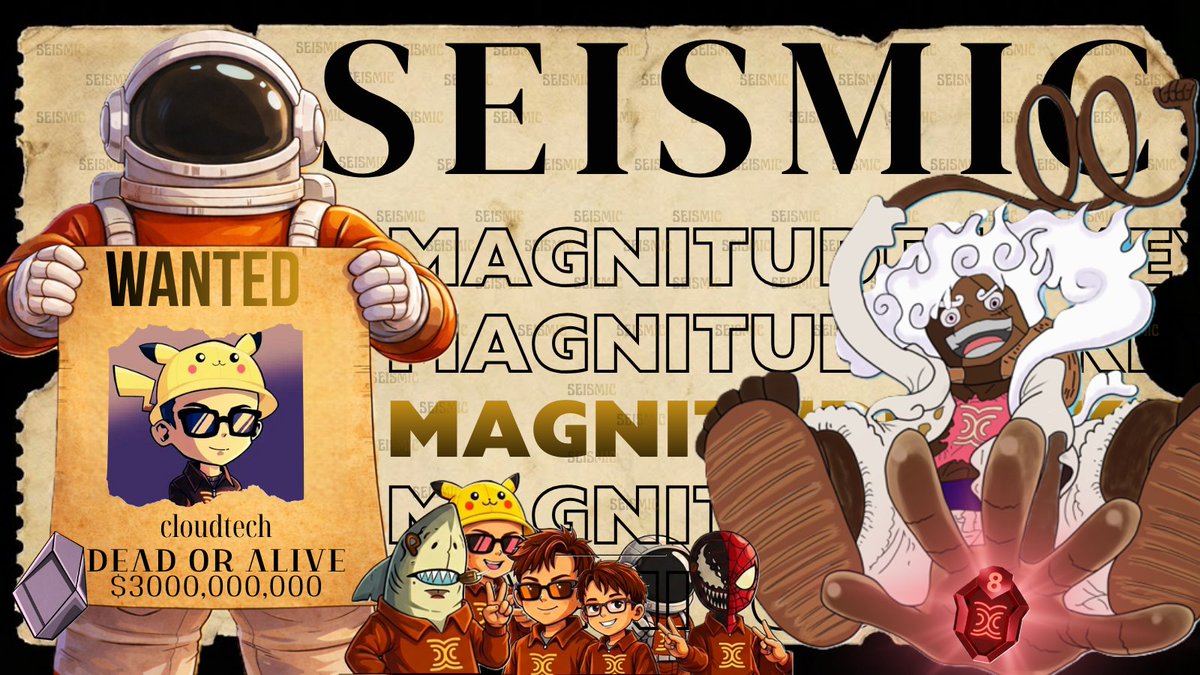
Here’s a quick sketch I’m working on about the @SeismicsysVN community. ✏️ Can you guess who might appear in this drawing? @SeismicSys @NoxxW3 @xealistt @heathcliff_eth @lyronctk

Reminder: DNS twins are live. Your existing DNS domain can now function as an ENS-compatible name. Find your twin 👇 doma.xyz/ens

MPC. FHE. TEEs. All powerful on their own, but none solve the coordination problem. The hard part isn’t just encrypting computation; it’s the orchestration required to make it functional and secure. That’s what Rialo Extended Execution (REX) does. REX is a protocol-level orchestration system for confidential computation that manages the entire lifecycle of a secure request: Program Governance – Programs to be executed are verified and approved for specific execution runs before they ever touch the core. Encrypted Routing – Encrypted inputs are routed cryptographically to a computation core only after the appropriate program logic is loaded. Explicit Consent – Computation is performed only after explicit authorization from both the application and the user, enforced by strict policy. Confidential Compute Core – Secure execution using MPC, FHE, or TEEs, including protected Web2 API calls within an isolated environment. Verifiable Outputs – The system generates and verifies cryptographic attestations that prove a specific computation was correctly executed before routing the result to its destination. REX transforms Rialo into infrastructure for real-world secure computation: Private AI agents that process personal data without seeing it. Sensitive enterprise workflows that maintain competitive secrecy. Authenticated API automation for secure, off-chain interactions. Verifiable off-chain compute with immutable on-chain guarantees. This is native privacy at the protocol layer. Get Real. Get Rialo.


DNS domains now compose 90%+ of our business, and as we move to get several of our TLDs also listed in ICANN over the next few years our focus will continue to grow on the DNS and traditional internet market. We expect that 2-3 years from now DNS and the traditional web will be 99%+ of our business. For this reason you'll see updates on our site to reflect our new focus on traditional web2 domains. This is intentional. Web3 only domains were part of the crypto craze in 2021 but did not cross the chasm into mainstream usage. And for a while now we have believed they will remain a niche market now and into the future. They were a great place to start our journey into domains, but going forward our focus will be even more on the traditional market as it's the market that has crossed the chasm and is seeing mainstream usage.

DNS domains now compose 90%+ of our business, and as we move to get several of our TLDs also listed in ICANN over the next few years our focus will continue to grow on the DNS and traditional internet market. We expect that 2-3 years from now DNS and the traditional web will be 99%+ of our business. For this reason you'll see updates on our site to reflect our new focus on traditional web2 domains. This is intentional. Web3 only domains were part of the crypto craze in 2021 but did not cross the chasm into mainstream usage. And for a while now we have believed they will remain a niche market now and into the future. They were a great place to start our journey into domains, but going forward our focus will be even more on the traditional market as it's the market that has crossed the chasm and is seeing mainstream usage.


Only a few days left until DeCo kicks off! ♾️ For those attending, don't forget @MurielMedard will be hosting a prep session on Sunday at MIT, perfect for brushing up on your decentralized coding basics before the conference begins. Details on the Luma page ⬇️


Coordinating institutional capital into the Pharos RealFi Ecosystem Vault, @yield_network acts as the onchain bookrunner, organizing capital formation and aligning RWA issuance with professional allocator standards. More info - yieldnetwork.io #PharosRealFiAlliance

BFT consensus protocols in production blockchains suffer from two problems: Upgrading them is a nightmare involving complex coordination and expensive downtime They can't handle a complete committee swap without disrupting network operation Rialo solves both with Gauss. Gauss lets Rialo hot-swap consensus protocols and validator sets without a second of downtime. It introduces a clean separation between a consensus protocol's inner log and a sanitized outer log. It allows committee membership, failure thresholds, and the consensus protocol itself to evolve independently. The Gauss paper has been officially accepted. Take a sneak peek at the paper written by Subzero’s very own @allenclement, @natachacrooks, @neilgiridharan, and @aleak 👇


Im assembling a team... March 23-24 we're hosting DeCo at MIT-- featuring the top researchers, builders, and investors who are working on decentralized coding. The goal: Find out how we can apply decentralized coding to solve blockchain's biggest problems.