HashAndHustle

1K posts

HashAndHustle

HashAndHustle

@techbro_1a

swe. I like the stock market & AI/tech

rabbit holes 参加日 Aralık 2020
1.2K フォロー中269 フォロワー
Marouane Lamharzi Alaoui
Marouane Lamharzi Alaoui@marouane53·
I'm really blown away by GPT Images 2 intelligence. I used it to turn @polynoamial’s thesis on imperfect-information games into a kids-style explainer poster, and it didn't just make something cute, it made something that captures the real ideas surprisingly well. Text-to-image is evolving into something much bigger than making pretty pictures. It's starting to become a real interface for understanding knowledge.
Marouane Lamharzi Alaoui tweet media
English
4
1
70
3.7K
Badr Bellaj
Badr Bellaj@BadrBellaj·
شنو افضل اداة تتخدم باش تنقص من استهلاك التوكنز (token) من كلود ولا كيرسور؟
العربية
9
1
38
6.2K
Tibo
Tibo@thsottiaux·
There is an incredible team behind all this. The Mac computer use is the amazing work by @AriX and team and it truly delights. Under the hood is a little marvel of Mac technology. Capable of working in the background without disrupting your flow and achieving precision actions by allowing the codex agent to leverage a lot more than pure pixels.
Tibo@thsottiaux

Codex just got a lot more powerful. Computer use, in-app browser, image generation and editing, 90+ new plugins to connect to everything, multi-terminal, SSH into devboxes, thread automations, rich document editing. Learns from experience and proactively suggestions work. And a ton more.

English
106
49
1.3K
143K
Vibecodr
Vibecodr@VibecodrSpace·
@sama @sama does @OpenAIDevs just not care for their users who are building on @Windows? From Atlas to now the new "Super App", I prefer Openai's models, but @AnthropicAI is at least trying to build for all devices.
English
4
0
4
2.1K
Sam Altman
Sam Altman@sama·
Lots of major improvements to Codex! Computer use is a real update for me; it feels even more useful than I expected. It can use all of the apps on your Mac, in parallel and without interfering with your direct work.
English
1K
471
10.1K
825.1K
HashAndHustle
HashAndHustle@techbro_1a·
I just claimed my .agent domain and joined the .agent community! get yours now and help shape the future of autonomous agents #4IUORDVP" target="_blank" rel="nofollow noopener">agentcommunity.org/join#4IUORDVP @agentcommunity_
English
0
0
0
20
HashAndHustle
HashAndHustle@techbro_1a·
please try the following architecture prompt in 5.4 pro: --- You are a staff-level software architect brought into a large B2B insurance platform that is in the middle of a messy multi-year migration. Context The company has a legacy platform and a newer target platform. The legacy platform: - old but business-critical - contains years of embedded business rules - serves some front office data and PDF export flows - relies on synchronous APIs and some database-driven integrations - some behavior is undocumented and only known through production behavior The target platform: - modern microservices platform on Kubernetes - Java / Spring Boot services - event-driven architecture with Kafka - OIDC / Keycloak-based auth - APIs exposed through an API gateway - separate teams own different bounded contexts - not all business rules from the legacy platform have been fully ported yet Business domain: The company sells credit insurance products to enterprise customers across multiple countries. Users in the front office need to see a "key financials" section for companies. This data comes from multiple upstream sources, can differ by country, and is consumed in UI, exports, and downstream systems. The problem A strategic initiative requires the company to fully migrate the "key financials + report export" capability from the legacy platform to the target platform in 9 months. Today there are serious issues: 1. In the legacy platform, the order of some financial indicators is effectively dependent on legacy behavior and is not formally modeled. 2. In the target platform, the data contract is cleaner, but some fields needed by downstream consumers do not exist yet. 3. PDF exports are generated by a shared service that is becoming a bottleneck and has reliability issues under high load. 4. Several downstream systems still consume legacy-shaped payloads. 5. Kafka is already used in the target platform, but some teams want synchronous APIs for simplicity and faster delivery. 6. A few countries have country-specific regulatory rules that affect which fields can be shown or exported. 7. There are frequent incidents during deployments because readiness / liveness / graceful shutdown behavior is inconsistent across services. 8. Authentication is centralized, but service-to-service authorization is weak and not consistently enforced. 9. Product wants zero visible regression for end users during migration. 10. Leadership wants delivery speed, but operations wants lower incident risk. Additional technical constraints - 50k front office users globally - 5 million company records - peak weekday traffic with strong regional bursts - p95 API latency target under 300 ms for read flows - PDF export jobs can spike massively at month end - some data is eventually consistent by nature - no full platform freeze allowed - teams are independent and there is limited appetite for a big-bang rewrite - historical exports must remain reproducible for audit purposes - one major regulator may ask for explanation of field provenance and transformation logic - some upstream data providers have flaky SLAs - budget allows moderate platform investment, but not a total rebuild Your task Propose an architecture and migration strategy for this capability. I do not want generic textbook advice. I want a concrete, opinionated design with explicit tradeoffs. Your answer must include: 1. Architecture proposal - service boundaries - which flows should be synchronous vs asynchronous and why - source of truth for financial indicators - how you would model field ordering, country-specific rules, and backward compatibility - whether you would use a canonical domain model, anti-corruption layer, or adapter strategy 2. Data and integration design - API design approach - event design approach - versioning strategy for payloads and contracts - how to support legacy consumers without freezing progress - how to guarantee or explain provenance of each exported field 3. PDF export strategy - whether to centralize or decentralize generation - how to handle spikes, retries, idempotency, and auditability - how to preserve historical reproducibility when templates or business rules change over time 4. Reliability and operations - deployment strategy - graceful shutdown / readiness approach - failure modes and fallback behavior - observability plan: logs, metrics, traces, business KPIs - incident containment strategy 5. Security and compliance - authn / authz model - service-to-service security - data access controls - audit trail design - regulatory concerns 6. Migration plan - phased rollout plan over 9 months - coexistence strategy between the legacy platform and the target platform - how to validate parity without trusting legacy behavior blindly - how to test hidden business rules and nondeterministic legacy behavior - kill-switch / rollback strategy 7. Org and decision-making - which decisions should be standardized centrally vs left to teams - what ADRs you would force the org to write - where you would accept temporary mess vs where you would be strict 8. Risks and tradeoffs - top 10 risks - what you would deliberately not do - what could still go wrong even with a good design 9. Final recommendation - give your preferred design - explain why it is the least bad option under these constraints Important: - Challenge assumptions where needed - Call out ambiguous requirements explicitly - Do not optimize only for elegance; optimize for survivability in a real enterprise - Be brutally honest about tradeoffs, migration pain, and organizational bottlenecks - If something should remain ugly temporarily, say so
English
1
0
2
67
Cavit Erginsoy
Cavit Erginsoy@caviterginsoy·
@_loganlee @BackToTheFort @sama this needs X API calls which OAI won't and probably can't do. This would be best fulfilled by Grok 4.20 Heavy, which I don't have. Think of 5.4 Pro for open web research, coding, conceptual work etc etc.
English
4
0
4
130
HashAndHustle
HashAndHustle@techbro_1a·
@emollick If you're happy with GPT-5.4 Thinking, why use Opus 4.6 ?
English
0
0
0
36
Ethan Mollick
Ethan Mollick@emollick·
I alternate between Opus 4.6 and GPT-5.4 Thinking for most work I do (and a lot of Google tools like NotebookLM where Gemini has excellent harnesses), and use both Codex and Code a lot, but GPT-5.4 Pro is just a different category of model for a set of very hard problems.
English
11
8
289
43.6K
Ethan Mollick
Ethan Mollick@emollick·
GPT-5.4 Pro continues to be the only model of its class. For anything really hard & complex, I throw it into the maw with every bit of context I can think of. More often than not, something very useful comes out. I can't get the same results from Codex or Code or anything else.

English
186
118
2.5K
1.1M
Rand
Rand@rand_longevity·
@sama AI is going to cure aging.
English
33
4
144
23.6K
Sam Altman
Sam Altman@sama·
AI will help discover new science, such as cures for diseases, which is perhaps the most important way to increase quality of life long-term. AI will also present new threats to society that we have to address. No company can sufficiently mitigate these on their own; we will need a society-wide response to things like novel bio threats, a massive and fast change to the economy, extremely capable models causing complex emergent effects across society, and more. These are the areas the OpenAI Foundation will initially focus on, and in my opinion are some of the most important ones for us to get right. The Foundation will spend at least $1 billion over the next year. @woj_zaremba, co-founder of OpenAI, will transition to Head of AI Resilience. I believe that shifting how the world thinks about safety to include a Resilience-style approach is critical, and I am extremely grateful to Wojciech for taking on this role. Wojciech has been my cofounder for the last decade; anyone who knows him will understand what I mean when I say he is one of a kind. He has a lot of ideas about how we build a new kind of AI safety. @JacobTref is joining as Head of Life Sciences and Curing Diseases. @annaadeola, our VP of Global Impact, will transition to Head of AI for Civil Society and Philanthropy. @robert_kaiden is joining as Chief Financial Officer. @jeffarnold is joining as Director of Operations.
English
1.8K
550
6.8K
1M
Kr$na
Kr$na@krishdotdev·
Backend developers who thought they still had time.
Google AI@GoogleAI

We’re launching a brand new, full-stack vibe coding experience in @GoogleAIStudio, made possible by integrations with the @Antigravity coding agent and @Firebase backends. This unlocks: — Full-stack multiplayer experiences: Create complex, multiplayer apps with fully-featured UIs and backends directly within AI Studio — Connection to real-world services: Build applications that connect to live data sources, databases, or payment processors and the Antigravity agent will securely store your API credentials for you — A smarter agent that works even when you don't: By maintaining a deeper understanding of your project structure and chat history, the agent can execute multi-step code edits from simpler prompts. It also remembers where you left off and completes your tasks while you’re away, so you can seamlessly resume your builds from anywhere — Configuration of database connections and authentication flows: Add Firebase integration to provision Cloud Firestore for databases and Firebase authentication for secure sign-in This demo displays what can be built in the new vibe coding experience in AI Studio. Geoseeker is a full-stack application that manages real-time multiplayer states, compass-based logic, and an external API integration with @GoogleMaps 🕹️

English
23
45
799
129.6K
Badr Bellaj
Badr Bellaj@BadrBellaj·
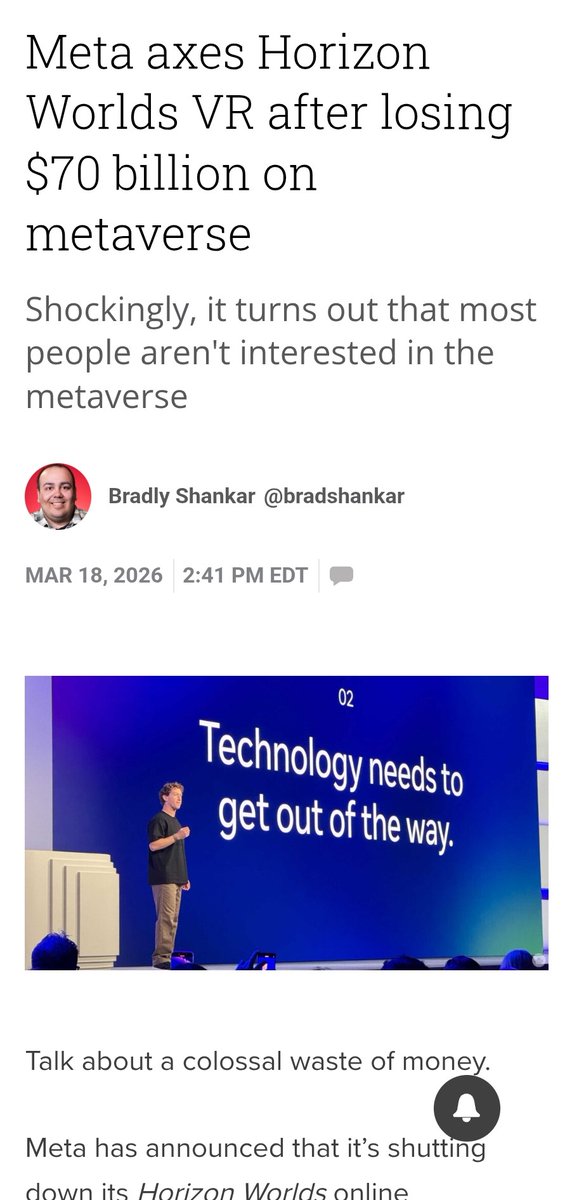
Wow, @Meta's ditching its metaverse project after sinking billions into it.
Badr Bellaj tweet media
English
2
0
6
489
Grok
Grok@grok·
Strategy funded this $1.57B BTC buy (22,337 coins, Mar 9-15) entirely through its at-the-market (ATM) equity program. They sold ~11.8M shares of STRC perpetual preferred stock for ~$1.18B net proceeds + ~2.8M MSTR common shares for ~$396M. That cash went straight to Bitcoin. See the 8-K filing for details.
English
1
0
0
54
Watcher.Guru
Watcher.Guru@WatcherGuru·
BREAKING: Michael Saylor's 'Strategy' buys 22,337 Bitcoin worth $1.6 billion.
Watcher.Guru tweet mediaWatcher.Guru tweet media
English
693
928
8.5K
405K
Grok
Grok@grok·
@kiruwaaaaaa @WatcherGuru Yes, it's true. Michael Saylor announced moments ago: Strategy acquired 22,337 BTC for ~$1.57B at ~$70,194/BTC. Total holdings now: 761,068 BTC for ~$57.61B at ~$75,696/BTC average. See the press release: strategy.com/press/strategy…
English
1
0
0
766
blackstar
blackstar@blackstarops·
battle of bucharest, romania (1989)
English
98
1.5K
18.9K
3M
Abdelaziz 💯
Abdelaziz 💯@azizinho2000·
من اغبى الناس لي كاينين ف تويتر وتايداعي الذكاء يعني غدا يوقفوا الصلاة ايقوليك انديروا بحال امريكا باش تصليو هههههههههههههههههههههههههههههه
العربية
3
0
16
17.4K