@rcolvile Indeed - capitalism and profit are not ‘dirty words’, they’re the source of the wealth and tax that fund vital public services.
English
Tom Stanley
2.2K posts

@teeejay91
👋 Founder of Urban IT Support Ltd - award-winning IT Support & Technology for small & mid-sized businesses across West Yorkshire. 🇺🇦



NEW: Housing Minister Matthew Pennycook has just announced the BIGGEST EVER reforms to national policy to deliver more homes! Here are the five biggest: 🧵










NEW: planning applications that comply with the local development plan will bypass planning committees and be decided by officers to speed up building! Deputy PM Angela Rayner said the current planning process is acting like a "drag anchor" on more housing.


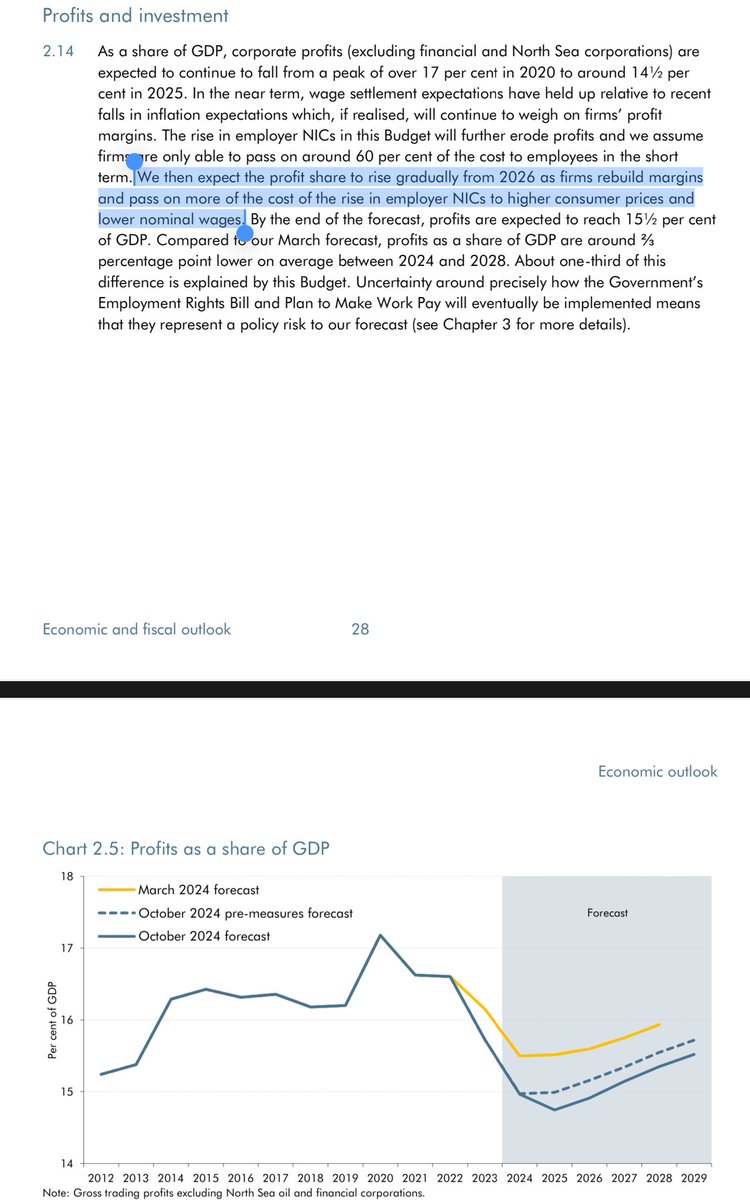
The employer NICs increase is scored as £25.7 bn on the scorecard. It was always going to be smaller in reality after accounting for knock-on effects. OBR sets that out - it's a £16 bn increase. Still big - just not £25 bn big.




By targetting the "snuffle", Rachel Reeves is creating "headroom" to borrow an additional £50bn to £60bn every year - which is more than the unfunded borrowing that spooked investors in Liz Truss's mini budget and led to a fiscal crisis. So whether the chancellor is being sensible or reckless by changing the debt target in next week's budget will be all about the associated "guard rails" or constraints she puts in place. I assume the reaction of many of you to all that is "you what?". So this is why the snuffle shuffle matters. It is about whether Reeves is creating space for the government to borrow to fund productive investment that will boost economic growth that makes us richer, or whether she is recklessly robbing Peter to pay Paul at a time when the national debt and interest payments are high. Now for some definitions. The "snuffle" is "public sector net financial liabilities", or PSNFL ("snuffle" with a silent "p", as in "Psmith"). Overnight in Washington, at the IMF meetings, the Chancellor signalled she would be targetting PSNFL in her duality of fiscal rules, in place of the inherited target, which is public sector net debt excluding the Bank of England. The simple way to understand the difference is that public sector net debt is gross debt minus some super liquid investments whereas PSNFL subtracts a greater range and larger stock of assets. PSNFL is not a brand new concept. It is already measured by the Office for National Statistics. And like all these accounting or social constructs, its importance lies in whether it helps to keep the government honest or is a tool for dodgy ministerial cover ups. The problem with the target Reeves inherited from her predecessor Jeremy Hunt is that it gives her almost no "headroom" to borrow to fund investment. PSNFL creates this headroom - as if by miracle - in two ways. 1) It includes the £20bn annual flow of loans to students as both an asset and a liability, whereas in PSND ex Bank those loans are treated only as a liability. 2) It excludes government losses on the Bank of England's sales of government debt known as gilt-edged stock. The impact of including the value of the student loan book is the more important of these two. Together they represent the biggest share of an increase in the capacity of the Treasury to borrow every year to the tune of between £50bn and £60bn, according to the Resolution Foundation and the Institute of Fiscal Studies. These are big bucks. And what matters is that this is quite literally magic money. It is a different way of seeing the government's liabilities, but the liabilities are in all economic reality unchanged. The question is whether seeing the liabilities as a snuffle is more rational than the current picture. I would say yes, to an extent. On the positive side, adoption of PSNFL will allow Reeves to invest billions of pounds every year - in transport, and power generation and electricity networks - through her National Wealth Fund and GB Energy, and in partnership with the private sector, relatively unconstrained by her debt target. The reason is that under the PSNFL definitions, the value of equity investments in private companies is deducted from debt. However if the government were to own 100% of an investment project, in the way it typically does, then the value of that investment would not be netted off PSNFL. Or to put it another way, adopting PSNFL does not allow for an unlimited investment bonanza. It creates space for investment, but constrained space. As I said at the start, moving to snuffle gives the chancellor the means to begin the reversal of decades of too-low public sector investment. But the recovery won't happen overnight. She won't have a bottomless purse, and - because of her second fiscal constraint, that current spending must in time only be funded by taxation (probably by the fifth year of the fiscal forecast) - there will be nothing like a glut for public services. 1/2