Chen Tessler

1.8K posts

Chen Tessler banner
Chen Tessler

Chen Tessler

@ChenTessler

Research Scientist @NVIDIAAI ; Training humanoids 🤖 ; Reinforcement learning PhD @TechnionLive 🇮🇱. Views are my own.

Israel 가입일 Mart 2012
657 팔로잉2.4K 팔로워
고정된 트윗
Chen Tessler
Chen Tessler@ChenTessler·
Animation 🤝 Robotics ProtoMotions GTC 2026 release — bridging the gap between digital humans and real humanoid robots. Train in simulation. Deploy on hardware. One framework, one codebase. nvlabs.github.io/ProtoMotions
English
6
35
127
7.2K
Alec
Alec@AlecSaysThings·
@ChenTessler i don't even want to think about the work that requires. may your journey be straightforward and free of bugs. 🫡
English
1
0
0
32
Chen Tessler
Chen Tessler@ChenTessler·
Think it's soon time to make ProtoMotions asynchronous 🫣 Should be much easier to have multiple async GPUs than to have them sync properly all the time + avoid NCCL timeout issues from slow ranks (slow since they simulate drastically different logic 👀).
English
1
0
3
223
Alec
Alec@AlecSaysThings·
@LouisLeLay4 this is excellent! pure RL rewards? or is there any AMP or motion imitation? or like a desired end pose?
English
1
0
0
21
Chen Tessler
Chen Tessler@ChenTessler·
@Stone_Tao How do you debug code and ensure good quality when you have students/interns/junior engineers working on your code? Code review, tests, and since it's a visual domain you can (in many cases) visualize the logic.
English
0
0
0
63
kache
kache@yacineMTB·
that's honestly insanely cheap
kache tweet media
English
42
8
765
109.5K
Chen Tessler
Chen Tessler@ChenTessler·
This is super cool. I'm sure you can hack around the vision part by making it not fully physics simulated, but it's so cool to see like this. Eventually it will be smoother, and then every reaction becomes real. You get hit? Real ragdoll reaction and recovery. You shoot? Recoil leads to real viewpoint jitter. It's the next step after CS:GO making that when you reload when the magazine is half full then you lose the bullets you left in the magazine. Full realism 🤯
English
1
0
1
33
Alec
Alec@AlecSaysThings·
@ChenTessler thanks man! it's pretty fun to walk around. once i get the ADS better I think it will be more tolerable to look at. lol
English
1
0
0
26
Alec
Alec@AlecSaysThings·
Day 177: First Person View 🎦🏃 It's about time that I see what it's like to properly pilot my character. And it reveals a LOT of things that need work. First off, it's not enough just to shoulder the rifle. I need to build a front and back sight into the rifle itself, and adjust the aim reward to require adhesion to a line between the head camera and the target aim point. We'll call this "camera aim line" for now. Then I will craft a reward to align the back and front sights along that "camera aim line". Second, the head movement needs to be more smooth and level. It's pretty disorienting at the moment. Third, I need to add in an "aim down sights (ADS)" command. That way I can command the network to adhere to the "camera aim line" only when I want to aim down sights, and release the aim requirement when I want to focus on movement. Perhaps it might even be good to limit the movement speed command during ADS. Overall responsiveness from the rifle is fantastic, but the head is a bit slow to react. There's also some little bugs where it struggles to look directly up and down, which might be a joint limit issue... Lot's learned from this new perspective!
English
2
0
7
275
PnL
PnL@PnL63962200·
@levanonisrael נראה לי שכולם היו חותמים על זה, פשוט מר סבבים לא יודע לסיים כלום. לא השמיד אויב אחד אפילו כי הוא רק יודע להצטלם עם הצבא לאשר חיסולים לא למנף את זה מדינית
עברית
1
0
15
388
Israel Levanon 🇮🇱🌲
Israel Levanon 🇮🇱🌲@levanonisrael·
אני מאוד מבין אנשים ששוקלים ירידה מהארץ במצב הנוכחי. אי אפשר להבטיח מלחמות שוב ושוב ולצפות שיישארו פה - צריך לייצר אופק שגרתי ונטול מלחמות. הדרך לייצר את האופק הזה היא לסיים את המלחמה הזו רק בנצחון אמיתי. ייקח כמה שייקח
עברית
60
1
74
6K
Dhruv Batra
Dhruv Batra@DhruvBatra_·
Claude Code on the left. Codex on the right. Out of quota on both. Now what?
Dhruv Batra tweet media
English
5
0
12
6.5K
Chen Tessler
Chen Tessler@ChenTessler·
@AlecSaysThings I wouldn't say double, a lot of the memory goes on simulation, actor, critic, replay buffers, etc... But it would increase.
English
1
0
1
40
Alec
Alec@AlecSaysThings·
@ChenTessler to elaborate, i think my vram usage would double since I'd have roughly 2x the motions and the secondary discriminator.
English
1
0
0
8
Alec
Alec@AlecSaysThings·
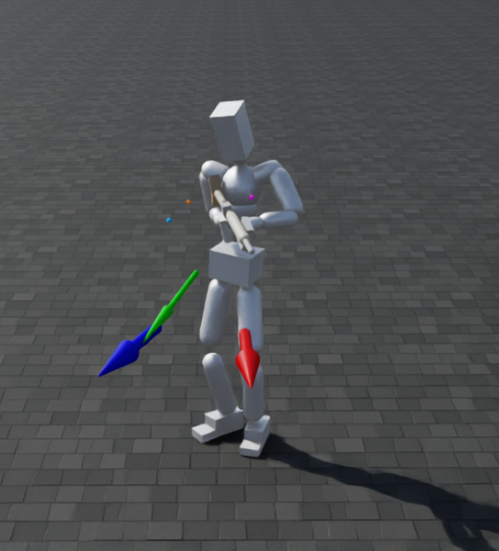
Day 175: Stance 🤺🔧 It's so obvious, but I completely overlooked it. The torso shape isn't the problem, it's that the "facing" direction is fighting the "aim" direction. Blue arrow = where the torso should face. Green arrow = where the rifle should point. My blue "facing" arrow has been set to exactly the horizontal heading derived from the green "aim" direction. But in reality, proper stance requires an offset of the torso relative to the aimed position. For a right handed grip, the blue "facing" arrow should be offset by maybe 20-30 degrees to the right of the green arrow. This allows the rifle to be shifted backwards closer to the body, meaning the left hand doesn't have to reach as far forward. And now we train again. 🔄
Alec tweet mediaAlec tweet media
English
1
0
2
213
Chen Tessler
Chen Tessler@ChenTessler·
@AlecSaysThings "I think that will come with a pretty big hit to the num_envs I can run due to vram constraints. Or am I wrong on that assumption?" you mean due to multiple discriminators?
English
2
0
1
42
Alec
Alec@AlecSaysThings·
Yessir! So first, I use a "rifle motion set" that I generated from Kimodo for the first part of the curriculum, and I let AMP look at the whole body except for wrists and hands. Once the elbows are good, I jump to the second part where I make AMP arm blind. Since I started using the 6 DOF joints for hand contact, the elbows don't typically drift up in training. I also have been thinking about using my rifle animations for upper body, and the parkour set for lower body. I think that will come with a pretty big hit to the num_envs I can run due to vram constraints. Or am I wrong on that assumption? It's still on my to-do list though. What I do have is: - small forward lean reward (chest over pelvis) And I just added: - a small offset of facing direction - facing direction now uses the chest body instead of pelvis to leave the pelvis free for natural gait.
English
1
0
0
54
Chen Tessler
Chen Tessler@ChenTessler·
@OriKatz3 אתה מודע לזה שכל עלות התוכנית היא פחות מאשר כמות הכסף שקליפורניה מאבדת בשנה להונאות? זה באמת כסף קטן בשביל דבר כל-כך מגניב
עברית
0
0
1
32
Guy Tevet
Guy Tevet@GuyTvt·
@ChenTessler @CedricKuperman Is driving games with RL controllers a realistic vision? It is much riskier compared to today's motion graphs. What will be the real benefit?
English
1
0
2
42
Chen Tessler
Chen Tessler@ChenTessler·
@mxu_cg Even Naruto knows it. "Just RL it" is all you need.
English
0
0
3
84
Michael Xu
Michael Xu@mxu_cg·
Naruto was doing massively parallel reinforcement learning before Isaac Gym
Michael Xu tweet media
English
3
3
12
480
Aviv Tamar
Aviv Tamar@AvivTamar1·
@ChenTessler @SchmidhuberAI I'm not sure, I didn't read all of them, but I didn't find the world model papers more convincing than ideas/results from 5-10 years ago. What did you find to be convincing/high impact? x.com/i/status/20363…
Aviv Tamar@AvivTamar1

I don't get it. Learning to Poke by Poking from @pulkitology et al (in 2016!!) cost function was next latent prediction + single regularization term (inverse model loss: z_t, z_t+1 -> a_t). Am I missing something? Why is it not a "JEPA" model?

English
1
0
0
230
Aviv Tamar
Aviv Tamar@AvivTamar1·
Hmmm... I gave PMAX a read - very nice paper, and >30 years later still reads very fresh! (well, except for the experiments) Every student working on JEPA should read it. That this work is not mentioned in recent JEPA papers with almost identical ideas is... strange.
Jürgen Schmidhuber@SchmidhuberAI

Dr. LeCun's heavily promoted Joint Embedding Predictive Architecture (JEPA, 2022) [5] is the heart of his new company. However, the core ideas are not original to LeCun. Instead, JEPA is essentially identical to our 1992 Predictability Maximization system (PMAX) [1][14]. Details in reference [19] which contains many additional references. Motivation of PMAX [1][14]. Since details of inputs are often unpredictable from related inputs, two non-generative artificial neural networks interact as follows: one net tries to create a non-trivial, informative, latent representation of its own input that is predictable from the latent representation of the other net’s input. PMAX [1][14] is actually a whole family of methods. Consider the simplest instance in Sec. 2.2 of [1]: an auto encoder net sees an input and represents it in its hidden units (its latent space). The other net sees a different but related input and learns to predict (from its own latent space) the auto encoder's latent representation, which in turn tries to become more predictable, without giving up too much information about its own input, to prevent what's now called “collapse." See illustration 5.2 in Sec. 5.5 of [14] on the "extraction of predictable concepts." The 1992 PMAX paper [1] discusses not only auto encoders but also other techniques for encoding data. The experiments were conducted by my student Daniel Prelinger. The non-generative PMAX outperformed the generative IMAX [2] on a stereo vision task. The 2020 BYOL [10] is also closely related to PMAX. In 2026, @misovalko, leader of the BYOL team, praised PMAX, and listed numerous similarities to much later work [19]. Note that the self-created “predictable classifications” in the title of [1] (and the so-called “outputs” of the entire system [1]) are typically INTERNAL "distributed representations” (like in the title of Sec. 4.2 of [1]). The 1992 PMAX paper [1] considers both symmetric and asymmetric nets. In the symmetric case, both nets are constrained to emit "equal (and therefore mutually predictable)" representations [1]. Sec. 4.2 on “finding predictable distributed representations” has an experiment with 2 weight-sharing auto encoders which learn to represent in their latent space what their inputs have in common (see the cover image of this post). Of course, back then compute was was a million times more expensive, but the fundamental insights of "JEPA" were present, and LeCun has simply repackaged old ideas without citing them [5,6,19]. This is hardly the first time LeCun (or others writing about him) have exaggerated LeCun's own significance by downplaying earlier work. He did NOT "co-invent deep learning" (as some know-nothing "AI influencers" have claimed) [11,13], and he did NOT invent convolutional neural nets (CNNs) [12,6,13], NOR was he even the first to combine CNNs with backpropagation [12,13]. While he got awards for the inventions of other researchers whom he did not cite [6], he did not invent ANY of the key algorithms that underpin modern AI [5,6,19]. LeCun's recent pitch: 1. LLMs such as ChatGPT are insufficient for AGI (which has been obvious to experts in AI & decision making, and is something he once derided @GaryMarcus for pointing out [17]). 2. Neural AIs need what I baptized a neural "world model" in 1990 [8][15] (earlier, less general neural nets of this kind, such as those by Paul Werbos (1987) and others [8], weren't called "world models," although the basic concept itself is ancient [8]). 3. The world model should learn to predict (in non-generative "JEPA" fashion [5]) higher-level predictable abstractions instead of raw pixels: that's the essence of our 1992 PMAX [1][14]. Astonishingly, PMAX or "JEPA" seems to be the unique selling proposition of LeCun's 2026 company on world model-based AI in the physical world, which is apparently based on what we published over 3 decades ago [1,5,6,7,8,13,14], and modeled after our 2014 company on world model-based AGI in the physical world [8]. In short, little if anything in JEPA is new [19]. But then the fact that LeCun would repackage old ideas and present them as his own clearly isn't new either [5,6,18,19]. FOOTNOTES 1. Note that PMAX is NOT the 1991 adversarial Predictability MINimization (PMIN) [3,4]. However, PMAX may use PMIN as a submodule to create informative latent representations [1](Sec. 2.4), and to prevent what's now called “collapse." See the illustration on page 9 of [1]. 2. Note that the 1991 PMIN [3] also predicts parts of latent space from other parts. However, PMIN's goal is to REMOVE mutual predictability, to obtain maximally disentangled latent representations called factorial codes. PMIN by itself may use the auto encoder principle in addition to its latent space predictor [3]. 3. Neither PMAX nor PMIN was my first non-generative method for predicting latent space, which was published in 1991 in the context of neural net distillation [9]. See also [5-8]. 4. While the cognoscenti agree that LLMs are insufficient for AGI, JEPA is so, too. We should know: we have had it for over 3 decades under the name PMAX! Additional techniques are required to achieve AGI, e.g., meta learning, artificial curiosity and creativity, efficient planning with world models, and others [16]. REFERENCES (easy to find on the web): [1] J. Schmidhuber (JS) & D. Prelinger (1993). Discovering predictable classifications. Neural Computation, 5(4):625-635. Based on TR CU-CS-626-92 (1992): people.idsia.ch/~juergen/predm… [2] S. Becker, G. E. Hinton (1989). Spatial coherence as an internal teacher for a neural network. TR CRG-TR-89-7, Dept. of CS, U. Toronto. [3] JS (1992). Learning factorial codes by predictability minimization. Neural Computation, 4(6):863-879. Based on TR CU-CS-565-91, 1991. [4] JS, M. Eldracher, B. Foltin (1996). Semilinear predictability minimization produces well-known feature detectors. Neural Computation, 8(4):773-786. [5] JS (2022-23). LeCun's 2022 paper on autonomous machine intelligence rehashes but does not cite essential work of 1990-2015. [6] JS (2023-25). How 3 Turing awardees republished key methods and ideas whose creators they failed to credit. Technical Report IDSIA-23-23. [7] JS (2026). Simple but powerful ways of using world models and their latent space. Opening keynote for the World Modeling Workshop, 4-6 Feb, 2026, Mila - Quebec AI Institute. [8] JS (2026). The Neural World Model Boom. Technical Note IDSIA-2-26. [9] JS (1991). Neural sequence chunkers. TR FKI-148-91, TUM, April 1991. (See also Technical Note IDSIA-12-25: who invented knowledge distillation with artificial neural networks?) [10] J. Grill et al (2020). Bootstrap your own latent: A "new" approach to self-supervised Learning. arXiv:2006.07733 [11] JS (2025). Who invented deep learning? Technical Note IDSIA-16-25. [12] JS (2025). Who invented convolutional neural networks? Technical Note IDSIA-17-25. [13] JS (2022-25). Annotated History of Modern AI and Deep Learning. Technical Report IDSIA-22-22, arXiv:2212.11279 [14] JS (1993). Network architectures, objective functions, and chain rule. Habilitation Thesis, TUM. See Sec. 5.5 on "Vorhersagbarkeitsmaximierung" (Predictability Maximization). [15] JS (1990). Making the world differentiable: On using fully recurrent self-supervised neural networks for dynamic reinforcement learning and planning in non-stationary environments. Technical Report FKI-126-90, TUM. [16] JS (1990-2026). AI Blog. [17] @GaryMarcus. Open letter responding to @ylecun. A memo for future intellectual historians. Substack, June 2024. [18] G. Marcus. The False Glorification of @ylecun. Don’t believe everything you read. Substack, Nov 2025. [19] J. Schmidhuber. Who invented JEPA? Technical Note IDSIA-3-22, IDSIA, Switzerland, March 2026. people.idsia.ch/~juergen/who-i…


English
7
10
184
28.3K
Chen Tessler
Chen Tessler@ChenTessler·
@AvivTamar1 @SchmidhuberAI Didn't read that paper. But he didn't stop there, right? He has multiple papers proving it's a high impact research path.
English
1
0
0
195
Aviv Tamar
Aviv Tamar@AvivTamar1·
@ChenTessler @SchmidhuberAI It wasn't me :) OK, but what wasn't the 1st JEPA paper exactly that? No results, just giving a new name to plant a flag?
English
1
0
1
216
Chen Tessler
Chen Tessler@ChenTessler·
@AvivTamar1 @SchmidhuberAI People have already done exactly that :) My point is that flag planting shouldn't be a viable approach in research. Not that stealing is ok. In my view, ML isn't theoretical physics. Simply posting a hypothesis has zero value if you never made a minimal convincing effort.
English
2
0
4
234
Aviv Tamar
Aviv Tamar@AvivTamar1·
@ChenTessler @SchmidhuberAI So, let's say I want to follow your work on human motion generation, and I push really hard on it, is it OK at some point to give it a new name and stop citing you?
English
1
0
4
240
Chen Tessler
Chen Tessler@ChenTessler·
@kuteesar @AvivTamar1 @SchmidhuberAI So what I mean by sit on -- you had 30 years and didn't even do 1 follow up work with real experiments to show the idea is worth the ink it's written on. I find that weird if you truly think it's worth pursuing.
English
1
0
2
34