🄲🅈🄿🅂 ™️

7.3K posts

🄲🅈🄿🅂 ™️ banner
🄲🅈🄿🅂 ™️

🄲🅈🄿🅂 ™️

@Cyps5

My promise is to speak the truth Pro Deo et Patria

가입일 Ağustos 2017
1K 팔로잉743 팔로워
고정된 트윗
🄲🅈🄿🅂 ™️
While tyranny may exert significant power for a time, history shows that it is ultimately vulnerable to the forces of change and the will of the people. Tyranny often relies on fear and oppression, which can only sustain control for so long. Resistance grows as people seek freedom and justice.
English
0
0
1
799
🄲🅈🄿🅂 ™️
Key word from the interview: “Section 212 mandates the defence forces to defend the constitution. I don’t want to believe that the defence forces are derelicting on their duty but they are watching the process and when Zanu Pf itself becomes a security threat, I want to believe they will advise accordingly”
English
0
0
2
36
TheNewsHawks
TheNewsHawks@NewsHawksLive·
🔴Retired Air Vice-Marshal Henry Muchena - real name Jabulani Mahlangu - speaks to Ignite Media about the current contentious constitutional amendments following his recent letter to parliament protesting the changes which extend President Emmerson Mnangagwa’s term and shake up the political, electoral and governance systems.
English
19
35
73
9K
🄲🅈🄿🅂 ™️
@daddyhope Donald Trump’s conduct falls far short of what is expected from a world leader, and by choosing to support him, Americans have forfeited the moral standing to criticize any African leader or label them as corrupt, tyrannical, or despotic.
English
0
0
0
3
Hopewell Chin’ono
Hopewell Chin’ono@daddyhope·
The American ambassador to Greece under Donald Trump is Kimberly Guilfoyle, his son Donald Trump Jr.’s former girlfriend. Imagine Emmerson Mnangagwa appointing ED Junior’s ex-girlfriend as Zimbabwe’s ambassador to Greece. America’s ambassador to France is Charles Kushner, the father-in-law of Ivanka Trump, Trump’s daughter. Imagine Mnangagwa appointing Gerald Mlotshwa’s father as Zimbabwe’s ambassador to France. The co-negotiator for America in the Middle East is Jared Kushner, Donald Trump’s son-in-law, Ivanka’s husband. Imagine Mnangagwa appointing Pokello as Zimbabwe’s negotiator in an international crisis. Trump appointed his son-in-law Jared Kushner to handle a broad portfolio including Middle East peace, criminal justice reform, and relations with Mexico. Imagine Mnangagwa assigning Gerald Mlotshwa to run multiple critical national portfolios without any prior public service experience. He also appointed close political allies and loyalists with little relevant experience to key diplomatic and administrative roles, including Richard Grenell, Mick Mulvaney, Peter Navarro, and Stephen Miller. Imagine a system where loyalty to the leader outweighs competence and experience in state appointments. In Africa, America calls it corruption and nepotism, in America they call it “political appointments” and “trusted insiders.” Jared Kushner set up a private equity firm after leaving government and secured about US$2 billion from Saudi Arabia’s sovereign wealth fund, led by Saudi’s defacto leader, Mohammed bin Salman. This has serious conflict-of-interest because he handles Middle East policy for America. Donald Trump has also pursued major real estate and licensing deals in the Middle East, including projects linked to state-backed or politically connected investors in countries such as Saudi Arabia and the UAE. A sitting president should not be financially benefiting in regions where he shapes policy, even if no laws are proven to have been broken. In Africa, this would be labelled corruption or state capture, but in the United States it is often discussed as ethics, conflicts of interest, or influence, even when the underlying dynamics, proximity to power translating into financial gain, look strikingly similar. Donald Trump is one of the most corrupt Western leaders ever elected into power, but most of his supporters, especially those who do not live in America, are oblivious to this because they do not support his ideas, they support his personality rather than his ideas. So regardless of whether he rapes or abuses power, they just continue supporting him. They are the equivalent of people who support mediocrity, if the mediocre person is seen as their own, they will go all out in supporting him regardless of his corrupt rule.
English
132
963
2K
598.4K
🄲🅈🄿🅂 ™️
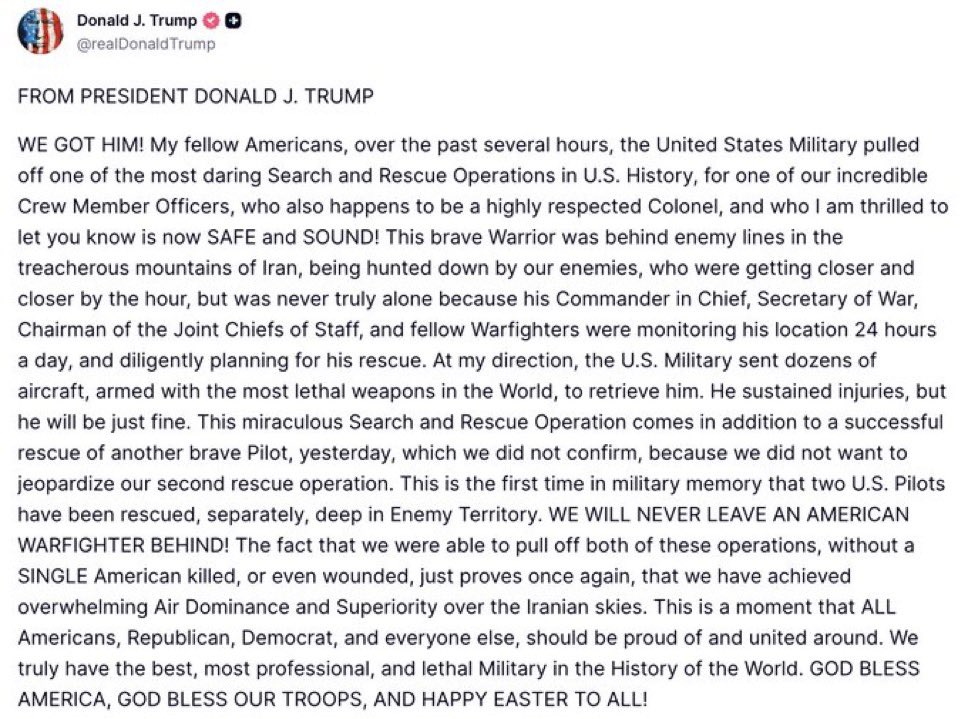
@WhiteHouse @Jamwanda2 How far the mighty have fallen. America clamoring for global praise over what should be a routine military rescue is like applauding a fish for knowing how to swim.
English
0
0
0
12
The White House
The White House@WhiteHouse·
🚨“WE GOT HIM! My fellow Americans, over the past several hours, the United States Military pulled off one of the most daring Search and Rescue Operations in U.S. History, for one of our incredible Crew Office Members, who also happens to be a highly respected Colonel, and who I am thrilled to let you know is SAFE and SOUND!” - President Donald J. Trump 🇺🇸
The White House tweet media
English
11.6K
43.3K
232.1K
12.8M
Cindy Soko
Cindy Soko@SokoCindy·
Let me warn Matinyarare no one has fought against President ED Mnangagwa and won in the history of Zimbabwe
Cindy Soko tweet media
English
237
12
44
70.9K
The Aspiring Dictator
The Aspiring Dictator@SANDEJAQ·
If there’s to be any change to that method of electing the head of state, there must be a referendum. There’s no room for authoritarianism in a democratic state brought about by the blood of our brothers and sisters in the liberation struggle. Professor, how can you advocate for such an evil amendment? What do you stand to benefit from selling out the liberation struggle?
Prof Jonathan Moyo@ProfJNMoyo

The True Meaning of Universal Adult Suffrage in the Constitution of Zimbabwe (2013): In the important national conversation on the Constitution of Zimbabwe (Amendment No. 3) H.B. 1 Bill, 2026, there’s a needless misunderstanding that “universal adult suffrage”—the principle demanded as “one man, one vote” during the hard-won armed liberation struggle—requires the presidential election to be conducted through a direct popular voting system. This is simply not true. Universal Adult Suffrage is explicitly protected in Chapter 4 of the Constitution of Zimbabwe, under the Declaration of Rights. Section 67(3)(a) makes it crystal clear that: “Subject to this Constitution, every Zimbabwean citizen who is of or over eighteen years of age has the right to vote in all elections and referendums to which this Constitution or any other law applies, and to do so in secret.” This provision is about empowering every eligible adult citizen with an equal voice at the ballot box, cast in complete secrecy. It guarantees the right to vote; but it does not prescribe or lock Zimbabwe into any particular voting system—whether direct or indirect. Two powerful facts bring this home and reveal the real value of the amendment in the Bill. First, for the past 46 years, the only Zimbabweans denied this fundamental right have been citizens living in the Diaspora. The Minister of Justice, Legal and Parliamentary Affairs, Hon. Ziyambi Ziyambi, has already announced that one of the major electoral dividends of the Constitution of Zimbabwe (Amendment No. 3) H.B. 1 Bill, 2026 will be the long-overdue extension of the right to vote to Zimbabweans outside the country. This step will finally make the right to vote truly inclusive, ensuring that no citizen is disenfranchised or left with no electoral voice simply because they live beyond the country’s borders. Second, the universal adult suffrage clause in section 67 is deliberately silent on the choice of voting mechanism. Zimbabwe’s elections have always included both direct and indirect voting systems since 1980, depending on the office in question. To be clear: confusing “one man, one vote” with a mandatory direct-voting model misreads the fundamental law of the land. Embracing the true meaning of universal adult suffrage or "one man one vote", honours both the national liberation struggle and the Constitution, strengthens national unity, and moves everyone forward with clarity and confidence!

English
10
14
47
16.8K
🄲🅈🄿🅂 ™️
@ProfJNMoyo To clear up the confusion you’ve mentioned, why not reset the process entirely and let people decide through a referendum?
English
0
0
0
10
Prof Jonathan Moyo
Prof Jonathan Moyo@ProfJNMoyo·
The True Meaning of Universal Adult Suffrage in the Constitution of Zimbabwe (2013): In the important national conversation on the Constitution of Zimbabwe (Amendment No. 3) H.B. 1 Bill, 2026, there’s a needless misunderstanding that “universal adult suffrage”—the principle demanded as “one man, one vote” during the hard-won armed liberation struggle—requires the presidential election to be conducted through a direct popular voting system. This is simply not true. Universal Adult Suffrage is explicitly protected in Chapter 4 of the Constitution of Zimbabwe, under the Declaration of Rights. Section 67(3)(a) makes it crystal clear that: “Subject to this Constitution, every Zimbabwean citizen who is of or over eighteen years of age has the right to vote in all elections and referendums to which this Constitution or any other law applies, and to do so in secret.” This provision is about empowering every eligible adult citizen with an equal voice at the ballot box, cast in complete secrecy. It guarantees the right to vote; but it does not prescribe or lock Zimbabwe into any particular voting system—whether direct or indirect. Two powerful facts bring this home and reveal the real value of the amendment in the Bill. First, for the past 46 years, the only Zimbabweans denied this fundamental right have been citizens living in the Diaspora. The Minister of Justice, Legal and Parliamentary Affairs, Hon. Ziyambi Ziyambi, has already announced that one of the major electoral dividends of the Constitution of Zimbabwe (Amendment No. 3) H.B. 1 Bill, 2026 will be the long-overdue extension of the right to vote to Zimbabweans outside the country. This step will finally make the right to vote truly inclusive, ensuring that no citizen is disenfranchised or left with no electoral voice simply because they live beyond the country’s borders. Second, the universal adult suffrage clause in section 67 is deliberately silent on the choice of voting mechanism. Zimbabwe’s elections have always included both direct and indirect voting systems since 1980, depending on the office in question. To be clear: confusing “one man, one vote” with a mandatory direct-voting model misreads the fundamental law of the land. Embracing the true meaning of universal adult suffrage or "one man one vote", honours both the national liberation struggle and the Constitution, strengthens national unity, and moves everyone forward with clarity and confidence!
English
110
60
55
32.5K
Savheya veFashion
Savheya veFashion@Savheya_Happie·
Nhai Mwari Mari ine chitema😭 So ooh, ngaende paNearest Embassy, this is abuse 🙌 Please leaders makesure we don't runaway from this peaceful country to this. Apa kamukadzi aka kakaita uta nekushaya shape.
Filipino
120
58
272
93.8K
Steve Pritzker
Steve Pritzker@StevePritzker·
@UnitedStandMUFC if they think keeping Carrick is a plan, they're deluded. this club needs someone who can actually make an impact, not just ride the wave of a few decent results.
English
9
1
7
1.2K
The United Stand
The United Stand@UnitedStandMUFC·
🚨 Man United haven’t contacted other candidates yet, a big boost for interim boss Michael Carrick. Wilcox & Berrada aren’t rushing while results stay strong. Carrick’s success is seriously strengthening his case, but if not him, United want a manager with real stature and experience. [@RobDorsettSky] #mufc
The United Stand tweet media
English
54
70
1.4K
73.1K
𝑲𝒖𝒅𝒛𝒂𝒊 𝑴𝒖𝒕𝒊𝒔𝒊
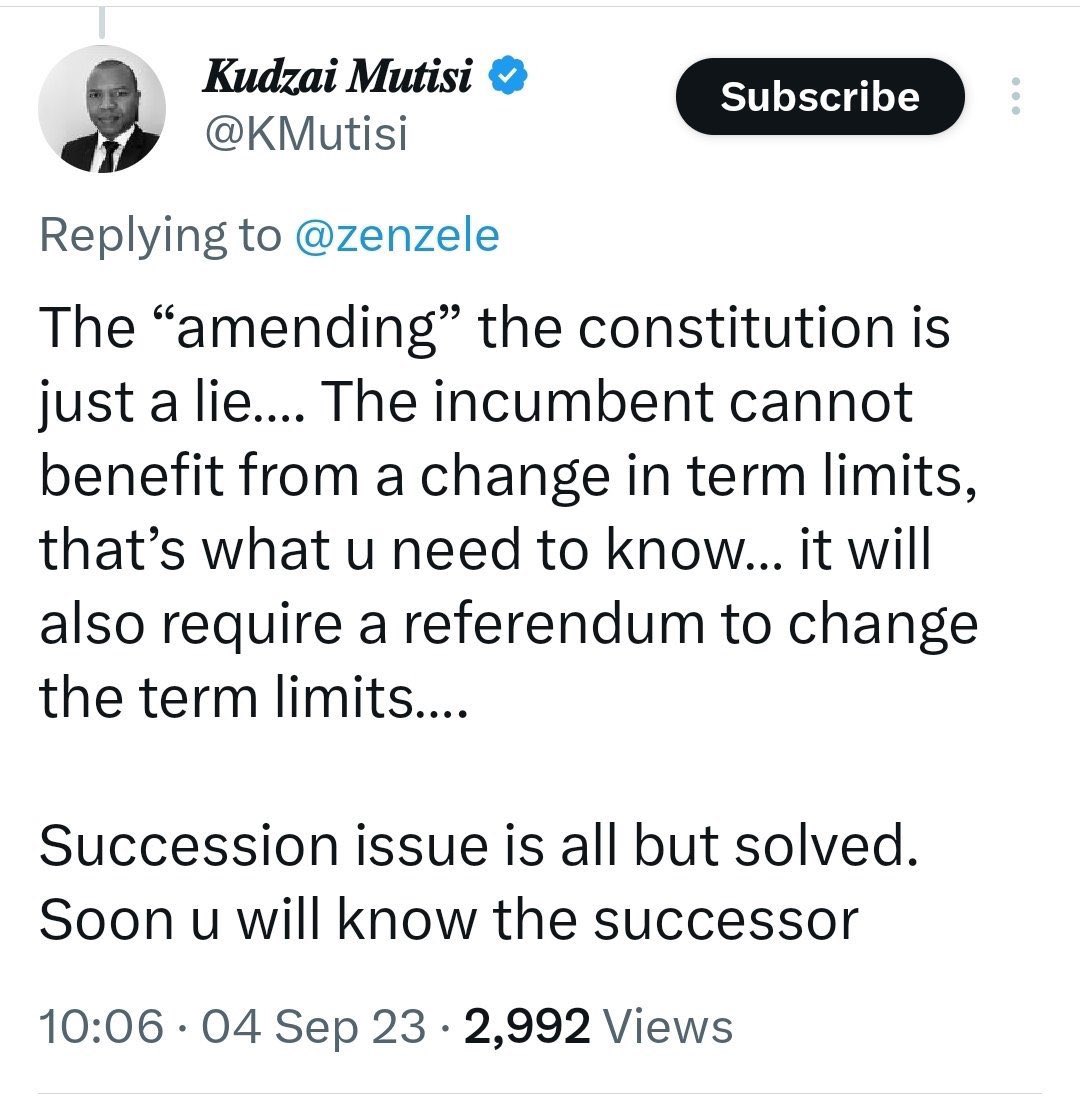
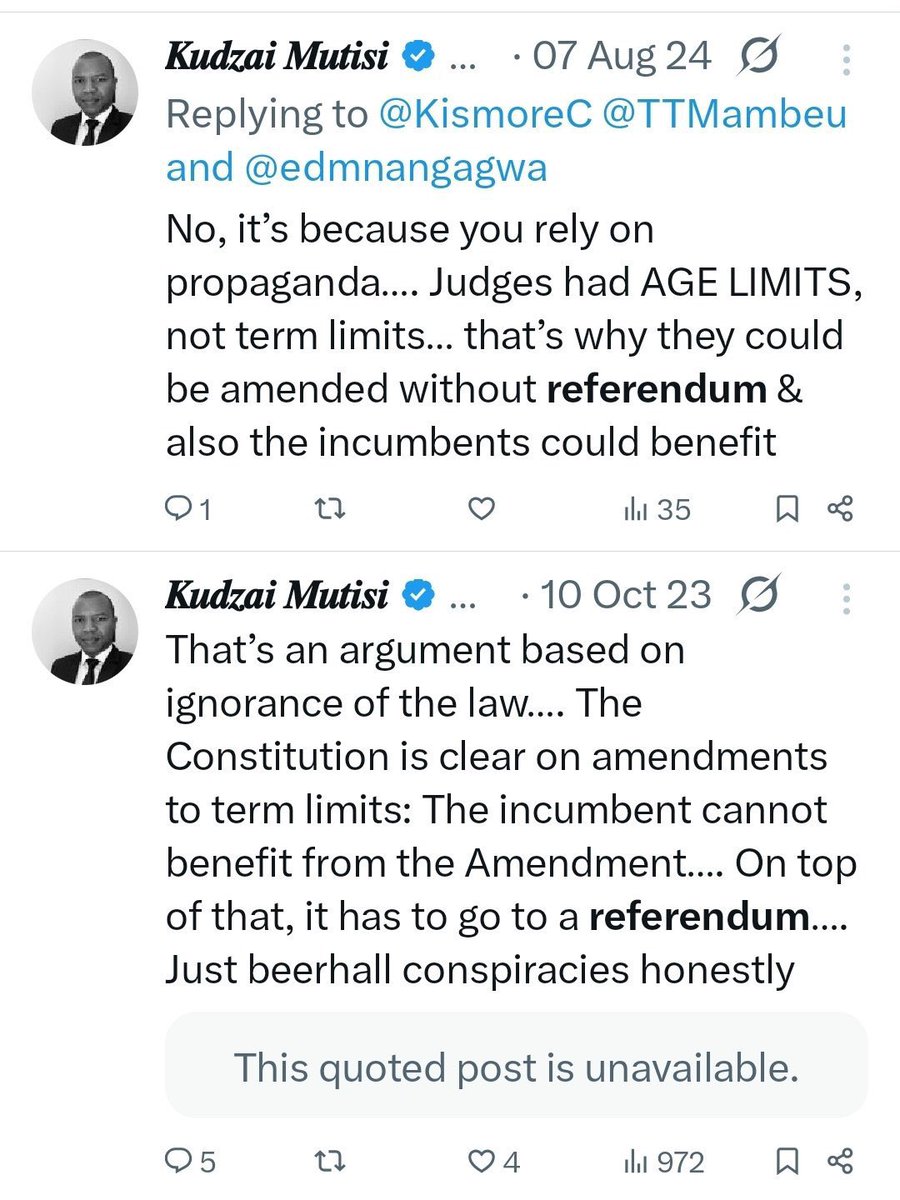
If their approach is threatening people then they are just irrelevant & TOXIC people. This is a period to debate the Constitutional Amendments, EVERYONE must be free to do so. The fact that they are Former Generals doesn’t make them the only ones with the right to speak. @TembaMliswa is a Zimbabwean just like Muchena, none is better than the other in this case… He should go to Iran and show his bravery there instead of intimidating Zimbabweans airing their views… In fact, that behaviour makes them UNSUITABLE for political office, Zimbabweans are looking for COMPETENT PEOPLE, not thugs who intimidate people at every turn.
TheNewsHawks@NewsHawksLive

🔴Former Air Vice-Marshal Henry Muchena's response to Temba Mliswa.

English
109
6
18
21.8K
LynneM 💕💝💎
LynneM 💕💝💎@LynneStactia·
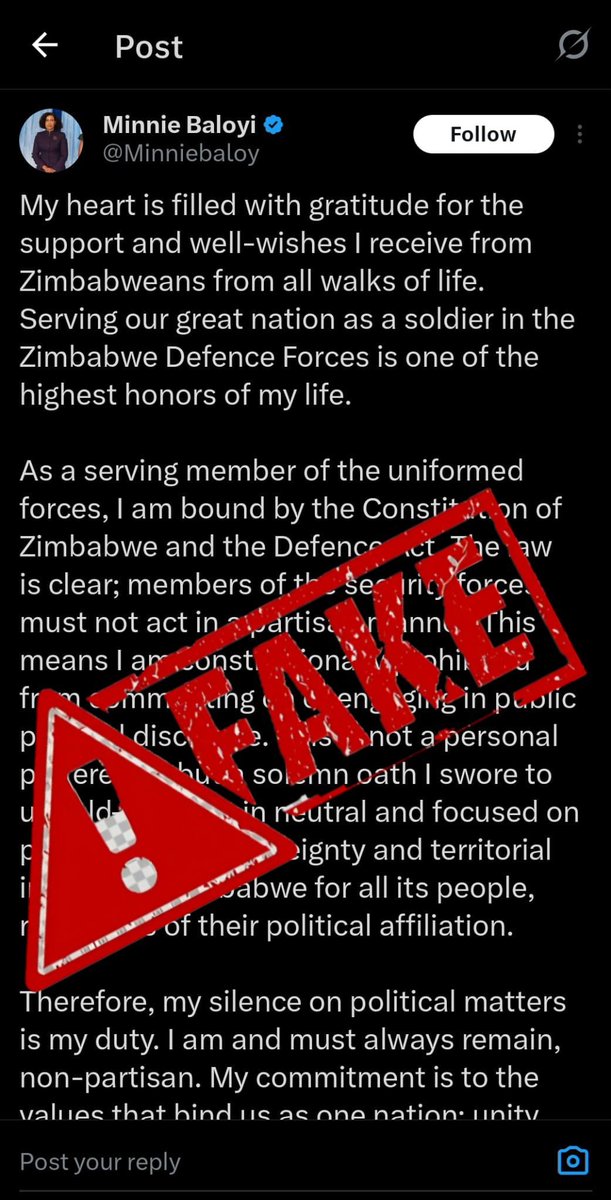
Hallo guys, just a reminder that @Minniebaloy is a FAKE ACCOUNT, it is run by Chihuahuas of Zvigananda in the bid to gain followers and then start attacking the very person they are impersonating! Please report it as spam & notify @Support if you can . That ghost @Minniebaloy has blocked me in a bid to make my alert ‼️ posts go away however, it won’t stop me from posting & reminding people that the account was opened in 2024, the ghost has wiped out the history to pretend as if the account is new! Beware of SCAMMERS ‼️ Such psychopaths like @Minniebaloy who impersonate people can lure you to DMs and demand money 💰… this is NOT Colonel Miniyothabo Baloyi! Thank you 🙏🏽
LynneM 💕💝💎 tweet mediaLynneM 💕💝💎 tweet mediaLynneM 💕💝💎 tweet media
English
6
21
36
2.6K
🄲🅈🄿🅂 ™️
My point isn’t that Kutama or St George’s were supposed to do the parenting for him. It’s that enrolling his sons in those environments shows that Mugabe was at least attempting to put some structure around his sons. Why is all the focus on RGM though? Where was the mother when Bob attended to his busy schedule?
English
0
0
0
9
Dave C. Chikosi
Dave C. Chikosi@faithcoach4u·
@Cyps5 @BMutebuka A Christian school cannot play the role that only parents can play. The teacher, coach, pastor etc cannot replace the parent. This is a mistake many parents make ie outsourcing responsibility
English
1
0
0
23
Brighton Mutebuka
Brighton Mutebuka@BMutebuka·
Robert Mugabe failed Chatunga, full stop. Early on during court proceedings, Chatunga appeared vacant & totally consumed by an alternative realm. The plot & themes @ the centre of the tragedy speak to the hollowness & mirage involved @ the core of the clash between the pursuit of individual glory & family legacy! Robert Mugabe mistook longevity of life for invincibility. When he eventually realised the folly of his views after ignominy hit him in the face, it was too little too late! Those visible but fading scars on Chatunga's cheeks are a poignant reminder of the ultimate abdication of parental responsibility in pursuit of a political whirlwind! Chatunga's decision to surrender the pursuit of a bail application is tantamount to a haunting social & political confession. There are powerful lessons to be learnt in this tragi-comedy. The political establishment must never mistake delayed accountability for social & political exoneration!
Shadwell, England 🇬🇧 English
15
16
106
22.1K
🄲🅈🄿🅂 ™️
@ProfJNMoyo Zimbabweans do not need a treatise to push them into an arrangement that they should decide through a referendum. Muri kutyeiko kungoti navhu vasarudze zvavanoda?
English
0
0
0
51
Prof Jonathan Moyo
Prof Jonathan Moyo@ProfJNMoyo·
MUCHENA’S USE OF LIES TO PURPORT TO DEFEND THE CONSTITUTION IS NEITHER REVOLUTIONARY NOR CONSTITUTIONAL: Air Marshal (Retired) Henry Muchena—and the unnamed co-authors, alleged retired generals and senior civil servants said to be ex-combatants who cowardly remain incognito behind his 15 March 2026 letter—are correct that the liberation struggle rested on two fundamental, non-negotiable pillars: land and universal adult suffrage (“one man, one vote”). These principles remain sacred. They are, however, blatantly lying in claiming that “universal adult suffrage” or “one man one vote” ever meant the direct election of the head of state or government, during the liberation struggle or since independence in 1980. Nowhere under the sun has universal adult suffrage equated to direct election of the executive. Muchena’s claim—and that of his incognito retinue—is neither revolutionary nor constitutional; it is embarrassingly ignorant, illiterate, uninformed and dangerously misinforming. It is irresponsible and dangerous to elevate illiteracy to the level of political noise for purposes of conflict-mongering. Universal adult suffrage simply means the right of every adult citizen to vote without discrimination based on race, sex, property or similar qualifications. It concerns who is entitled to cast votes, not the voting system used to cast them. This right applies equally to direct and indirect voting systems alike. The heroic armed struggle under PF-Zapu and Zanu-PF delivered universal adult suffrage in 1980. But this triumph did not confer direct “one man one vote” elections for President Canaan Banana or Prime Minister Robert Mugabe in the 1980 and 1985 polls. Rather, the triumph restored the right to vote for every adult Zimbabwean under the voting system that prevailed. Both Banana and Mugabe were creatures of indirect election in 1980 and 1985: Banana chosen by Parliament sitting jointly as an electoral college; Mugabe appointed by the President as the leader commanding a majority in the House of Assembly. Muchena’s lie betrays both the liberation legacy and constitutional truth. Far from an aberration, this truth is powerfully affirmed by notable global examples. The United Kingdom has upheld full universal adult suffrage since 1928—extending the vote to all women—yet its citizens have never directly elected their Prime Minister. Voters choose Members of Parliament; the leader of the party commanding a majority in the House of Commons becomes Prime Minister through parliamentary confidence. India, the world’s largest democracy, constitutionally entrenched universal adult suffrage in 1950 (Article 326 of the Constitution) for direct elections to the Lok Sabha (Parliament), yet the Prime Minister is indirectly elected by the parliamentary majority. Even the United States, the world’s oldest democracy, having perfected near-universal suffrage through the 15th, 19th, 24th and 26th Amendments, deliberately rejects a nationwide “one person, one vote” for its President, electing the executive instead through 538 members of the Electoral College. These examples demonstrate conclusively that “one man, one vote” secures the right to participate—it does not dictate the mechanism for voting to choose the executive. To claim otherwise is not merely historically false; it is intellectually bankrupt. Direct Presidential Election: A Relic of the Failed 1987 One Party One-Man Rule Socialist State Retired Air Marshal Henry Muchena and the political interests he fronts peddle a blatant lie that Zimbabwe’s current direct presidential election is rooted in the liberation struggle’s galvanising mantra for “one man, one vote.” Nothing could be further from historical truth and constitutional reality. As pointed out above, universal adult suffrage was secured in 1980. The direct election system for the Executive Presidency was deliberately engineered—not to express that suffrage—but to entrench a legislated one-party, one-man-rule socialist state anchored squarely in the 1987 Unity Accord between PF-Zapu and Zanu-PF. The Accord itself (see attachment), signed at State House on 22 December 1987, is unambiguous about this. 1987 Unity Accord Agreement: Zimbabwe's Model for the current Directly Elected Executive President 1. That Zanu (PF) and (PF) Zapu have irrevocably committed themselves to unite under one political party. 2. That the unity of the two political parties shall be achieved under the name Zimbabwe African National Union (Patriotic Front), in short Zanu (PF). 3. That Comrade Robert Gabriel Mugabe shall be the First Secretary and President of Zanu (PF). 4. That Zanu (PF) shall have two Second Secretaries and Vice-Presidents who shall be appointed by the First Secretary and President of the Party. 5. That Zanu (PF) shall seek to establish a socialist society in Zimbabwe on the guidance of Marxist-Leninist principles. 6. That Zanu (PF) shall seek to establish a one party state in Zimbabwe. 7. That the leadership of Zanu (PF) shall abide by the Leadership Code. 8. That the existing structures of Zanu (PF) and (PF) Zapu shall be merged in accordance with the letter and spirit of this Agreement. 9. That both parties shall, in the interim, take immediate vigorous steps to eliminate and end the insecurity and violence prevalent in Matabeleland. 10. That Zanu (PF) and (PF) Zapu shall convene their respective congresses to give effect to this Agreement within the shortest possible time. 11. That in the interim, Comrade Robert Gabriel Mugabe is vested with full powers to prepare for the implementation of this Agreement and to act in the name and authority of Zanu (PF). Signed at State House this 22nd day of December 1987. Joshua Mqabuko Nkomo, President, (PF) Zapu. Robert Gabriel Mugabe, First Secretary and President of Zanu (PF). Paragraphs 5 and 6 expose the Accord’s twin objectives. Pursuant to this vision, the Constitution of Zimbabwe Amendment (No. 7) Act, 1987 fused Head of State, Head of Government and Commander-in-Chief into an imperial Executive Presidency. On 30 December 1987 Mugabe was installed as Zimbabwe’s first Executive President—after he was elected not by direct popular vote—but indirectly by Parliament sitting jointly as an electoral college. Where were Muchena, his retired generals and senior civil servants who are ex-combatants when this happened in 1987? The direct election introduced in March 1990 was designed as a mere formality under an anticipated monolithic political project for a de jure one party state. The current system is therefore no liberation dividend at all; it is the constitutional offspring of a failed ‘Marxist Leninist’ project for one party one man-rule which was rejected by history itself. It is ironic and laughable that self-anointed guardians of democracy and citizen empowerment now scramble as defenders of the Constitution to salvage the directly elected Executive Presidency—a tarnished vestige of a botched de jure one-party, one-man-rule socialist state. Its very persistence defies the 2013 Constitution's sacred cornerstone: a multi-party democratic system enshrined in section 3(2)(a) as the bedrock of good governance. How the Directly Elected Executive President Agenda to Legislate for a One Party One-Man Rule Failed In 1987, armed with the Unity Accord and the Constitution of Zimbabwe Amendment (No. 7) Act, Zanu-PF meticulously constructed the framework for a one-party, one-man-rule socialist state. The vision was unambiguous: by 1990, prevailing social, economic and political conditions would enable the direct election of an unchallenged President Robert Mugabe as an imperial Executive President, while Zanu-PF—legislated as the sole lawful party—would confront no opposition whatsoever. This ideological and constitutional template gave birth to Zimbabwe’s current voting system of direct presidential elections. Yet history unfolded with radical, irresistible force to torpedo this agenda. Scarcely 10 months after the 22 December 1987 Unity Accord, Edgar Tekere’s expulsion from Zanu-PF in October 1988—ignited by his blistering public denunciation of corruption and the one-party state push—produced the first fatal fracture. Tekere promptly launched the Zimbabwe Unity Movement (ZUM) in April 1989: the inaugural credible urban opposition party championing multiparty democracy, free-market reforms and an end to nepotism. Compounding this internal rupture, the fall of the Berlin Wall in November 1989—just weeks before the PF-Zapu and Zanu-PF Unity Congress—and the subsequent implosion of the Soviet Union demolished the global ideological scaffolding that sustained one party one-man rule. Simultaneously, the World Bank’s seminal November 1989 report, Sub-Saharan Africa: From Crisis to Sustainable Growth, proclaimed “good governance” under multiparty democracy as the indispensable precondition for development—demanding accountable institutions, judicial integrity, reduced corruption, free press and citizen empowerment—thereby directly assaulting the legitimacy of legislated one-party regimes across Africa. Zimbabwe’s 1990 election campaign itself laid bare the fragility of the one party state project. Widespread irregularities, harassment in ZUM strongholds and brazen violence—including a daylight assassination attempt on candidate Patrick Kombayi and multiple ZUM-linked killings—inaugurated the pattern of what has become the scourge of disputed elections. Although Zanu-PF achieved a parliamentary landslide, ZUM’s two seats, ZANU-Ndonga’s one and Tekere’s commanding 20% presidential vote obliterated any legal argument for legislating a de jure one-party state. By late 1990 the agenda lay dead within Zanu-PF itself. The July 1990 adoption of the World Bank/IMF-sponsored Economic Structural Adjustment Programme (ESAP)—with its sweeping neoliberal reforms of liberalisation, subsidy removal and privatisation—delivered the decisive ideological coup de grâce, and accelerated the irreversible retreat from a legislated one-party state. These six epochal developments transformed the 1987 constitutional design of an imperial Executive Presidency from a triumphant formality into a perpetual source of intractable national contestation. All told, the adoption of ESAP delivered the decisive blow to Zanu-PF’s ambition to entrench the imperial Executive Presidency of 1987. By aligning with the World Bank’s 1989 governance framework—articulated in its seminal study Sub-Saharan Africa: From Crisis to Sustainable Growth—ESAP mandated multiparty democracy and good governance as prerequisites for sustainable development. This dismantled the legislative path to a de jure one-party socialist state, despite the de facto political dominance secured through the PF-ZAPU and Zanu-PF Unity Accord. This hybrid ESAP-inspired model proved irreconcilably incompatible with the Constitution of Zimbabwe Amendment (No. 7) Act of 1987. That transformative legislation fused Head of State and Government, abolished the Prime Ministership, and designed direct presidential elections from 1990 as mere formalities to cement an unchallenged vanguard party and its leader after an anticipated one-party triumph. Over the ensuing 36 years, this constitutional dislocation has unleashed a relentless cycle of disputed elections, political violence, societal polarisation, corruption, policy paralysis, inefficient service delivery, infrastructural decay, and toxic governance—severely undermining national development and social progress. In the immediate wake of ESAP, retrenchments and subsidy cuts sparked urban unrest, exposing the 1987 framework’s structural obsolescence as an instrument of one party one-man rule. The failure to enact a de jure one-party state, coupled with retention of an imperial Executive Presidency in a nominal multiparty system, spawned early fissures: plummeting voter turnout, protests, and simmering social discord. A subsequent attempt to reform the presidency via a new constitution collapsed in 2000. Even the 2013 Constitution, forged as a compromise between Zanu-PF and the MDC formations and enshrining multiparty democracy as a foundational principle, failed to rectify the core incompatibility by retaining the 1987 directly elected Executive President. The military coup in 2017, followed by the fiercely contested 2018 and 2023 elections and ensuing governance crises, crystallised an unassailable reality: the 1987 fusion of powers, engineered for a one party one-man rule state, had become a dangerous anomaly in a multiparty environment, perpetuating an obsessive focus on a single office and trapping the nation in perpetual electoral contestation that undermines peace, development, unity, stability and national security. The consequences have been catastrophic. Since 2000, the mismatch between the 1987 Executive Presidency and a multi-party democratic political system has erected five toxic barriers to progress: a short five-year electoral cycle that consigns governance to perpetual electioneering, privileging populism and political survival over effective service delivery, while igniting disputed polls, policy paralysis, rampant corruption, inefficiency, and deepening polarisation. Muchena’s Referendum Call a Constitutional Fraud Retired Air Marshal Henry Muchena’s 12 March 2026 letter compounds his falsehoods about universal adult suffrage by brazenly demanding that the Constitution (Amendment No. 3) Bill be subjected to a national referendum. He declares that if the amendments are in the national interest, they must be put to the people—yet he cites no constitutional provision or law to support his claim. Instead, he cynically invokes the year 2000, falsely claiming Zanu-PF “championed” a referendum. The decision to hold that referendum on the 2000 Draft Constitution was taken independently by the Constitutional Commission, not by Zanu-PF. Such mendacity is not revolutionary discourse; it is naked conflict-mongering calculated to sow discord and undermine national stability. The constitutional position is unequivocal. Section 328(6) reserves the ultimate democratic veto—the national referendum—solely for the most sacred provisions: amendments to Chapter 4 (Declaration of Rights), Chapter 16 (Agricultural Land), or section 328 itself. Section 328(9) extends this protection to the clause. Only in these exceptional cases must a Bill, even after securing a two-thirds parliamentary majority, be submitted to the people within three months and approved by a majority of participating voters. All other provisions—including all those in the Amendment No. 3 Bill, 2026—require nothing more than a two-thirds majority in Parliament. No referendum is required or permitted. Any demand to extend the limit beyond this scope is illegal, unconstitutional, and amounts to conflict mongering disguised as democratic zeal. Section 117(2)(a) of the Constitution expressly empowers the Tenth Parliament to amend the Constitution in accordance with section 328(5). This Parliament is sovereign and not bound by its predecessors. As the United States Supreme Court held in Fletcher v. Peck (1810), one legislature cannot abridge the powers of a succeeding legislature. The Tenth Parliament therefore possesses full constitutional legitimacy to enact the Amendment No. 3 Bill without a referendum. Muchena’s referendum call is not only baseless but is also dangerous psychodrama. Conclusion The Constitution (Amendment No. 3) Bill of 2026 delivers a bold antidote to Zimbabwe's enduring constitutional malaise dating back to 1987. By shifting presidential selection to Parliament, lengthening the electoral cycle from five to seven years, and embedding electoral safeguards, the Bill dismantles the falsehood that the directly elected Executive Presidency is a legacy of the liberation struggle—when in fact it was specifically crafted in 1987 to entrench a legislated one party one-man rule state—and when it has crippled the nation since the Mach 1990 general election. Muchena and his veiled allies are outrageously mistaken in claiming the Bill strips anyone’s voting rights; the claim is not an argument or debate it is a blatant lie. Far from diminishing suffrage, the Bill expands it profoundly. As the Minister of Justice, Legal and Parliamentary Affairs Hon Ziyambi Ziyambi has announced, a pivotal outcome of the Bill will be granting Zimbabweans in the Diaspora their long-denied right to vote, under the Electoral Act—finally fulfilling universal adult suffrage for all. Equally erroneous is their call for a referendum on the Bill. Under section 328, a referendum is not a political weapon but a strictly legal tool reserved only for any amendment to Chapters 4, 16 and section 328; and no other part of the Constitution. Weaponizing the referendum is reckless conflict-mongering that imperils national harmony. Far from regression or disenfranchisement, the Bill forges a visionary recalibration: fostering stability, continuity, cohesion, and socioeconomic advancement. It redeems the Constitution from the 1987 imperial presidency's grip meant for a legislated one party one-man rule state, fulfilling history's urgent call since the Unity Accord. President Mnangagwa and his Cabinet deserve commendation for coming up with the ground-breaking Bill. Its reforms, including taming the 1987 executive behemoth, are progressive and unprecedented. In championing the Bill, which truly offers something for everyone, they herald a transformative era, bridging Zimbabwe's turbulent history with a prosperous horizon beyond self-interest and beyond 2030. Significantly, the Bill reforms the electoral system, not individuals who can only be reformed by God!
Prof Jonathan Moyo tweet media
English
325
39
83
65.2K
🄲🅈🄿🅂 ™️
Nhaiwe Kudza, the 2013 Constitution was not forced on Zimbabwe by outsiders. It was adopted through a national referendum, under a ZANU‑PF government, with President Robert Mugabe signing it into law. Whatever anyone thinks about the Lancaster House Constitution, the fact is that Zimbabweans themselves, war veterans included, participated in the long COPAC process that produced the 2013 document. More importantly, the 2013 Constitution is the supreme law of the land. It is the only constitution currently recognised by the state, the courts, and the people. Respecting it is not about supporting the West or any political faction, it’s about respecting the rule of law and the will of Zimbabweans who endorsed it. “We the people” If ZANU PF indeed stands for and with the people, muri kutyei kuita referendum?
English
0
0
0
10
𝑲𝒖𝒅𝒛𝒂𝒊 𝑴𝒖𝒕𝒊𝒔𝒊
The War Veterans negotiated the Lancaster House Constitution…. They watched it being amended many times… & it was gutted in 2013 to be replaced by a Constitution sponsored & authored by the West… No useful war veteran will be fighting to keep a Constitution negotiated at a time when Western puppets were in govt…. The 2013 Constitution has nothing to do with the Liberation Struggle, it’s the Lancaster Constitution that they got… These are just dumb people who don’t know what’s good for them… people who are being influenced by WEAK & INSECURE politicians who see everything as a conspiracy against them….
LynneM 💕💝💎@LynneStactia

🔹This 4 page letter, submitted by Godfrey Gurira, Secretary for Information and Publicity of the War Veterans Pressure Group (WVPG), details the group's opposition to Constitution Amendment Bill No 3.  🔸 The WVPG emphasises that the freedom of Zimbabwe was secured through the “costly and painful journey” of the liberation struggle. They assert that war veterans hold a “sacred responsibility” to defend the values of the revolution and cannot permit actions that would betray those who died for these principles. 🔹The group argues that defending the Constitution of Zimbabwe is a “patriotic obligation” rather than a treasonous act. They position themselves alongside “progressive forces” within both the ruling party and the broader democratic movement to ensure the supreme law of the land is upheld! 🔸Members of the WVPG have formally approached the Constitutional Court to seek judicial intervention against Constitution Amendment Bill No-3. In short they are saying #NoTo2030 !!

English
55
5
7
10.9K
🄲🅈🄿🅂 ™️
I hear you, Brighton, and you’re not wrong about Mugabe’s skewed priorities. The man was obsessed with power to the point of delusion, asi even with all that, I still think the situation with Chatunga is not as clear cut. Mugabe akazama to create a structured upbringing for both his sons, enrolling one at Kutama, where he was expelled and accepting the other one’s expulsion from St George’s College, these were not the actions of a man completely uninterested in parenting. They were the moves of someone who, within the limits of his worldview and lifestyle, genuinely tried to instil discipline. Was it enough? Obviously not. Was he often absent and consumed by power? Absolutely. But sometimes children spiral despite the structures you try to put around them. And in Mugabe’s case, the political whirlwind he chose to prioritise ended up swallowing his family life too. So yes, he misprioritised terribly but on the narrow question of whether he tried with Chatunga, I think he did, just not consistently and certainly not effectively. Do you remember, Mugabe openly stated in an interview after he was toppled thatvhe did not believe his sons, Robert Jnr or Chatunga, would take after him, citing concerns about their behavior and underperformance at school?
English
1
0
4
397
Brighton Mutebuka
Brighton Mutebuka@BMutebuka·
My brother, Bob lived til how long? He was constantly gallivanting on official gvt business, well into his mid nighties. He even died without a will. Conceivably, where would the time come from to exercise genuine parental responsibility over Chatunga when he squandered what he had through skewed prioritisation?
Shadwell, England 🇬🇧 English
1
0
5
1.2K