
고정된 트윗
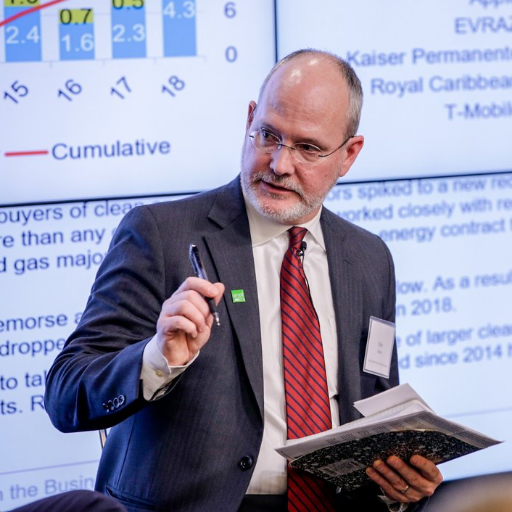
In honor of next month's EV Reunion (+@SCE Dean Taylor's retirement), and to prove my veteran California EV advocate bonafides, I'd like to share the following embarrassing clip. I miss that hair!
youtu.be/EgsvvmXtaVw

YouTube

English
Kyle L Davis
3.9K posts

@DC_Kyle
Working on Federal Policy @CEBAPower (DC Office). Formally, @Enel_NA, @enelgreenpower, @BHEnergyCo, @edisonintl, & @SouthCoastAQMD. Tweets are my own.



The US Department of Energy just mapped every data center in America. This is what the AI power grid looks like. The dots are data centers. Yellow = operating. Orange = under construction. White = planned. The lines are high-voltage transmission 735kV, 500kV, 345kV the arteries that move electrons from generators to compute loads. Look at the density along the East Coast, Northern Virginia to the Carolinas. Then look at Texas. Then Northern California. The largest circles on this map represent facilities demanding over 5,000 MW of power. Single campuses pulling more electricity than mid-sized cities. Northern Virginia is so dense the dots overlap. Data centers cluster on transmission corridors. Not because land is cheap because power is available. When the line is full, the next data center goes somewhere else. The grid is the bottleneck. Every orange dot is a power purchase agreement being negotiated right now. Every white dot is a utility commission filing, a gas plant approval, a pipeline capacity booking. The $66.8 bn NextEra-Dominion deal, Meta's 10 new gas plants in Louisiana, the Alaska LNG FID push they all trace back to maps that look like this. AI infrastructure is built in substations, on transmission corridors, and at the end of gas pipelines. Link in the comments, to see my stocks 👇












China isn’t “betting on nuclear” or “heading back to fossils.” It’s scaling a whole new energy system in real time. Wind & solar -> doing the heavy lifting. Nuclear is growing… but at system scale, it’s a rounding error. This isn’t a transition. It’s a legacy system rapture. Most people get stuck on headlines like “China is building coal and nuclear.” True. But that’s not the signal. Here’s the system in 2025 (installed capacity): Total: 3,887 GW Solar: 1,202 GW (30.9%) Wind: 640 GW (16.5%) Hydro: 448 GW (11.5%) Nuclear: 62 GW (1.6%) Thermal: 1,539 GW (39.5%) Wind + solar: 1,842 GW 47.4% of total capacity. Solar alone is ~19× nuclear. Now zoom out (2010 → 2025 growth): Solar: ~+17,000%+ (from near-zero at system scale) Wind: +1,960% Nuclear: +520% Hydro: +107% Fossil (thermal): +117% One of these is exponential. The rest are incremental. Fossil capacity is still growing. Its dominance is shrinking. Now the part people miss: China has ~20–25 nuclear reactors under construction. Sounds big. It isn’t. That pipeline adds ~20–30 GW over time. China added more solar than that in months. Scale wins. Growth tells the real story (2015 → 2025): Solar: +1,159 GW Wind: +509 GW Nuclear: +35 GW Not even close. On generation: Yes, coal still dominates output. It runs more hours. But the structure is shifting: Wind + solar are already ~22% of generation and rising fast. They’re taking most of demand growth. Coal’s share is declining structurally, even if absolute output fluctuates. Capacity shows where the system is going. Generation shows where it is today. China is building the future faster than it can retire the past. This isn’t ideology. It’s deployment physics. Cost curves follow deployment and cost always wins. I spent a lot of time getting this chart and data right because it matters. There’s a constant stream of fear-driven misinformation about China’s energy system. Some of it comes from politics, some from business interests, and some from commentators who underestimate their own biases. This is why data matters. #Bettrification


