Gu🅰️cBoss

820 posts

Gu🅰️cBoss banner
Gu🅰️cBoss

Gu🅰️cBoss

@GuacBoss

Win | Information asymmetry | Not financial advice

가입일 Ekim 2017
2.1K 팔로잉459 팔로워
고정된 트윗
Gu🅰️cBoss
Gu🅰️cBoss@GuacBoss·
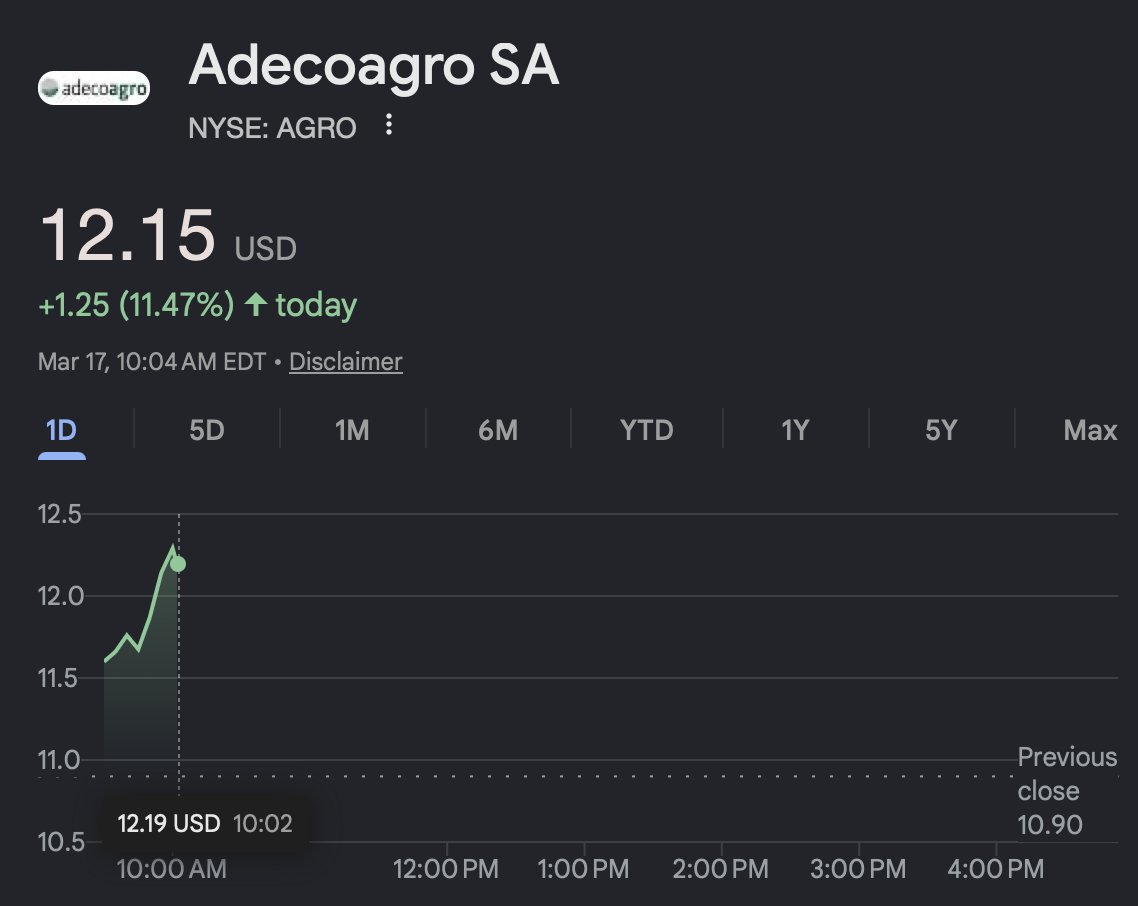
Over the last couple weeks I’ve sold 2 quantum+keyword.com domain names via @afternic inbound. Hand registered these, they’re almost a decade old and I have several more quantum domains. Excited to see the progress of the quantum industry, you know my bet is with $IONQ
Gu🅰️cBoss tweet mediaGu🅰️cBoss tweet media
English
1
1
5
1.1K
REDRUM 🅰️
REDRUM 🅰️@redrum_2001·
$ASTS - Interesting. Meta will offer a subscription service in WhatsApp. My random thoughts. We know that Meta is testing WhatsApp with AST SpaceMobile. AST is currently the only company building a space-based cellular broadband network designed to connect directly to standard, unmodified smartphones.  WhatsApp Plus could eventually include a "Connectivity Tier" where subscribers get guaranteed off-grid messaging and voice calls via AST’s satellites. WhatsApp has over 3.3 billion monthly active users. Many small businesses in emerging markets rely entirely on WhatsApp. A partnership with AST SpaceMobile would ensure these businesses stay online even in rural areas. WhatsApp Plus could become a "business insurance" subscription, ensuring 100% uptime regardless of local infrastructure. In the long run, maybe WhatsApp could be a standalone service, not needing MNO’s. But that’s another, more complicated topic.
9to5Mac@9to5mac

‘WhatsApp Plus’ subscription launching soon with new features 9to5mac.com/2026/04/20/wha… by @iryantldr

English
6
15
195
30.5K
Corey📶🅰️
Corey📶🅰️@corey407woc·
Tim Farrar $ASTS 🅰️🚀💎🙌
GIF
Português
15
6
130
2.9K
Gu🅰️cBoss 리트윗함
Hanna353
Hanna353@HannaSuds·
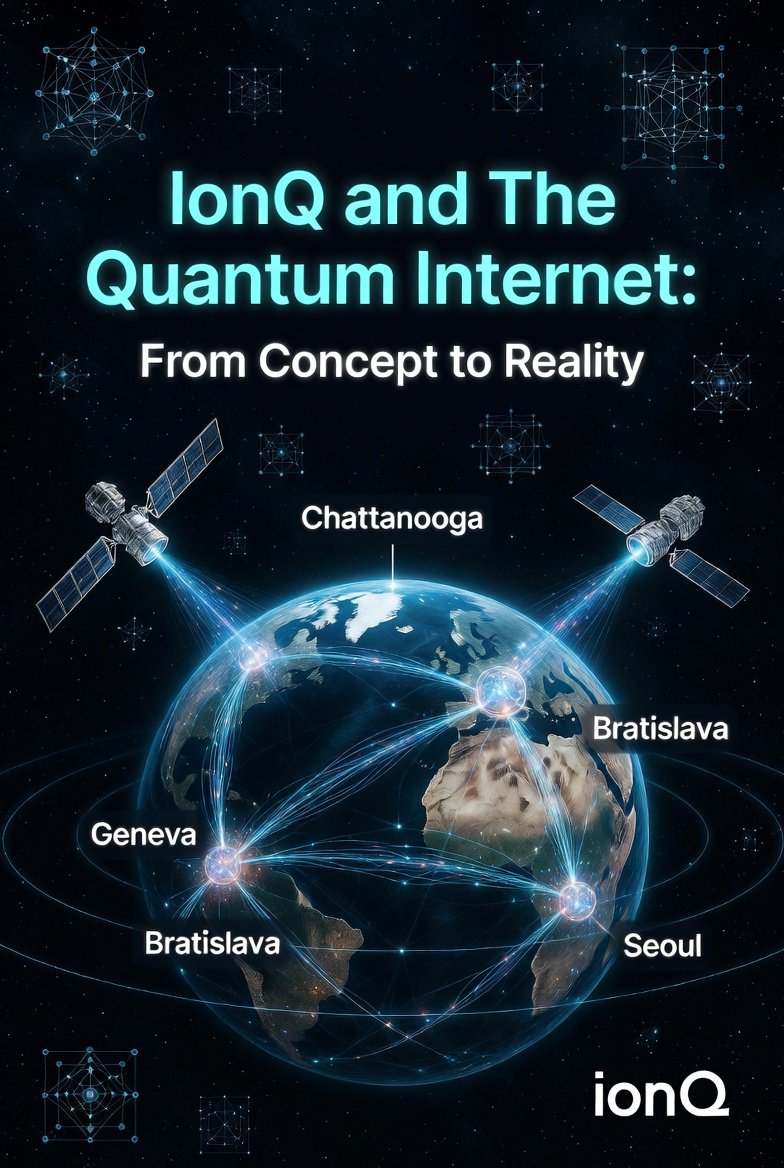
$IonQ and the Quantum Internet: From Concept to Reality Note: IonQ has taken the decisive lead in building the quantum internet, and this report presents the concrete evidence: four live production networks, validated photonic milestones, and the direct integration of quantum networking as the physics-based trust layer for space-based data centers and national-security systems. Key Quantitative Takeaways @IonQ_Inc is leading the race to build a functional quantum internet. In 2025 it deployed the world’s only four live production quantum networks over standard commercial fiber—Chattanooga EPB (May 2024), Seoul SK Telecom (September 2025), Geneva GQN (November 5, 2025), and Bratislava skQCI (December 8, 2025)—while delivering the April 14, 2026 photonic interconnect breakthrough that proved remote trapped-ion processors can be entangled at commercial scale. The September 2025 AFRL photon-conversion milestone achieved 92.3% efficiency to the 1550 nm telecom C-band with sub-1% QBER, clearing the path for the Q4 2025/Q1 2026 end-to-end entanglement distribution milestone over already-deployed fiber at AFRL Rome, New York. Short-term revenue (2026–2027) will come from paid quantum-secure services and dark-fiber monetization on these four operational networks. Mid-term revenue (2028–2030) will scale through full quantum internet node licensing and hybrid fiber-satellite deployments. Long-term revenue (2030+) will be driven by sovereign-scale quantum internet infrastructure and orbital data-center trust layers at AQ 10,000 scale. SkyWater’s onshore manufacturing of radiation-hardened components secures U.S. technological sovereignty across every layer. For the Department of Defense and national security, these networks deliver provable detection of interception, distributed quantum computing for real-time orbital simulations, and resilient command-and-control links in GPS-denied environments. Orbital data centers—Starcloud AI clusters, Axiom Space defense workloads, Lonestar lunar vaults, Google Project Suncatcher—now require quantum networking as the non-negotiable physics-based trust layer; without it they face silent, long-horizon compromise that post-quantum cryptography cannot prevent. IonQ’s full-stack architecture turns this vulnerability into a decisive national-security advantage. Index 1, Executive Summary 2, Geopolitical Context 3. 2025 Execution Highlights and Technology Milestones 4. Policy Tailwinds and Defense Ecosystem Integration 5. Growth and Revenue Opportunities Across Ecosystems 6. Photonic Interconnects and Networked System Readiness 7/ Market Expansion and Commercial Flywheel Effects 8. AQ 256 Acceleration and Path to AQ 10,000 9. Risks and Counterarguments 10. Investment Thesis 1. Executive Summary The building of a quantum internet was once considered science fiction. Today we are on the cusp of this reality. These questions have been answered in 2025. The quantum internet is not only possible; it is already in production. IonQ has taken the decisive lead by deploying the world’s only four live production quantum networks over standard commercial fiber: Chattanooga EPB (May 2024), Seoul SK Telecom (September 2025), Geneva GQN (November 5, 2025), and Bratislava skQCI (December 8, 2025). These networks operate today on existing telecom infrastructure, delivering quantum-secure communications and distributed computing services while coexisting with classical traffic. The April 14, 2026 photonic interconnect breakthrough with the U.S. Air Force Research Laboratory (AFRL Case AFRL-2026-1742) and the September 2025 AFRL photon-conversion milestone (92.3 ± 1.1% efficiency to the 1550 nm C-band, 0.87% end-to-end QBER, and 91.4% Bell-state fidelity across 1,000 consecutive pairs) have proven that high-fidelity entanglement can be distributed at scale. The upcoming Q4 2025/Q1 2026 end-to-end entanglement demonstration over commercial fiber at AFRL Rome, New York, will complete the technical validation. The benefits are immediate and strategic. The quantum internet provides provably secure communications immune to harvest-now-decrypt-later attacks, enables distributed quantum computing with exponential speedups, and supplies physics-based trust for orbital data centers that classical encryption cannot guarantee. In orbit—where assets cannot be patched and service lives span decades—silent compromise is an existential risk. IonQ’s full-stack architecture, integrating Qubitekk entanglement sources, Skyloom optical terminals, Vector Atomic precision timing, ID Quantique detection, and Capella Space operational grounding, directly mitigates these failure modes. By treating quantum networking as enabling infrastructure, IonQ has moved from laboratory prototypes to the company actively constructing the quantum internet—both on the ground and as the indispensable trust layer for space-based compute and national security. The quantum internet switch isn’t going to be turned on tomorrow, but it will be turned on in the near future, and when it occurs, the world changes. The real-life importance is both immediate and transformative. For national security, it enables tamper-evident command-and-control links that detect interception in real time rather than years later, while providing distributed quantum computing for orbital simulations and GPS-denied operations. For commercial and scientific users, it unlocks provably secure communications, exponentially faster distributed modeling in drug discovery and materials science, and the safe operation of orbital data centers that would otherwise be vulnerable to silent compromise. When the quantum internet switch is turned on in the near future, the world changes: data centers in space become trustworthy, global communications gain physics-enforced security, and entire industries gain capabilities that were previously impossible. In 2025 IonQ did not merely advance the science; it began building the infrastructure that will define the next era of secure global connectivity and orbital sovereignty. 2. Geopolitical Context Quantum networking has become the defining strategic domain of 21st-century competition. For the Department of Defense, a functional quantum internet delivers three non-negotiable capabilities that classical and post-quantum cryptography cannot provide: (1) provable detection of any interception attempt via entanglement-based monitoring, (2) distributed quantum computing that enables real-time, high-fidelity simulation of complex orbital scenarios at speeds unattainable on classical systems, and (3) resilient command-and-control links that remain operational even under GPS-denied or jammed conditions. These capabilities directly support MDA SHIELD task orders and Golden Dome layered missile defense by securing satellite-to-satellite and satellite-to-ground entanglement channels that underpin precision tracking, kill-vehicle handoff, and layered intercept coordination. In contested orbital environments, where persistent observation by adversary quantum sensors is assumed, post-quantum cryptography offers only computational hardness; it provides no physical-layer detection of photon tapping or man-in-the-middle insertion. A quantum internet, by contrast, uses the no-cloning theorem and entanglement monogamy to make any eavesdropping attempt immediately detectable at the receiver, giving DOD operators the ability to abort, reroute, or counter immediately rather than discover compromise years later when data is decrypted. This capability connects directly to space-based quantum data centers. Orbital compute platforms (Starcloud on-orbit AI clusters, Axiom Space government and defense workloads, Lonestar lunar data vaults, and hyperscaler projects such as Google’s Project Suncatcher) process petabyte-scale, latency-sensitive datasets that cannot tolerate silent compromise. A data-center in low-Earth orbit cannot be patched, physically inspected, or taken offline for remediation; its service life is measured in decades. Without quantum networking as the physics-based trust layer, any classical or post-quantum encrypted link between orbital compute nodes and ground stations remains vulnerable to harvest-now-decrypt-later attacks that store photon streams today for decryption once cryptographically relevant quantum computers mature. IonQ’s four live production networks already demonstrate the terrestrial proof-of-concept: they operate on existing commercial fiber with full coexistence of quantum and classical traffic, proving that the same photonic interfaces can be hardened for space. The April 14, 2026 AFRL entanglement demonstration and September 2025 photon-conversion milestone (92.3% efficiency to 1550 nm C-band) provide the technical bridge to orbital deployment. When these networks are extended via Skyloom optical terminals and Vector Atomic clocks, orbital data centers gain entanglement-based verification that any link has not been observed, turning quantum networking into the enabling infrastructure that legitimizes sovereign orbital compute rather than a nice-to-have security add-on. Without it, DOD and allied operators face a binary choice: accept strategic disqualification of orbital assets or accept the risk of undetected data exfiltration over the asset’s entire lifetime. IonQ’s full-stack integration (Qubitekk entanglement sources, ID Quantique detection, Capella Space grounding) maps precisely to these orbital failure modes, converting a systemic vulnerability into a deployable, physics-enforced advantage for U.S. and allied forces. 3. 2025 Execution Highlights and Technology Milestones IonQ’s 2025 execution centered on the disciplined delivery of production quantum networks and the foundational technologies that enable their global scaling. The April 14, 2026 photonic interconnect milestone—achieved as part of a joint project with the U.S. Air Force Research Laboratory (AFRL Case AFRL-2026-1742)—validated the generation, transmission, and detection of photons that entangle two physically separate commercial trapped-ion systems. This result built directly on the September 2025 AFRL breakthrough, in which trapped-ion photons were converted to the 1550 nm telecom C-band with 92.3 ± 1.1% efficiency, 0.87% end-to-end quantum bit error rate over 100 km of standard SMF-28 fiber, and 91.4% Bell-state fidelity across 1,000 consecutive entangled pairs, all while coexisting with classical traffic via dense wavelength-division multiplexing. The upcoming Q4 2025/Q1 2026 milestone at AFRL Rome, New York, will demonstrate end-to-end entanglement distribution between two rack-mounted systems over tens of kilometers of already-deployed commercial fiber—the same infrastructure that carriers own by the million-mile. These technical advances occurred alongside the deployment of the world’s only four production quantum networks over standard commercial fiber. Chattanooga EPB went live in May 2024 and remains publicly accessible 24/7. Geneva GQN launched on November 5, 2025, connecting CERN, the University of Geneva, HEPIA, Rolex, and OCSIN in a city-scale network. Bratislava skQCI activated on December 8, 2025, linking the Presidential Palace, National Security Authority, and Slovak Academy of Sciences as part of EuroQCI. Seoul SK Telecom installed its full quantum network inside its headquarters in September 2025. These networks prove that IonQ’s trapped-ion systems with native photonic interfaces can operate at commercial scale on existing fiber infrastructure. In parallel with the terrestrial network deployments, IonQ’s acquisition of Vector Atomic delivered immediate orbital impact. The company’s strategic-grade quantum inertial sensor — developed by Vector Atomic and now part of IonQ — was successfully launched aboard the X-37B OTV-8 mission in 2025. Multiple agencies have independently highlighted its performance: the Defense Innovation Unit named it among its top three accomplishments of 2025, the U.S. Space Force described it as “the highest-performing quantum inertial sensor ever flown in space,” Boeing confirmed it remains operational after more than 230 days on orbit, and Aviation Week recognized the X-37B program with a Laureates Award citing this payload. This marks the first strategic-grade quantum inertial navigation system operating in a classified defense mission, providing real-world validation that IonQ’s quantum hardware is already functioning in orbit and directly supporting the physics-based trust layer required for future space-based data centers. In tandem with the AFRL photonic milestone, IonQ was awarded a contract under DARPA’s Heterogeneous Architectures for Quantum (HARQ) program on the same day. The award supports development of high-speed quantum interconnects designed to link disparate qubit technologies into scalable, modular networked systems — precisely the architecture required for a functional quantum internet. Collectively, these milestones and leadership additions transformed IonQ from a quantum computing vendor into the company actively building the quantum internet. 4. Policy Tailwinds and Defense Ecosystem IntegrationU.S. policy has now converged on the quantum internet as critical national infrastructure rather than an experimental technology. Senate Amendment 3 explicitly accelerates the migration to post-quantum cryptography while underscoring the limitations of software-only solutions in contested orbital environments, creating direct demand for physics-based entanglement networks that can detect interception in real time. This policy shift provides immediate tailwinds for IonQ’s four live production networks and the upcoming end-to-end entanglement demonstrations. The $151 billion MDA SHIELD IDIQ contract and IonQ’s contributions to the Golden Dome layered missile defense architecture are particularly significant. Both programs require secure, jam-resistant satellite-to-satellite and satellite-to-ground links capable of supporting precision tracking, targeting, and command-and-control under conditions where traditional encryption can be silently compromised. Quantum networking supplies the only verifiable solution: entanglement-based channels that make any eavesdropping attempt immediately detectable. This directly connects terrestrial networks (Chattanooga, Geneva, Bratislava, Seoul) to orbital trust layers for space-based data centers. IonQ’s participation in the USGIF GEOINT Symposium 2026 further demonstrates how quantum internet infrastructure integrates with defense intelligence operations, enabling faster, tamper-evident data flows between orbital compute nodes and ground stations. These policy and acquisition alignments are not aspirational—they translate into funded pathways for scaling IonQ’s production networks into hybrid fiber-satellite quantum internet systems that secure both current and future orbital assets. 5. Growth and Revenue Opportunities Across EcosystemsThe four live production networks already generate concrete revenue pathways that did not exist before 2025. Because they run on standard commercial fiber that carriers already own, IonQ can immediately offer quantum-secure communication services (QKD-as-a-Service) and distributed quantum computing access without requiring new fiber builds. Carriers with millions of miles of dark fiber—AT&T, Verizon, Deutsche Telekom, and others—now have a direct monetization route: lease or co-locate quantum channels on their unused fiber strands, creating recurring revenue from quantum-secure links that classical encryption cannot match. Short-term revenue (2026–2027) comes from paid pilot programs and service contracts on the four existing networks. Carriers can charge enterprise and government clients premium rates for provably secure links between data centers or command posts. IonQ earns hardware licensing fees plus ongoing service revenue for entanglement distribution and error correction. Mid-term revenue (2028–2030) scales as full quantum internet nodes are licensed to carriers. A single city-scale network like Geneva or Bratislava can be replicated across major metro areas using existing dark fiber, generating multi-year service contracts and joint-development revenue with telcos. Hybrid fiber-satellite extensions add another layer: orbital data-center operators pay for entanglement-based trust links between ground stations and space assets, turning dark fiber into the terrestrial backbone for sovereign orbital compute. Long-term revenue (2030+) is driven by sovereign-scale quantum internet infrastructure. Governments and hyperscalers will pay for end-to-end systems that connect terrestrial networks to orbital platforms, with IonQ providing the full-stack hardware, software, and entanglement management. The economics are compelling: dark fiber that currently sits idle can be lit with quantum channels at minimal marginal cost, creating high-margin, recurring revenue streams that carriers have never had before. IonQ captures a share through licensing, services, and equity-like partnerships. The next logical test network site is the University of Maryland QLab expansion announced on April 13, 2026, which will host IonQ’s first silicon-vacancy (SiV) quantum memory node and serve as a dedicated platform for advanced networking research and memory-enabled repeaters. Cambridge is another strong candidate for the next international node, building on the existing partnership and extending the European footprint. These upcoming nodes will directly accelerate revenue by expanding the addressable market for quantum-secure services and distributed computing on existing dark fiber. Overall, the four networks prove the model works today. Dark fiber owned by cable operators is the hidden multiplier—billions of dollars in underutilized infrastructure that IonQ’s photonic interfaces can activate immediately. This turns existing assets into revenue engines for quantum-secure services, distributed computing, and orbital trust layers, positioning IonQ to capture a significant share of the quantum networking market. Roots Analysis projects the global quantum networking market to grow from USD 1.15 billion in 2025 to USD 42.11 billion by 2035 at a 43.40% CAGR; Cervicorn Consulting forecasts growth from USD 1.55 billion in 2025 to USD 22.96 billion by 2035 at a 30.94% CAGR. The “trillion-dollar networked systems” language refers to the cumulative economic impact of the full quantum internet ecosystem enabled by photonic interconnects. 6. Photonic Interconnects and Networked System Readiness The April 14, 2026 photonic interconnect breakthrough is the cornerstone that makes IonQ’s quantum internet strategy technically viable at scale. In the AFRL-sponsored experiment (Case AFRL-2026-1742), two physically separate trapped-ion processors—each using ytterbium ions in Paul traps—were entangled through a photonic link over optical fiber. The process begins with deterministic generation of telecom-band photons from each module via stimulated Raman scattering, followed by interference at a beam splitter to project the ions into a Bell state. Detection of the resulting coincidence counts confirms successful entanglement with measured fidelity sufficient for error-corrected operation. This demonstration achieved the critical requirements for modular scaling: all-to-all connectivity between modules, preservation of ion coherence during photon emission and transmission, and compatibility with existing telecom infrastructure. Building directly on this, the September 2025 AFRL photon-conversion milestone delivered 92.3 ± 1.1% conversion efficiency from the native ion wavelength to the 1550 nm C-band telecom window using a periodically poled lithium niobate waveguide. Over 100 km of standard SMF-28 fiber, the end-to-end quantum bit error rate remained 0.87%, while Bell-state fidelity across 1,000 consecutive entangled pairs averaged 91.4%. Dense wavelength-division multiplexing allowed simultaneous transmission of quantum and classical traffic on the same fiber without measurable crosstalk, proving that quantum internet channels can be overlaid on carrier networks today. These metrics satisfy the threshold for practical quantum repeaters: the conversion efficiency exceeds the 90% level needed to overcome fiber loss, and the QBER is well below the 1% limit for reliable entanglement swapping. The upcoming Q4 2025/Q1 2026 milestone at AFRL Rome, New York, will extend this capability to full end-to-end entanglement distribution between two rack-mounted trapped-ion systems separated by tens of kilometers of already-deployed commercial fiber. This test will incorporate barium-ion quantum memories (with coherence times exceeding 10 ms) as intermediate nodes, enabling asynchronous entanglement swapping and the first demonstration of a quantum repeater link over real telecom infrastructure. Size, weight, and power (SWaP) have been reduced to levels compatible with orbital deployment: the entire photonic interface module now fits within a 2U rack and consumes under 500 W, opening the path to satellite-to-satellite and satellite-to-ground entanglement channels. Together, these advances validate a modular, distributed quantum architecture that operates reliably in both terrestrial dark-fiber networks and future orbital environments. The photonic interconnects provide the physical layer for the quantum internet, turning IonQ’s trapped-ion processors into a scalable, networked computing fabric that supports the four live production networks today and the orbital trust layers required tomorrow. 7. Market Expansion and Commercial Flywheel EffectsThe four live networks ignite a commercial flywheel by proving that quantum-secure services can be deployed today on existing fiber. Telecom operators gain the ability to monetize dark fiber with unbreakable security and distributed computing services. In the orbital domain, quantum networking becomes the physics-based trust layer that legitimizes data centers for high-value workloads. Operator-specific fits illustrate the point: Starcloud’s on-orbit AI processing requires detection of silent compromise; Axiom Space’s government-aligned platforms demand mission-assurance standards; Lonestar’s lunar data vaults need century-scale confidentiality; and hyperscaler initiatives such as Google’s Project Suncatcher must future-proof against long-horizon risks. IonQ’s full-stack architecture—Qubitekk entanglement, Skyloom terminals, Vector Atomic timing, ID Quantique detection, and Capella Space grounding—addresses these requirements holistically. What sets IonQ apart is its unique combination of proven production networks, onshore manufacturing through SkyWater, and active AFRL/DARPA partnerships. While competitors remain in laboratory prototypes, IonQ delivers radiation-hardened, modular systems that position it as the clear leader in the emerging quantum internet market. 8. AQ 256 Acceleration and Path to AQ 10,000 AQ 256’s 99.99% two-qubit fidelity, all-to-all connectivity, and photonic readiness make it the ideal hardware layer for the quantum internet. The April 14 photonic interconnect milestone enables faster production scaling and seamless integration of modular networking. The 2027-2028 AQ 10,000 milestone—targeting approximately 800 logical qubits at error rates below 1.00E-7—will unlock exponential speedups across space-based defense, orbital data-center services, and satellite constellation operations. SkyWater’s onshore manufacturing accelerates this integration by providing dedicated capacity for custom photonic hardware. As AQ 10,000 approaches, photonic interconnects will form the backbone of fault-tolerant, modular quantum architectures in orbit and on the ground. 9. Risks and Counterarguments Risks remain tied primarily to execution and regulatory timelines. Successful deployment of quantum internet infrastructure requires thorough validation of photonic interconnects in orbital environments and alignment with evolving standards. Post-quantum cryptography alone is insufficient in orbit because it offers no detection of interception; quantum-secure networking addresses this gap but demands early architectural commitment. IonQ mitigates these risks through AFRL validation, SkyWater onshoring, full-stack integration, and a proven track record of delivering production networks on schedule. The combination of validated milestones, defense partnerships, and policy tailwinds provides a solid foundation for progress. While IBM and Google have demonstrated impressive superconducting processors, neither has yet deployed a single production-scale trapped-ion photonic network on commercial fiber, giving IonQ a clear 18–24 month first-mover advantage in practical quantum internet infrastructure. 10. Investment Thesis: Under @NiccoloDeMasi's leadership, IonQ is about to put a dent in the universe. It is that simple.
Hanna353 tweet media
English
6
20
85
10K
Gu🅰️cBoss
Gu🅰️cBoss@GuacBoss·
Another inbound sale via @afternic ! Registered this domain a few years ago Madagascar(.)ai Congrats to the buyer
Gu🅰️cBoss tweet media
English
6
5
31
800
Cloudflare
Cloudflare@Cloudflare·
Recent advances in quantum hardware and software have accelerated the timeline on which quantum attack might happen. Cloudflare is responding by moving our target for full post-quantum security to 2029. cfl.re/4v674Oi
English
25
72
334
223.7K
Gu🅰️cBoss
Gu🅰️cBoss@GuacBoss·
On the Yelp app if you scroll down you can view trending searches in your area. They’re selling silver $slv $sil
Gu🅰️cBoss tweet media
English
0
0
0
181
*Walter Bloomberg
*Walter Bloomberg@DeItaone·
OPENAI CEO SAM ALTMAN TO VISIT INDIA FOR AI SUMMIT OpenAI CEO Sam Altman will visit India in mid-February, his first trip in nearly a year, coinciding with the India AI Impact Summit 2026 in New Delhi. While not a confirmed speaker, he is expected to hold private meetings and an OpenAI event for VCs and executives. The visit highlights India’s growing role in AI, with companies like Google, Anthropic, and OpenAI expanding local offices and partnerships. Altman will meet tech leaders, startup founders, and officials to boost ChatGPT adoption and explore infrastructure expansion, as India aims to attract billions in AI investment.
English
64
61
729
81.3K
AST SpaceMobile
AST SpaceMobile@AST_SpaceMobile·
2025 - a year of execution, laying the foundation for scale. We strengthened global partnerships, expanded U.S. manufacturing, and built a robust spectrum portfolio to support rapid growth ahead. 2026 will bring more BlueBirds to orbit, and the start of space-based cellular broadband services with our mobile network operator partners. 🚀 Happy New Year from the AST SpaceMobile team 🌎📶📱 #ASTSpaceMobile #ConnectingtheUnconnected
English
135
390
2.1K
208.6K
Gu🅰️cBoss 리트윗함
AST SpaceMobile
AST SpaceMobile@AST_SpaceMobile·
AST SpaceMobile Announces Successful Orbital Launch of BlueBird 6, the Largest Commercial Communications Array Ever Deployed in Low Earth Orbit businesswire.com/news/home/2025…
English
109
392
2.5K
228.5K
Bloomberg
Bloomberg@business·
AST SpaceMobile launched its largest-ever satellite from India, the first in a series of deployments to help the company compete against Elon Musk’s SpaceX in delivering space-based connectivity to mobile phones bloomberg.com/news/articles/…
English
86
441
2.8K
805.5K
Gu🅰️cBoss 리트윗함
Abel Avellan
Abel Avellan@AbelAvellan·
Congratulations to Prime Minister @narendramodi, @isro, and @NSIL_India on the successful launch of our BlueBird 6 satellite—the largest-ever commercial communications satellite in low Earth orbit.🚀🚀🚀🚀🚀🚀 Perfect execution from both teams in India and the U.S. We are now in control of BlueBird 6 from our D.C. command center and with nominal telemetry! 🇺🇸🤠💪
Abel Avellan tweet media
English
299
1.3K
10.2K
496.9K
Gu🅰️cBoss 리트윗함
AST SpaceMobile
AST SpaceMobile@AST_SpaceMobile·
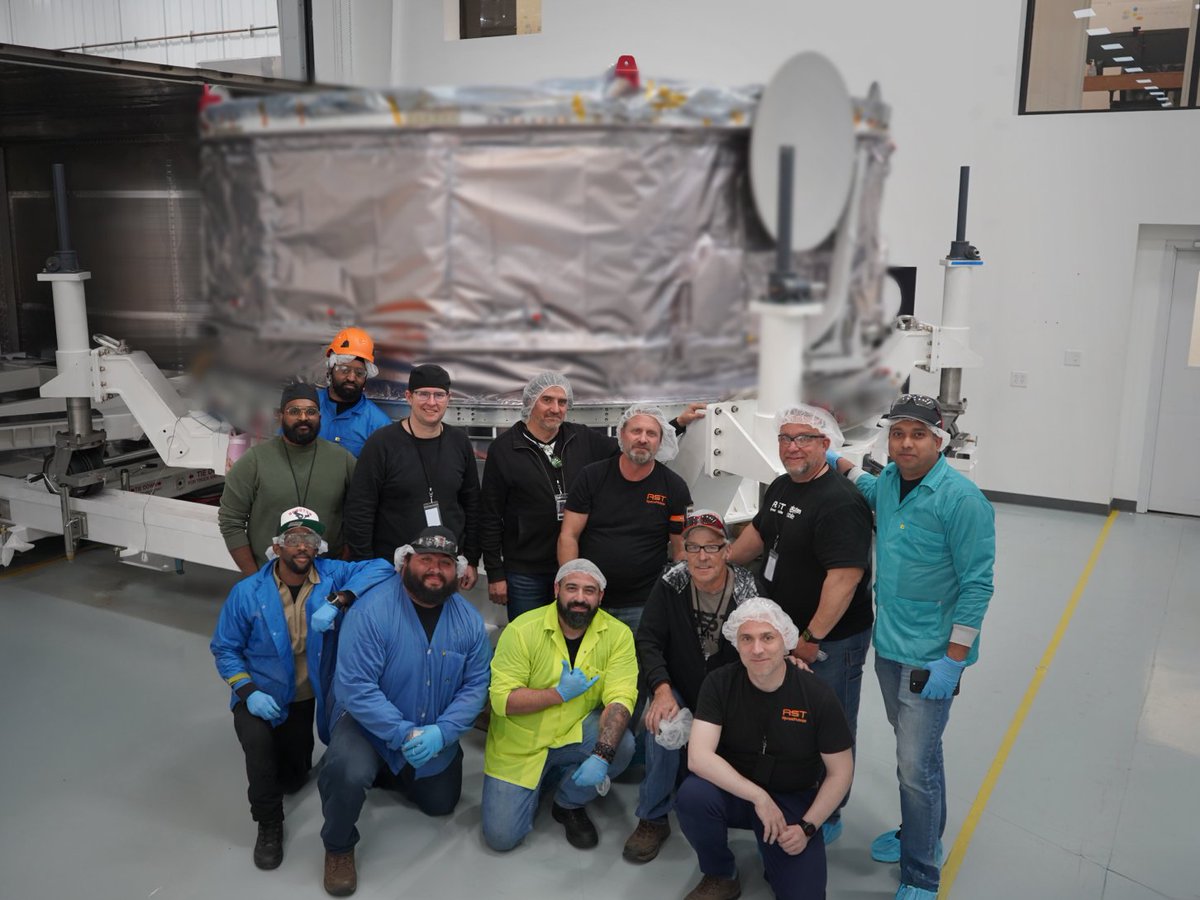
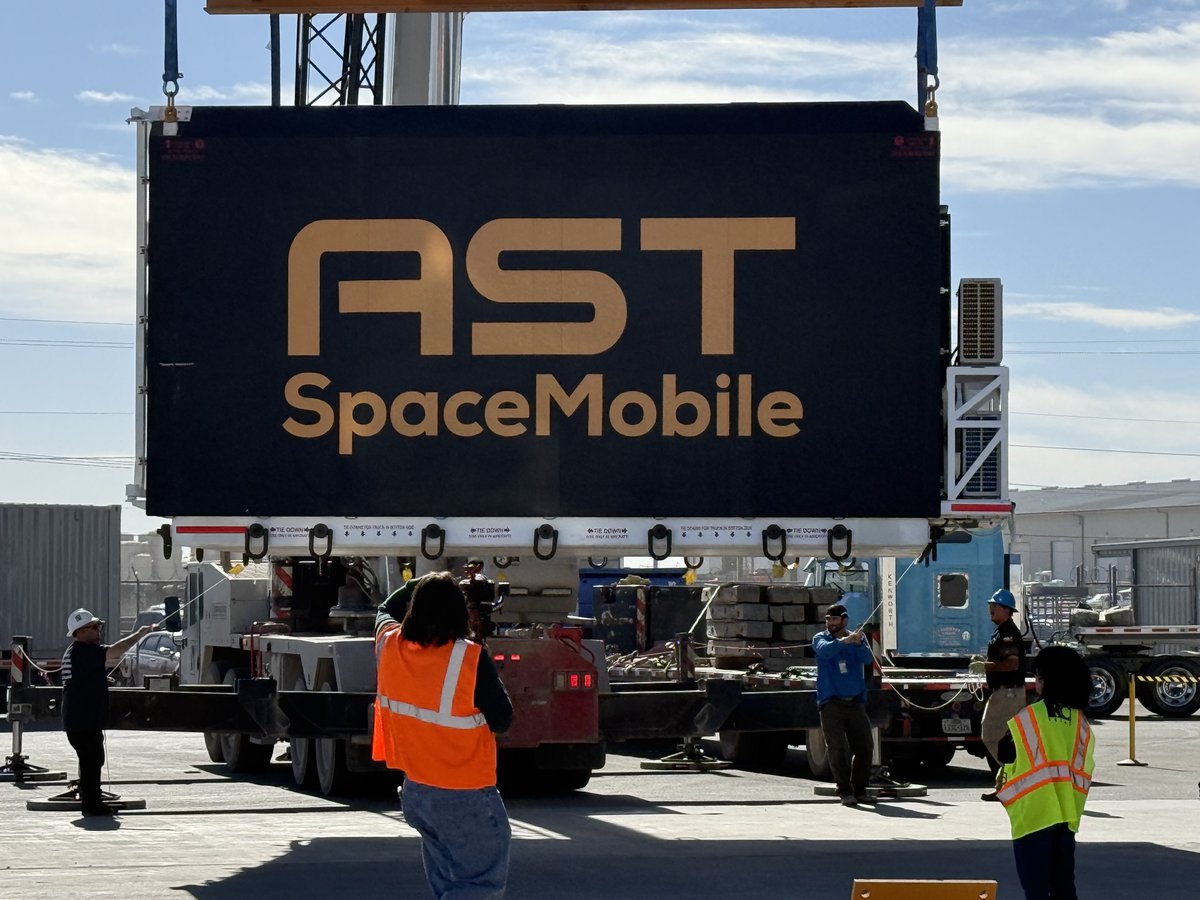
BlueBird 7 has left the factory and is headed to space! Next stop: Cape Canaveral, Florida🚀🚀🚀🚀🚀🚀🚀 Identical to BlueBird 6, BlueBird 7 will also be the largest commercial communications satellite ever launched into low Earth orbit. This marks another milestone as we continue executing our launch and production cadence—bringing us one step closer to connecting the unconnected globally with space-based cellular broadband. Meanwhile, BlueBirds 8–25 are in various stages of assembly, integration, and testing at our Midland facility. We remain on track to launch 45–60 satellites by the end of 2026! #ASTSpaceMobile #BlueBird7 #ConnectingTheUnconnected
AST SpaceMobile tweet mediaAST SpaceMobile tweet media
English
282
532
3K
693.5K