고정된 트윗

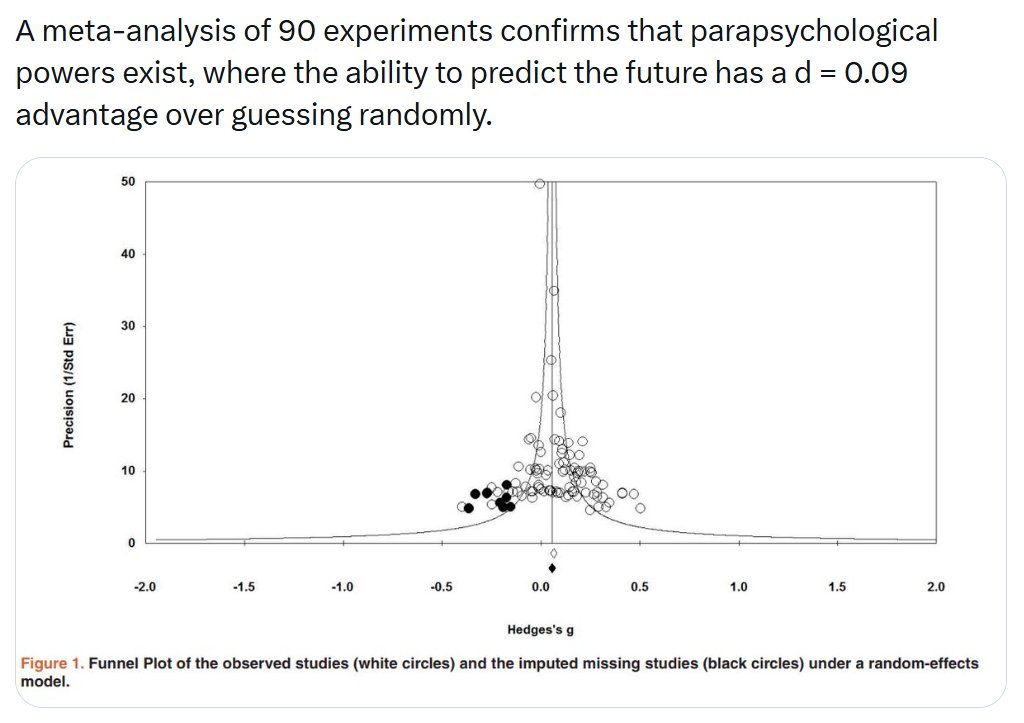
All studies have limitations, but some studies are like power plants that don't produce power, with the engineers explaining, "Like other power plants, ours has limitations . . ."
English
Jean-Claude Fox
27.2K posts

@JeanClaudeFox2
The Hans-Peter Briegel of pointilism. Grrr/grrrm.


Alphabet generated over $160b in operating cash flow last year… yet it’s still issuing $40b+ in equity to fund AI compute (including a private placement to berkshire) One of the biggest cash generators in tech is diluting to keep up

Japan is not a higher-trust society than the United States of America



Talked to a colleague about how littering is worse in Neukölln than in Berlin's other boroughs and there was a tacit understanding we wouldn't say what one doesn't say. And now you know why Bowie's track "Neukölln" is an instrumental.
Rule changes for the SpaceX $SPCX IPO: Index providers waived the profitability requirement and cut the seasoning window from 90 days to 5. This forces over $30 trillion in passive 401k and retirement money to buy SpaceX at IPO valuations. Bloomberg Intelligence estimates S&P 500 funds must absorb 19% of SpaceX's float within 6 months. Russell 1000 and Nasdaq 100 funds will absorb 24%. The rules built to protect passive investors: 1. S&P 500 has required 12 months of trading and 4 quarters of GAAP profitability since 2002. Both waived. 2. Nasdaq cut its inclusion window from 90 trading days to 15. 3. FTSE Russell cut its to 5. All three benchmarks are now structured to buy SpaceX at IPO pricing.
@Thinkwert Most people (incl. some commenting here) see those as a negative, but I like digressions. Reading Javier Marias' last novel now and the opening dialogue takes 150 pages, and not because there's so much talking. Excellent.

ANNOUNCEMENT: WE’RE SAVING SCIENCE! We’re often told that science is “self-correcting.” But that’s not really true. Science doesn’t correct itself like a thermostat adjusting the temperature in your house. Science is a human institution run by human beings. And human beings are vulnerable to career incentives, groupthink, moral fads, political pressure, and fear. And when those forces capture academic journals, peer review stops being a filter for bad ideas and starts becoming more of a credentialing system for fashionable nonsense. This isn’t exactly new. In 1996, the physicist Alan Sokal managed to publish a totally gibberish article in the journal Social Text full of trendy postmodern jargon. His point was simple: if you flatter the ideological commitments of certain academic editors, nonsense can pass as real scholarship. Two decades later, @ConceptualJames, @HPluckrose , and @peterboghossian pulled off the “grievance studies” hoax, placing over a half dozen absurd papers in peer-reviewed journals. One paper used dog parks to analyze rape culture and queer performativity. Another rewrote parts of Mein Kampf in the language of feminist theory. The problem wasn’t just that fake papers got published. It was that they were completely indistinguishable from the real thing. And today, the problem is even worse. We now have serious SCIENCE journals publishing papers about feminist lesbians marrying brine shrimp. We have disturbing papers that aim to “queer” and sexualize infants. We have scholarship on “lesbian-queer-trans-canine relationalities” and “trans-dog intimacies.” But while Clown World papers are concerning because it makes a complete mockery of academia, the same broken, ideologically captured system is also publishing research in legitimate science and medical journals that pushes sex and gender pseudoscience, relies on deeply flawed data, and influences policies on the medical transition of children and young adults. That’s not funny. That affects real people. It affects medicine. It affects law. It affects children. And when critics try to respond, they often discover there’s no serious mechanism for correction. Submitted Letters to the Editor often go completely ignored. Contrary evidence is rejected without comment. As a result, the best critiques are often relegated to personal blog posts, social media threads, or newspaper op-eds, while the original paper remains in the literature wearing the armor of “peer review.” That is untenable. So Kevin McCaffree, editor-in-chief of Theory and Society (@Theory_Society), and I decided to do something about it. Today, in the Wall Street Journal, we announced a first-of-its-kind article type called “Peer Review.” The idea is simple: publication should be the beginning of academic scrutiny, not the end of it. A Peer Review article can critique a paper from any scholarly journal. It can address problems with methods, evidence, logic, definitions, theory, or interpretation. But it has to focus on the claims and arguments, not personal attacks. Submissions are capped at 2,500 words and go through a straightforward merit review instead of endless gatekeeping and ideological screening. We ask just one basic question: Is this critique coherent, serious, reasonable, or even popular enough to deserve scholarly attention? If yes, it gets published. And the authors of the original paper get a built-in right of reply, so readers can see the critique and the response in a legitimate academic venue. That’s how science is supposed to work. Science becomes self-correcting only when real people build the mechanisms that allow correction to happen. That’s what we’ve done. Now it’s time for academics to use it. Read our announcement on the @WSJ below. 🔗wsj.com/opinion/a-way-…


So, I took multiple classes on Moby-Dick as an undergrad & one of the first things you learn is that Ishmael is NOT his name; it’s an allusion to Ishmael from the Book of Genesis (the exiled son of Abraham, of whom it was prophesied, “His hand shall be against every man, and every man’s hand against him”). The narrator imagines himself an outcast, rejected by society & forced to seek his destiny on the high seas. His self-understanding is beautifully transformed during the scene in which he shares a bed with the cannibal harpooner Queequeg, who becomes his bosom friend. As his heart softens, he writes, “I felt a melting in me. No more my splintered heart and maddened hand were turned against the wolfish world.” Love has come to redeem him. He is Ishmael no more.